My Newsfeed

logo
The Baseline
22 Aug 2025
Five Interesting Stocks Today - August 22, 2025
By Trendlyne Analysis

1. Endurance Technologies:

This auto parts supplier rallied 9% in the past week after its board approved a capacity expansion at the Waluj plant in Maharashtra. The company will invest about Rs 136 crore to increase production of its braking systems. The expansion is expected to be completed by the fourth quarter of FY26.

Endurance said the expansion is being driven by rising demand for advanced safety products, especially its anti-lock braking systems (ABS). The government has proposed making ABS mandatory for all two-wheelers above 50cc from January 1, 2026. 

The company currently has an ABS capacity of about 6.4 lakh units and plans to increase this to nearly 30 lakh units by March 2026. MD Anurag Jain said that Endurance has given dual-channel ABS samples to Royal Enfield and Bajaj, and the company expects to begin supplies in September 2025. He added, “We currently have a 13–15% share in the ABS market, which we expect to increase to at least 25% after the expansion, while continuing to hold around 60% share in disc brakes.”

The company announced its Q1 results on August 13. Revenue rose 17.5% YoY, supported by 9% growth in domestic sales and a strong 39% rise in exports to Europe. Net profit was up 11% YoY but came in 3.3% below Forecaster estimates. Die casting accounted for almost half of the revenue, followed by suspension.

Endurance acquired a 60% stake in the Stoferle group in Germany during the quarter for €38 million (~Rs 386 crore). Stoferle, which makes high-precision parts for German automakers, has annual revenues of €84 million (Rs 854 crore) with margins of 18–20%. The management believes this deal will strengthen Endurance’s presence in Europe and bring benefits through common raw material sourcing and better use of capacity across projects.

Axis Securities has a ‘Buy’ rating on the company, pointing to its strong track record in handling large deals, which supports long-term growth. The company is looking to grow its share in the four-wheeler segment and expand business with customers in the premium bike market. These benefits are expected to show from H2FY26. Axis projects revenue and profit CAGR of 13% and 14% over FY26–28.

2. Va Tech Wabag:

Thiswater treatment company rose 5% in three trading sessions after announcing itsQ1FY26 results on August 12. The company’s revenue increased 17% YoY to Rs 734 crore, while its net profit grew 19.6% to Rs 65.8 crore. The growth was fueled by strong progress on large projects in Chennai and Saudi Arabia. 

A strong order book also supported growth. Rajiv Mittal, Chairman & Managing Director,said, “We closed the quarter with a well-diversified order book of approximately Rs 15,800 crore— over four times our annual revenue.” The order bookcomprises 64% in Engineering, Procurement, and Construction (EPC) and 36% in Operations and Maintenance (O&M).

The company recorded orderinflows of approximately Rs 2,600 crore during the quarter. This includes the reinstatement of its largest internationalorder, the Yanbu Desalination Project in Saudi Arabia, which had been previously cancelled, and theBengaluru water reuse project. On August 19, the company won a five-year, Rs 118 croreorder from the Ministry of Works, Kingdom of Bahrain, for O&M of a sewage treatment plant. This strengthens the company’s O&M presence in the Middle East.

The company targets a revenue CAGR of 15-20% over the next 3-5 years, with EBITDA margins of 13-15%. Its targeted revenue mix, with over 50% from international projects, 30% from industrial clients and 20% from the high-margin O&M business, is expected to support margin expansion and healthy cash flows.

While the company’s outlook remains positive, it faces some challenges, such as projectdelays like the six-to-seven-month slowdown in the Indosol Solar desalination. Mittal said, “The delay was due to a change of government and the need to reallocate the land originally assigned.” The company’s bidding approach also limits opportunities on projects without full payment security or strategic rationale.

Following the results, Axis Securitiesmaintained its ‘Buy’ rating, citing VA Tech Wabag’s strong order book, diversified project mix, and disciplined execution as key drivers for sustainable growth and margin expansion.

3. Sarda Energy & Minerals:

Thismetals and mining company surged 8% last week afterwinning the bid for the Senduri coal mine in Madhya Pradesh. The acquisition deepens its backward integration strategy by securing long-term coal supply for its thermal power plants, particularly the 600 MW unit at Binjkot, which sits close to the mine.

With the acquisition of this power plant in Binjkot last year, the company now getshalf of its total revenue from the power segment. The firm currently has nearly 762 MW of thermal capacity and 167 MW of hydro capacity. They sell this energy into merchant markets and also use it for their operations, hedging against volatility in either segment.

The remaining half of its revenue comes from ferro alloys and steel, which just a year ago made up over 90% of total sales. Iron ore pellets remain the foundation, but the company is steadily moving into value-added products like sponge iron, billets, rods and wires to capture higher realisations. To further growth in this segment, Chairman Prakash Sardasaid that the firm is “securing the raw materials (via acquisition of mines) needed for ferro alloys and steel, which will reduce dependency on external sources” and lift margins.

The stock had already rallied more than 20% earlier this month afterQ1FY26 results surprised Dalal Street. Revenue jumped 71% YoY, while net profit more than doubled, powered by higher energy prices and a 37% rise in hydropower generation from an early monsoon. With power’s contribution rising in the earnings mix, EBITDA margin expanded sharply to over 40%, compared with 33.5% a year earlier.

Looking forward, management reiterated its focus on maintaining a balanced model—treating power as an annuity-like cash flow engine while using ferro alloys and steel for cyclical upside. "With steady power sales, captive integration, and growing mining strength, we expect to sustain high earnings visibility across cycles," management said on the call.

Notably, investorMukul Agrawal held more than 1% of the company’s shares at the end of June 2025, according to Trendlyne’sshareholding data. The company also appears in a screener of stocks where bothFII andMFs have increased their shareholding in the last quarter.

4. Finolex Industries:

Thisplastic products manufacturer rose 6% on August 18 after the Directorate General of Trade Remedies (DGTR) issued arecommendation to the Finance Ministry. DGTR proposed imposing anti-dumping duty on polyvinyl chloride (PVC) resin imports to stabilise prices, curb cheap imports and support domestic producers.

The proposed duties range from $22 to $284 per metric ton (MT), varying by country of origin. China is the largest PVC supplier to India, accounting for over 50% of total demand and faces a proposed duty of over $232 per MT. PVC resin is a raw material used in pipes, fittings, frames, and sheets in the agriculture and infrastructure sectors.

Currently, domestic PVC prices hover around $700 per MT. Saurabh Dhanorkar, MD,notes, “We expect domestic prices to rise once the anti-dumping duty is implemented, likely from October, and we believe this will support margins and improve capacity utilisation.” He also expects the company to achieve double-digit EBITDA margins in FY26, up from the current 9%, once PVC prices stabilise and demand picks up in H2FY25.

Finolex Industries derives 70% of its revenue from the agriculture segment and the rest from the infrastructure segment. In Q1FY26, both segments experienced weak demand, coupled with price volatility and lower realisations. This caused net profit and revenue to fall short ofForecasters’ estimates by 11% and 36%, respectively.

Dhanorkarsaid, “The early onset of monsoon reduced demand in Q1. But demand has ramped up in early August with high single-digit volume growth despite the monsoon continuing, and we expect this trend to continue in the second half of the fiscal year.” Thanks to this, the company expects to cross double-digit volume growth in FY26.

BOB Capital Markets maintains its 'Buy' rating on the stock with a target price of Rs 265 per share, citing strong earnings and rising infrastructure segment revenue. The brokerage expects the anti-dumping duty on PVC to push domestic prices higher and believes this will improve the company’s operating margin. It projects EBITDA to grow at a 33% CAGR from FY26-27.

5. Godrej Properties (GPL):

The stock of this realty company rose 6% over the past week. On August 21, the company won a Telangana Housing Board e-auction for a 7.8 acre residential plot in Kukatpally, Hyderabad. The winning bid was Rs 547.8 crore, and the company estimates the project's revenue potential to be around Rs 3,800 crore. According to CEO Gaurav Pandey, the acquisition in Kukatpally is a "strategic location aligned with the city's growth."

While the company’s revenue declined by 4.7% YoY in Q1FY26, net profit increased by 15.4%. This rise was fueled by higher price realization from new project launches. Net profit also exceeded Forecaster estimates by 77.5%, supported by strong pre-sales, which accounted for 54% of total bookings for the quarter. The stock features in a screener of companies whose annual profit growth has surpassed that of the broader sector.

In Q1, the company added five new projects with a potential saleable area of 9.2 million square feet and an estimated gross domestic value (GDV) of Rs 11,400 crore. This achievement represents 57% of its annual business development goal within the first quarter alone. Pirojsha Godrej, the Executive Chairperson of GPL, stated, “We are on track to achieve our bookings target of Rs 32,500 crore in FY26 and are also on track to meet our guidance across all other operating parameters.” 

GPL has maintained its FY26 guidance, targeting Rs 40,000 crore in new launches and Rs 32,500 crore in pre-sales. Mr. Pandey also commented on current project pricing, adding, “With a few exceptions, we have successfully increased prices by 2% to 3% across most projects in the North. In Mumbai, prices have risen by 1% to 2%, while the increase has been less than 1% in Pune. In the South, we've seen a price increase of around 2% to 3%. Our post-launch sales for the last quarter exceeded Rs 2,750 crore.”

Motilal Oswal anticipates that sales booked over the past two years, which have a stronger margin profile, will be recognized in FY26-27, helping to alleviate investor concerns. The brokerage believes GPL is well-positioned to deliver strong performance in growth, cash flows, and margins, supported by a solid project pipeline and healthy returns. It has maintained its ‘Buy’ rating on the stock with a target price of Rs 2,843.

Trendlyne's analysts identify stocks that are seeing interesting price movements, analyst calls, or new developments. These are not buy recommendations


Market closes lower, PMO reviews DoT's proposal to cut Vodafone Idea's AGR dues
By Trendlyne Analysis

Nifty 50 closed at 24,870.10 (-213.7, -0.9%), BSE Sensex closed at 81,306.85 (-693.9, -0.9%) while the broader Nifty 500 closed at 22,991.30 (-145.9, -0.6%). Market breadth is in the red. Of the 2,513 stocks traded today, 949 were in the positive territory and 1,515 were negative.

Indian indices closed lower after extending losses in the afternoon session. The Indian volatility index, Nifty VIX, rose 2.9% and closed at 11.7 points. Vodafone Idea closed 7.9% higher as reports emerge that the Prime Minister's Office (PMO) is reviewing the Department of Telecommunications’ (DoT's) proposal to cut adjusted gross revenue (AGR) dues.

Nifty Smallcap 100 and Nifty Midcap 100 closed in the red, tracking the benchmark index. BSE Metal and Nifty PSU Bank were among the worst-performing indices of the day. According to Trendlyne’s sector dashboard, Hardware Technology & Equipment emerged as the highest-performing sector of the day, with a rise of 3.6%.

European indices are trading higher, except the UK’s FTSE 100 and Portugal’s PSI indices, which are trading flat. Major Asian indices closed in the green, except Australia’s S&P ASX 100 and Indonesia’s IDX Composite indices, which closed 0.6% and 0.1% lower. US index futures are trading higher, indicating a positive start to the session as investors await Federal Reserve Chair Jerome Powell’s speech at Jackson Hole later today.

  • Relative strength index (RSI) indicates that stocks like HBL Power Systems, Maruti Suzuki, TVS Motor and Eicher Motors are in the overbought zone.

  • Edelweiss Financial Services to sell a 15% stake in Edelweiss Asset Management, the asset manager of Edelweiss Mutual Fund, to WestBridge Capital for Rs 450 crore.

  • Vodafone Idea is surging as reports emerge that the Prime Minister's Office (PMO) is reviewing the Department of Telecommunication's (DoT's) proposal to cut adjusted gross revenue (AGR) dues. The DoT also proposes giving the telecom provider additional time to repay the dues, smaller annual payouts and waivers on interest penalties on AGR dues. The company currently owes Rs 83,400 crore in AGR dues.

  • Ashoka Buildcon secures an order worth Rs 500 crore from North Western Railway for the upgradation of the existing 25 kilovolt (kV) electric traction system.

  • Nuvama notes a slowdown in general insurance growth in July and expects overall industry growth to remain muted due to weak motor sales. However, it believes large insurers could gain from stricter enforcement of Expenses of Management (EoM) rules. The brokerage maintains a 'Buy' rating on ICICI General Insurance and Star Health, with target prices of Rs 2,340 and Rs 490, respectively.

  • Midwest Gold rises to its all-time high of Rs 1,915.7 as its board of directors approves the merger of its subsidiary, Midwest Energy, with itself.

  • Choice International’s subsidiary, Choice Consultancy Services, secures orders worth Rs 140 crore for housing redevelopment, rural digitisation, urban planning, and water management projects in Maharashtra, Odisha, and Rajasthan.

  • Foseco India rises sharply after signing a deal to acquire a 75% stake in Morganite Crucible at Rs 1,557 per share, valuing the deal at Rs 654 crore. This acquisition will enable Foseco to expand into the non-ferrous market segment.

  • Care Edge Ratings reports a sharp drop in banks' gross NPAs in Q1FY26, reflecting improved asset quality. The net non-performing asset (NNPA) ratio held steady at 0.5% for the second straight quarter, down from 0.6% a year ago. The improvement was driven by better asset quality, upgrades, and stricter retail lending norms. However, stress remains in unsecured loans, education loans, and credit card dues.

  • Ircon International secures an order worth Rs 510 crore from the Meghalaya Infrastructure Development & Finance Corporation (MIDFC) to construct residential schools at eight locations in Meghalaya.

  • Geojit BNP Paribas upgrades Suzlon Energy to a 'Buy' call from 'Accumulate', with a target price of Rs 75 per share. This indicates a potential upside of 28%. The brokerage expects revenue and margins to improve, driven by strong delivery momentum and better utilisation in the wind turbine generator (WTG) and forging businesses. It expects the company's revenue to grow at a CAGR of 42% over FY26-27.

  • Hindalco Industries plans a $10 billion investment over five years to expand its aluminium, copper, and speciality alumina operations in India and overseas.

  • UBS names Ambuja Cement, UltraTech, and Dalmia Bharat as top picks, citing demand recovery, lower costs, and ongoing reforms. Despite Q1 volumes rising just 3%, below estimates, UBS anticipates strong EBITDA in Q2 and projects 7–8% growth for FY26, given the sector's near- to medium-term prospects. Following a steep decline in FY25, cement prices are expected to rebound in FY26 and FY27, boosting sector profitability.

  • Apollo Micro Systems surges to its new 52-week high of Rs 236.4 as it bags orders worth Rs 25.1 crore from the Defence Research and Development Organisation (DRDO) and Defence Public Sector Undertakings (PSUs).

  • Intellect Design Arena is rising as its subsidiary signs a memorandum of understanding (MoU) with UK-based ITIXA to form a 51:49 joint venture (JV). The JV will provide AI-enabled software together with bookkeeping, accounting, payroll, HR, and other related business support services to businesses in the UK.

  • R Systems International rises sharply as it enters into a definitive agreement to acquire Novigo Solutions for Rs 400 crore. This deal will enable R Systems to expand its offerings in advanced automation solutions in the Middle East and strengthen its delivery presence in Bengaluru and tier-2 cities.

  • Sanjay Kulshrestha, CMD of HUDCO, expects the company’s assets under management (AUM) to exceed Rs 1.5 lakh crore by Q3FY26, with infrastructure projects making up 75% of the order book by FY26-end. He notes the net interest margin stood at 2.9% in Q1FY26 and anticipates it will remain in the 3.2-3.3% range for the full fiscal year.

  • Apollo Hospitals plunges as 19 lakh shares (1.3% stake) worth Rs 1,489 crore, reportedly change hands in a block deal at an average price of Rs 7,850 per share. Promoter Suneeta Reddy is likely the seller in the transaction.

  • Texmaco Rail is rising as it secures an order worth Rs 103 crore from Leap Grain Rail Logistics to supply BCBFG wagons and BVCM brake vans.

  • NIIT Learning Systems' board of directors approves a corporate guarantee worth Euro 15.8 million (~ Rs 159.6 crore) to ICICI Bank UK, in favour of its subsidiary, NIIT (Ireland), for a loan worth Euro 15 million (~ Rs 152 crore).

  • Manoj Verma, Chief Operating Officer of Bikaji Foods, states that the company has no plans for more price hikes. Bikaji has already implemented a 3.5–4% price hike over the past three quarters. His comments come amid a sharp rebound in Malaysian crude palm oil, which has risen 16% since its low in May 2025, after falling nearly 30% from its peak. Verma does not expect a significant increase in palm oil costs going forward.

  • GHV Infra Projects receives a letter of intent (LoI) worth Rs 2,000 crore from Valor Estate for the engineering, procurement and construction (EPC) of the police housing project in Malad under the Project Affected People (PAP) scheme.

  • PTC Industries is rising as it bags an order worth Rs 110 crore from BrahMos Aerospace for the supply of critical titanium castings over the next 24 months.

  • Titagarh Rail Systems is rising as it secures an order worth Rs 445 crore from Garden Reach Shipbuilders & Engineers for the construction of two vessels. The vessels will handle geological mapping, mineral exploration, ocean monitoring, and onboard scientific analysis.

  • Wipro to acquire 100% of Harman Connected Services for $375 million (approximately Rs 3,274 crore) to strengthen its global engineering, research, and development (ER&D) and information technology (IT) services.

  • Nifty 50 was trading at 25,022.50 (-61.3, -0.2%), BSE Sensex was trading at 81,951.48 (-49.2, -0.1%) while the broader Nifty 500 was trading at 23,117.60 (-19.6, -0.1%).

  • Market breadth is neutral. Of the 2,005 stocks traded today, 989 were on the uptick, and 962 were down.

Riding High:

Largecap and midcap gainers today include Ipca Laboratories Ltd. (1,418.40, 4.4%), Bharti Hexacom Ltd. (1,859.60, 3.2%) and UNO Minda Ltd. (1,265.80, 2.9%).

Downers:

Largecap and midcap losers today include Hyundai Motor India Ltd. (2,366.60, -3.4%), ICICI Lombard General Insurance Company Ltd. (1,910.70, -2.9%) and Samvardhana Motherson International Ltd. (95.16, -2.8%).

Volume Shockers

11 stocks in BSE 500 are trading on high volumes today.

Top high volume gainers on BSE included Aditya Birla Fashion and Retail Ltd. (81.25, 7.4%), Zee Entertainment Enterprises Ltd. (123.58, 5.5%) and Poly Medicure Ltd. (2,070.60, 5.4%).

Top high volume loser on BSE was Finolex Cables Ltd. (849.50, -0.2%).

PTC Industries Ltd. (13,764, 3.0%) was trading at 11.5 times of weekly average. Procter & Gamble Health Ltd. (6,581.50, 3.8%) and Titagarh Rail Systems Ltd. (858.85, 0.4%) were trading with volumes 6.3 and 5.6 times weekly average respectively on BSE at the time of posting this article.

BSE 500: highs, lows and moving averages

15 stocks overperformed with 52 week highs, while 1 stock were underachiever and hit their 52 week lows.

Stocks touching their year highs included - Apollo Hospitals Enterprise Ltd. (7,922.50, -0.1%), Cummins India Ltd. (3,916, 0.8%) and JM Financial Ltd. (193.02, 1.7%).

Stock making new 52 weeks lows included - Cohance Lifesciences Ltd. (884.70, -1.5%).

11 stocks climbed above their 200 day SMA including Zee Entertainment Enterprises Ltd. (123.58, 5.5%) and PTC Industries Ltd. (13,764, 3.0%). 21 stocks slipped below their 200 SMA including Samvardhana Motherson International Ltd. (95.16, -2.8%) and Lodha Developers Ltd. (1,261, -2.5%).

Market closes higher, Valor Estate partners with GHV Infra for a Rs 2,000 cr housing project in Mumbai
By Trendlyne Analysis

Nifty 50 closed at 25,083.75 (33.2, 0.1%), BSE Sensex closed at 82,000.71 (142.9, 0.2%) while the broader Nifty 500 closed at 23,137.15 (-6, 0.0%). Market breadth is balanced. Of the 2,519 stocks traded today, 1,219 were on the uptick, and 1,257 were down.

Indian indices closed in the green after extending gains in the morning session. The Indian volatility index, Nifty VIX, fell around 3.6% and closed at 11.4 points. Star Health and Allied Insurance closed 0.9% higher on reports that the Government may exempt life and health insurance premiums for individuals from GST.

Nifty Smallcap 100 closed flat, while Nifty Midcap 100 closed in the red. Nifty Auto and Nifty PSU Bank closed lower. According to Trendlyne’s sector dashboard, Hardware Technology & Equipment emerged as the best-performing sector of the day, with a rise of 3.6%.

European indices are trading flat or lower. Major Asian indices closed mixed. US index futures are trading lower, indicating a cautious start to the session. Investors await the start of the Federal Reserve’s Jackson Hole symposium later in the session, as well as the release of the weekly jobless claims data. Meanwhile, Walmart, Intuit, Workday, and Ross Stores are set to report their earnings today.

  • Money flow index (MFI) indicates that stocks like HBL Power Systems, Ola Electric Mobility, TVS Motor, and Fortis Healthcare are in the overbought zone.

  • Valor Estate rises as it partners with GHV Infra for a Rs 2,000 crore housing project in Malad, Mumbai. GHV Infra will act as the engineering, procurement, and construction (EPC) partner, with the project targeted for completion in 60 months from commencement.

  • Deven Choksey retains its 'Buy' call on Ashok Leyland, with a target price of Rs 155 per share. This indicates a potential upside of 18.3%. The brokerage expects the company to grow in the medium term, driven by growth in the light, medium & heavy commercial vehicle segments, combined with margin expansion. It expects the firm's revenue to grow at a CAGR of 8.3% over FY26-27.

  • JSW Steel's subsidiary, Mivaan Steels, emerges as the successful bidder for a coal block, Rajgamar Dipside, in Chhattisgarh, in an auction held by the Ministry of Coal (MoC).

  • IDBI Bank jumps over 8% after Arunish Chawla, Secretary at the Department of Investment and Public Asset Management (DIPAM), says that due diligence for the bank’s divestment is nearly complete and is expected to conclude by September. Reports suggest that financial bids for the 60.7% stake sale (30.5% from the government and 30.2% from LIC) are likely to be invited in Q3FY26.

  • Garden Reach Shipbuilders & Engineers rises after reports indicate the Centre may approve schemes worth around Rs 65,000 crore for the shipping sector. The Union Cabinet is expected to clear the proposals within a month.

  • PTC Industries receives an order worth over Rs 100 crore from BrahMos Aerospace to supply critical titanium castings for the supersonic cruise missile programme.

  • Angel One falls sharply as Securities and Exchange Board of India (SEBI) Chairman Tuhin Kanta Pandey discloses plans to increase the tenure of equity derivatives. He highlights that SEBI is exploring ways to extend the maturity of derivatives contracts and deepen volumes in the cash market. Derivatives broking contributes 45% of the company’s revenue.

  • Motilal Oswal initiates coverage on HDB Financial Services with a 'Neutral' rating and a target price of Rs 860. It believes current valuations already account for medium-term growth. The brokerage is looking for clearer signs of stronger loan growth, better management of industry and product cycles, and lasting improvements in return ratios before turning more positive.

  • Computer Age Management Services is rising as it receives approval from the Reserve Bank of India (RBI) to transfer its online payment aggregator business to its subsidiary, CAMS Payment Services.

  • Transrail Lighting is rising as it receives orders worth Rs 837 crore from domestic and international markets for engineering, procurement and construction (EPC) of transmission line towers.

  • IndiGrid Infrastructure Trust rises to its all-time high of Rs 160 per share as it enters an agreement with Techno Electric & Engineering to acquire NERES XVI Power Transmission at an enterprise value of Rs 460 crore.

  • HSBC notes muted growth in the Indian IT sector, citing structural issues like productivity gains and market share loss to Global Capability Centres (GCCs). It expects a cyclical recovery, with 6–7% growth likely by FY27 as spending picks up. It prefers LTIMindtree, Tech Mahindra, and Infosys among large caps, and Mphasis, Hexaware, and Persistent Systems in mid caps.

  • PTC India Financial Services is rising as it enters an agreement with Enviro Infra Engineering's subsidiary, EIE Engineering, to transfer Vento Power Infra's management for Rs 115.6 crore. This comes after the company issued a letter of intent (LoI) to Enviro Infra for the resolution of debt of Vento Power.

  • Kotak Institutional downgrades InterGlobe Aviation to an 'Add' call from 'Buy' with a lower target price of Rs 6,850 per share, citing operational challenges. The brokerage notes that despite falling crude prices, airline yields have remained flat for the past three years. It believes phasing out damp leases and deferring new aircraft deliveries resulted in capacity cuts. IndiGo’s average monthly flights have declined to about 2,000 this month, down 11% QoQ.

  • Fortis Healthcare hits an all-time high of Rs 971 as it signs an agreement with Ekana Group to operate and manage a 550-bed greenfield super specialty hospital near Gomti Nagar in Lucknow.

  • India’s Composite PMI rises to 65.2 in August, up from 61.1 in July, indicating stronger demand conditions. New business rose sharply for both goods producers and service providers. Export orders surged at the fastest rate since composite data tracking began in 2014, driven by higher inflows from Asia, the Middle East, Europe, and the US.

  • Insurance stocks like Niva Bupa Health Insurance, Star Health and Allied Insurance, and SBI Life Insurance are rising as reports suggest that life and health insurance bought by individuals may be exempt from the 18% GST levy. The GST Council will take the final decision after wider consultations with states.

  • Godrej Properties wins the bid for a 7.8-acre land parcel from the Telangana Housing Board in Hyderabad for Rs 547 crore. The project has an estimated revenue potential of around Rs 3,800 crore.

  • V-Guard Industries promoter Kochouseph Chittilappilly sells 41.5 lakh shares worth Rs 154 crore through a block deal on Wednesday at an average price of Rs 370 per share.

  • Nuvama initiates coverage on Hexaware Technologies with a 'Buy' rating and a target price of Rs 950. The brokerage notes that the company’s revenue is well-positioned to surpass industry growth, supported by stable cash flows and margins. It also highlights the firm’s strong growth potential in a niche IT segment, driven by its diversified presence across multiple verticals.

  • Ujaas Energy's board of directors schedules a meeting on August 26 to consider a proposal for issuing bonus shares.

  • India Cements rises sharply as its promoter, Ultratech Cement, plans to sell a 6.5% stake (or 2 crore shares) worth Rs 745 crore through an offer for sale (OFS).

  • Clean Science & Technology plunges as 2.1 crore shares (20% stake), worth Rs 2,343 crore, reportedly change hands in a block deal at an average price of Rs 1,124 per share. Promoters Ashok Boob and Krishna Boob are likely the sellers in the transaction.

  • Jupiter Wagons' subsidiary, Jupiter Tatravagonka Railwheel Factory, bags a letter of intent (LoI) worth Rs 215 crore to supply 5,376 wheelsets for the Vande Bharat train.

  • Nifty 50 was trading at 25,087.75 (37.2, 0.2%), BSE Sensex was trading at 82,220.46 (362.6, 0.4%) while the broader Nifty 500 was trading at 23,180.30 (37.2, 0.2%).

  • Market breadth is overwhelmingly positive. Of the 2,011 stocks traded today, 1,456 were gainers and 500 were losers.

Riding High:

Largecap and midcap gainers today include IDBI Bank Ltd. (97.58, 8.2%), Mankind Pharma Ltd. (2,600.10, 3.7%) and Swiggy Ltd. (435.70, 3.5%).

Downers:

Largecap and midcap losers today include Dabur India Ltd. (515.70, -3.6%), Tata Communications Ltd. (1,589, -3.4%) and Suzlon Energy Ltd. (58.16, -2.8%).

Volume Shockers

21 stocks in BSE 500 are trading on high volumes today.

Top high volume gainers on BSE included KIOCL Ltd. (444.25, 10.4%), IDBI Bank Ltd. (97.58, 8.2%) and Lemon Tree Hotels Ltd. (166.34, 6.9%).

Top high volume losers on BSE were Angel One Ltd. (2,537.80, -6.7%), Tata Communications Ltd. (1,589, -3.4%) and Clean Science & Technology Ltd. (1,149, -2.7%).

Jupiter Wagons Ltd. (343.25, 4.1%) was trading at 65.8 times of weekly average. India Cements Ltd. (390.95, 5.6%) and Happiest Minds Technologies Ltd. (597.25, 0.9%) were trading with volumes 35.2 and 18.1 times weekly average respectively on BSE at the time of posting this article.

BSE 500: highs, lows and moving averages

18 stocks took off, crossing 52 week highs, while 1 stock hit their 52 week lows.

Stocks touching their year highs included - Apollo Hospitals Enterprise Ltd. (7,926.50, 0.6%), Fortis Healthcare Ltd. (947.55, -1.7%) and Grasim Industries Ltd. (2,881.20, 0.6%).

Stock making new 52 weeks lows included - Clean Science & Technology Ltd. (1,149, -2.7%).

20 stocks climbed above their 200 day SMA including Mankind Pharma Ltd. (2,600.10, 3.7%) and PVR INOX Ltd. (1,122.55, 3.3%). 13 stocks slipped below their 200 SMA including Angel One Ltd. (2,537.80, -6.7%) and Tata Communications Ltd. (1,589, -3.4%).

logo
The Baseline
21 Aug 2025
You must have heard about the panic around

Japan in 1989, China in 2023, India in 2024:  the year that governments in these countries officially started to worry about falling birth rates. 

Fewer babies seems like a strange thing to be concerned about in India, a country of 1.4 billion people. We are reminded of the fact that we are the world's most populous country every time we step into a Mumbai local, a Bangalore metro; if we enter a mall during a Diwali sale, or misguidedly visit Shimla on a long weekend.  

But fewer numbers of babies worry governments due to the economic impact. A falling birth rate means a shrinking working population, slower GDP growth and lower tax payments to governments to fund old age pensions, subsidies, and social security. So when working populations fall, the country becomes poorer over time.

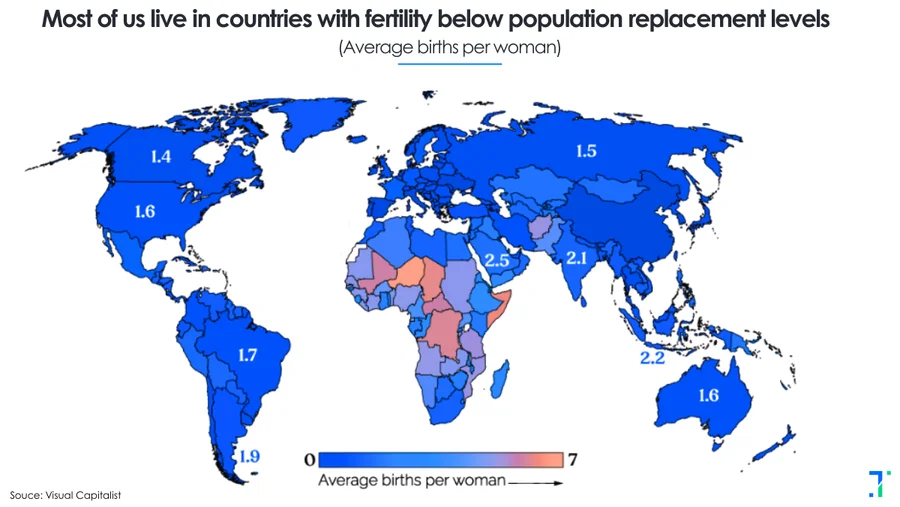
For a population to be at replacement level and neither grow nor shrink, a country needs a fertility rate (average number of children per woman) of 2.1. India's population fell below that fertility replacement level in 2020. And the fertlity rate is even lower in southern states like Kerala, Karnataka and Tamil Nadu, where the average number of children per woman is between 1.2 and 1.6. The Chief Minister of Tamil Nadu M K Stalin has suggested that to fix this, Tamilians "should have 16 children each".

Humans used to be a fertile species - fertility rates typically used to be between 4.5 to 7.5. But we are now at a turning point. For the first time in recorded history, the world's largest economies are all below the population replacement rate.

Most of Europe fell below the replacement level in the 1970s, the US in the 1980s, and China in the 1990s.  South Korea’s fertility rate fell below 0.7 children per woman this year, the lowest in the world, meaning its population will halve by 2075. Africa is now the only large region in the world with fertility rates above the global replacement level. 

Most of the world's economic output now comes from low-fertility countries. Economists have started to panic, over this output falling as populations decline.

In the 1960s, the writer Paul Ehrlich visited India and, overwhelmed by the sheer number of people in the streets of New Delhi, warned about over-population disaster and global famine. Decades later, the Cato Institute called Ehrlich "a misanthrope who'd make you apply for a government permit to have a baby if he could".

Now we are worrying about the opposite: too few people.  But is a declining population really that bad for the world?


Fertility is not just falling - it is falling faster than before 

When I walk around my city (Bangalore), an interesting trend I see is the number of families with just one kid. Just a few years ago, two kids was common enough. Now among friends and family, I am seeing a lot of ones - and even a few zeroes.

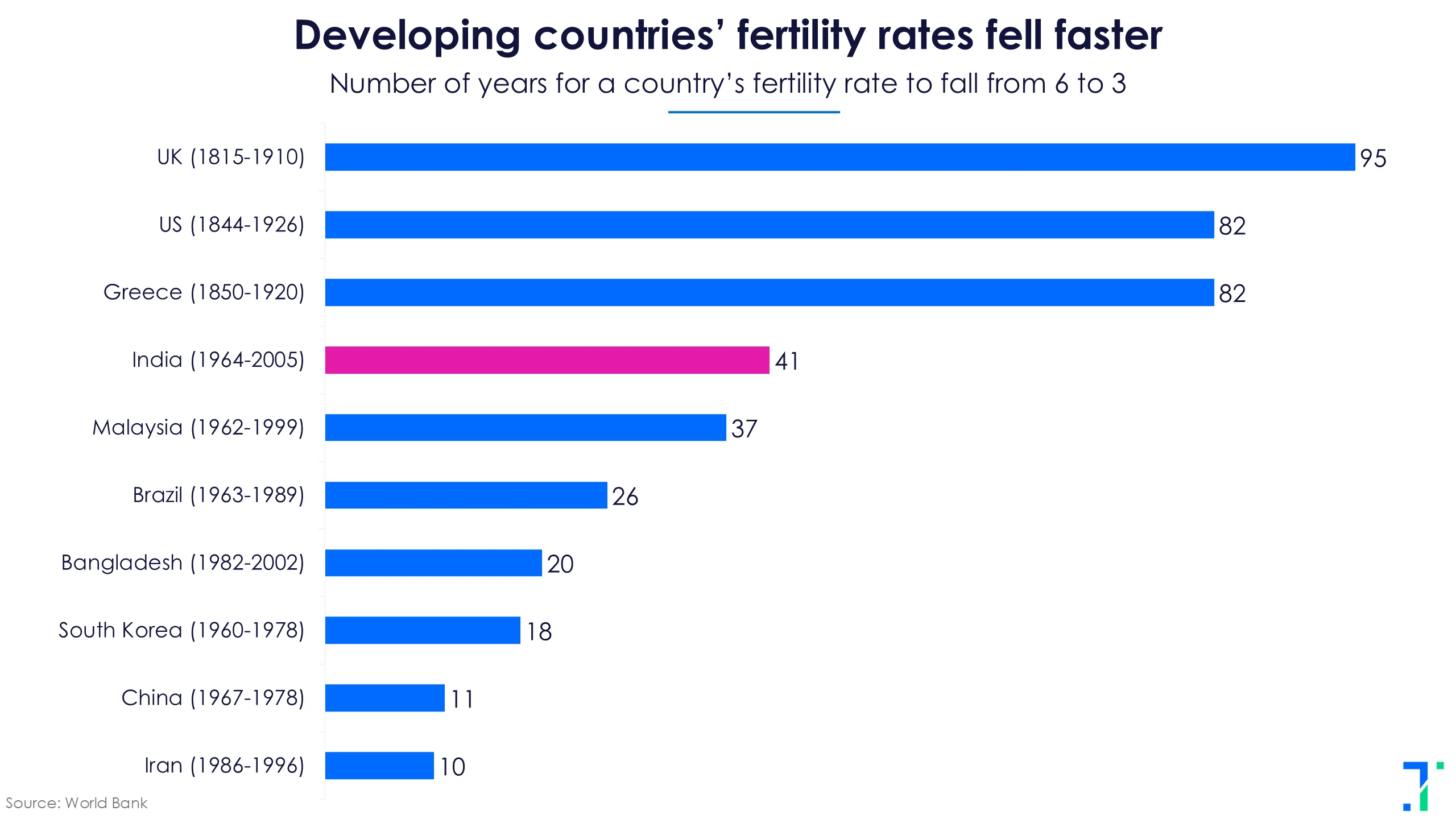
This trend is happening worldwide. Fertility is falling faster than before. The decline from a fertility rate of six to three took almost a century to happen in Britain—from 1816 to 1910. It took less than half that time for India,  just 18 years in South Korea and 11 years in China.

In cities like Seoul and Beijing, nursery school staff are taking up jobs in old age homes instead. More than 10% of pre-school teachers in China have quit in the past five years due to falling student numbers. 

When people are asked about why they are having fewer children, they mention the high cost of living, lack of time, and a lack of community support because in many cases, parents live as nuclear families while their relatives live elsewhere.

But when governments have tried to intervene by providing paid time off for parents, free childcare and generous child subsidies (China is offering couples $500 a year to have a child), the fertility rate has not increased.

This suggests that there are other factors at work. Economists have for instance, found a direct relationship between the number of years of education women receive, and falling fertility levels. When women have options like jobs and access to birth control, they have fewer kids. 

Children also once used to be the only social security people had in their old age. But they take time and money to raise. They are also unpredictable: as adults, they may move far away from you, marry someone you don't like, or even change their minds about you. In the age of  investments with predictable returns, reliable careers and pensions, having kids has become increasingly optional.

Are we having another Ehrlich moment?

Is it possible, that like Paul Ehrlich, we are panicking prematurely? In 1900, the world's population was around 1.6 billion. We are sitting at four times that number, as populations across the globe exploded in the past 100 years.  

When population soared, technology - in the form of fertilizers and pesticides that raised crop yields  - saved humans from the famine Ehrlich predicted would "end the world in 2000". Now, technology is again changing fast.

Better healthcare is already helping people to have longer careers - CEOs like Warren Buffett are working at 94, which would have been unthinkable even two decades ago. As people live longer and healthier, retirement ages can be pushed, putting less stress on pensions and social security. Rather than worry about ageing populations, countries should worry about populations ageing well.

Another factor is the underemployment of women in countries like India. Increasing labor participation of women from the current 40% levels would provide a long-term productivity boost, rather than falling for bad ideas like pushing them back home to have sixteen children. 

AI is a third new, important factor to consider - if artificial intelligence and robots substantially raise productivity per person, then countries will be able to drive economic growth with much fewer people. And if AI is eventually able to innovate at human or close to human levels, then we will start seeing technological breakthroughs at an even faster pace than ever before. 

Falling fertility has coincided with huge gains for us in gender equality, education and reproductive freedom.  Rather than trying to rewind the clock, we should think about how we can build a world with fewer people. The planet will thank us.

logo
The Baseline
21 Aug 2025
Caught in the crossfire: Will India’s economy hold up against Trump’s tariff shock?
By Divyansh Pokharna

Global trade tensions have flared up again, and India is right in the middle of the storm. President Trump has imposed 25% tariffs and an additional 25% penalty on Indian goods, citing the country’s continued purchase of Russian oil. Interestingly, the penalty does not apply to other nations such as China, the largest importer of Russian crude. 

For Indian exporters, this move threatens their business relationships with US customers and has made their near-term growth outlook uncertain.

Markets took comfort when reports after the Trump–Putin meeting suggested that Washington may relax the extra penalties on India’s Russian oil imports. But exporters are cautious, aware that US policy under Trump can shift quickly, and the outlook can change overnight.

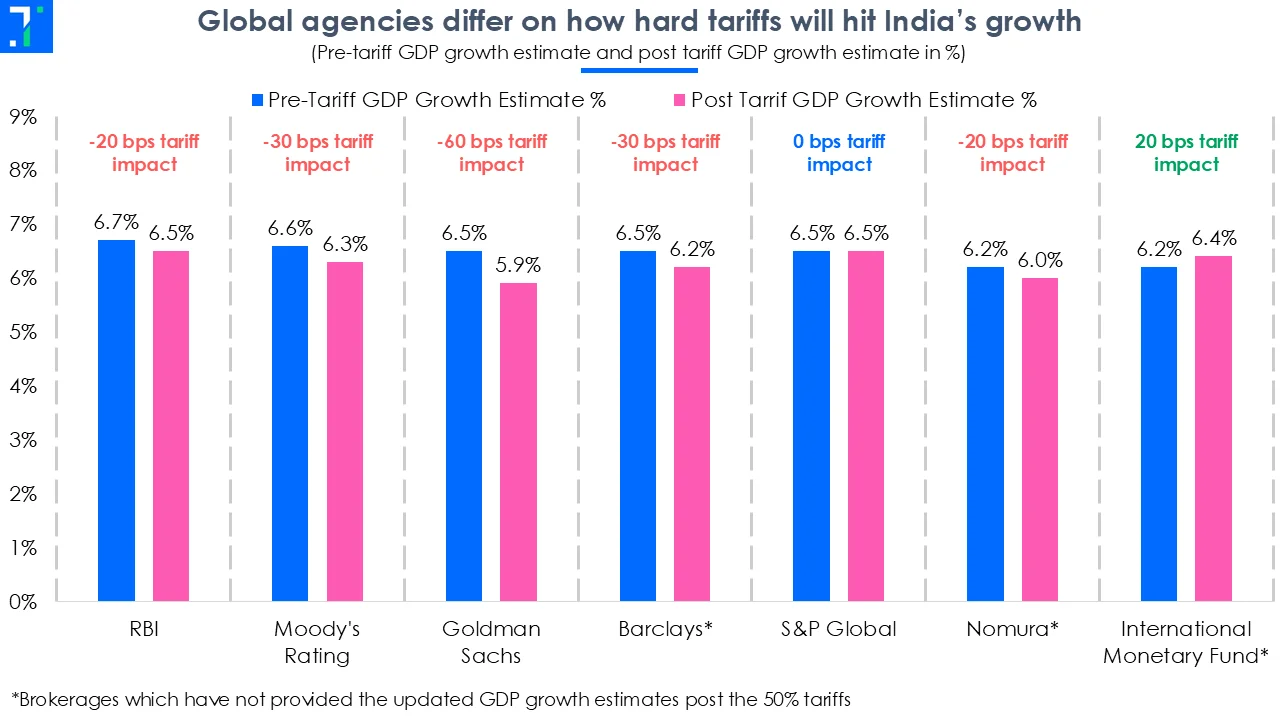
The Reserve Bank of India reflected this uncertainty in its April 9 forecast. It trimmed the FY26 growth projection when the US first threatened a 26% tariff, but it left the estimate unchanged after the steeper 50% tariff announcement on August 6, not foreseeing a significant additional impact. RBI Governor Sanjay Malhotra said, “We don't see a major impact of US tariffs on the Indian economy unless there is a retaliatory tariff,” said RBI Governor Sanjay Malhotra. But he added that “the global environment continues to be challenging.”

International institutions have echoed this view, with the IMF raising its growth forecast slightly and S&P Global judging the tariff impact as manageable. The US buys only a sixth of Indian goods, and the Indian government has been reaching out to its BRICS partners to boost trade ties after the new tariffs. The BRICS countries already trade more goods with one another than with the US. 

Other global agencies, however, take a more cautious view. Goldman Sachs believes that higher tariffs will weigh more heavily on exports and company earnings than official forecasts suggest. It estimates that GDP growth could decline by as much as half a percentage point, more severe than the RBI anticipates.

In this edition of Chart of the Week, we look at how analysts see US tariffs impacting India’s growth. Some global agencies see them as a serious threat, while others point out that strong domestic demand limits the overall effect.

From manageable slowdown to sectoral shock: mixed views on tariff impact on sectors

Moody’s Ratings and Barclays remain cautious, though not overly worried about the tariff shock. Moody’s estimates that the 50% US tariff could trim India’s GDP by around 30 bps, mainly because of a lower contribution from exports. It believes the overall hit will be limited, citing strong domestic demand and a resilient services sector. 

Barclays offers a similar estimate of a 30 bps slowdown, pointing out that India’s growth is driven more by domestic consumption than by exports. Both agree that some export-heavy sectors, such as textiles and jewellery, will feel the pressure, but the broader economy should hold up.

Nomura takes a different angle. While it expects the overall hit to growth to be smaller—around 20 bps compared with Moody’s and Barclays’ 30 bps—it warns that the sectoral fallout could be more severe. Calling the 50% tariff “almost like a trade ban,” it highlights that smaller industries such as textiles and jewellery, already operating on thin margins, could be disproportionately affected. At the same time, Nomura sees a possible cushion: India may be able to redirect some exports to Europe, the UK, and New Zealand.

Goldman Sachs sees the most severe risk. It estimates that tariffs could shave as much as 60 bps off India’s growth if they remain in place. More than the immediate slowdown, Goldman Sachs cautions that the bigger threat lies in uncertainty. Prolonged tariffs, it argues, may discourage companies from making new investments or planning expansions.

Industry leaders echo these concerns. Siva Ganapathi, MD of Gokaldas Exports, says that the 50% tariff feels “more like a ban than a tax” and warns it could disrupt supply chains, pushing buyers to shift away from India. Shrenik Ghodawat, MD of the Sanjay Ghodawat Group, adds that sectors like textiles, gems, and seafood must quickly find alternative markets to cushion the blow. He estimates that if tariffs persist, India’s GDP could slow by 0.4 to 1 percentage point.

Domestic demand expected to keep growth outlook intact

The RBI has kept its outlook largely steady. The signal is clear: the central bank expects strong spending to continue supporting the economy despite external pressures.

S&P Global has taken an even more upbeat stance. The ratings agency recently upgraded India’s sovereign credit rating from BBB- to BBB, calling the impact of the 50% US tariff “manageable” or even “marginal.” It reasons that exports to the US make up only about 2% of India’s GDP, and with key sectors such as pharma and electronics exempt, the actual exposure is closer to 1.2% of GDP.

S&P also highlights that India’s economy is powered mainly by its consumers, with nearly 60% of growth driven by domestic spending. On top of that, the “China-plus-one” shift is drawing global companies to India—not just for exports, but to tap into its fast-growing home market. Together, these factors give India an added cushion and make growth more resilient.

The IMF is similarly optimistic. It raised India’s growth forecast to 6.4% for both FY26 and FY27, up from 6.2% and 6.3% earlier. While acknowledging that a 50% US tariff could trim growth by 20–30 basis points, it expects strong household demand and continued government investment to offset much of the drag. The fund stresses that because India’s economy depends more on domestic consumption and public investment than on external trade, it is less vulnerable to shocks like tariffs.

The RBI, S&P, and IMF all share a common view: India’s growth story rests on domestic demand rather than exports. Tariffs may pinch a few export-oriented sectors, but they are unlikely to derail the broader economy. The real test lies in how long the tariffs last. A short disruption may sting exporters without affecting overall growth, while a prolonged 50% tariff could add pressure. Even at the lower 25% rate, the impact would still be noticeable, though far more contained.

Market closes higher, NCLT delays Vedanta's demerger hearing amid government objection
By Trendlyne Analysis

Nifty 50 closed at 25,050.55 (69.9, 0.3%), BSE Sensex closed at 81,857.84 (213.5, 0.3%) while the broader Nifty 500 closed at 23,143.15 (76.6, 0.3%). Market breadth is in the green. Of the 2,504 stocks traded today, 1,405 were gainers and 1,057 were losers.

Indian indices closed in the green, supported by the announcement of GST reforms and China’s assurance to lift export restrictions on rare earth magnets to India. The Indian volatility index, Nifty VIX, rose 0.1% and closed at 11.8 points. Nazara Technologies dropped over 12% after the government introduced the Online Gaming Bill 2025, which proposes to ban money games, ads, and payments, threatening real money gaming platforms.

Nifty Midcap 100 & Nifty Smallcap 100 closed in the green, following the benchmark index. Nifty IT and BSE IT were among the top index gainers today. According to Trendlyne’s Sector dashboard, Hardware Technology & Equipment emerged as the best-performing sector of the day, with a rise of 5.5%.

Asian indices closed mixed, while European indices are trading lower. US index futures traded in the red indicating a cautious start to the trading session. Investors await Fed Chair Jerome Powell’s upcoming speech at the Jackson Hole symposium this week, as well as the release of the July meeting minutes later today. Meanwhile, US Treasury Secretary Scott Bessent expects a significant rise in revenue from President Trump’s sweeping tariffs, projecting more than the initial $300 billion estimate, with plans to use the funds to reduce federal debt.

  • Relative strength index (RSI) indicates that stocks like HBL Power Systems, Hyundai Motor, Maruti Suzuki and TVS Motor are in the overbought zone.

  • Tac Infosec surges to its 5% upper circuit after its US subsidiary, CyberScope Web3 Security, approves filing for a proposed Nasdaq IPO with the Securities and Exchange Commission (SEC). The filing is through a confidential Draft Registration Statement.

  • Deven Choksey maintains its 'Buy' call on Minda Corp, with a target price of Rs 596 per share. This indicates a potential upside of 17.4%. The brokerage remains positive on the stock, driven by rising EV penetration, product premiumisation, and a strong order book. It expects the firm's revenue to grow at a CAGR of 14% over FY26-27.

  • Aurobindo Pharma reportedly emerges as the frontrunner to acquire Prague-based generic drugmaker Zentiva from Advent International for $5.5 billion (approximately Rs 47,882 crore). The deal strengthens Aurobindo’s presence in Europe, particularly in Eastern Europe.

  • Ramco Cements rises over 2% as its CEO, A V Dharmakrishnan, outlines the company’s target to double its revenue to Rs 16,000 crore over the next 4–5 years. This growth will be driven by a Rs 2,000 crore boost from its new construction chemicals brand and an expansion of cement production capacity to 30 MTPA (million tonnes per annum) by mid-2026.

  • Sula Vineyards rises sharply as it reportedly plans to enter the premium spirits market through an acquisition. The move aims at entry into the whisky, scotch, and vodka segments.

  • Geojit BNP Paribas retains its 'Buy' call on KPIT Technologies, with a target price of Rs 1,430 per share. This indicates a potential upside of 17.6%. The brokerage expects higher client engagement in H2FY26, supported by new vehicle programs in middleware architecture, off-highway mobility, and expansion in China and India. It expects a revenue CAGR of 10.2% over FY26-27.

  • Vedanta is falling as the NCLT delays hearing on its proposed demerger to September 17, after the government raised objections over hidden details, inflated revenues, and undisclosed liabilities. SEBI also flags a “serious breach,” saying Vedanta altered its scheme after receiving a No Objection Certificate.

  • Yee Farn Phua, Director at S&P Global Ratings, believes the GST reform will have only a limited impact on fiscal revenue. He believes that a simplified structure could improve compliance, reduce disputes, and broaden the tax base. Phua also notes that lower rates and clearer implementation could help boost short-term consumption.

  • PG Electroplast is rising as it enters a partnership with PAX Global Technologies' subsidiary, PAX India, to enter the high-growth digital infrastructure solutions market. As per the partnership, PG Electroplast will manufacture PAX-branded point-of-sale (POS) devices in its existing facilities.

  • Lupin launches Bosentan tablets for oral suspension in the US with 180-day exclusivity after receiving US FDA approval for its abbreviated new drug application. The tablets are used to treat pulmonary arterial hypertension. According to IQVIA, the drug has annual sales of $10 million as of June 2025.

  • Natco Pharma launches its Bosentan tablets in the US market, used to treat high blood pressure in the lungs. The drug had an estimated market size of $10 million as of June 2025.

  • Nazara Technologies issues a clarification stating that it has no direct involvement in real money gaming (RMG) businesses. This comes in response to the government's proposal to ban online money gaming. The company adds that its only indirect RMG exposure is a 46.1% stake in Moonshine Tech, and revenue from Moonshine’s ‘PokerBaazi’ is not consolidated in its financials.

  • Bharti Airtel is rising as it discontinues its entry-level 1 GB per day recharge plans of Rs 249 for a month. This increases the entry-level recharge to Rs 279 for 1.5 GB per day for a month.

  • Regaal Resources' shares debut on the bourses at a 38.2% premium to the issue price of Rs 102. The Rs 306 crore IPO received bids for 159.9 times the total shares on offer.

  • Aditya Infotech’s Q1FY26 revenue rises 16.4% YoY to Rs 744 crore, driven by growth in the security and surveillance equipment business. Net profit increases 46.1% YoY to Rs 32.8 crore. The company features in a screener of stocks outperforming their industry in price change over the past quarter.

  • Reports suggest that 41.5 lakh shares (0.9% equity) of V-Guard Industries, amounting to Rs 154 crore, have changed hands in a block deal.

  • Nazara Technologies falls sharply as the government is likely to propose strict rules under the Online Gaming Bill, 2025. The draft reportedly bans money games, ads, and payments, posing big risks for real-money gaming platforms.

  • Dynamic Cables surges as it secures a license from the Bureau of Indian Standards to manufacture high conductivity aluminium alloy stranded conductors and thermosetting insulated armoured fire survival cables. The company also expands its production capacity, supporting a monthly turnover of up to Rs 135 crore, compared to Rs 100 crore earlier.

  • GNG Electronics rises sharply as its Q1FY26 net profit surges 52.4% YoY to Rs 18.5 crore, owing to lower depreciation & amortisation expenses. Revenue jumps 22.5% YoY to Rs 315.1 crore during the quarter. It features in a screener of stocks outperforming their industries in price change over the past month.

  • Antique Stock Broking notes a sequential recovery in the FMCG sector, highlighting resilience in companies like Nestle, ITC, HUL, and Emami. However, the brokerage believes Dabur and Colgate are likely to remain under pressure, citing challenges in the beverages segment and sluggish demand growth, respectively. It names Marico and GCPL as its top picks in the FMCG space.

  • Lloyds Metals & Energy rises as it wins the bid for the Tandsi-III coking coal mine in Madhya Pradesh with 23 million metric tonnes (MMT) of reserves.

  • Endurance Technologies’ board approves the capacity addition of anti-lock braking system (ABS), disc brake system, and brake discs for an investment of Rs 125 crore.

  • Tata Steel files a writ petition in the Orissa High Court against a Rs 1,902.7 crore demand notice from the Deputy Director of Mines, Jaipur, for a shortfall in mineral dispatches from the Sukinda Chromite block.

  • Hindustan Aeronautics is rising as it reportedly secures a Rs 62,000 crore order after the Cabinet Committee on Security approves the supply of 97 Light Combat Aircraft (LCA) Tejas Mark 1A jets to the Indian Air Force.

  • Nifty 50 was trading at 24,943.70 (-37.0, -0.2%), BSE Sensex was trading at 81,671.47 (27.1, 0.0%) while the broader Nifty 500 was trading at 23,050.40 (-16.2, -0.1%).

  • Market breadth is in the green. Of the 2,019 stocks traded today, 1,182 were on the uptrend, and 768 went down.

Riding High:

Largecap and midcap gainers today include Indian Hotels Company Ltd. (806.80, 4.1%), Infosys Ltd. (1,496.20, 3.9%) and Phoenix Mills Ltd. (1,559.70, 3.8%).

Downers:

Largecap and midcap losers today include Aurobindo Pharma Ltd. (1,046.40, -4.0%), Hyundai Motor India Ltd. (2,488.10, -3.6%) and Bharat Forge Ltd. (1,158.90, -2.5%).

Volume Shockers

22 stocks in BSE 500 are trading on high volumes today.

Top high volume gainers on BSE included Ola Electric Mobility Ltd. (53.21, 18.7%), Carborundum Universal Ltd. (990.25, 13.8%) and Godfrey Phillips India Ltd. (11,064, 12.8%).

Top high volume losers on BSE were Aurobindo Pharma Ltd. (1,046.40, -4.0%), Gujarat State Petronet Ltd. (303, -1.3%) and Apar Industries Ltd. (8,353.50, -0.9%).

Latent View Analytics Ltd. (427.35, 4.8%) was trading at 11.1 times of weekly average. Intellect Design Arena Ltd. (987.70, 9.0%) and Dabur India Ltd. (535, 2.5%) were trading with volumes 8.4 and 6.6 times weekly average respectively on BSE at the time of posting this article.

BSE 500: highs, lows and moving averages

18 stocks took off, crossing 52 week highs,

Stocks touching their year highs included - Apollo Hospitals Enterprise Ltd. (7,883, 0.8%), Ashok Leyland Ltd. (133.10, -0.1%) and Fortis Healthcare Ltd. (963.95, 1.6%).

30 stocks climbed above their 200 day SMA including Rashtriya Chemicals & Fertilizers Ltd. (157.30, 5.3%) and Neuland Laboratories Ltd. (13,693, 5.0%). 5 stocks slipped below their 200 SMA including Century Plyboards (India) Ltd. (739.20, -2.5%) and Shriram Finance Ltd. (616.30, -1.6%).

logo
The Baseline
19 Aug 2025
Five stocks to buy from analysts this week - August 19, 2025
By Divyansh Pokharna

1. Manappuram Finance:

ICICI Securities upgrades its rating on this NBFC to ‘Buy’ with a target price of Rs 305, a 13.2% upside. Manappuram is working to expand its share of gold loans to 75% of its total loans, up from the current 65%. The goal is to improve the share of secured loans to 90% and reduce the share of unsecured microfinance. The management believes this shift will improve asset quality by reducing exposure to riskier segments.

To achieve this, the company will offer gold loans through its subsidiaries. It plans to introduce them at its Asirvad subsidiary, which has around 1,100 branches. If successful, the model will be extended to other subsidiaries. Under this plan, the company expects gold loan branches to grow to over 5,000 by year-end, up from 4,044 now.

Analysts Ansuman Deb, Shubham Prajapati, and Sanil Desai are also optimistic about the appointment of new CEO Deepak Reddy. They expect him to strengthen core businesses such as gold loans, vehicle loans, and housing finance, along with improving governance and customer focus.

In Q1FY26, the company's AUM rose 3% QoQ but fell 1.4% YoY, mainly because of weak performance at Asirvad Microfinance. The segment has been under pressure as many borrowers took on excessive debt, leading to higher defaults. This pushed up credit costs and weighed on profitability. The management expects conditions to improve and hopes the segment to recover by Q4FY26.

2. Global Health (Medanta):

Axis Direct maintains a ‘Buy’ rating on this hospitals chain with a target price of Rs 1,550, an upside of 12.9%. In Q1, the company’s net profit rose 45% YoY, beating Forecaster estimates by 17.2%, helped by a one-time gain from an interest reversal. However, EBITDA margins fell to 22%, down 190 bps YoY, due to annual salary hikes and costs related to the new Noida hospital.

The company’s average revenue per occupied bed (ARPOB) grew 4% YoY in Q1. Management expects mature hospitals to see 3–7% annual growth, mainly from treating more complex cases rather than price hikes. For newer hospitals, ARPOB may fluctuate quarterly but should gradually rise over time, supported by shorter patient stays. Management added that occupancy for advanced care hospitals will likely peak at 70–75% in FY26.

Medanta plans to invest Rs 3,500 crore to add 3,000 new beds over the next five years, along with Rs 450 crore for maintenance in the next three years. Analyst Aman Goyal notes that the company’s strong balance sheet will support this expansion, along with technology upgrades and acquisitions in key regions.

3. Can Fin Homes:

Geojit BNP Paribas upgrades its rating to ‘Buy’ on this housing finance company with a target price of Rs 900, an upside of 17.2%. In Q1FY26, the company’s loan disbursements grew 9% YoY to Rs 2,000 crore. The management expects disbursements of Rs 10,500 crore in FY26, with Rs 2,500 crore planned for Q2. Net profit rose 12.1%, even as the company increased provisions to clear out overdue accounts early in the year.

Can Fin Homes has passed on the recent repo rate cuts to its customers, lowering rates by 25 bps. However, the benefit will reach borrowers gradually, since most loans reset only once a year. By Q1, 67% of the loan book was on annual resets, down from 72% in March. The remaining loans reset every quarter.

Analyst Arun Kailasan notes that with banks passing on rate cuts to customers with a delay, net interest margins should remain stable. He expects net interest income to grow 11.2% and net profit to rise 40.4% over FY26–27.

4. Lemon Tree Hotels:

IDBI Capital maintains a ‘Buy’ rating on this hotel company with a target price of Rs 177, a 19% upside. The company’s Q1FY26 revenue rose 17.8% YoY to Rs 315.8 crore. Growth was driven by a 10% rise in average room rate to Rs 6,236 and higher management fees from third-party contracts and its subsidiary, Fleur Hotels.

Analysts Archana Gude and Jaydeep Taparia note broad-based growth, with Aurika Mumbai’s occupancy jumping to 76.6% from 45.8% last year, driven by higher corporate and direct bookings. During the quarter, the company signed 14 new management and franchise contracts, adding 1,273 rooms, and operationalised five hotels with ~400 rooms.

Management expects accelerated growth across owned, leased, managed and franchised assets, supported by strong travel demand, new contracts, and expansion. Net debt declined 11% YoY to Rs 1,658 crore, and the company targets becoming debt-free within the next 18 months.

5. MRF:

Anand Rathi maintains a ‘Buy’ rating on this auto tyres manufacturer with a target price of Rs 1,70,000, a 16% upside. MRF’s Q1FY26 revenue grew 6.7% YoY, beating Forecaster estimates by 3.1%. Growth was driven by stronger domestic demand and an improvement in product pricing. However, EBITDA margin declined to 12.4% from 14.1% last year due to higher input costs.

Management noted that the April-June quarter usually brings higher sales, as new vehicle production boosts orders from original equipment manufacturers and replacement demand also picks up. But this year, demand was subdued due to tariff issues in April, the impact of geopolitical tensions in May, and early monsoons.

Despite these challenges, analyst Mumuksh Mandlesha remains optimistic about the company. The brokerage expects revenue, EBITDA, and net profit to grow at a CAGR of 9%, 13%, and 19%, over FY26-28. This is supported by stronger replacement and export demand, market share gains, and margin recovery from lower rubber and crude derivative prices.

Note: These recommendations are from various analysts and are not recommendations by Trendlyne.

(You can find all analyst picks here)

Market closes higher, Motilal Oswal initiates coverage on JSW Cement with a 'Neutral' rating
By Trendlyne Analysis

Nifty 50 closed at 24,980.65 (103.7, 0.4%), BSE Sensex closed at 81,644.39 (370.6, 0.5%) while the broader Nifty 500 closed at 23,066.60 (135.1, 0.6%). Market breadth is highly positive. Of the 2,517 stocks traded today, 1,666 were on the uptick, and 797 were down.

Indian indices closed higher after rising in the morning session. The Indian volatility index, Nifty VIX, fell 4.5% and closed at 11.8 points. Auto stocks, including Ola Electric, Tata Motors, and Bajaj Auto, closed higher after China lifted export curbs on rare earth magnets to India, easing supply constraints.

Nifty Smallcap 100 and Nifty Midcap 100 closed higher. Nifty Oil & Gas and S&P BSE IPO were among the top index gainers today. According to Trendlyne’s sector dashboard, Oil & Gas emerged as the best-performing sector of the day, with a rise of 2.2%.

Asian indices closed mixed. European indices are trading in the green. US index futures are trading flat as investors await Home Depot earnings. Comments from Federal Reserve officials on interest rates and monetary policy are due later this week. Brent crude futures are trading lower on speculation that Ukraine-Russia-US talks could ease sanctions on Russian oil.

  • Money flow index (MFI) indicates that stocks like HBL Power Systems, Hyundai Motor India, JM Financial, and JK Cement are in the overbought zone.

  • Magellanic Cloud surges as it secures an order worth Rs 85 crore from Rail Vikas Nigam to implement AI-enabled video surveillance systems across Southern Railway.

  • Motilal Oswal initiates coverage on JSW Cement with a ‘Neutral’ rating and a target price of Rs 163. The brokerage highlights that the company’s capital expenditure plans of Rs 5,600 crore will help expand capacity and support its entry into the northern region. It also expects a revenue CAGR of 19% over FY26–28.

  • Tata Motors is rising sharply as it reportedly partners with Motus Holdings to re-enter the South African passenger vehicles market, owing to rising demand for budget vehicles in the country. Motus Holdings will be the exclusive distributor of Tata Motors cars in South Africa.

  • Tyre makers expect demand to pick up in H2FY26, fueled by festive buying and a potential rural rebound. Despite short-term softness, they stay cautiously optimistic, backed by replacement demand, urban consumption, and easing input costs. Neeraj Kanwar, MD of Apollo Tyres, anticipates improved demand post-monsoon, supported by infrastructure and mining activity, and expects stronger topline growth in both India and Europe.

  • Century Plyboards (India)'s Executive Director, Keshav Bhajanka, expects its revenue to grow in the mid-teens in FY26, driven by improvements across the plywood, laminates, medium density fibreboard (MDF), and particle wood segments. He also states that value growth will outperform volume growth due to the price hikes implemented on the back of inflation.

  • Seamec's board of directors terminates its Chief Executive Officer (CEO), Rakesh Ayri, due to non-performance, effective August 19.

  • Paradeep Phosphates and Fertilisers and Chemicals Travancore are rising as China lifts fertiliser export restrictions to India. India imports nearly 80% of its specialty fertilisers, such as water-soluble nutrients and liquid foliar feeds, from China.

  • Auto stocks like Ola Electric, Tata Motors, and Bajaj Auto rise as China agrees to ease export curbs on rare earth magnets. With China supplying 90% of global output, the move could ease supply disruptions that have impacted production. This comes as domestic demand improves amid talks of a potential GST cut.

  • Sarda Energy & Minerals rises as it wins the bid for the Senduri Coal Mine in Madhya Pradesh, with 248.5 million tonnes of coal reserves. The company will share 9.5% of revenue with the state government.

  • Kernex Microsystems is rising as it receives a Rs 151.4 crore order from Western Railways to deploy the Kavach system.

  • Alembic Pharma receives US FDA approval for its abbreviated new drug application (ANDA) for Macitentan tablets. The drug treats high blood pressure in the arteries of the lungs. According to IQVIA, the drug had a market size of $1.2 billion in June 2025.

  • Citi turns positive on Indian equities, projecting a 7% upside in the Nifty 50 by June 2026, with a target of 26,700. Strong macro fundamentals, steady domestic flows, and a likely recovery in consumption and credit demand during the festive season support the outlook. Citi notes that Q1 earnings were broadly in line, with muted trends. It also highlights a rebound in domestic mutual fund flows in July, especially in the multi-cap and flexi-cap segments.

  • IDBI Capital downgrades Bata India to a 'Hold' call from 'Buy', with a lower target price of Rs 1,147 per share. This indicates a potential upside of 2%. The brokerage is cautious on the stock due to its weak Q1FY26 earnings and the shift in consumer behaviour towards online platforms, leading to growth in e-commerce and direct-to-consumer (D2C) brands. It expects the company's revenue to grow at a CAGR of 5.4% over FY26-27.

  • Reliance Infrastructure is rising as it bags an order from NHPC to develop a 390 megawatt (MW) interstate transmission system for a solar power project.

  • Reliance Industries is rising as Jio discontinues its entry-level 1 GB recharge plans of Rs 209 for 22 days and Rs 249 for 28 days. This increases the entry-level recharge to Rs 299 for 1.5 GB per day for 28 days. The company's subsidiary, Reliance Consumer Products, acquires a majority stake in a joint venture (JV) with Naturedge Beverages to enter the healthy functional beverage market.

  • Motilal Oswal maintains its 'Buy' rating on Glenmark Pharmaceuticals with a target price of Rs 2,400. The brokerage notes the company’s Q1FY26 performance was below expectations due to weak domestic formulations, low Europe & rest of the world (ROW) sales, along with higher OpEx impacting margins. However, it has raised its FY26/FY27 earnings estimates by 3%/8%, factoring in income from the ISB 2001 drug deal and US regulatory constraints.

  • Bluestone Jewellery and Lifestyle's shares debut on the bourses at a 1.4% discount to the issue price of Rs 517. The Rs 1,540.7 crore IPO received bids for 2.7 times the total shares on offer.

  • Inox Wind rises sharply as it divests a stake worth Rs 175 crore in its subsidiary, Inox Renewable Solutions, at a valuation of Rs 7,400 crore.

  • Vardhman Textiles and Indo Count Industries are rising as the Finance Ministry temporarily exempts the 11% import duty on raw cotton till September 30. The move aims to ease pressures from the 50% tariff imposed by the US on Indian exports.

  • Raja Gopal Sastry, CFO of Endurance Technologies, says a GST cut would boost demand in the auto sector, noting that most of the company’s components currently fall under the 28% GST bracket. He adds that the government’s mandate on Anti-lock Braking Systems (ABS) in two-wheelers is a major opportunity. Sastry also mentions that discussions are underway with OEMs for part orders.

  • SPML Infra is rising as it bags an order worth Rs 1,073 crore from the Indore Municipal Corp to upgrade the water supply system. As part of the project, the company will set up a water intake, raw water pumping house, water treatment plant, pumping stations & transmission systems, and electric substations. The company will also operate and maintain the water system for the next 10 years.

  • GMR Airports is rising as its board of directors schedules a meeting on August 21 to consider and approve raising up to Rs 5,000 crore through the issue of securities, including a qualified institutional placement (QIP) or other modes.

  • Va Tech Wabag secures a Rs 118 crore order from the Ministry of Works, Municipalities Affairs and Urban Planning in Bahrain. The contract involves the operation and maintenance (O&M) of the 40 MLD Madinat Salman Sewage Treatment Plant and Long Sea Outfall for five years.

  • Hindustan Zinc rises as its board of directors approves setting up a 10 million tonnes per annum (MTPA) zinc tailings processing plant in Rampura Agucha, Rajasthan. The board expects the project to be completed in the next 28 months, with a capex of Rs 3,823 crore.

  • Nifty 50 was trading at 24,915.20 (38.3, 0.2%), BSE Sensex was trading at 81,319.11 (45.4, 0.1%), while the broader Nifty 500 was trading at 22,958.65 (27.2, 0.1%).

  • Market breadth is in the green. Of the 1,984 stocks traded today, 1,210 showed gains, and 710 showed losses.

Riding High:

Largecap and midcap gainers today include Hyundai Motor India Ltd. (2,581.30, 6.5%), Samvardhana Motherson International Ltd. (99.40, 5.7%) and Astral Ltd. (1,366.10, 4.0%).

Downers:

Largecap and midcap losers today include Bajaj Holdings & Investment Ltd. (13,785, -5.1%), Kalyan Jewellers India Ltd. (507.35, -2.5%) and Solar Industries India Ltd. (14,699, -1.7%).

Volume Rockets

22 stocks in BSE 500 are trading on high volumes today.

Top high volume gainers on BSE included KIOCL Ltd. (401, 19.9%), Ola Electric Mobility Ltd. (44.83, 8.7%) and Devyani International Ltd. (167.09, 7.5%).

Top high volume losers on BSE were Bajaj Holdings & Investment Ltd. (13,785, -5.1%) and SRF Ltd. (2,929.60, 0%).

Vardhman Textiles Ltd. (435.10, 6.3%) was trading at 39.8 times of weekly average. Exide Industries Ltd. (392.80, 4.4%) and TTK Prestige Ltd. (663.65, 3.0%) were trading with volumes 12.1 and 9.5 times weekly average respectively on BSE at the time of posting this article.

BSE 500: highs, lows and moving averages

15 stocks took off, crossing 52 week highs,

Stocks touching their year highs included - Ashok Leyland Ltd. (133.28, 1.2%), CCL Products India Ltd. (920.50, 2.0%) and Indian Bank (671.65, -0.7%).

37 stocks climbed above their 200 day SMA including Devyani International Ltd. (167.09, 7.5%) and Motherson Sumi Wiring India Ltd. (41.89, 6.2%). 10 stocks slipped below their 200 SMA including Neuland Laboratories Ltd. (13,044, -3.6%) and PTC Industries Ltd. (13,402, -2.2%).

logo
The Baseline
19 Aug 2025
Which stocks did superstar investors buy in Q1FY26?
By Divyansh Pokharna

The first quarter of FY26 was marked by market volatility, largely driven by global trade tensions. During these months, the US and India were busy negotiating the first phase of a Bilateral Trade Agreement, to improve trade between the two countries, and bring down tariffs on both sides.

But President Trump blew up the negotiations, complaining about India’s imports on Russian oil, and imposed a 50% import tariff on Indian goods. The move prompted a warning from Moody's about a potential slowdown in India's manufacturing sector and overall economic growth. However, S&P Global Ratings expects the tariffs to have limited impact on the economy, noting that exports to the US are small and key sectors like pharma and consumer electronics are largely exempt. The agency also upgraded India’s sovereign rating from ‘BBB-’ to ‘BBB’.

To invest in markets as volatile as this, people follow superstar investors like RARE Enterprises, Ashish Kacholia, Sunil Singhania, and Vijay Kedia for insights. Their buying and selling activity helps retail investors identify promising sectors and stocks. We take a look at their top buys in Q1FY26.

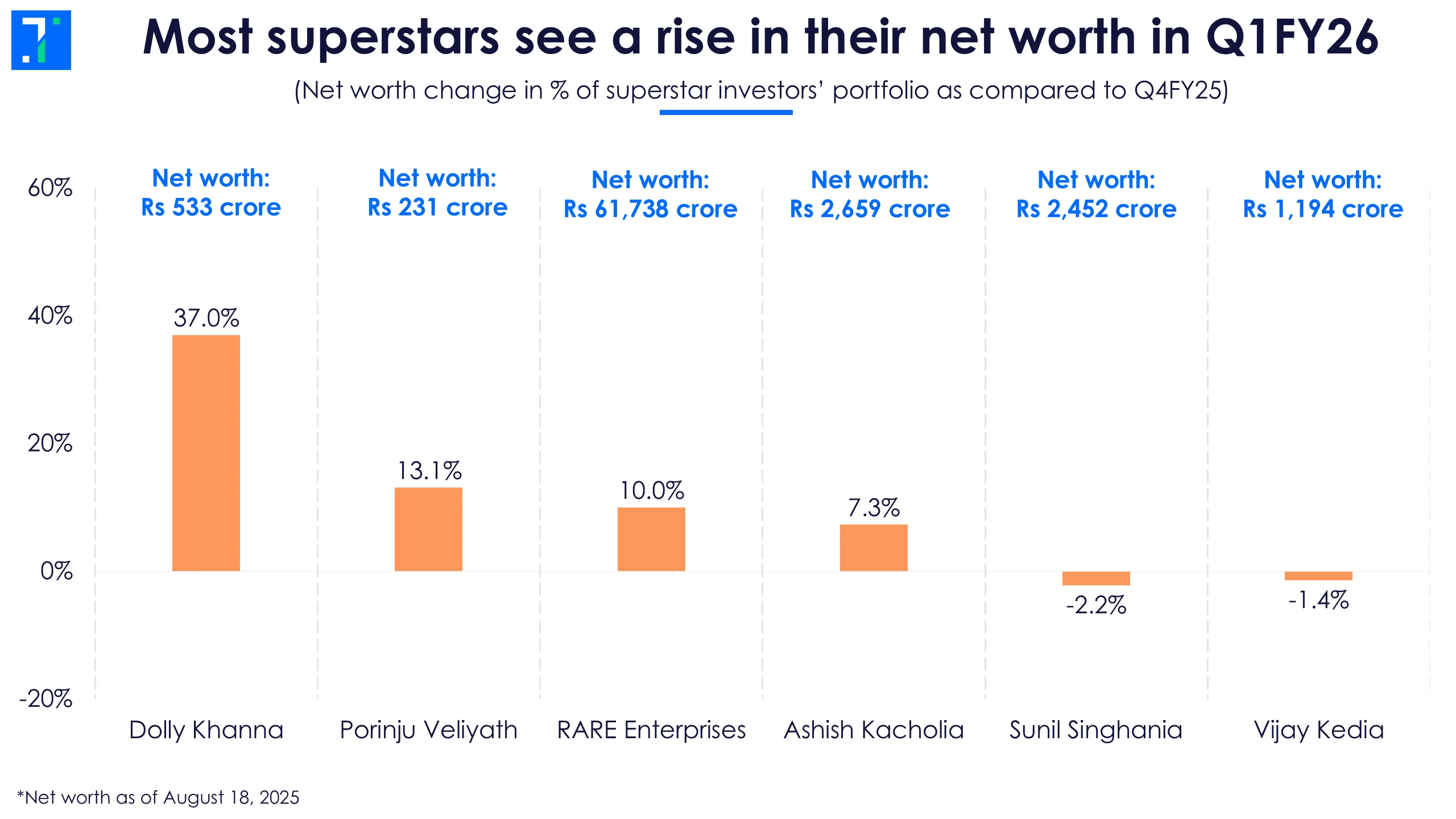
In Q1, most superstar investors remained cautious due to market volatility. They made fewer additions and more stake sales, continuing the pattern seen from the March quarter. The chart below shows changes in their current public portfolio net worth. 

Despite limited buying, several of their existing holdings delivered strong gains during the quarter, leading to a rise in net worth for most of these investors. Note that superstar net worth includes current holding changes, as well as new buys and sells. 

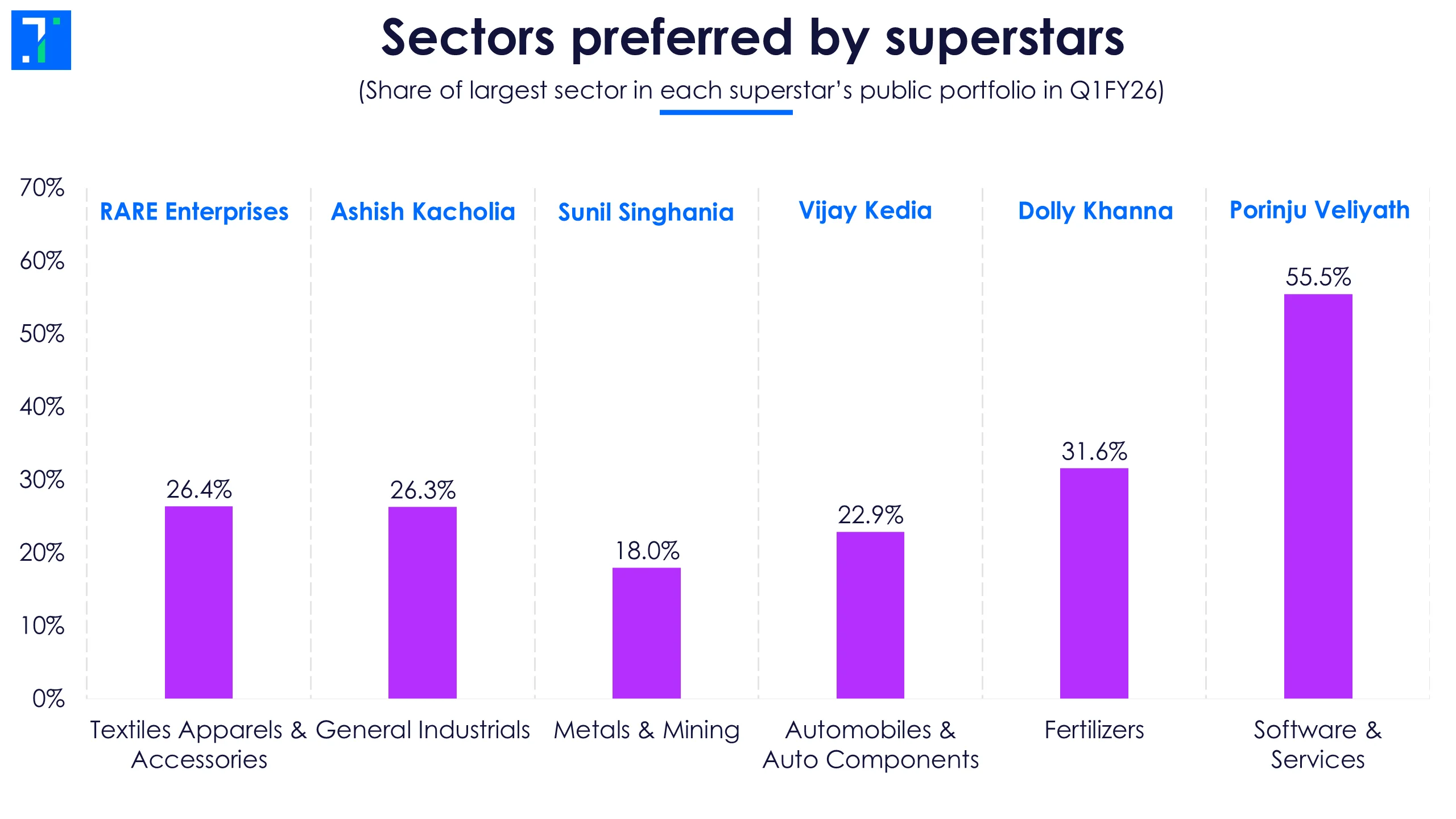
Each superstar investor's portfolio reflects their unique investing style and sector preferences. The chart below highlights the dominant sectors in each investor’s public portfolio. 

Sector preferences vary among superstar investors – RARE Enterprises leans towards the Textiles Apparels & Accessories, while Ashish Kacholia favours general industrials. Sunil Singhania focuses on the metals & mining sector, and Vijay Kedia’s preferred industry is automobiles & auto components. Dolly Khanna leans more towards the fertilizers industry, and Porinju Veliyath’s top sector is software & services.

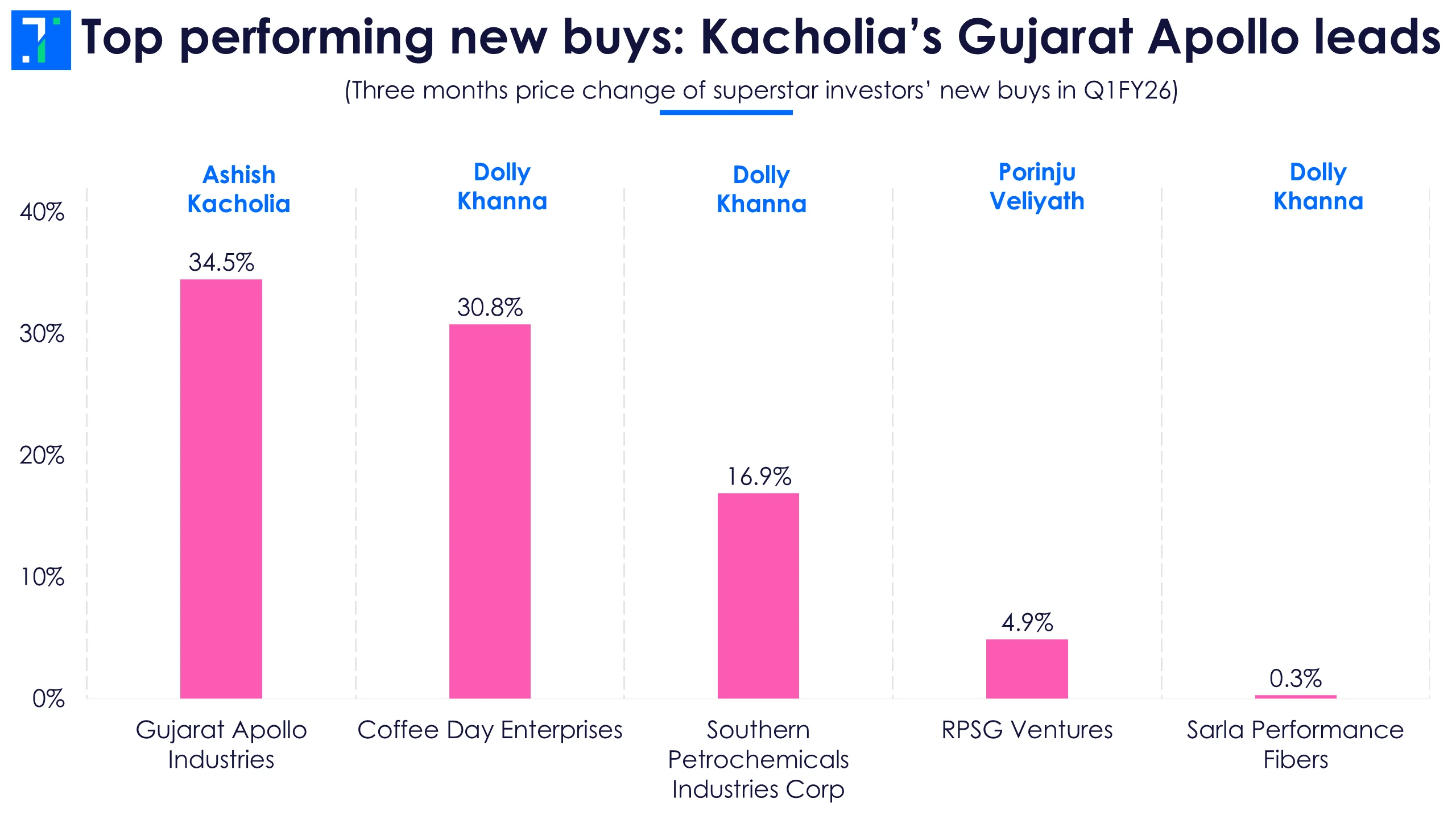
Ashish Kacholia added just one new stock to his portfolio in Q1, which topped the list of best-performing stocks for the quarter. Dolly Khanna made the most new investments during this period, with Coffee Day Enterprises emerging as her top-performing stock. Here’s a look at the key stocks held by these superstar investors.

Kacholia’s Gujarat Apollo Industries topped the list with a 34.5% rise over the past quarter. Among Dolly Khanna’s holdings, Coffee Day Enterprisesrose 30.8%, followed by Southern Petrochemicals Industries and Sarla Performance Fibers. Porinju’s RPSG Ventures also appears in the list, gaining 4.9% in Q1.

RARE Enterprises records no new buys in Q1

Rakesh Jhunjhunwala’s portfolio, currently managed by Rekha Jhunjhunwala and RARE Enterprises, has risen by 10% to Rs 61737.8 crore as of August 18. The fund has stayed relatively quiet in recent months, making no new purchases or stake increases during the quarter. However, RARE has fully sold its stake in Nazara Technologies.

Net worth has increased despite no stake additions, driven by strong performance in key holdings such as Star Health and Allied Insurance, Concord Biotech, Fortis Healthcare, etc. However, its two largest holdings, Inventurus Knowledge Solutions and Titan Company, recorded nearly flat performance in the past quarter.

Ashish Kacholia adds a new company in Q4, raises stake in three

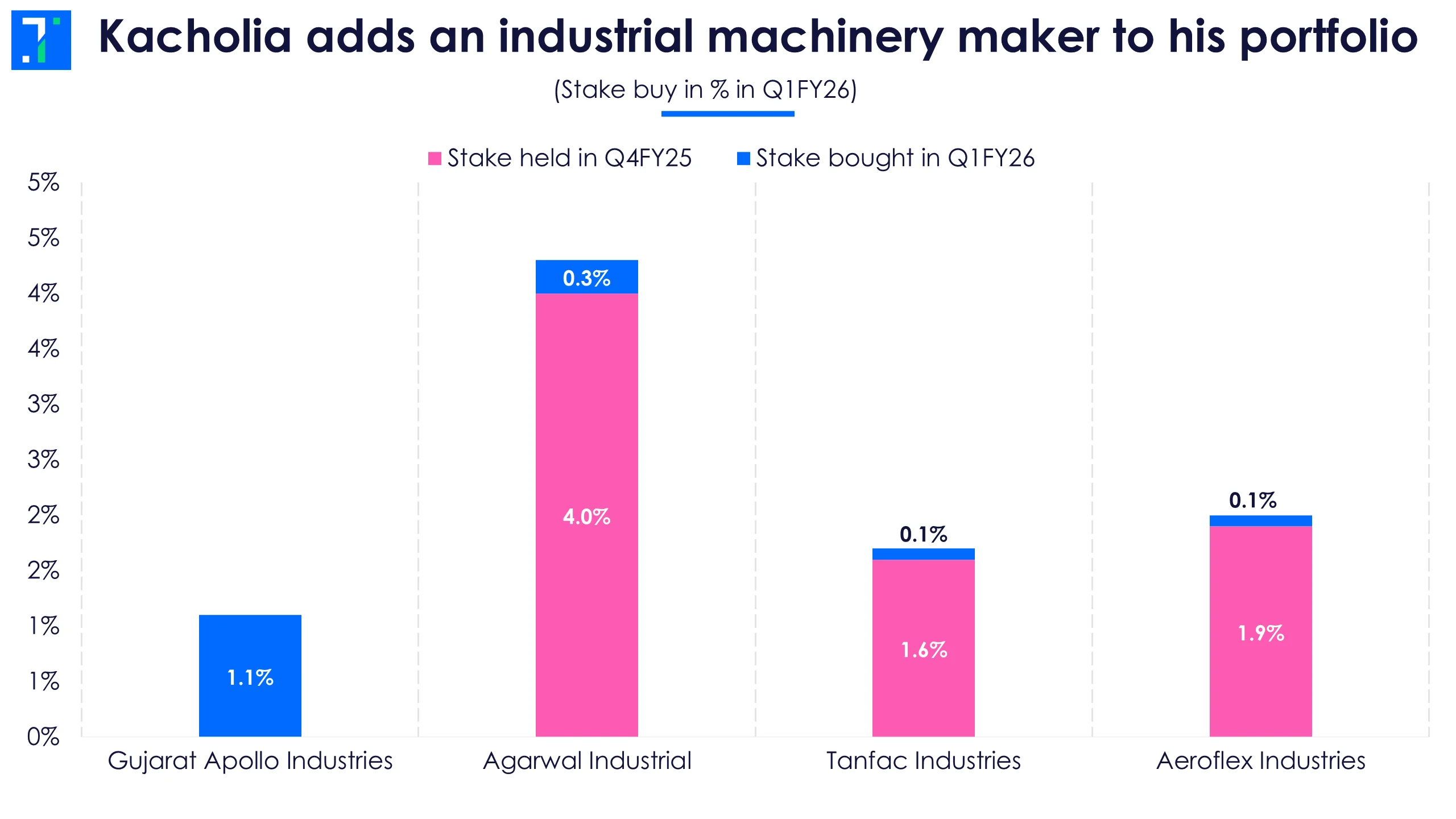
Ashish Kacholia’s net worth rose 7.3% to Rs 2,659 crore as of August 18. During the quarter, the ace investor addedGujarat Apollo Industries, a small-capindustrial machinery maker, to his portfolio, investing about Rs 5 crore for a 1.1% stake.

FIIs alsoincreased their holding in the company, from a mere 0.01% to 0.14% during the quarter. The stock appears in ascreener of stocks that outperformed their industry during the quarter. It has risen by 73.8% over the past year.

Kacholia also bought a 0.3% stake inAgarwal Industrial Corp during Q1, increasing his holding to 4.3%. The stock ranks high on Trendlyne’s checklist with a score of 56.5%. However, it has declined by 32.3% over the past year.

He also made small additions of 0.1% each to his holdings in Tanfac Industries and Aeroflex Industries. Both companies have strong Durability scores and rank high on Trendlyne’s checklist. They also turn up in a screener of stocks that have delivered consistently high returns over the past five years.

Sunil Singhania slightly increases his stake in Mastek

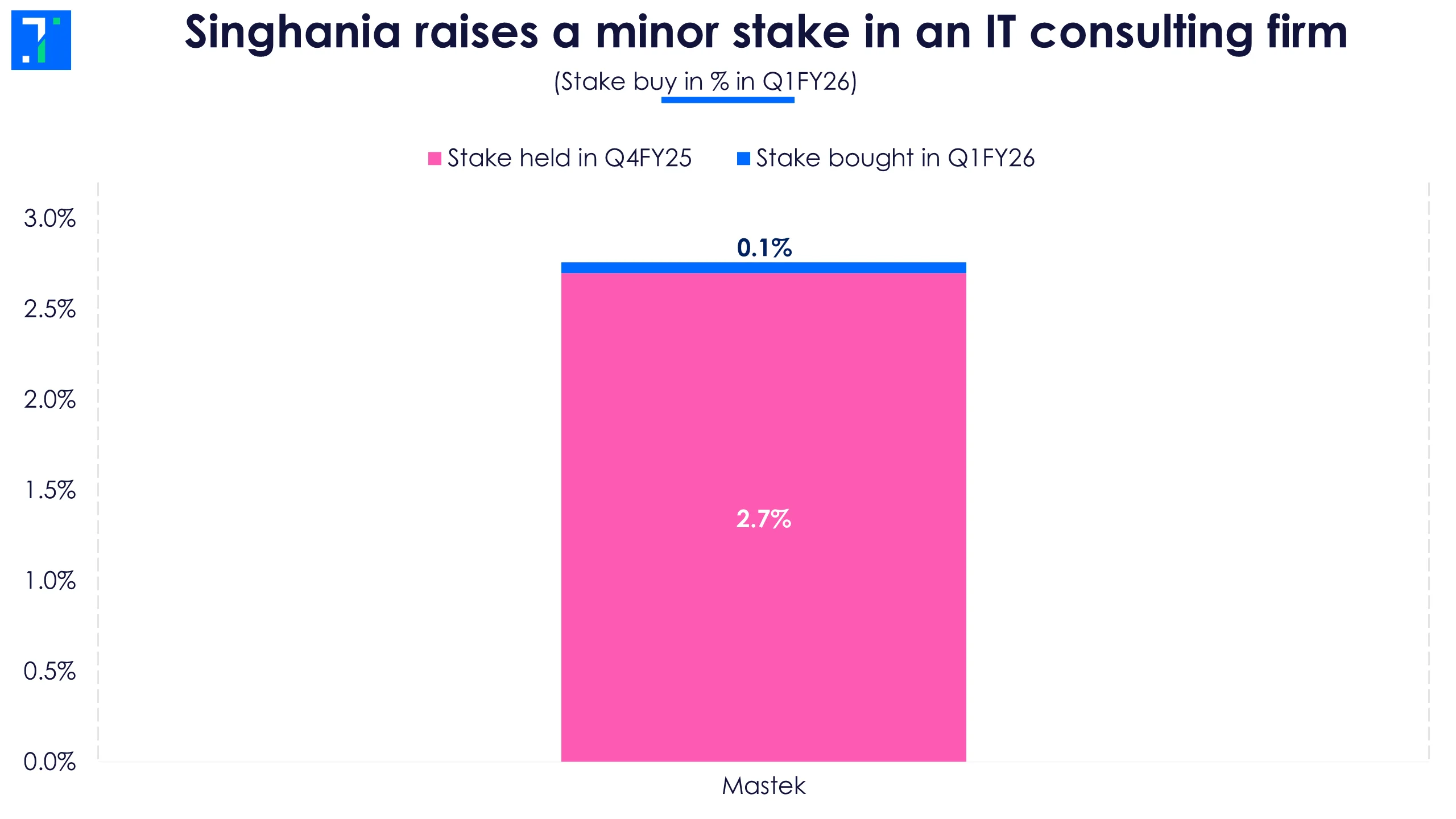
Sunil Singhania’s Abakkus Fund saw its net worth drop 2.2% to Rs 2,452.3 crore as of August 18. Singhania’s fund remained cautious during the quarter, making more stake sales and adding only a small 0.1% stake in Mastek.

The fund now holds a 2.8% stake in the IT consulting firm. However, this is down from 3% stake in the June quarter last year.

Trendlyne classifies Mastek as a Mid-range Performer, driven by its high Durability score but average Valuation and Momentum scores. The stock is undervalued based on both current PE and future earnings estimates.

Analysts estimate the stock could rise around 22% over the next year, with an average target price of Rs 3,072. It has already gained 7.3% in the past quarter.

Vijay Kedia makes no new buys in Q1

Vijay Kedia's net worth has fallen by 13.4%, reaching Rs 1,193.8 crore as of August 18. He has been relatively quiet in recent months, making no new purchases or stake increases during the quarter, but has sold stakes in a few companies.

Dolly Khanna adds three new companies in Q1

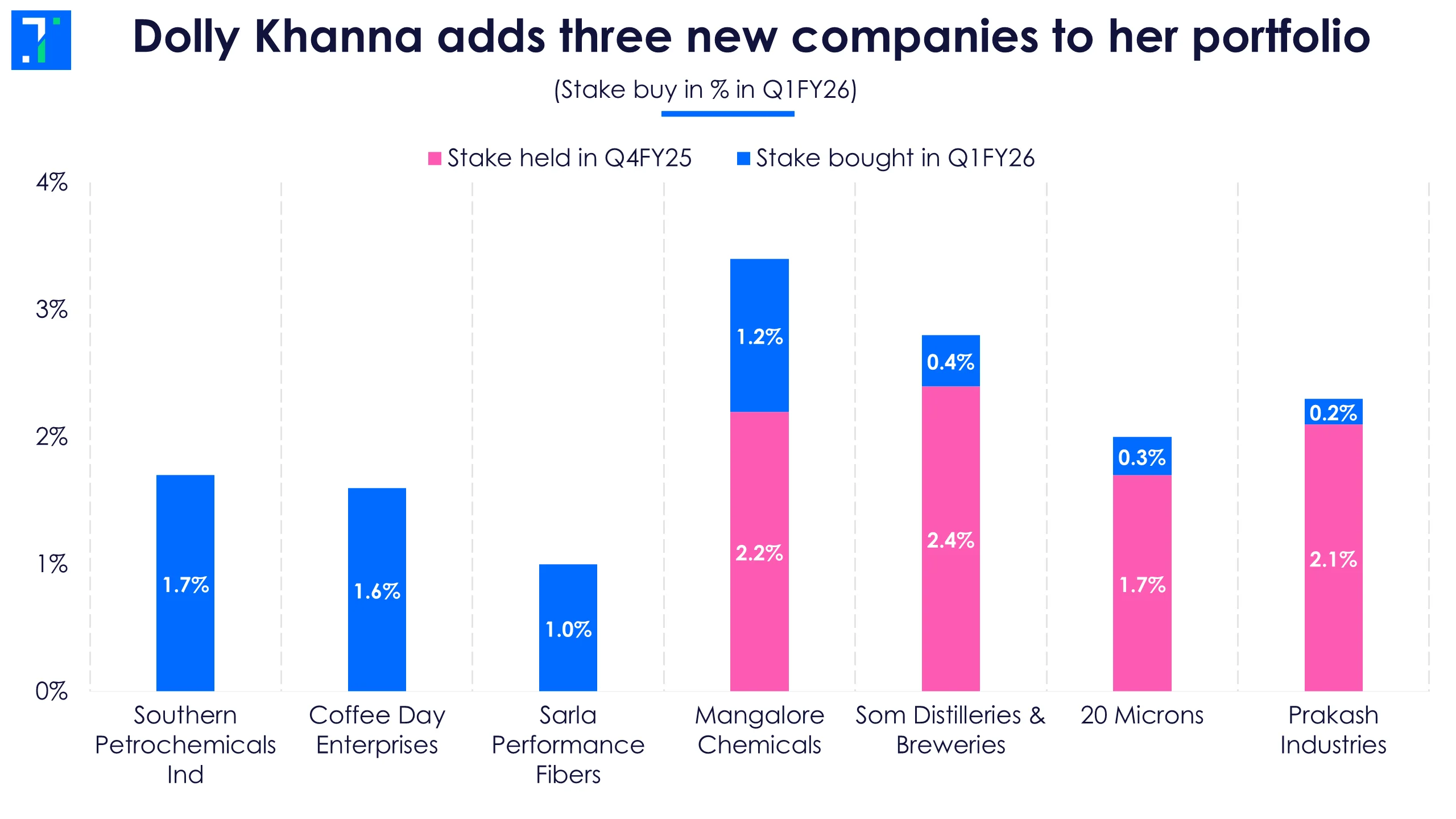
Dolly Khanna's net worth increased by 37%, reaching Rs 533.3 crore as of August 18. She publicly holds 17 companies and continued to expand her portfolio in Q1 by adding three new companies and increasing stakes in another seven. 

Her new investments include a 1.7% stake in Southern Petrochemicals Industries Corp, a fertilizer manufacturer, and a 1.6% stake in Coffee Day Enterprises, which runs coffee outlets. She also bought a 1% stake in Sarla Performance Fibers, a textiles firm.

Over the past quarter, Southern Petrochemicals’ share price has risen by 16.9%, Coffee Day has gained 30.8%, while Sarla Performance has increased by 0.3%. 

Khanna increased her stake in Mangalore Chemicals & Fertilizers by acquiring 1.1%, taking her holding to 3.3%. This is the fourth consecutive quarter where she has raised her stake in the company. It has surged 158.9% over the past year, outperforming its industry by 59 percentage points.

Khanna also bought minor stakes in Som Distilleries & Breweries (0.4%), 20 Microns (0.3%), and 0.2% each in Prakash Industries and Rajshree Sugars & Chemicals. Additionally, she made small purchases in KCP Sugar, Zuari Industries, and GHCL

Porinju Veliyath adds an IT consulting firm to his portfolio in Q1

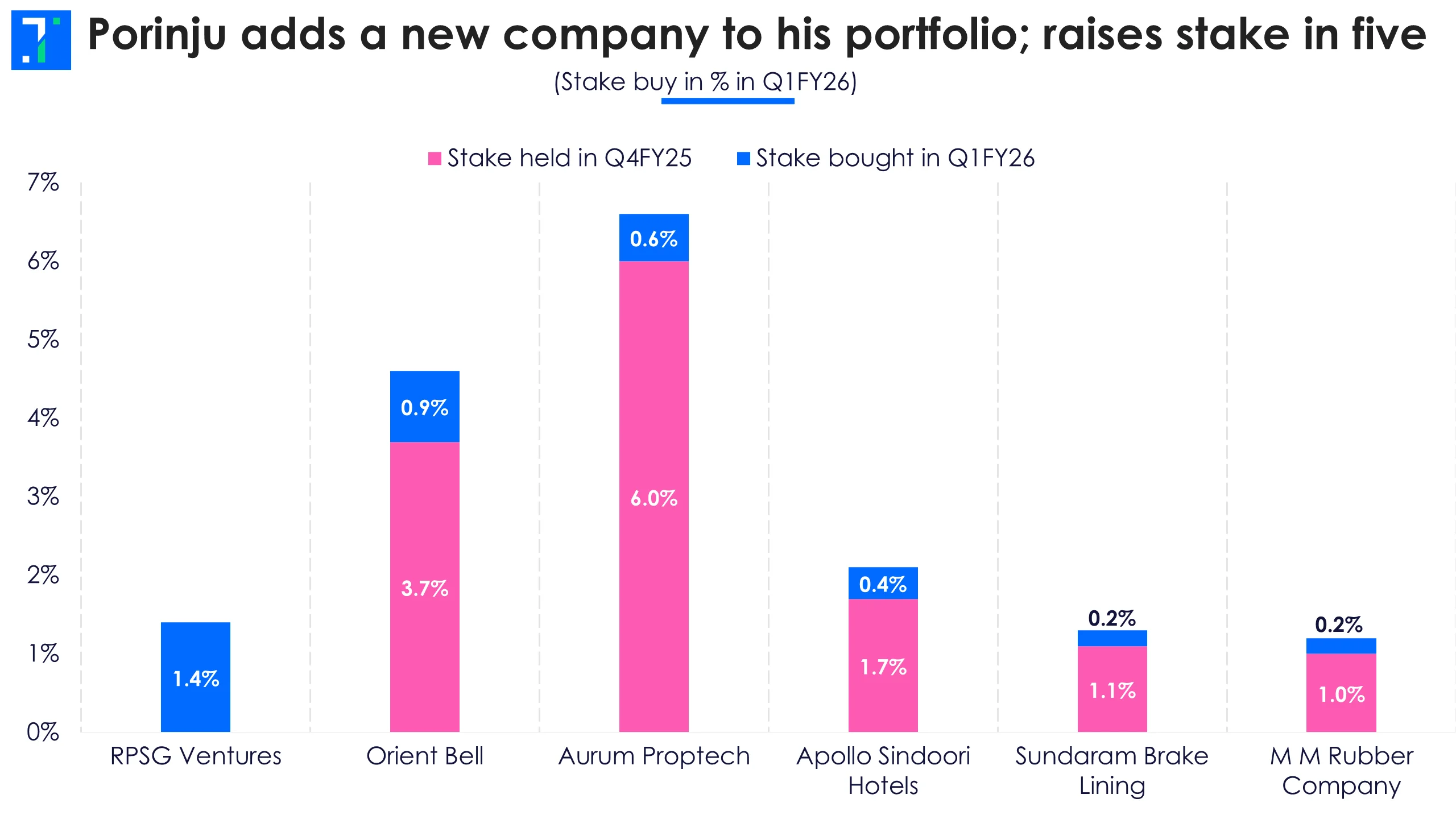
Porinju Veliyath's net worth increased by 13.5%, reaching Rs 232.2 crore. During the June quarter, he added RPSG Ventures to his portfolio, acquiring a 1.4% stake in the IT consulting & software company. The company’s share price has increased by 12.2% over the past year, outperforming its industry by 23.6 percentage points. 

During Q1FY26, Porinju increased his stake in Orient Bell by 0.9%, taking his holding to 4.6% in the ceramics manufacturer. The stock has strong Durability and Valuation scores of 85 and 61.3. The company has gained 3.9% over the past quarter. 

He also picked up a 0.4% stake in Apollo Sindoori Hotels and now holds 2.1% in the hotels stock. The company has gained 8.7% over the past quarter, outperforming the industry by 8.4 percentage points. It also has a high Durability score of 65. 

Porinju bought a 0.2% stake each in Sundaram Brake Lining and M M Rubber Company. He has a 1.3% stake in both the auto parts maker as well as the auto tyres manufacturer. These companies feature in a screener of stocks with zero promoter pledge.

Market closes higher, Ahluwalia Contracts' net profit misses Forecaster estimates by 14% in Q1
By Trendlyne Analysis

Markets closed higher. Nifty 50 closed at 24,876.95 (245.7, 1%), BSE Sensex closed at 81,273.75 (676.1, 0.8%) while the broader Nifty 500 closed at 22,931.50 (251.3, 1.1%). Market breadth is in the green. Of the 2,540 stocks traded today, 1,610 showed gains, and 878 showed losses.

Indian indices closed higher after PM Narendra Modi promised GST reforms before Diwali, US President Trump indicated reconsidering secondary tariffs on India and a credit rating upgrade by S&P Global. The Indian volatility index, Nifty VIX, fell 0.1% and closed at 12.3 points. JK Cement closed 4.3% in the green as its board approved a Rs 4,805 crore investment for a greenfield expansion project.

Nifty Smallcap 100 and Nifty Midcap 100 closed in the green, tracking the benchmark index. BSE Auto and Nifty Consumer Durables were among the best-performing indices of the day. According to Trendlyne’s sector dashboard, Automobiles & Auto Components emerged as the highest-performing sector of the day, with a rise of 4.4%.

European indices are trading lower, except Portugal’s PSI index, which is trading 1.2% higher. Major Asian indices closed mixed. US index futures are trading with varied trends, indicating a cautious start to the session as investors await the latest Federal Reserve decision on interest rates later this week. US President Trump to meet Ukrainian President Volodymyr Zelensky in Washington today to discuss a potential peace deal with Russia.

  • Relative strength index (RSI) indicates that stocks like Fortis Healthcare, HBL Power Systems, and Dr. Lal Pathlabs are in the overbought zone.

  • Jindal Worldwide is falling as its net profit declines 3.5% YoY to Rs 17.4 crore in Q1FY26 due to inventory buildup. However, revenue increases 9.6% YoY to Rs 539.9 crore, driven by an improvement in the textiles segment during the quarter. The company appears in a screener of stocks underperforming their industry price change over the past quarter.

  • Astral and Finolex Industries are rising after the Directorate General of Trade Remedies (DGTR) recommends imposing anti-dumping duty on polyvinyl chloride (PVC) resin imports for five years. The move is likely to stabilise PVC resin prices and normalise inventories.

  • Ahluwalia Contracts’ Q1FY26 revenue rises 9.7% YoY to Rs 1,020.7 crore, driven by strong project execution. Net profit grows 67.6% YoY to Rs 51.2 crore. The company appears in a screener of stocks outperforming their industry price change over the past quarter.

  • State-run telecom operator Mahanagar Telephone Nigam (MTNL) reports a rise in loan defaults, with outstanding dues to public sector banks reaching Rs 8,659 crore as of July. This is up from Rs 8,584.9 crore in June, comprising Rs 7,794.3 crore in principal and Rs 790.6 crore in interest.

  • Axis Direct downgrades PI Industries to a 'Hold' call from 'Buy', with a lower target price of Rs 3,930 per share. This indicates a potential upside of 4.8%. The brokerage believes that the near-term industry challenges with tariff-related uncertainties and high inventory levels will limit revenue growth in FY26. It expects the firm's revenue to grow at a CAGR of 10.2% over FY26-27.

  • Borosil is rising as its net profit grows 87.4% YoY to Rs 17.4 crore, driven by growth in the non-glassware segment. Revenue rises 8% YoY to Rs 242.5 crore, helped by lower finance costs. The firm appears in a screener of stocks with zero promoter pledge.

  • Dilip Buildcon's joint venture (JV) with Ranjit Buildcon (RBL) secures a Rs 1,503.6 crore order from Gurugram Metro Rail (GMRL) to construct 14 elevated stations.

  • EV makers are securing resized local magnets or sourcing from countries like South Korea to offset China’s export curbs, ensuring smooth production ahead of the festive season. Ather Energy CEO Tarun Mehta says the company is exploring options such as partial motor assembly in China, using heavier rare-earth-free magnets, and adopting ferrite-based motor technology to reduce rare-earth dependence.

  • Ashok Leyland surges on expectations of GST rationalisation in the automobile segment. The government has reportedly proposed sharp rate cuts on entry-level two-wheelers, small cars, and hybrids, likely easing the burden for the middle class and boosting demand in the auto sector.

  • Jai Corp surges more than 15% as its Q1FY26 net profit jumps 7.6x YoY to Rs 104.3 crore, driven by lower inventory, finance and depreciation & amortisation expenses. Revenue grows 83.3% YoY to Rs 234.8 crore, owing to improvements in the plastic processing and real estate segments. It features in a screener of stocks with above-line growth and below-line valuations.

  • PNC Infratech secures an order from NHPC to set up a 300 megawatt (MW) inter-state transmission system and a 150 MW/600 megawatt-hour (MWh) energy storage system (ESS).

  • Challa Srishant, MD of CCL Products India, says the 50% US tariff on Brazil has led to sharp price fluctuations. He expects some volatility to continue until November, but emphasises that the company's Cost-Plus model limits the impact. Srishant adds that the new facilities are currently operating at 30% capacity, with a target to ramp this up to 70–80% over the next 2–3 years.

  • JK Cement's board approves an investment of Rs 4,805 crore for a greenfield expansion project. The project involves setting up a new cement clinkerisation unit of 4 million tonnes per annum (MTPA) and a cement grinding capacity of 3 MTPA at its Jaisalmer plant, Rajasthan.

  • EMS secures a Rs 104 crore letter of acceptance (LOA) from UP Jal Nigam for the Agra water supply project. The work involves engineering, design, and construction of a water treatment plant and an intake well-cum-pump house.

  • Knowledge Realty Trust's shares debut on the bourses at a 3% premium to the issue price of Rs 100. The Rs 4,800 crore IPO received bids for 12.5 times the total shares on offer.

  • Auto stocks like Maruti Suzuki India and Hyundai Motor India surge over 8% as the Indian government proposes reducing GST on small cars to 18% from 28%. The government plans its biggest tax overhaul since 2017, with consumer, auto, and insurance firms set to benefit as prices drop from October, post approval.

  • Alembic Pharma receives US FDA approval for its abbreviated new drug application (ANDA) for tretinoin cream. The drug, used to treat acne vulgaris, had a market size of $94 million in June 2025, according to IQVIA.

  • KEC International is rising as it secures orders worth Rs 1,402 crore across its businesses. Its transmission & distribution (T&D) unit receives orders to supply transmission towers in the USA. In the cables segment, it secures orders to supply various types of cables and conductors in India and overseas markets.

  • Inox Wind's Q1FY26 revenue rises 32.6% YoY to Rs 862.5 crore, driven by strong project execution. Net profit doubles YoY to Rs 105.8 crore. The company appears in a screener of stocks where mutual funds have increased their shareholding in the past month.

  • Motilal Oswal notes that the second-generation GST reforms, aiming to reduce tax burden and boost consumption, propose a shift from four tax slabs to two (5% and 18%). The brokerage expects these changes to cut retail prices by 4-5% and increase consumption. It names consumer staples, autos, cement, hotels, retail, durables, logistics, quick commerce, and EMS sectors as likely beneficiaries.

  • Swan Energy is falling as its Q1FY26 net profit plunges 86.2% YoY to Rs 19.1 crore due to higher raw materials, inventory, employee benefits, and depreciation & amortisation expenses. However, revenue grows 9.5% YoY to Rs 1,272.1 crore, led by improvements in the textile and distribution & development segments. It shows up in a screener of stocks with high promoter pledges.

  • Zaggle Prepaid Ocean Services surges as its net profit grows 56% YoY to Rs 26.1 crore in Q1FY26, helped by lower finance costs. Revenue increases 31.6% YoY to Rs 332 crore, driven by new client acquisition and AI integration during the quarter. The company appears in a screener of stocks with improving book value per share over the past two years.

  • Vodafone Idea is rising as its Q1FY26 net loss beats Forecaster estimates by 3.4% despite expanding 2.7% YoY to Rs 6,608.1 crore due to higher license fees & spectrum usage, roaming & access, marketing, and finance costs. However, revenue grows 3.7% YoY to Rs 11,164.2 crore, driven by improvements in subscriber base and average revenue per user (ARPU). It features in a screener of stocks with improving net cash flow over the past two years.

  • Glenmark Pharma is falling as its net profit plunges 86.2% YoY to Rs 46.9 crore in Q1FY26. However, revenue increases marinally by 0.6% YoY to Rs 3,264.4 crore as gains in India and emerging markets were offset by declines in Europe and North America. The company appears in a screener of stocks with PE ratio higher than the Industry average.

  • Markets are up today morning. Nifty 50 was trading at 24,946.70 (315.4, 1.3%), BSE Sensex was trading at 81,315.79 (718.1, 0.9%) while the broader Nifty 500 was trading at 22,956.40 (276.2, 1.2%).

  • Market breadth is ticking up strongly. Of the 2,094 stocks traded today, 1,741 were gainers and 295 were losers.

Riding High:

Largecap and midcap gainers today include Maruti Suzuki India Ltd. (14,068, 8.8%), Hyundai Motor India Ltd. (2,423.40, 8.2%) and Ashok Leyland Ltd. (131.76, 8.0%).

Downers:

Largecap and midcap losers today include Suzlon Energy Ltd. (58.07, -3.3%), Hitachi Energy India Ltd. (19,775, -3.0%) and Kalyan Jewellers India Ltd. (520.20, -2.5%).

Crowd Puller Stocks

55 stocks in BSE 500 are trading on high volumes today.

Top high volume gainers on BSE included Supreme Petrochem Ltd. (805.15, 10.1%), Maruti Suzuki India Ltd. (14,068, 8.8%) and Pfizer Ltd. (5,766.50, 8.2%).

Top high volume losers on BSE were Glenmark Pharmaceuticals Ltd. (1,973.90, -3.5%), Deepak Nitrite Ltd. (1,810.50, -2.5%) and Galaxy Surfactants Ltd. (2,237.30, -1.4%).

Relaxo Footwears Ltd. (471.25, 7.9%) was trading at 34.5 times of weekly average. KEC International Ltd. (831.55, 6.8%) and Escorts Kubota Ltd. (3,623.80, 6.6%) were trading with volumes 29.9 and 21.3 times weekly average respectively on BSE at the time of posting this article.

BSE 500: highs, lows and moving averages

25 stocks made 52 week highs, while 1 stock tanked below their 52 week lows.

Stocks touching their year highs included - Apollo Hospitals Enterprise Ltd. (7,822.50, 0.0%), Ashok Leyland Ltd. (131.76, 8.0%) and Bajaj Holdings & Investment Ltd. (14,523, 2.7%).

Stock making new 52 weeks lows included - Cohance Lifesciences Ltd. (897.35, -1.8%).

34 stocks climbed above their 200 day SMA including Apollo Tyres Ltd. (464.45, 7.4%) and Blue Star Ltd. (1,915.70, 7.3%). 7 stocks slipped below their 200 SMA including NMDC Steel Ltd. (39.70, -1.0%) and MphasiS Ltd. (2,698.10, -0.8%).