News from trendlyne

logo
The Baseline
02 Apr 2026
Five Interesting Stocks Today - April 2, 2026
By Trendlyne Analysis

1. InterGlobe Aviation (IndiGo):

The stock of this airline company rose by over 5% on April 1 after it named William Walsh as its next CEO, effective August 3. Walsh is currently the Director General of the International Air Transport Association (IATA), and viewed as a "steady hand" for an airline navigating geopolitical turbulence and regulatory scrutiny. Investors are betting his global expertise will stabilize the airline when he transitions from his current role this July.

The outlook for IndiGo hasn't been entirely clear skies; its stock has fallen about 18% since the Iran conflict began on February 28. Between strict new pilot duty-time rules and rising hostilities in the Gulf, the market leader is facing a triple threat of demand, cost, and revenue pressure. Several brokerages have preemptively lowered their profit and margin estimates for the upcoming fiscal year. Its stock appears on a screener of stocks having a low to medium Trendlyne momentum score.

Regulators are also keeping IndiGo on a shorter leash, opting for a "moderate" approach to flight approvals following the airline's major operational meltdown last December. While IndiGo planned to launch its summer schedule with 2,000 daily flights in April, executives now warn of possible cuts. Since the schedule was set before the Middle East crisis escalated, uncertainty may force a significant reduction in services. 

Analysts at Motilal Oswal highlight that the US-Iran escalation and closed Pakistani airspace have disrupted routes that carry 25% of global traffic. With Gulf operations contributing 18-20% of annual revenue, the current suspension is creating a major Q4 shortfall. Financially, the stakes are high, as the brokerage estimates that every $1 increase in crude oil prices trims profit by Rs 360 crore, leading to an estimated Rs 1,600 crore rise in fuel expenses, which already account for one-third of total costs.

ICICI Securities maintained its ‘Buy’ rating despite all the headwinds, but reduced the target price to Rs 5,210. While expensive fuel and a weaker Rupee have pushed up internal costs, higher ticket prices are helping cushion the blow. The brokerage estimates the cost per available seat kilometer (CASK) will hit Rs 3.5 in Q4FY26, before stabilizing at Rs 3.4 throughout FY27 and FY28 as operations hopefully normalize.

2. Hindustan Aeronautics (HAL):

This aerospace & defence stock jumped 5.3% on Wednesday after the company reported healthy growth for FY26. Revenue jumped 4% to Rs 32,350 crore as the firm executed orders and sped up deliveries. Discussing the outlook, Chairman and Managing Director Dr DK Sunil said, “The outstanding manufacturing orders provide long-term revenue growth visibility over the next 7-8 years, with a focus on strong execution.”

The order book climbed 34.3% to Rs 2.5 lakh crore. Massive Ministry of Defence contracts for aircraft, helicopters and engines fueled this surge. To manage this backlog, HAL opened a third Tejas fighter jet production line and a second basic trainer aircraft line at its Nasik factory. The company also partnered with Mishra Dhatu Nigam to create a strategic “metal bank” for nickel, cobalt, molybdenum, and other high-performance superalloys. This move ensures a steady supply of critical raw materials and reduces reliance on foreign suppliers for these rare metals.

However, HAL’s large order book led to the company being excluded from the fifth-generation stealth fighter jet project after failing to qualify under the evaluation framework laid down by the Defence Research and Development Organisation. The framework states that companies with an order book greater than 3x of their revenue would not be picked for the stealth fighter jet programme. HAL’s order book is currently 7.7x of its annual revenue.

HAL also faces short-term supply chain risks. The company relies heavily on Israeli aerospace giants for technology and parts. It works closely with Israeli firms like Israel Aerospace Industries, Elbit Systems, and Rafael to import crucial electronics, radars, and warfare systems for its Tejas and Su-30MKI jets. The US-Iran conflict threatens the production schedules of these Israeli suppliers. But the geopolitical tensions also create an incentive to manufacture more defence equipment locally over the long term.

Following the provisional turnover update for FY26, Citigroup retained a ‘Buy’ rating on HAL with a target price of Rs 5,560, implying a 50.8% upside. The brokerage believes the rapidly expanding order book guarantees steady revenue growth over the long term.

3. Eternal:

Thisfood delivery company’s stock surged 4.8% on March 24,supported by a platform fee hike and improving sentiment around profitability.

The trigger was Zomato’s decision to raise its platform fee by 20% to Rs 15 per order. This move helps offset rising costs like fuel and protects profit margins. Analysts at Elara Capital estimate each Rs 1 increase adds nearly Rs 120 crore to its earnings, keeping the company on track to achieve its FY28 EBITDA margin guidance of 5–6%.

The company isn't worried about losing customers. The revised feeaccounts for only ~3.1% of the average order value of Rs 475, making it unlikely to affect customer behaviour. Past trends also show that gradual fee hikes have not disrupted order growth.

The stockrose another 3.3% on April 1 after HDFC Securities upgraded it to a “Buy,” citing a potential upside of 46.7%, driven by expectations of a stronger Q4FY26. Trendlyne’sForecaster also sees revenue growing 13.7% and profits rising 46.6% from the previous quarter.

Analysts believe the Gold membership program will fuel growth in its food delivery business, attracting more users and orders. They project a significant yearly jump: 20% more monthly users, 24% more orders, and an 18% rise in order value.

The company's quick commerce arm, Blinkit, is expected to maintain momentum. They project a 10% quarterly growth in order value, outpacing competitor Swiggy Instamart (~3%), supported by the addition of dark stores, stable daily orders, and near break-even profitability.

Looking beyond food, the company isinvesting in its "District" segment. Despite recent losses, this venture hopes to create a broader consumer platform.

Commenting on District's outlook, CFO Akshant Goyal said, “For us to deliver 30% CAGR over the next three to four years, it doesn't necessarily mean that the industry has to grow that much. A lot of it can also come from market share gains, and we are building that into our plans right now.” Analysts note Q4 is seasonally weak for this segment, and anticipate continued investment.

4. PVR Inox:

Thismultiplex operator is witnessing a strong content-led recovery, backed by a record year for Indian cinema. CY2025 saw box office collections touch Rs 13,395 crore, with 37 films crossing the Rs 100 crore mark. Popular releases like Dhurandhar helped drive footfalls higher, pushing occupancy up to 28.5%.

Managementbelieves the “content cycle is now well-oiled,” supported by a steady pipeline of Hindi, regional, and Hollywood films. This momentum is already reflecting in revenues, with ticket sales contributing over half of total income, while food and beverage spending adds more than 30%. Kamal Gianchandani, who oversees business planning and strategy, said, “The best years are ahead of us,” pointing to a strong outlook for 2026 and 2027.

Expansion remains measured, with a clear pivot toward asset-light growth. The company is scaling its FOCO (franchise-owned, company-operated) model, where developers invest most of the capital while PVR manages operations. It has 149 screens signed under this model andadded over 75 screens in FY26. The company plans to open around 150 screens in FY27, focusing on underpenetrated Tier II and III cities, while keeping annual capex in the Rs 350–400 crore range.

At the same time, the company is focusing on deleveraging. Net debt has declined to Rs 365 crore, down by over Rs 1,000 crore since the merger with INOX. Thesale of its 4700BC business has further improved liquidity, keeping the company on track to become net debt-free by early FY27. Lower leverage and controlled capex are expected to reduce interest costs and support margin expansion, with EBITDAmargins at 18% already nearing pre-COVID levels.

The company appears in ascreener of stocks where brokers upgraded their recommendations in the past three months. Geojit BNP Paribasmaintains an ‘Accumulate’ rating with a target price of Rs 1,065. The brokerage expects a recovery-led growth trajectory, with revenue projected to grow at 11% over FY26–28 and margins improving steadily as operating leverage kicks in.

5. Thermax

This heavy-equipment company rose 1.4% in the last week as its subsidiary bagged an order worth Rs 1,600 crore. The order is for an 800 MW thermal plant in Madhya Pradesh and covers the supply and installation of the boiler.

Thermax’s order book stood at Rs 12,641 crore by 9MFY26, up 11% YoY. The growth came from inflows in industrial products and export-led infra work, including refinery projects. 

Forecaster expects revenue to rise marginally by 2.5% in FY26, while net profit is likely to remain flat. MarketMind notes that about 25% of the order book is tied to refinery and petrochemical projects, with meaningful exposure to the Middle East, increasing risks of delays and higher costs where cross-border movement is involved.

CEO Ashish Bhandari said that the profit in the chemicals business fell by about Rs 48 crore from last year, mainly due to new capacity costs and weak volumes. He added that margins may improve, but are “unlikely to return to earlier highs soon.” The company has also been more selective in taking new infra orders, choosing to avoid projects with higher execution risks even if it slows growth in the near term.

ICICI Direct had upgraded the stock to ‘Buy’ with a higher target price of Rs 3,400. It expects execution to improve after a weak phase, with margins in the infra segment already showing recovery. The brokerage also points to a gradual shift toward more stable segments like industrial products and cooling solutions. 

Shareholding data indicates that mutual funds have increased their stake over the past five months, signalling growing institutional confidence despite a muted near-term outlook.

Trendlyne's analysts identify stocks that are seeing interesting price movements, analyst calls, or new developments. These are not buy recommendations.


Market closes higher on strong rupee and value buying
By Trendlyne Analysis

Nifty 50 closed at 22,713.10 (33.7, 0.2%), BSE Sensex closed at 73,319.55 (185.2, 0.3%) while the broader Nifty 500 closed at 20,938.35 (3.2, 0.0%). Market breadth is in the green. Of the 2,761 stocks traded today, 1,793 were gainers and 925 were losers.

Indian indices closed higher after rebounding in the afternoon session, supported by a strong rupee and value buying. The Indian volatility index, Nifty VIX, rose 2% and closed at 25.5 points. Powerica's shares made their debut on the bourses at a 7.3% discount to the issue price of Rs 395. The Rs 1,100 crore IPO received bids for 1.4 times the total shares on offer.

Nifty Smallcap 100 and Nifty Midcap 100 closed lower. Nifty IT and Nifty India Digital are among the top index gainers today. According to Trendlyne’s sector dashboard, Software & Services emerged as the best-performing sector of the day, with a rise of 2%.

Asian indices closed mixed. European indices are trading with varied trends. US index futures are trading lower as Donald Trump says the US will ramp up its operations against Iran in the coming weeks and is close to achieving its objectives. Brent crude futures are trading higher as Trump reiterates that the US will not push for reopening the Strait of Hormuz.

  • Money flow index (MFI) indicates that stocks like Emami, ICICI Lombard General Insurance and Ashok Leyland are in the oversold zone.

  • Alkem Laboratories’ board approves increasing investment to Rs 1,036 crore from Rs 533 crore for a greenfield formulations manufacturing facility in Ujjain, Madhya Pradesh.

  • V2 Retail is rising as its standalone revenue grows 59% YoY to Rs 798 crore in Q4FY26. The company added 33 new stores during the quarter, bringing its total store count to 325.

  • Steel Authority of India's (SAIL's) Chairman and Managing Director (CMD), Amarendu Prakash, tenders his resignation, effective April 1. The company's board appoints Krishna Kumar Singh as the interim CMD for three months.

  • DAM Capital upgrades the Indian cement sector to a 'Buy' rating, despite acknowledging spikes in raw material costs due to Middle East tensions and a possible demand pullback. The brokerage expects a 6% cement price hike in FY27 to cushion margins, while revising volume growth estimates lower to 4% from 7% due to moderated government capex and housing activity.

  • Bansal Wire Industries rises sharply as its sales volume jumps 20.3% YoY to 1.2 lakh units in Q4FY26.

  • The Reserve Bank of India (RBI) reportedly approves the acquisition of a 60% stake in RBL Bank by Emirates NBD Bank for about Rs 26,853 crore.

  • Nestle India's board of directors approves setting up a new 20,500 tonnes per annum (TPA) Maggi Noodles production line at its Sanand factory with a capex of Rs 90 crore.

  • Indian banking stocks, including SBI, PNB, and Union Bank, fall as the Reserve Bank of India (RBI) cracks down on rupee speculation. The RBI bars banks from offering rupee non-deliverable forwards and rebooking cancelled forex contracts to curb arbitrage and speculative bets. Meanwhile, HSBC flags lower earnings potential for Indian banks and the broader BFSI sector.

  • Astra Microwave Products is rising as its joint venture (JV), Astra Rafael Comsys, secures an order worth Rs 250.6 crore from Hindustan Aeronautics for software-defined radio (SDR).

  • BofA Securities Europe SA sells 5.4 lakh shares of Bharti Airtel for Rs 96.2 crore through a block deal at an average price of Rs 1,782 per share. BNP Paribas Financial Markets picks up the shares.

  • Oriana Power’s subsidiary, TrueRE, signs a long-term green ammonia purchase agreement with the Solar Energy Corporation of India. The contract involves supplying 60,000 tonnes annually, with a total value of about Rs 3,135 crore over 10 years.

  • Reports suggest the Income Tax Department has issued a draft notice to Jane Street, questioning Singapore treaty benefits on Rs 20,000 crore of derivative gains over the past 4–5 years. The firm already faces a Rs 4,843 crore impounding order from the Securities and Exchange Board of India (SEBI), and could incur an additional Rs 7,000 crore if the benefits are denied.

  • V-Mart Retail is rising sharply as its revenue jumps 24% YoY to Rs 971 crore in Q4FY26, supported by same-store sales growth (SSSG) of 12%. The company opens 29 stores and closes six, taking the total store count to 577.

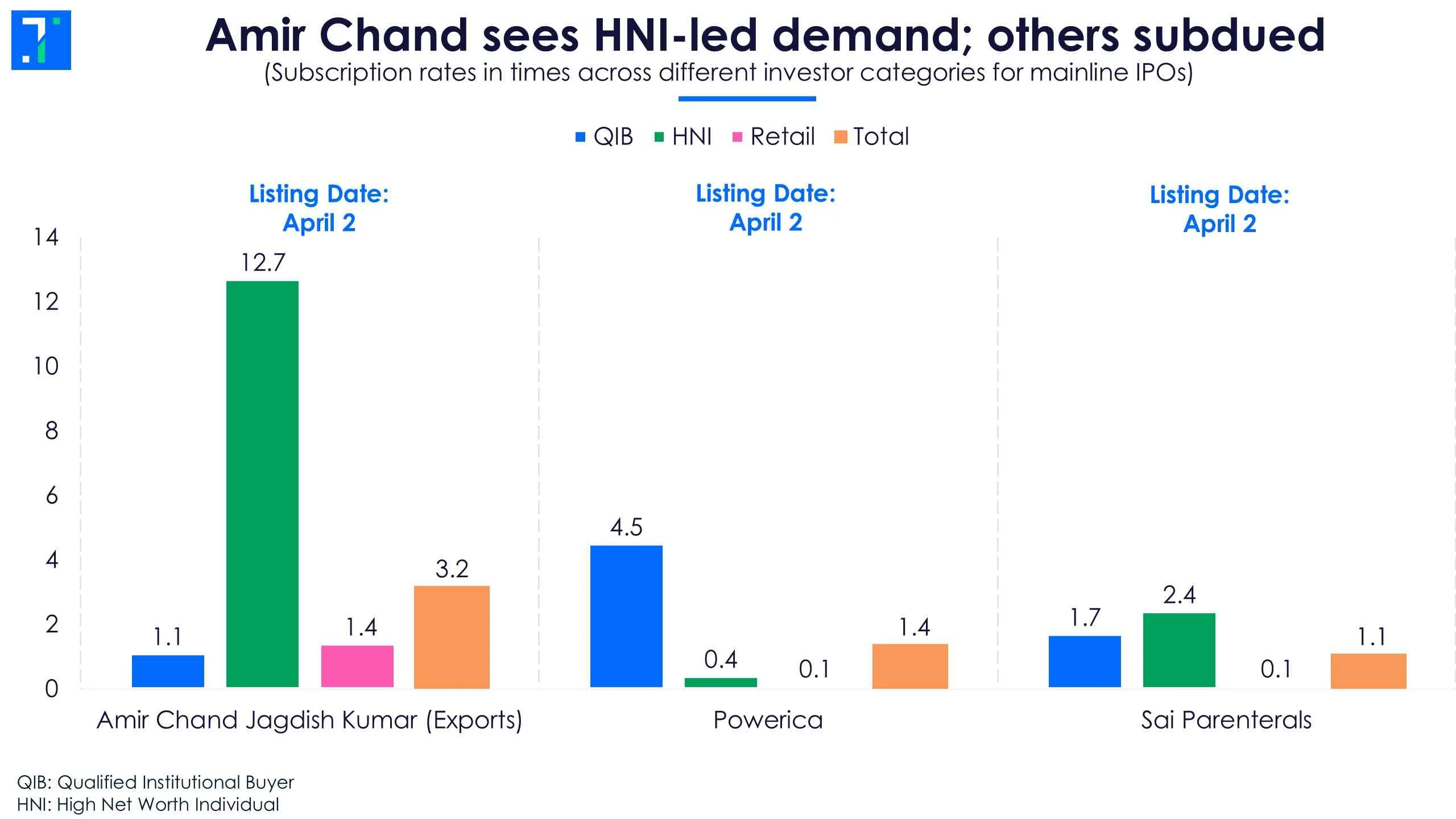
  • Amir Chand Jagdish Kumar's shares debut on the bourses at a 5.7% discount to the issue price of Rs 212. The Rs 440 crore IPO received bids for 3.2 times the total shares on offer.

  • Sai Parenterals' shares debut on the bourses at a 2% premium to the issue price of Rs 392. The Rs 408.8 crore IPO received bids for 1.1 times the total shares on offer.

  • The Indian government waives customs duties on key petrochemicals such as polyethylene, polypropylene, and PVC until June 30, 2026. The move aims to ease supply disruptions from the West Asia conflict and curb rising input costs, supporting downstream sectors like plastics, packaging, textiles, pharma, and auto components.

  • Powerica's shares debut on the bourses at a 7.3% discount to the issue price of Rs 395. The Rs 1,100 crore IPO received bids for 1.4 times the total shares on offer.

  • Adani Ports & SEZ receives approval from the National Company Law Tribunal (NCLT) to merge its subsidiary, Adani Harbour Services, with itself.

  • Hero MotoCorp's sales grow 8.8% YoY to 6 lakh units in March, driven by higher demand in the 100-125cc and scooter segments. Exports jump 15.6% to 45,693 units during the month.

  • Indian defence stocks fall sharply, with the Nifty India Defence index down about 3% as investors turn to profit booking after the previous session’s rally. The decline also tracks broader market weakness, with the Sensex dropping around 1,400 points and the Nifty slipping below 22,250 in early trade.

  • Karnataka Bank's Q4FY26 total deposits grow 3.8% YoY to Rs 1 lakh crore, and gross advances rise 6.9%. CASA ratio increases 190 bps to 33.7% during the quarter, indicating a reduction in the bank's cost of funds.

  • NMDC's monthly iron ore sales climb 40.1% YoY to 5.9 million tonnes (MT) in March, supported by higher sales from Chhattisgarh and Karnataka. Production jumps 50.7% to 5.4 MT.

  • TVS Motor's total wholesales grow 28% YoY to 12.2 lakh units in Q4FY26, driven by a 27% increase in two-wheelers and a 65% YoY growth in three-wheelers.

  • Prestige Estates Projects enters a joint development agreement for a 17.2-acre land parcel in Sector 92, Gurugram. The project has a total saleable area of about 30 lakh square feet, with an estimated gross development value of over Rs 4,200 crore. This expands the company’s footprint in the National Capital Region (NCR).

  • Nifty 50 was trading at 22,228 (-451.4, -2.0%), BSE Sensex was trading at 72,262.05 (-872.3, -1.2%), while the broader Nifty 500 was trading at 20,457.30 (-477.9, -2.3%).

  • Market breadth is moving down. Of the 2,247 stocks traded today, 236 were gainers and 1,969 were losers.

Riding High:

Largecap and midcap gainers today include Coforge Ltd. (1,213.40, 5.2%), Bosch Ltd. (32,135, 4.9%) and LTIMindtree Ltd. (4,303.90, 4.8%).

Downers:

Largecap and midcap losers today include United Breweries Ltd. (1,485.10, -6.3%), SRF Ltd. (2,416.10, -5.4%) and Biocon Ltd. (352.55, -3.5%).

Crowd Puller Stocks

5 stocks in BSE 500 are trading on high volumes today.

Top high volume gainers on BSE included Latent View Analytics Ltd. (312.10, 19.5%), Ola Electric Mobility Ltd. (28.34, 9.5%) and Tata Chemicals Ltd. (651.90, 7.4%).

Hexaware Technologies Ltd. (443.95, 2.7%) was trading at 4.5 times of weekly average. Adani Green Energy Ltd. (856, 0.5%) was trading with volume 3.2 times weekly average on BSE at the time of posting this article.

BSE 500: highs, lows and moving averages

43 stocks were underachievers and hit their 52 week lows.

Stocks making new 52 weeks lows included - Bajaj Finserv Ltd. (1,640.70, -0.4%) and Bajaj Holdings & Investment Ltd. (8,992.50, 1.0%).

6 stocks climbed above their 200 day SMA including FSN E-Commerce Ventures Ltd. (245.98, 2.5%) and Avenue Supermarts Ltd. (4,362.40, 2.1%). 28 stocks slipped below their 200 SMA including Nippon Life India Asset Management Ltd. (829.90, -4.1%) and Eicher Motors Ltd. (6,649.50, -2.6%).

logo
The Baseline
02 Apr 2026
Gold rising, crude expensive, portfolio volatile: the new financial year begins

There's no other way to say it. Trump lies like he breathes. He claims Iran asked him to be the next Supreme Leader, that he passed cognitive tests no other US President has (these are actually tests for dementia), and that Iran sent him presents (one account joked the present was a "fake Gucci bag"), At multiple points over March, he claimed he was close to ending the war with Iran. 

On Tuesday, he said that the US is "winding down" the war in Iran, and will be out within "two or three more weeks". US markets rose sharply, and Indian markets also jumped. 

But the first worrying signal is the phrase. For Trump, "two or three weeks" is like the Indian "I'll be there in two minutes". It's a placeholder for an actual time, or could be a delaying tactic. US troops are still arriving in steady numbers in the middle east, and the Hormuz strait is still blocked, the three parties, US, Israel and Iran, are still heavily bombing each other. 

The second worrying sign is Trump saying this ahead of a three day weekend for the US, with markets closed for Good Friday on April 3. Perhaps he imagines that his ground troops will invade Iran on Thursday night and manage to seize Kharg island before Monday's market open, allowing the US to claim significant progress. In a national address he made on Wednesday, he also threatened to bomb Iran "back to the Stone Age", as US and Israel have been striking civilian infrastructure like electricity plants and pharmacies.

What does all this confusion mean for our portfolios? Commodities, despite Trump's possibly fake announcements, are showing warning signs. Economists say a recession is likely to emerge in the middle of the year. 

Let's be realistic. In a world led by madmen eager to start and prolong wars, we need to clearly break down the kind of portfolio action we need to take. 

Portfolio moves that make sense in FY27

Crude oil prices will remain high: Goldman Sachs notes that the damage to local production has already been significant. The damage to oil fields from the war has caused crude oil production from OPEC is down by 7 million barrels per day in March. Oil prices are likely to hover around $100 per barrel, raising India's import costs considerably. Global visible oil inventories have declined by 130 million barrels since the conflict began.

Polymarket bets put a 92% chance of Brent staying at $105 in mid June, reflecting the market's near-certainty that prices will hold elevated through the second quarter even if the conflict de-escalates modestly.

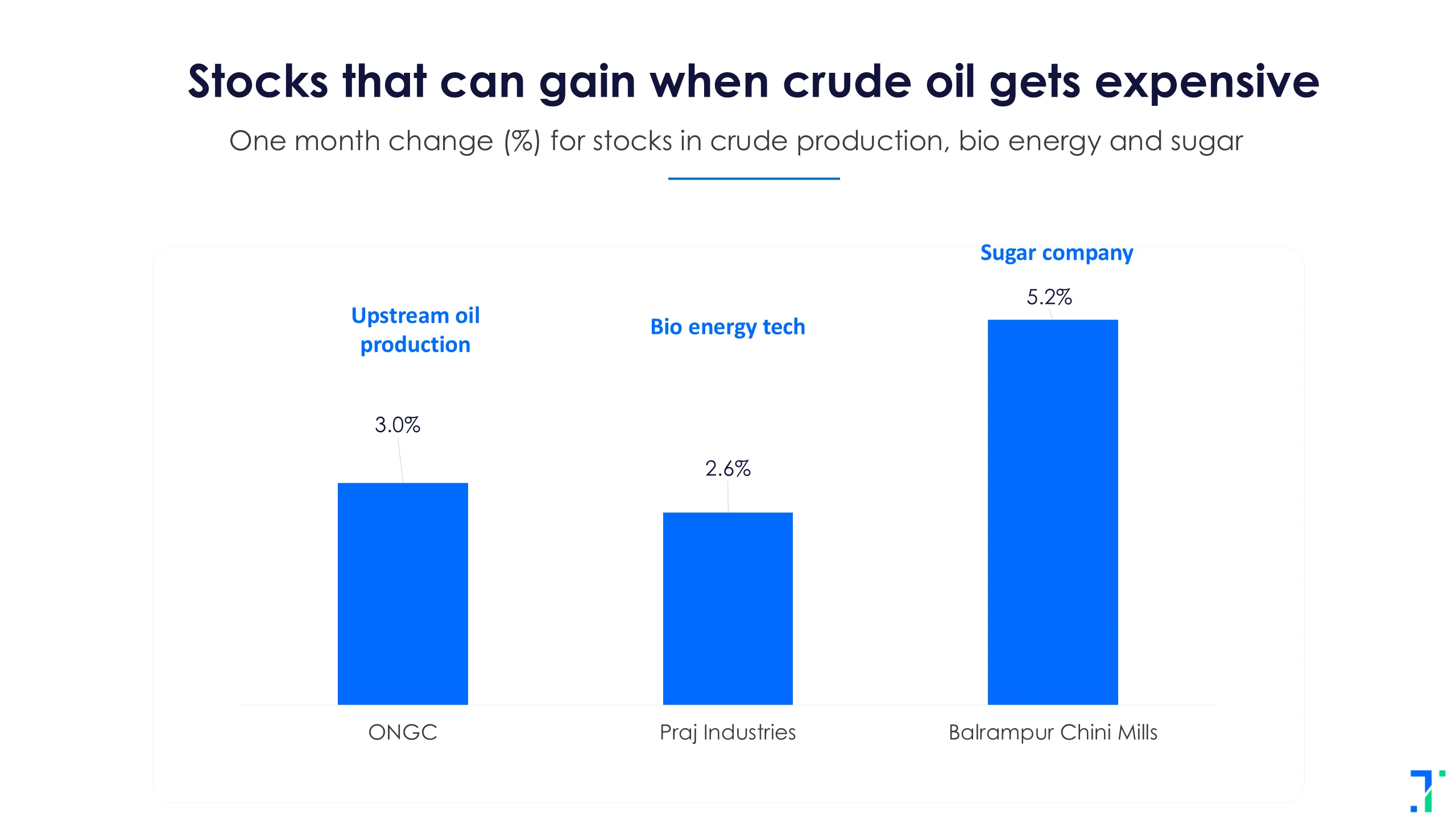
In this environment, investing in specific stocks that hold up in a high oil price environment, makes more sense. ONGC is an upstream oil player which benefits in margins when oil prices go up.

Sugar companies are another beneficiary of higher oil prices, owing to government policy. When expensive crude causes the import bill to go up, the government reliably accelerates its ethanol blending program to substitute crude with locally made ethanol.

Sugar companies like Balrampur Chini Mills divert sugar and molasses heavily towards ethanol production during these periods, due to high government procurement prices for ethanol. 

Praj Industries is a manufacturer that operates in a very specific space: it makes the plants and technology for sugar companies to distill ethanol, which soars in demand when oil prices rise. 

Gold is glittering - but don't fall too hard

In a world where safe havens look much less safe than before, it makes sense to adjust portfolios accordingly. Gold has re-emerged as a safe bet since 2025, It has however proved to be quite volatile, despite steady central bank buying in the metal. 

If you already hold Gold ETFs or Sovereign Gold Bonds (SGBs), your year gains are probably looking pretty good. But buying gold right now at the current high prices may not be a great idea. Instead, its best to keep gold at around 15% of your portfolio as an inflation hedge. If you have more than this, it may be time to partially book some profits. 

The most vulnerable sectors?

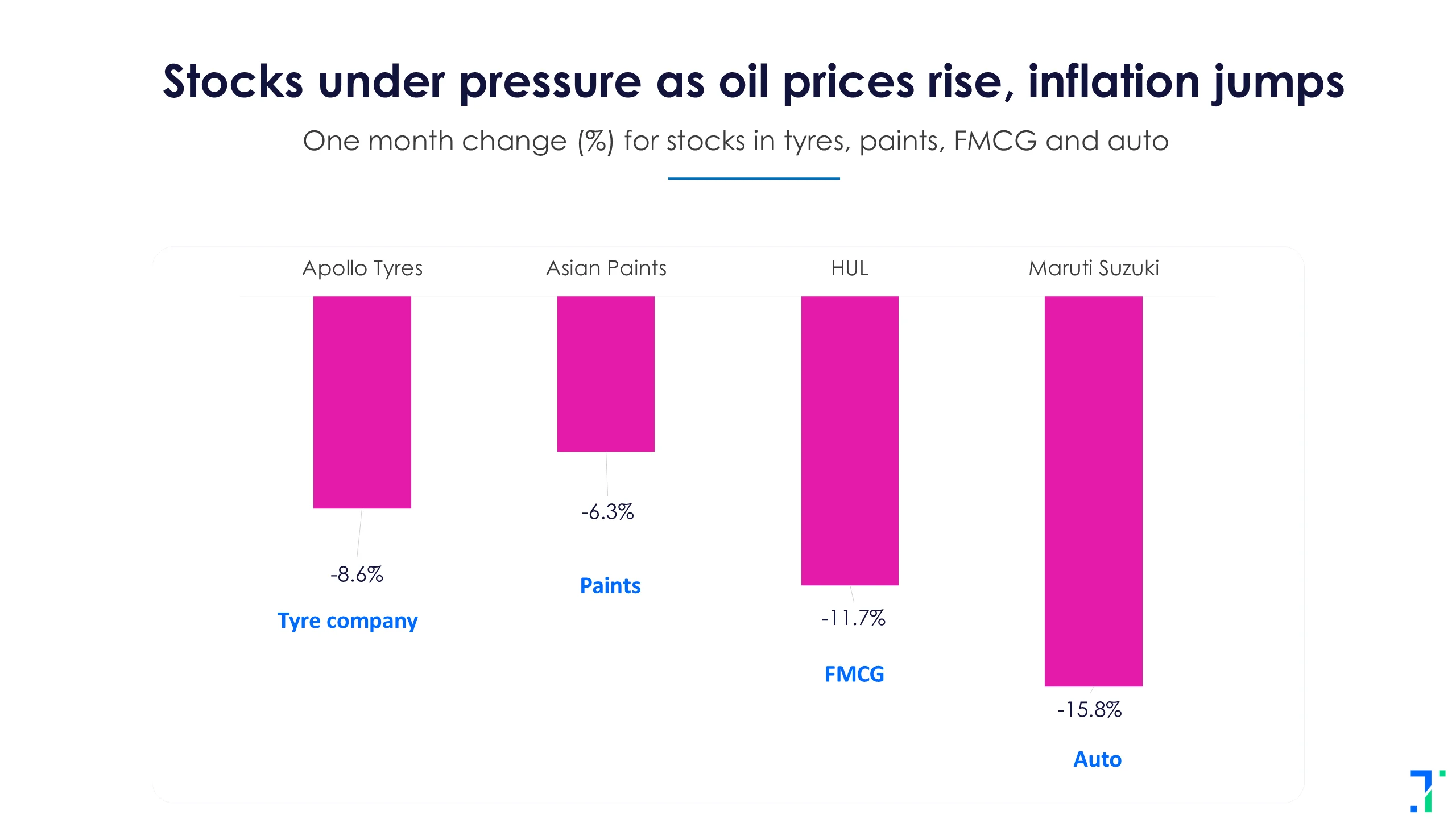
The impact of high oil and gas prices seeps through all sectors, from packaging to retail to fertilizer. We drive our cars, dress in polyester, and consume food grown from naphtha fuelled crops. But it is sectors with the least amount of pricing power that get hit the most from oil-linked inflation: tyre and paint stocks, where 40-60% of raw material is from crude derivatives (Apollo Tyres, Asian Paints), FMCG companies (HUL), and auto stocks. The impact of this will be most visible one quarter later, in the Q1FY27 results, as these companies get hit in their margins. Companies with the least pricing power in these sectors like entry level auto players (Maruti Suzuki) will tend to be the hardest hit.

These stocks tend to see both spike in raw material costs and demand destruction as inflation rises. Tyre replacement and paint purchases decline, and cost sensitive consumers in FMCG and entry level auto back off. Rebalancing portfolios away from these sectors over the next few weeks, as the impact of expensive, scarce oil makes its way through the Indian economy, may be the sensible choice. 

logo
The Baseline
01 Apr 2026
Rising energy costs test India’s growth outlook
By Anagh Keremutt

“A rare ‘Goldilocks’ phase of high growth and low inflation.” That is how Reserve Bank of India Governor Sanjay Malhotra described the Indian economy at the December policy meeting. Interest rates were expected to stay unchanged for an extended period.

That was, of course, before the US and Israel bombed Iran, the Hormuz Strait closed and crude oil prices spiralled up. Goldilocks has run off, as higher prices and a wider trade deficit raise inflation risks and weaken the rupee. Rating agencies now expect the central bank to raise rates in the near term to support the currency.

The surge in oil & gas prices after the Iran conflict is showing up in economic forecasts. Global institutions have started to cut growth estimates for India.

The risk is also in how long higher prices will persist. As the OECD noted, “the breadth and duration of the conflict are very uncertain”.

Forecasts are split in this volatile moment. Some analysts are more optimistic than others, and see domestic demand holding firm and absorbing part of the shock. In this edition of Chart of the Week, we look at how higher energy costs are changing growth forecasts and what that means for the economy.

Growth forecasts fall as oil shock starts to bite

What began as an energy supply disruption for the world is now visible in forecasts, expenses, and household budgets. 

Much of this traces back to the disruptions in the Strait of Hormuz. India imports about 88% of its crude oil and nearly half of its liquefied petroleum gas (LPG). Around half of its crude and over three-fourths of LPG shipments pass through this route. 

Goldman Sachs cut India’s CY26 growth forecast twice after the war in Iran, with a total reduction of 110 basis points (bps) to 5.9%. India’s dependence on imported energy makes it especially vulnerable. When oil prices rise, India spends more on imports, widening the trade deficit. This pushes the rupee lower, making dollar-based imports like oil and other raw materials costlier.

The effect is most visible in spending. A larger share of the country’s income is forced towards essentials, leaving less room for discretionary purchases. Businesses face the same issue. As costs rise, they either increase prices or take a hit to profits. Goldman Sachs now expects inflation in India to rise by 70 bps to 4.6% for CY26.

Goldman Sachs also downgraded Indian equities to ‘marketweight’, flagging it as less attractive than other Asian markets. It cut its 12-month Nifty 50 target by about 14% to 25,300-25,900, expecting earnings downgrades to follow as higher oil prices drive up costs.

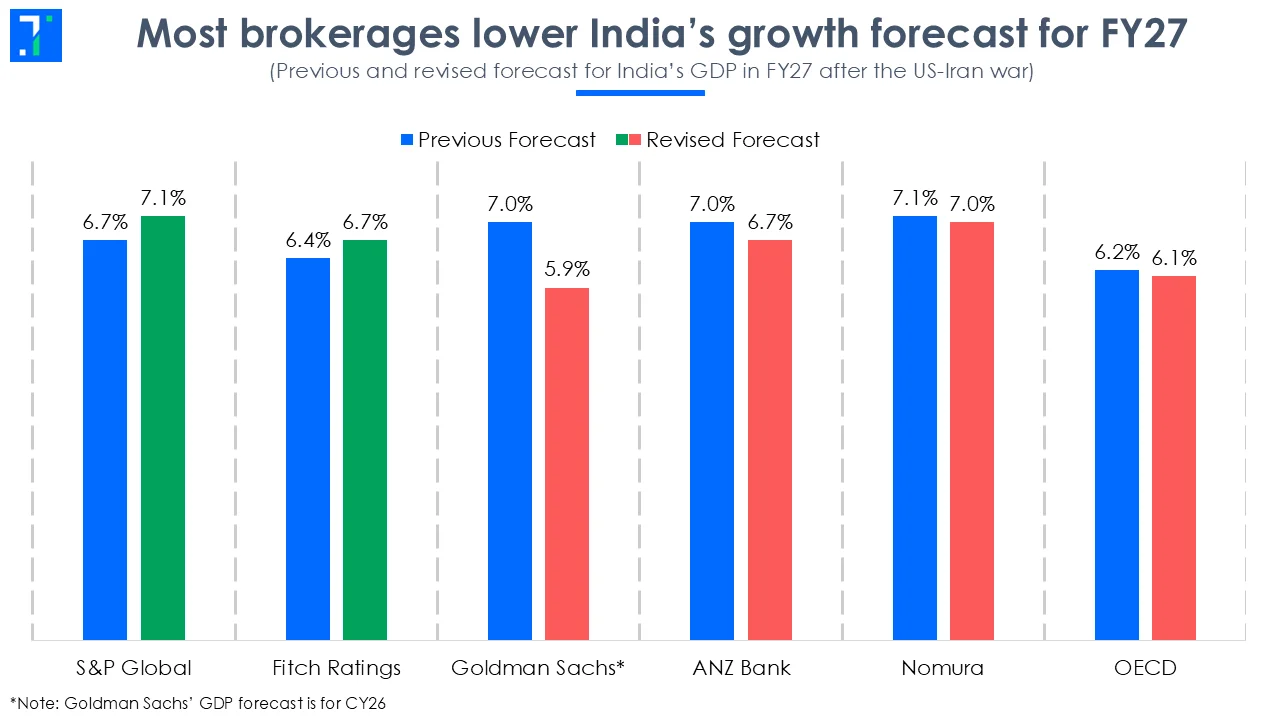
The OECD and Nomura both lowered their FY27 growth forecasts by 10 bps to 6.1% and 7.0%, respectively, while ANZ cut its estimate more sharply to a 6.5%-6.8% range.

There is no consensus among these institutions on how to handle the fall in the rupee. Goldman Sachs expects the RBI to actively intervene and stabilize the rupee, raising interest rates by 50 bps. Higher rates can support the rupee by offering better returns on fixed-income assets, attracting foreign investors. While this may help support the currency, it also raises borrowing costs. Credit becomes more expensive, which slows demand across consumption and investment.

In contrast, Standard Chartered supports letting the rupee weaken further. A weaker rupee reduces demand for imports, boosts exports, and narrows the gap between inflows and outflows. Economist Anubhuti Sahay said, “Despite having reserves to cover about 10 months of imports, the rupee may still need to weaken to absorb pressure from imports, a wider deficit, and capital outflows.”

In the meantime, Indian factories are closing as gas shortages hit industrial clusters. In Gujarat, about 98% of engineering firms are shut, while in Maharashtra, around half the units have closed. “All heating furnaces use LPG and, given the shortage and curbs on industrial use, factories have shut,” said Pankaj Chadha, chairman of the Engineering Exports Promotion Council. 

IndusInd Bank’s Gaurav Kapur sees a 30 bps hit to India’s GDP growth and warns that weaker consumption could weigh on the recovery. “The government has enough room to cut fuel taxes and soften the impact of higher oil prices, but the hit on the industrial sector will slow growth,” he said.

Some forecasts are optimistic as domestic demand holds steady

Not all forecasts are turning weaker. Some expect growth to hold up, even after the oil shock, as domestic demand remains intact.

The Associated Chambers of Commerce & Industry of India expects growth to stay above 7%. It points to strong factory and services activity, with readings better than most major economies in February 2026. At the same time, it notes that a weaker rupee and higher fuel prices could push prices up in the months ahead.

S&P Global takes a similar view, raising its FY27 growth forecast by 40 bps to 7.1%. It expects consumption, recovery in private investment, and exports to hold up to support growth. It also notes that higher oil prices may not fully reflect in retail prices, as the government is likely to intervene to limit the impact. 

Even so, it flags risks from the West Asia conflict. “Downside risks remain, primarily due to renewed geopolitical tensions and persistent trade-related uncertainties,” it said.

Fitch Ratings also raised its FY27 growth forecast by 30 bps to 6.7%, but with a different timeline. It expects growth to remain weak in the first half of FY27 as higher prices drag spending, before improving later as borrowing becomes cheaper and investment picks up.

This uneven recovery reflects how the oil shock is playing out. It is not just about higher prices, but how the pressure builds and spreads across the economy. Domestic demand is holding up for now, but the strain on growth is already visible.

logo
The Baseline
31 Mar 2026
Five stocks to buy from analysts this week - March 31, 2026
By Abdullah Shah

1. Uno Minda

Axis Direct upgrades this auto parts producer to a ‘Buy’ rating from ‘Hold’, with a target price of Rs 1,260 per share, a 22.1% upside. The impact of the US-Iran war is negative for the company in the short-to-medium term. The closure of the Strait of Hormuz and rising regional instability affect global logistics, raw material costs, and the European market, which is a key export destination for the company. Its stock price declined 13.2% over the past month.

Analyst Sanchit Kumar, however, sees strong long-term growth for the company, driven by new product launches, premiumisation, ongoing capacity expansion, and a robust EV order book. Uno Minda is also well-positioned to profit from stricter safety and acoustic regulations.

As India's top automotive horn maker and second globally, the company benefits from mandated Acoustic Vehicle Alerting Systems (AVAS) in EVs, recently securing orders in the electric passenger vehicle segment. Its airbag joint venture is building a new Rs 280 crore facility in Karnataka to meet the rising demand for vehicle safety features.

Through its 76% stake in the Minda Westport joint venture, the company also makes CNG and LPG kits, profiting directly from the surge in CNG vehicle sales. Kumar believes ongoing investments, a focus on making more parts locally, and strong demand at home will fuel its growth.

2. Power Grid Corp of India

Prabhudas Lilladher maintains its ‘Buy’ call on this electric utilities provider, with a target price of Rs 324 per share, an upside of 17.5%. Analysts Vishal Periwal and Shubham Shelar believe Power Grid is perfectly placed to seize India’s massive Rs 15 lakh crore transmission opportunity. This translates to a potential annual order pipeline of Rs 60,000–70,000 crore.

The company is consolidating 19 special purpose vehicles (SPVs) into two, with more mergers planned. Analysts note that this move will streamline governance, improve capital allocation, and boost scalability as Power Grid's asset base grows. Management approved a capex of Rs 37,000 crore for FY27 and Rs 45,000 crore for FY28. They expect further upside from new project wins and strong execution.

Periwal and Shelar say that the company's right-of-way (ROW) challenges have eased. The government introduced a market-linked compensation framework to improve land acquisition. Clearer guidelines have also reduced disputes, and the company has strengthened execution with dedicated ROW teams and specialised expertise. They expect Power Grid to achieve a 9.8% revenue CAGR and a 5.9% net profit CAGR through FY28.

3. Sky Gold and Diamonds

BOB Capital Markets initiates coverage on this small-cap jewellery manufacturer with a ‘Buy’ call and a target price of Rs 494 per share, an upside of 55.2%. The stock fell 11.9% last month. The Israel–Iran war poses a risk, as Middle East exports, about 10% of revenue, face potential shipping delays and higher costs. Analyst Lavita Lasrado still likes the company, pointing to strong growth in its B2B model where Sky Gold supplies gold jewellery to retail chains without owning its stores. This asset-light strategy keeps costs low and allows for efficient expansion.

Management reports that capacity has surged to over 1,000 kg per month, yet utilisation sits at a low 33–46%. This offers significant room for volume growth without major new spending. Sky Gold is also shifting its product mix towards higher-margin items like 18-carat studded and diamond jewellery, which now form about 25% of its offerings. Growth comes from deeper client relationships, new retailer tie-ups, export expansion, and selective acquisitions that strengthen manufacturing capabilities.

Analyst Lavita Lasrado expects revenue to grow at around 37% CAGR over FY26–28, driven by volume ramp-up and new clients. EBITDA margins should improve to around 6.5%, supported by a better product mix and operating leverage. However, the analyst identifies client concentration as a key risk, with a significant share of revenue coming from top customers.

4. Aurobindo Pharma:

Motilal Oswal retains its ‘Buy’ rating on this pharmaceutical manufacturer, with a target price of Rs 1,500 per share, an upside of 15%. Analysts Tushar Manudhane and Vipul Mehta believe several factors will boost future earnings: scaling up the Penicillin-G (Pen-G) plant, increased external sales of 6-Amino Penicillanic Acid (6-APA), higher demand in the EU, new US product launches, and integrating Lannett (US-based generics manufacturer).

Aurobindo makes 6-APA, which is a key ingredient in antibiotics like amoxicillin, ampicillin, and piperacillin. To support this, the company has set up a Penicillin-G (Pen-G) plant, which started operations in July 2025 and is now gradually increasing output. The 6-APA plant is also expected to reach full capacity in the next 3–4 months.

Manudhane and Mehta add that from the planned 15,000 metric tonnes (MT) of Pen-G, 3,000 MT goes to domestic sales. They use the remaining 12,000 MT of Pen-G to produce 6-APA. By producing these inputs in-house instead of buying them, Aurobindo reduces costs and improves control over its supply chain, giving it an advantage over competitors. They expect the company to achieve a 9% revenue CAGR and a 21% net profit CAGR from FY26-28.

5. Sagility:

ICICI Securities reiterates its ‘Buy’ rating on this business service provider, with a target price of Rs 66 per share, an upside of 65.2%. AI's growing use in healthcare outsourcing drives this positive outlook. Sagility operates in the US healthcare market, where low outsourcing offers a significant long-term opportunity. High client stickiness, with 97% retention and an 18-year average tenure, ensures steady growth.

Management states AI expands their work, rather than shrinking it. The company is moving from traditional employee-based models to outcome-based pricing, guaranteeing clients cost savings. Sagility uses AI across key areas like claims processing, payment integrity, revenue cycle management, and utilisation management to boost efficiency and cut costs. New growth opportunities exist in medical loss ratio management, appeals, and clinical services, representing a significant $20,000–32,000 crore market.

Analysts Ruchi Mukhija and Seema Nayak expect strong growth, supported by AI-led solutions and expansion into new service areas. EBITDA margins should remain stable at 24–25%. They add that US healthcare demand will keep growing, fueled by the popularity of GLP-1 drugs used for obesity and diabetes, higher healthcare activity and long-term outsourcing growth.

Note: These recommendations are from various analysts and are not recommendations by Trendlyne.

(You can find all analyst picks here)

IPOs queue up despite recent muted debuts
By Ruchir Sankhla

The market plunged on March 30, with the Nifty 50 closing 2.1% lower. The sell-off was triggered by a fresh escalation in the Middle East after Yemen’s Houthi rebels officially joined the conflict, launching missile strikes targeting Israel.

Sentiment was also hit by reports that an Indian national was killed in Kuwait as Iran hit a power and water desalination plant. These developments, coupled with US President Donald Trump’s suggestion of seizing Iran’s Kharg Island oil hub, have intensified fears of a prolonged "energy war."

For India, the impact of this war was reflected in the HSBC India Manufacturing PMI, which fell to a 4.5-year low of 53.8 in March. This reading indicates a sharp deceleration in factory activity as input costs rose at their fastest pace in 45 months, forcing manufacturers to hike output prices the most in seven months.

The Indian stock market will remain shut on March 31 for Shri Mahavir Jayanti and April 3 for Good Friday. Vinod Nair, Head of Research at Geojit Investments, said, "In the near term, market direction will hinge on developments in West Asia peace efforts and earnings risks from supply-side disruptions."

Despite all the volatility, primary market momentum continues this week, as four new offerings open for subscription. Five companies are also set to be listed on the exchanges, following the debut of five firms last week.

Mainboard IPOs offers a mixed bag, SMEs see flat listings

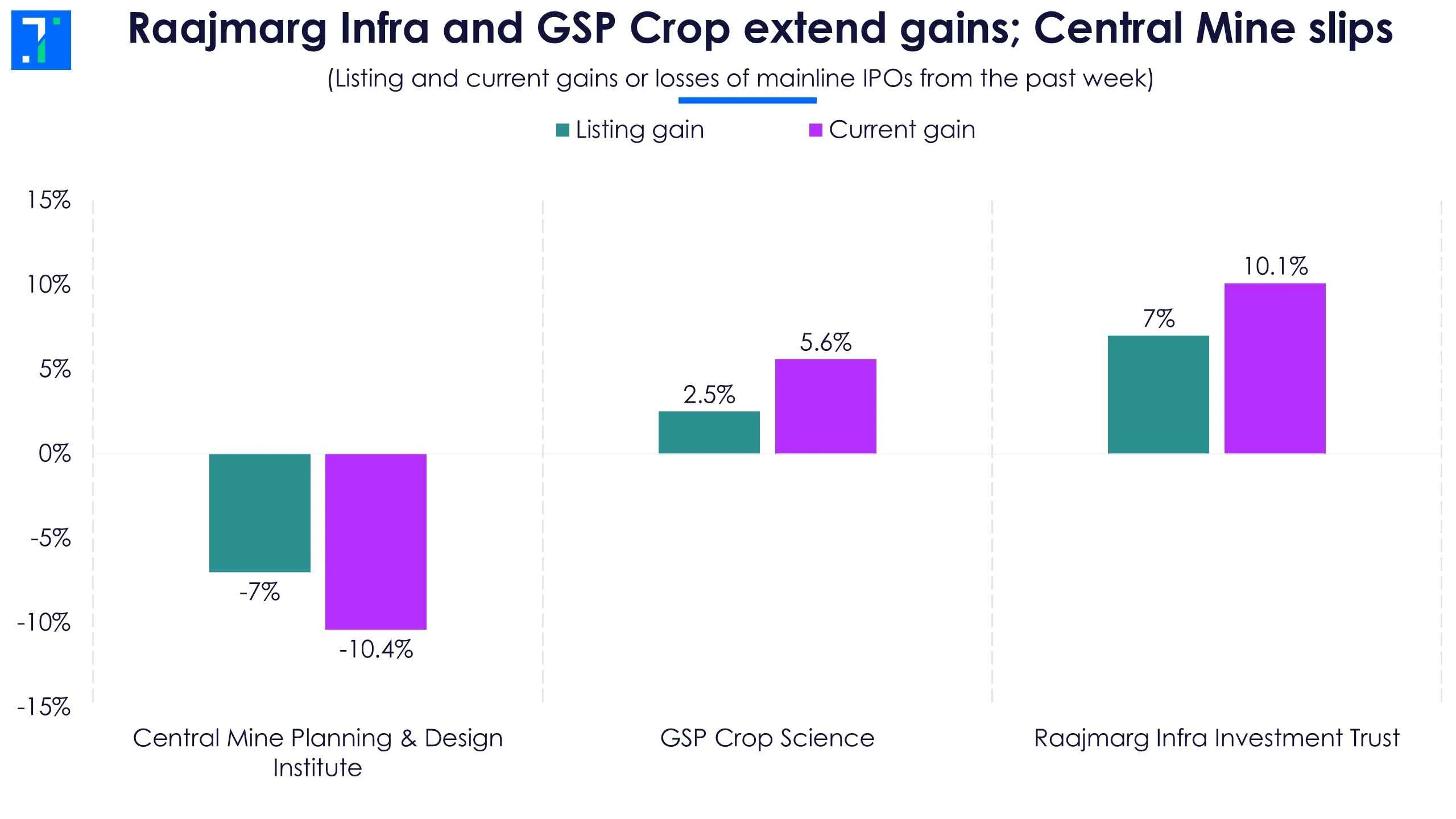
Central Mine Planning & Design Institute, an arm of Coal India, had a subdued market debut on March 30. Despite a dominant market share in mining consultancy, the Rs 1,842 crore IPO saw modest interest with a subscription of 1.1X. The stock listed at a discount of 7%, against its issue price of Rs 172, as investors weighed its heavy reliance on the coal sector against its strong EBITDA margins.

GSP Crop Science, an agrochemical manufacturer, delivered a steady performance on March 24. The Rs 400 crore public issue was subscribed 1.6X and debuted at Rs 328, a 2.5% premium over its issue price of Rs 320. Driven by its diversified portfolio of over 500 product registrations and strong R&D focus, the stock has shown resilience and is currently trading 5.6% above its issue price.

The NHAI-sponsored Raajmarg Infra Investment Trust (InvIT) made a successful entry into the infrastructure yield space on March 24. The massive Rs 6,000 crore issue saw a healthy subscription of 13.7X. It listed at a premium of 7%, against its issue price of Rs 100, and continues to attract investors looking for stable, government-backed cash flows, currently trading 10% higher.

Raajmarg Infra and GSP Crop extend gains; Central Mine slips 

Two SME IPOs listed last week.

Speciality Medicines, a pharma distributor focused on high-cost chronic therapies, listed on March 30. The Rs 29.1 crore fresh issue, which was launched to fund a new R&D centre and international registrations, faced a flat listing at its issue price of Rs 124 per share.

Novus Loyalty, a provider of AI-powered loyalty and engagement platforms, listed on March 25 following a subscription of 1.5X. The Rs 60.1 crore IPO debuted at its issue price of Rs 146. While the company has highlighted its expansion into cloud-native architectures, the stock has faced some initial selling pressure post-listing and is currently trading 4.1% below its debut price.

From pharma to power: Five IPOs gear up for debut

Sai Parenterals, a pharmaceutical manufacturer, closed its Rs 408.8 crore IPO on March 27. The issue received a steady response from investors, subscribing 1.1X. The offering was priced in a band of Rs 372-392 per share, with the company aiming to utilise the proceeds to strengthen its manufacturing infrastructure and meet incremental working capital requirements. The stock is scheduled to list on April 2.

Powerica, a manufacturer of diesel generating sets, closed its Rs 1,100 crore IPO on March 27. The issue saw a total subscription of 1.4X, characterised by significant divergence: while Qualified Institutional Buyers (QIBs) oversubscribed their portion by 4.5X, retail interest remained muted at 0.1X. The offering comprised a fresh issue of 1.8 crore shares and an offer for sale of 1 crore shares. The company is set to debut on April 2.

Amir Chand Jagdish Kumar (Exports), an exporter of Basmati rice under the "Aeroplane" brand, closed its Rs 440 crore IPO on March 27. The issue was subscribed 3.2X overall, driven by Non-Institutional Investors who booked their segment over 12.7X. The offering consisted entirely of a fresh issue of 2.1 crore shares, with proceeds earmarked for funding the company's extensive working capital needs. The stock will list on April 2.

Amir Chand sees HNI-led demand; others subdued

In the SME segment, two companies are set to list this week.

Tipco Engineering, a manufacturer of precision-engineered components, concluded its Rs 60.5 crore IPO on March 25. The issue saw a healthy subscription of 1.6X, supported by institutional interest at 3.8X. The proceeds from the fresh issue will be utilised to repay existing secured borrowings and bridge the working capital gap to support its robust order book. The stock is scheduled for listing on April 1.

Highness Microelectronics, a provider of digital imaging and display solutions, closed its Rs 21.7 crore IPO on March 27 with an overwhelming response, seeing a subscription of 180.3X. Retail and high-net-worth individuals led the charge, drawn by the company’s plans for backward integration. The funds will be used to establish a new assembly line for Open-Cell modules to reduce import dependency. The company will list on April 2.

Four IPOs to watch this week

Property Share Investment Trust (PSIT), India's first Small and Medium Real Estate Investment Trust (SM REIT), is launching its third scheme, PropShare Celestia. The IPO will open from April 10 to April 16. The price band is set at Rs 10,00,000–10,50,000 per unit. The stock will list on the BSE on April 24. Proceeds from the offer will be primarily used for the acquisition of "Project Celestia", a premium office space in Ahmedabad.

Three SME companies are also set to launch their IPOs.

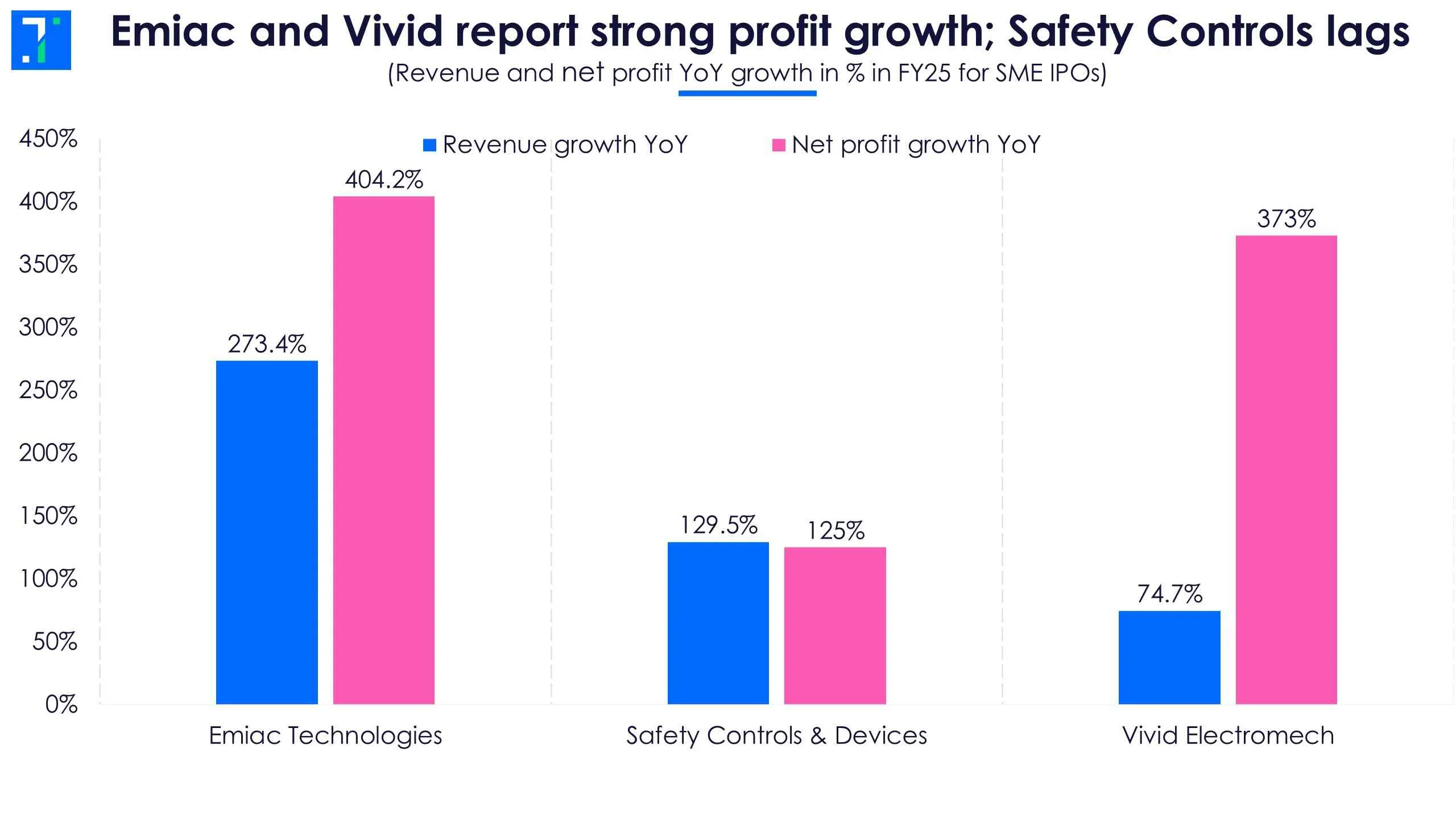
Vivid Electromech, a manufacturer of electrical panels, closed its Rs 130.5 crore IPO on March 30. The price band is set at Rs 528–555 per share. The issue includes a fresh issue of 18.8 lakh shares and an OFS of 4.7 lakh shares. The company plans to use the proceeds to build a new integrated manufacturing facility in Thane. The stock is expected to list on April 6.

Emiac and Vivid report strong profit growth; Safety Controls lags

Emiac Technologies, an AI-powered digital marketing and content creation firm, opened its Rs 31.8 crore IPO on March 27 and will close on April 8. The price band is fixed at Rs 93–98 per share. This is entirely a fresh issue of 32.4 lakh shares. The company plans to use these funds for technological upgrades and to expand its workforce. The stock will list on April 13.

Safety Controls & Devices, a provider of power infrastructure and safety solutions, will open its Rs 48 crore IPO on April 6 and will close on April 8. The price band is set at Rs 75–80 per share. The issue comprises 60 lakh equity shares and is aimed at funding its expansion in the power infrastructure sector. The shares will list on April 13.

Trendlyne Analysis released a IPO Note report for IPO on 30 Mar, 2026.
logo
The Baseline
27 Mar 2026
Five Interesting Stocks Today - March 27, 2026
By Trendlyne Analysis

1. Maruti Suzuki

This car company rose 2% on March 25 after announcing plans to invest Rs 10,189 crore in a new Gujarat plant with an annual capacity of 2.5 lakh units. The company currently operates at near-full utilisation, with a total capacity of around 25 lakh units.

The new facility will expand capacity by about 10% and help address supply constraints. It will be built in phases, with production expected to begin by 2029. Forecaster expects revenue to grow 18.5% in FY26, while net profit is projected to rise over 10%.

SUVs now account for over half of the passenger vehicle market, and the company’s share in this segment has increased to about 24.5% as of December 2025, up from around 19.5% in FY22. MD and CEO Hisashi Takeuchi said, “We are currently constrained by supply, not demand, and our priority is to scale capacity in line with market growth and exports.”

Exports remain a key growth driver, accounting for about 18% of total sales. The company contributed nearly 46% of India’s passenger vehicle exports in 2025, with export volumes growing over 25% YoY in the first nine months of FY26.

Geopolitical risks remain in the near term. Rising tensions in the Middle East have raised concerns around global trade routes, although the company’s exposure to the region is relatively limited. Senior Executive Rahul Bharti noted, “The Middle East region accounts for about 12.5% of our total exports,” adding that a diversified presence across nearly 100 countries reduces reliance on any single region.

Motilal Oswal reiterated its ‘Buy’ rating on the stock, with a lower target price of Rs 17,406, indicating that a larger portion of earnings growth is expected over the medium term. Margins have been under pressure due to higher discounts, coupled with rising input costs, but are expected to improve as pricing stabilises and the product mix strengthens.

2. Reliance Industries:

This conglomerate has had a dramatic week. Its stock fell 4.6% on Friday after the government imposed a new export tax levy on refineries selling petrol and diesel, adding to the pressure from the semi-annual Nifty 50 index rebalancing that reduced the stock’s weight. Passive funds are expected to withdraw roughly $25 million from the stock. 

The export tax move will squeeze gross refining margins (GRMs), especially as the global crude basket has surged past $100 per barrel due to geopolitical shocks, raising input costs across Reliance’s Jamnagar operations.

Reliance gets the majority of its revenue from its Oil-to-Chemicals (O2C) segment, with refined fuel exports contributing over 55% of overall sales. To drive international growth, the company is backing a historic $300 billion oil refinery development at the Port of Brownsville in Texas, as recently announced by US President Donald Trump.

As oil grows volatile, Reliance is expected to focus more on its consumer and green energy businesses. The company is diversifying fast, launching the first phase of its Dhirubhai Ambani Green Energy “Giga Complex”, with an eye on the multi-billion dollar domestic market for solar modules and green hydrogen.

Reliance has also introduced AI cloud services in India through tech partnerships following its massive data center expansion. While these launches are expected to support growth, the green energy rollout is likely to face intense competition from both early mover domestic and global players.

Management is also exploring acquisitions to strengthen its presence in critical mineral and battery technology markets. Chairman Mukesh Ambani says that the company is “actively pursuing targeted strategic partnerships” and prefers deploying internal cash generation toward acquisitions to scale up the new energy business.

Motilal Oswal has stayed bullish on Reliance despite the volatility in the Middle East (although the title of the report, “chaos can be a catalyst”, is not that encouraging). The brokerage expects near-term pressure in the oil segment, but sees new energy rollouts and telecom tariff hikes supporting long-term growth.

3. Natco Pharma:

This pharmaceutical company rose 2.5% on Wednesday after its board approved the demerger of its agrochemicals business into a separate listed entity. Shareholders will receive one share in the new company for every share held, effective October 1, 2026. Management expects the move to sharpen strategic focus and unlock value, especially as the crop health segment has seen strong growth, with revenue rising nearly 90% YoY in the past quarter.

The company trades at 11.2x earnings, the lowest amongst its peers. The demerger is expected to improve operational flexibility and enable more focused execution across both businesses. Shareholding data indicates that mutual funds have increased their stake over the past two months.

Natco derives most of its revenue from pharmaceuticals, with export formulations forming the largest share. This segment contributes over 75% of sales, driven by strong performance in Brazil, Canada, and other emerging markets. Growth came despite zero contribution from Revlimid, which was earlier a key earnings driver, indicating improving diversification in the base business.

To drive future growth, the company has launched a generic version of Pomalyst, a multiple myeloma treatment with a $3 billion market in the US. It has also introduced semaglutide in India through partnerships following the patent expiry in March. While these launches are expected to support growth, semaglutide is likely to face intense competition from multiple generic players.

Management is also exploring acquisitions to strengthen its presence in emerging markets. CEO Rajeev Nannapaneni said the company is “actively pursuing 2–3 targets” and prefers deploying cash toward acquisitions to scale the business.

Following the announcement, Geojit BNP Paribas raised its rating on the stock to ‘Accumulate’ with a target price of Rs 1,058. The brokerage expects near-term pressure from the decline in Revlimid but sees new launches and acquisitions supporting long-term growth.

4. Brigade Enterprises

This realty company jumped 3.9% on March 25after launching Brigade Belvedere. This new residential project in East Bengaluru has revenue potential of over Rs 1,100 crore and boosts the company’s footprint in the city's IT corridor.

Brigade is expanding beyond homes to become a more versatile developer. On March 10, itentered the industrial real estate sector with a 25-acre park in North Bengaluru, a move designed to generate steady rental income. The 2 million sq. ft. project will cater to logistics, manufacturing, and data centres, tapping into high demand near the airport.

The company's diversification continues. Itpartnered with Primus Senior Living on three senior housing projects totalling Rs 750 crore. Brigade is also growing its managed workspace business, adding a 550-seatlease in Hyderabad to reach 1.1 lakh sq. ft. of total leased space there.

Trendlyne’sForecaster predicts revenue will grow 14.4% YoY in Q4FY26. New home launches, solid project execution, and momentum in leasing and hospitality will drive this growth.

Brigade targets 15% annual pre-sales growth through FY27, but hitting this goal depends on getting projects approved on time. Managing Director Pavitra Shankarwarned, “If I don't get the approvals… we may not be able to make that number… as we are seeing a 50/50 contribution from existing and new launches,” highlighting that new launches are crucial for growth.

Looking ahead, the company will invest Rs 3,600 crore to double its hotel rooms by FY30. Shankarnoted, “The Indian hospitality sector continues to see demand outpacing supply.” This segment provides 10% of total revenue and is boosted by rising occupancy and room rates.

Geojit BNP Paribaskeeps its ‘Buy’ rating on the stock. It points to a powerful pipeline of 17 million sq. ft. in new launches to fuel growth. The leasing business remains stable, with 93% occupancy and 4.2 million sq. ft. of new commercial space in development. However, the brokerage warns that court cases at its Chennai project are a key risk.

5. Kalpataru Projects International

This construction & engineering company rose 5.5% on March 25 after it secured orders worth Rs 4,439 crore. The orders include building transmission lines and substation projects across India and overseas markets, adding to its execution pipeline.

The company’s order book stands at around Rs 63,300 crore, which means it already has a large portion of future work in hand. It has secured around Rs 19,500 crore of orders so far in FY26 and remains on track to meet its full-year target, with demand staying strong across segments. Forecaster expects revenue to grow over 23% YoY in FY26, while net profit is projected to surge over 56%. 

Executive Director & CEO Manish Mohnot said, “International projects account for around 60-65% of our order book, which helps diversify our business across geographies.” A large part of the order book is also from transmission and buildings segments, which together form about 70% of total orders and typically offer better margins.

In the first nine months of FY26, pre-tax profit margin rose by about 80 bps to 5.3%. This improvement comes as older low-margin projects are completed and a larger share of work shifts to newer orders with better pricing. At the same time, the company is getting paid faster on its projects, which has helped reduce net debt by about 29% to around Rs 2,240 crore.

Anand Rathi reiterated its ‘Buy’ call on the stock with a higher target price of Rs 1,408. The brokerage expects growth to stay strong as execution improves, debt reduces, and a larger share of projects comes from segments that earn higher margins. It also highlighted that most of the order book is already in these higher-margin segments, which gives confidence that profitability can keep improving from here.

Trendlyne's analysts identify stocks that are seeing interesting price movements, analyst calls, or new developments. These are not buy recommendations.

logo
The Baseline
27 Mar 2026
By Anagh Keremutt

As volatility soars, the Indian stock market has become a game of musical chairs, where global investors are crowding into a few select sectors before the music stops. 

Over the past year, this rotation sped up, as foreign investors favoured stocks and sectors with clear earnings visibility. FPIs sold over Rs 1 lakh crore worth of shares in the first three months of 2026 alone.

A weaker rupee has added to this pressure, with the currency hovering near Rs 94 against the US dollar. 

“Fears of a prolonged Israel-US-Iran conflict and disruption in the Strait of Hormuz have played a key role,” said Vaqarjaved Khan, Senior Fundamental Analyst at Angel One. He added that “rising US bond yields and profit booking after February’s rally” have further worsened stress in stock markets.

In this edition of Chart of the Week, we break down where foreign money is leaving, and where it is staying put.

FPIs cut exposure to IT and consumer stocks

One factor driving foreign investors away from IT is the disruption caused by Artificial Intelligence. AI is taking over routine tech tasks that Indian IT companies have long handled.

Tools like those developed by Anthropic can now do this work, raising concerns that companies may no longer outsource these tasks to Indian IT firms. This has raised doubts around the sector’s future earnings, with over Rs 89,000 crore in outflows over the past twelve months, making it the most heavily sold sector.

Consumer stocks also took a hit, as urban spending slowed despite income tax reforms.

FMCG names have seen persistent selling through FY26, with outflows crossing Rs 36,000 crore. Consumer durables and services also saw pressure, with roughly Rs 18,800 crore and Rs 14,400 crore in outflows, pointing to a broader slowdown in discretionary demand.

The stress intensified in February 2026 when the government raised GST on stick cigarettes from 28% to 40%, along with higher excise duties. This directly impacted ITC, which carries nearly a 28% weight in the broader consumer index.

Even defensive sectors like pharmaceuticals were not spared. The US increased surprise factory inspections, and in September, President Trump imposed 100% tariffs on Indian patented drugs. With the US accounting for about 31% of exports, these measures triggered outflows of over Rs 28,000 crore.

FPIs turn selective in rate-sensitive sectors

Foreign investors have turned cautious in rate-sensitive sectors. Financial services saw heavy selling through most of 2025 and early 2026, as concerns around slowing earnings and high valuations weighed on investor sentiment.

In telecom, FPIs were counting on a 15% price hike by late 2025 or, at the latest, by FY26. Data remains cheap in India, and usage is among the highest globally. However, the last price increase was in July 2024, leading to slower revenue growth through 2025. As price hikes stalled, foreign investors sold over Rs 10,500 crore within the first three months of 2026, though cumulative inflows still stand at nearly Rs 29,500 crore.

The automobile sector recovered from a slowdown by the second half of FY26, supported by festive demand, GST cuts, and income tax relief. Even then, flows stayed weak, with FPIs selling Rs 6,921 crore, indicating that the recovery has yet to translate into consistent earnings visibility.

Real estate is facing a similar gap between demand and reported earnings. Builders can only record revenue once projects are completed and handed over. Godrej Properties saw booking values jump 55% YoY to Rs 8,421 crore in Q3FY26, but revenue fell 17% in the same period.

Lower mortgage rates boosted demand, but rising input costs are cutting into future profits. Aluminum prices are up nearly 24% over the past year, while construction costs have risen 15%. This could squeeze margins by around 5%. 

“Developers have absorbed higher costs to protect sales, but if disruptions continue, prices may have to rise and project viability could be affected,” said Keval Valambhia, COO of CREDAI-MCHI.

Investors remained cautious, with nearly Rs 14,500 crore exiting the sector between March 2025 and early March 2026.

Power is running into a different constraint. Capacity has expanded quickly, but transmission gaps have limited how much of that electricity can actually reach consumers, a trend we have discussed earlier. The sector also faced US duties on solar imports before sentiment improved in February 2026. Even so, power recorded net outflows of nearly Rs 16,000 crore over this period, reflecting execution bottlenecks despite strong capacity growth.

Capital flows to sectors with visible growth

If that’s where money is leaving, where is it going?

Heavy manufacturing and capital goods are now the top picks for global investors. Capital goods and metals together brought in about Rs 52,600 crore since last March, making them the biggest drivers of inflows.

Government spending on infrastructure rose 9% to Rs 12.2 lakh crore for FY27. Demand for machinery is improving, with import growth accelerating to 13.4% by the third quarter of FY26. Factory usage levels have risen to 74.8%.

Five-year tax breaks for foreign machinery suppliers and duty cuts on critical minerals are reducing costs and helping companies expand capacity. Policy support and capacity expansion have drawn in over Rs 26,000 crore into capital goods over the past year.

“Valuations in capital goods have eased, which is bringing investors back into the sector,” said U.R. Bhat, co-founder and director at Alphiniti. “The US-India trade deal has also supported this trend,” she added.

Metal producers are benefiting after a prolonged period of cheap Chinese steel imports that had hurt margins. The government imposed anti-dumping duties in December 2025, ranging from $223 to $414 per tonne. This helped India turn into a net exporter in Q3FY26, just as Chinese industrial activity recovered. The sector has seen inflows of over Rs 26,000 crore since March 2025.

Oil & gas attracted strong inflows through most of 2025, supported by domestic demand and improving refining margins. Investors viewed the sector as a play on India’s industrial recovery, with nearly Rs 14,900 crore flowing in between March 2025 and mid-March 2026.

However, this trend reversed sharply in early March 2026. Rising tensions in Iran pushed Brent crude prices close to $120, raising concerns that fuel retailers would have to absorb higher costs. This led to nearly Rs 2,932 crore in outflows in just the first two weeks of March, as investors locked in gains and moved ahead of potential margin pressure.

This shift is playing out across sectors. Foreign capital is backing execution over potential. We are in a highly cautious market, where money is moving only to sectors showing steady, consistent growth.

logo
The Baseline
25 Mar 2026
Between Swiggy and Zomato, Swiggy takes the dark patterns crown

They are two companies with fundamentally nonsensical names, and we use them nearly everyday. People say 'Swiggy it' like they used to say 'Kodak moment'. These two listed companies, Swiggy and Zomato (Eternal), directly compete with each other in food delivery and quick commerce.

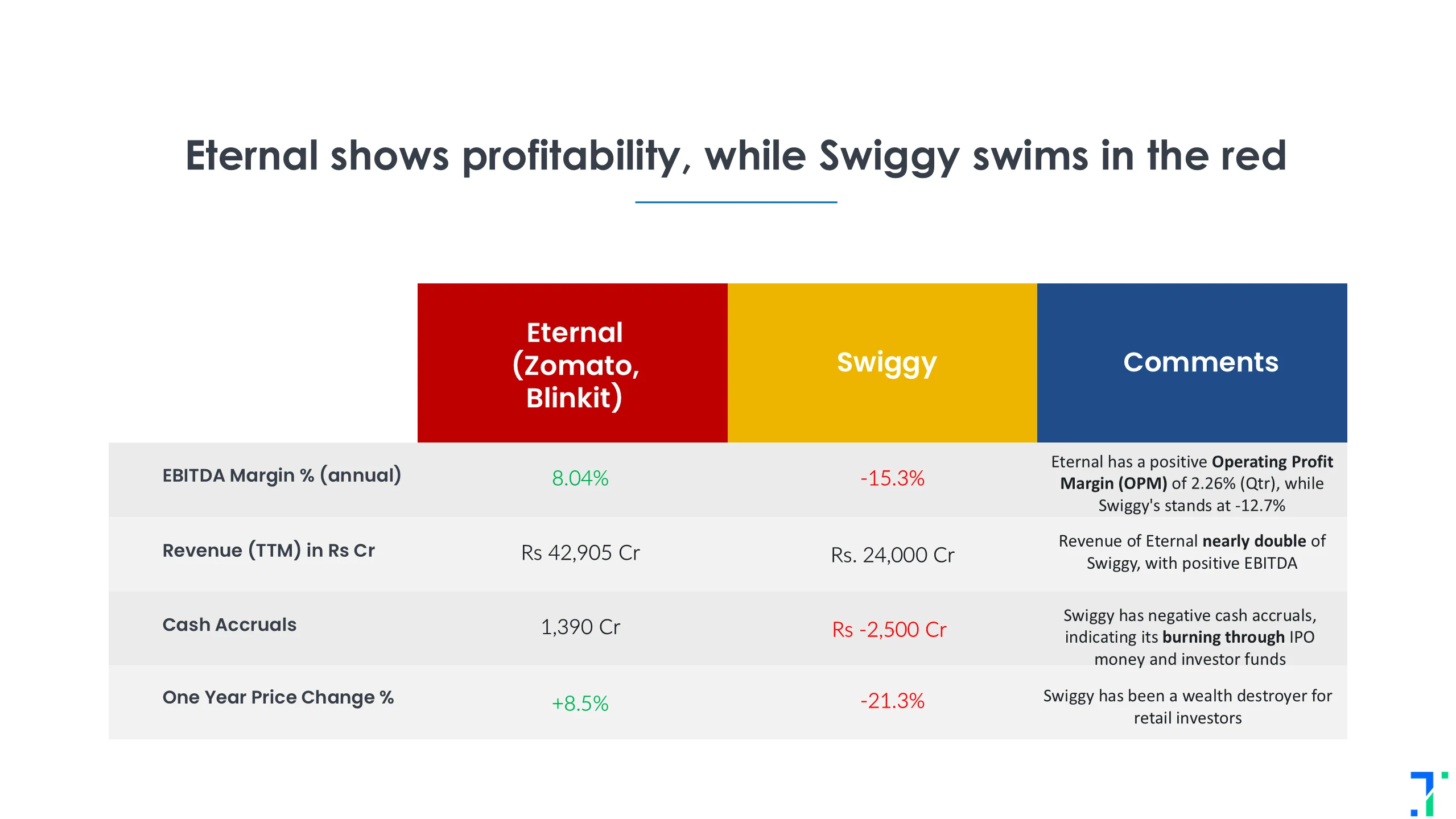
Swiggy's management never mentions their competitor by name in their earnings calls. It's a 'Voldemort' situation where they will say "market leader" instead of 'Blinkit/Zomato'. But they know, of course, that they are the runner-up in this space, both financially and in size. Eternal has more users as well as higher value users compared to Swiggy - 62 million annual paying users, with an average order value (AOV) of Rs. 640, while Swiggy has 42 million annual paying users with an AOV of Rs. 450.

Eternal has also maintained positive net profit for several quarters, while Swiggy is reporting significant quarterly losses (over Rs 1,000 crore in the most recent quarter).

Swiggy is in a difficult position financially, playing catch-up to Zomato and Blinkit, while also struggling to become profitable. Perhaps to push up their numbers, they seem to be copying the Zepto playbook of dark patterns on their apps. We take a closer look at some moves that are already getting pushback from its users.

Automatic checkboxes in the app

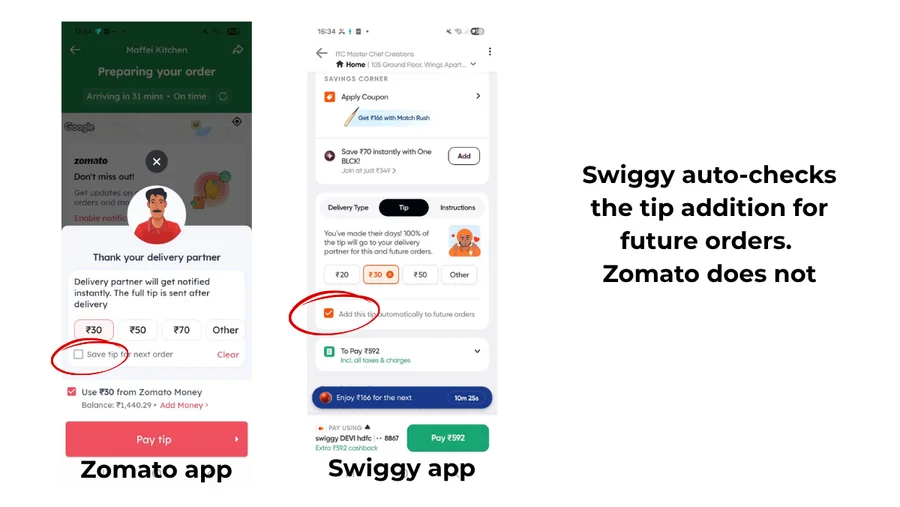
A significant concern for all players in the delivery and quick commerce space has been low payments to their delivery partners. To offset the problem of weak delivery payouts, all these apps encourage customers to add a delivery tip on orders. 

The key here is the difference in behaviour between the two apps, Zomato and Swiggy. On Swiggy, the tip is auto-checked, so that it applies by default to all your future orders. 

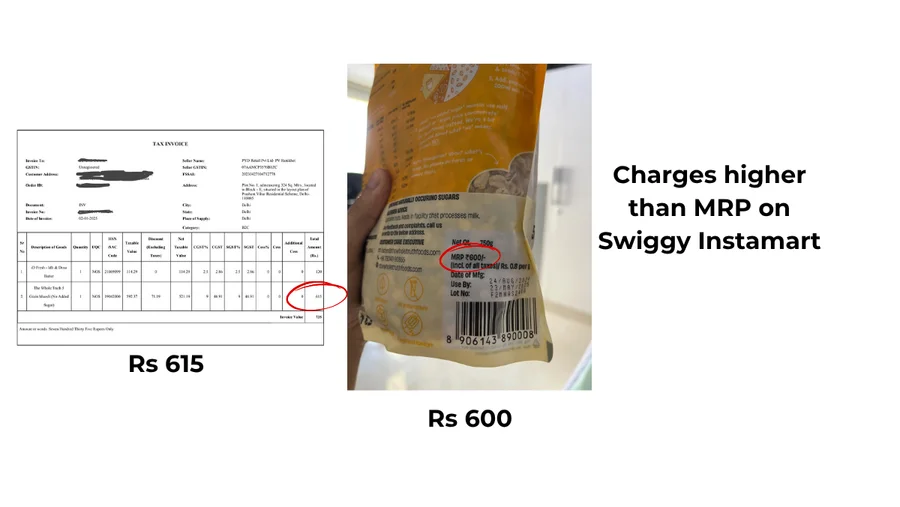
Users on Swiggy Instamart have also documented MRP differences in items delivered, versus what has been charged by the platform. MRP markups are a well known dark pattern in quick commerce: the company bets on the fact that most users ordering from these apps will not double check the item value against the invoice. This was also a major complaint against Zepto.

Getting a refund from Swiggy even for documented issues is increasingly difficult, thanks to Swiggy's AI bot. The bot often limits options to users, making it difficult to escalate the issue to human agents or the escalation desk. 

And speaking of refunds..

The newest dark pattern: zero refunds even on instant cancellation

One of the newest dark patterns Swiggy imposes on its users is its zero refund policy. This has recently emerged as a major point of concern for users. 

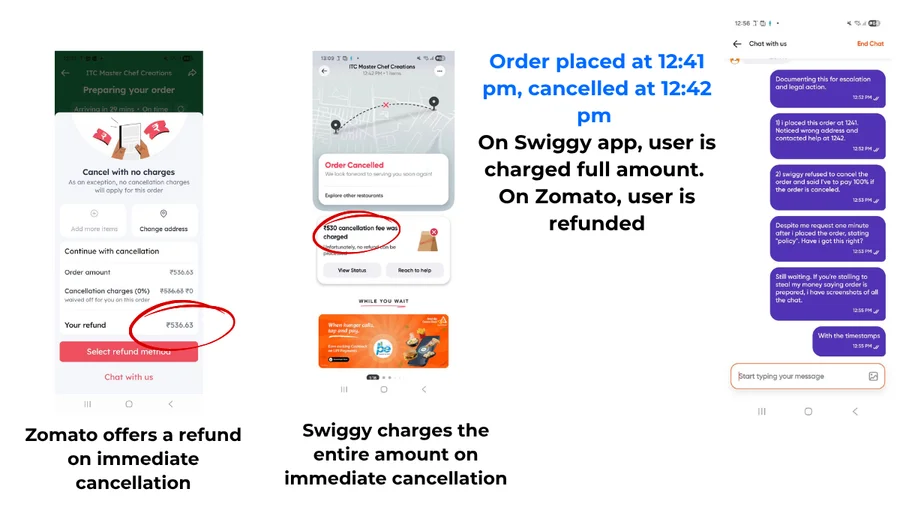
We noted the behaviour of both the apps on cancellation within one minute, of an order placed on the apps. 

When users contact Swiggy about these refunds, they cite "company policy" on charging users the full amount even on immediate order cancellation. This is a new change on the app: Swiggy previously allowed users to cancel with a full refund within one minute of placing their order. 

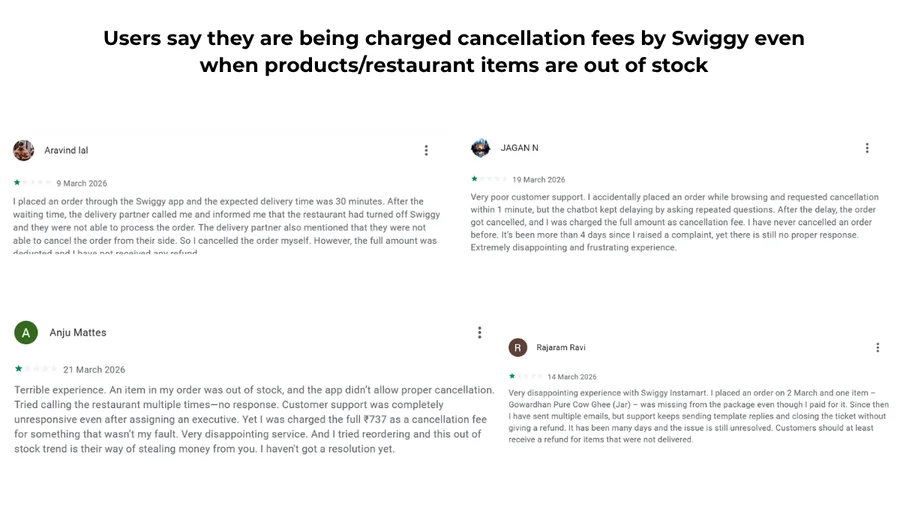
Other users have noted the lack of refunds even when products or restaurant items are out of stock. 

The "enshittification" trend in consumer apps

The Canadian writer Cory Doctorow coined the term "enshittification" in November 2022. The term describes how companies gradually degrade their services to their customers in order to maximize short-term profits. 

Doctorow described the pattern as follows:

Here is how platforms die: first, they are good to their users; then they abuse their users to make things better for their business customers; finally, they abuse those business customers to claw back all the value for themselves. Then, they die.

Users can very well cancel Swiggy over their cancellation fees. But while journalists and customers can highlight these issues and boycott these apps, long term behavioural change can happen only with regulation, and serious deterrance. This is especially needed for industries that are a duopoly - in the restaurant delivery market for instance, Zomato and Swiggy are the two dominant players. 

The action against Zepto however, is not encouraging. The company received just a slap on the wrist in the form of a Rs. 7 lakh fine for deceptive behaviour, ahead of their IPO. The cost to companies for implementing these kinds of extractive fees from consumers is low. Without structured deterrents, companies will keep trying these experiments. Caveat emptor.

logo
The Baseline
24 Mar 2026
Five stocks to buy from analysts this week - March 24, 2026
By Ruchir Sankhla

1. V-Guard Industries:

Geojit BNP Paribas upgrades this electrical appliance manufacturer to a ‘Buy’ call, with a target price of Rs 392 per share, an upside of 20.7%. The Israel–Iran war negatively impacts input costs and logistics. V-Guard relies on copper, polymers, and oil derivatives, so rising commodity and freight costs could pressure margins. However, minimal direct sales to the conflict zone protect its revenues and assets.

V-Guard’s Q3FY26 revenue grew 11% YoY. The electricals division led the charge, thanks to higher sales volumes and copper prices. Management predicts a strong Q4, banking on an early summer to boost seasonal demand. 

The company plans to grow six key categories to over Rs 1,000 crore each in sales. These include its popular Stabilizers, Fans, and Inverters, along with newer areas like Solar Rooftops, Kitchen Appliances, and the Sunflame brand.

Analyst Anil R expects V-Guard to achieve 24% earnings growth from FY26–28. This growth stems from its strong brand, a robust 40–45% market share in stabilizers, increasing adoption of smart fans (now ~25% of fan sales), and new product category expansions. Infrastructure demand and deeper penetration into tier-2/3 markets also support its medium- to long-term prospects.

2. Coforge

Motilal Oswal maintains its ‘Buy’ rating on this software company, with a target price of Rs 1,880 per share, an upside of 69.4%. The stock has fallen in the past month over worries about its exposure to the travel industry and the Middle East. Analysts Abhishek Pathak and Keval Bhagat believe the stock has already priced in these risks, creating a good buying opportunity backed by a strong order book.

Management reports stable demand across all key verticals, with consistent client spending and a strong deal pipeline. Coforge is capitalising on cross-selling opportunities from recent acquisitions, which support long-term growth. While AI concerns suggest traditional IT outsourcing might see reduced demand, potentially impacting revenue, the $2.4 billion Encora acquisition boosts Coforge’s AI capabilities and North American presence. This positions the company to deliver AI-driven solutions and counter potential disruptions.

Pathak and Bhagat expect Coforge to remain one of the faster-growing mid-cap IT companies, driven by strong deal wins and growth from integrations. They anticipate margins to improve to around 14% over the next two years.

3. Hindalco Industries

BOB Capital Markets initiates coverage on this aluminium producer with a ‘Buy’ call and a target price of Rs 1,050 per share, an upside of 22.9%. In the short term, the Israel-Iran war will likely hit Hindalco with higher energy and shipping costs, as well as potential raw material shortages. Long-term, strong local demand, efficient Indian plants, and expansion plans will power its earnings growth.

Hindalco is riding a wave of aluminium demand from the infrastructure, auto, and construction industries. Its subsidiary, Novelis, continues to perform well, with steady demand from beverage cans and auto parts. The company targets 3.5–4% long-term demand growth and plans $300 million in cost savings by FY28. It also aims for EBITDA above $600 per tonne, driven by efficiency and US capacity expansion. In copper, Hindalco plans to boost capacity from 521 KTPA to 821 KTPA, supported by strong domestic demand.

Analyst Sukhwinder Singh expects capital expenditure-led expansion in aluminium, alumina, and copper to drive volume growth from FY27. Cost efficiency efforts, including captive coal mines and improved energy sourcing, should reduce power costs over time. Despite higher debt from ongoing investments, leverage remains comfortable. He anticipates that strong demand, capacity expansion, and cost control will support long-term earnings growth. However, investors should keep in mind that the length of the closure of the Hormuz Strait could cause revisions in guidance and capex.

4. APL Apollo Tubes

Axis Direct recommends a ‘Buy’ rating on this steel tube producer with a target price of Rs 2,170, an upside of 9.9%. The Iran-Israel war negatively impacts the company’s Gulf operations. Its Dubai facility faces potential shipping delays and higher logistics costs, which could slightly hurt margins.

APL Apollo Tubes aims for a total production capacity of 10 million tonnes (MT) by FY30. It plans to achieve this through greenfield projects, de-bottlenecking, and speciality tube expansions, funding these with Rs 1,500 crore in capital expenditure. The company also intends to scale capacity to 8 MT by FY28.

The company delivered a strong Q3FY26 performance, with EBITDA increasing 37% YoY. For 9MFY26, EBITDA per tonne improved to Rs 5,145, thanks to premium product launches and strong Apollo brand positioning. Management expects 20% volume growth in Q4FY26 and FY27. They project EBITDA per tonne will reach Rs 5,500 in FY27–28, driven by cost control, product mix optimization, and a growing share of value-added products.

Analysts Aditya Welekar and Keval Barot highlight that strong brand acceptance, premium positioning, and operational efficiencies prepare APL Apollo for sustained margin expansion and steady volume growth. They note that the company became net-debt-free two years ago and now targets becoming liability-free by maintaining enough cash to match current liabilities.

5. KSB:

ICICI Direct maintains its ‘Buy’ rating on this pump manufacturer, with a target price of Rs 1,000 per share, an upside of 25.1%. The Israel–Iran war negatively affects KSB, with around 17% of orders exported, mainly to the Middle East. Instability in the region and Strait of Hormuz disruptions could push up freight and energy costs and delay deliveries. However, a strong domestic order book, especially from India's nuclear and solar projects, helps offset these risks.

KSB Pumps had a strong Q3FY26, with revenue climbing 8.7% YoY, thanks to increased pump and valve sales. Management reports a robust Rs 2,585 crore order book, including Rs 1,281 crore from nuclear power projects. The company has begun recognising nuclear project revenue, expecting Rs 100–200 crore in FY26, with more to come as Kaiga and Gorakhpur projects advance. High-margin standard products, aftermarket services, and increasing exports boost profit margins.

Analysts Chirag Shah and Dilip Pandey foresee KSB maintaining steady revenue growth, driven by strong new orders and improving margins. A diverse product range and aftermarket services enhance profitability. They project revenue and net profit will grow at a 13.8% and 14.4% CAGR, respectively, from FY26-27.

Note: These recommendations are from various analysts and are not recommendations by Trendlyne.

(You can find all analyst picks here)