By Ruchir SankhlaNifty 50 closed lower on September 28 as rising crude oil and continued foreign investor selling weighed on sentiment. Brent crude jumped back above $106 per barrel after US President Donald Trump rejected Iran’s proposal to resolve the conflict and reopen the Strait of Hormuz, reviving concerns over oil supply disruptions.
Last week, Indian equities logged their longest weekly losing streak in six years, as high crude prices, rising bond yields and persistent FII selling kept risk appetite weak. FIIs sold equities worth Rs 3,693.9 crore on Friday, while DIIs partly offset the pressure with purchases worth Rs 2,838.2 crore.
Looking ahead, the markets in India will remain closed on Friday for Mahatma Gandhi Jayanti, and Investors will track developments in the US-Iran talks, crude oil prices, rupee movement, foreign investor activity, US jobs and inflation data, and domestic macro indicators such as August industrial production and manufacturing PMI. Ajit Mishra, SVP – Research at Religare Broking, said, “Any progress on a framework for reopening the Strait of Hormuz could ease energy prices and provide some relief to India's import bill and the rupee, while renewed geopolitical tensions could keep volatility elevated.”
The primary market is set for another action-packed week, with 28 new issues opening for subscription and 17 companies heading for listing. This follows 14 IPO debuts last week, including the much-awaited listing of the National Stock Exchange.
NSE joins the market in a fourteen-IPO debut week
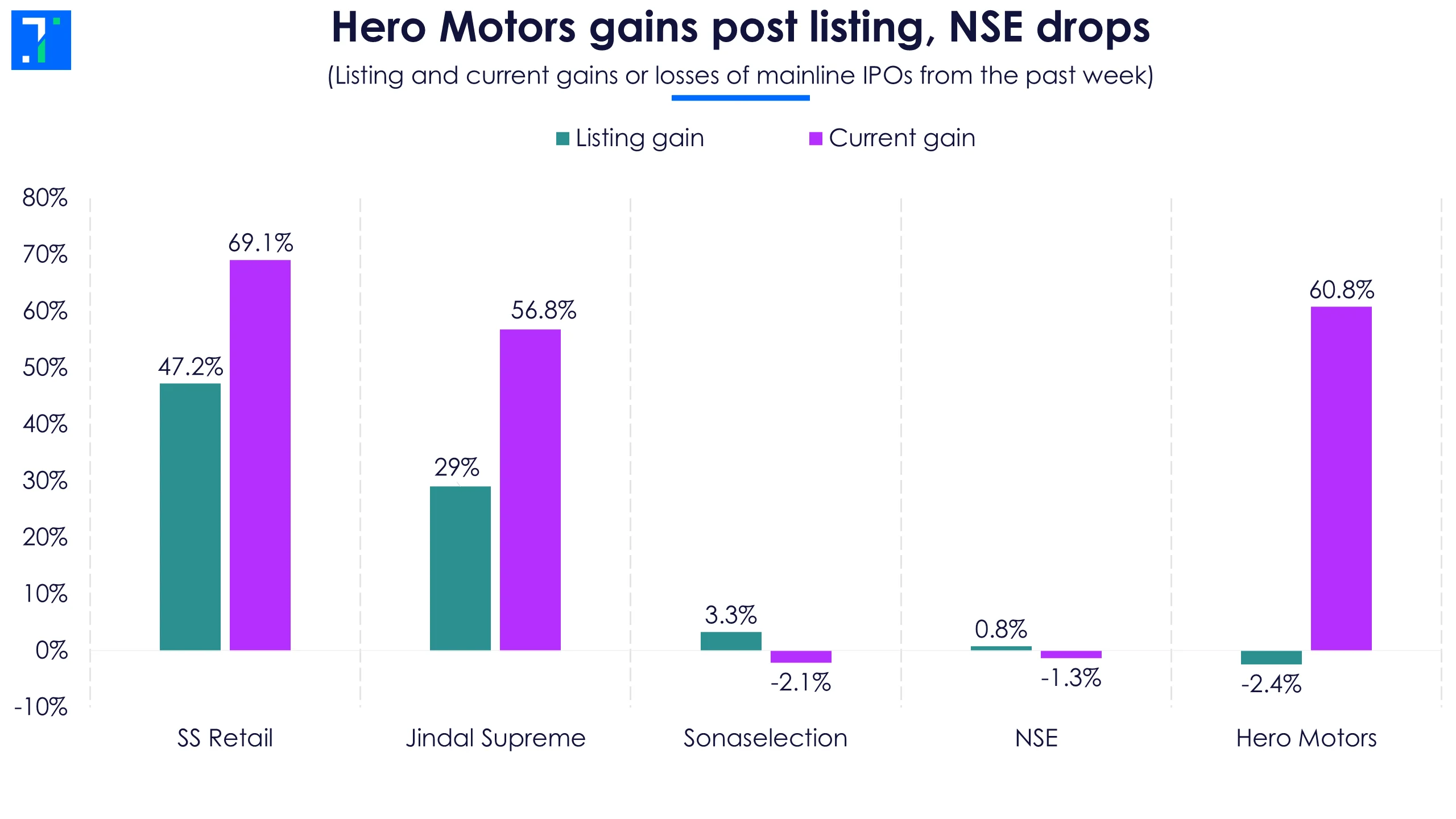
National Stock Exchange, India's leading stock exchange, made a positive debut on September 24. The Rs 22,568.9 crore IPO was subscribed 5.7x and listed at a 0.8% premium to its issue price of Rs 1,785. It was entirely an offer for sale by existing shareholders. The stock is currently trading 1.3% below its issue price.
Jindal Supreme, a manufacturer of steel pipes and tubes, delivered a stellar debut on September 23. The Rs 124.9 crore IPO was exceptionally subscribed 181.1x and listed at a 29% premium to its issue price of Rs 93. The stock has extended its gains and is currently trading 56.8% above its issue price.
SS Retail, a multi-brand retail chain, made a strong debut on September 23. The Rs 500 crore IPO was heavily subscribed at 103.3x and listed at a 47.2% premium to its issue price of Rs 424. The company plans to use the proceeds to fund interior construction and equipment for new stores. The stock is currently trading 69.1% above its issue price.
Hero Motors, an automotive technology company, made a steady debut on September 23. The Rs 1,000 crore IPO was subscribed 6.7x and listed at a 2.4% discount to its issue price of Rs 84. Since then, the company’s stock price has surged and is currently trading 60.8% above its issue price. The company plans to use the capital to expand its powertrain manufacturing capacity.
Sonaselection, an integrated fabric manufacturing company, had a positive debut on September 24. The Rs 141.6 crore IPO was subscribed 2x and listed at a 3.3% premium to its issue price of Rs 99. The company plans to use the proceeds to purchase plant and machinery for its existing facility. The stock has slipped post-listing and is currently trading 2.1% below its issue price.
Hero Motors gains post listing, NSE drops
Nine SME IPOs also entered the market last week.
SpectraA Technology Solutions and Robokidz Eduventures delivered the strongest SME debuts, both listing at 90% premiums. SpectraA debuted at Rs 224.2 against its Rs 118 issue price and later hit its upper circuit on Friday. The company plans to invest the proceeds in its Jaipur manufacturing facility. Robokidz listed at Rs 201.4 against an issue price of Rs 106 and will use the fresh capital for business expansion. It currently trades 99.5% above its issue price.
FX Multitech, Kheria Autocomp, Vivekanand Cotspin and Axiom Gas Engineering posted more modest listing gains. FX Multitech listed 6.1% above its issue price and plans to invest in its subsidiary. Kheria Autocomp debuted 3.9% higher and will use the proceeds for a new manufacturing facility, while Vivekanand Cotspin listed 2.7% higher and plans to invest in additional machinery. Axiom Gas Engineering gained 1.4% on listing, with proceeds earmarked for capex.
Vama Wovenfab, Shakti Polytarp and Quanto Agroworld had largely flat debuts. Vama listed at par but slipped 22.6% below, while Shakti Polytarp and Quanto Agroworld debuted around their issue prices. Shakti will use the proceeds for capital expenditure, and Quanto for farm expansion and a new distillation plant.
Adroit Industries stands out in a packed listing calendar
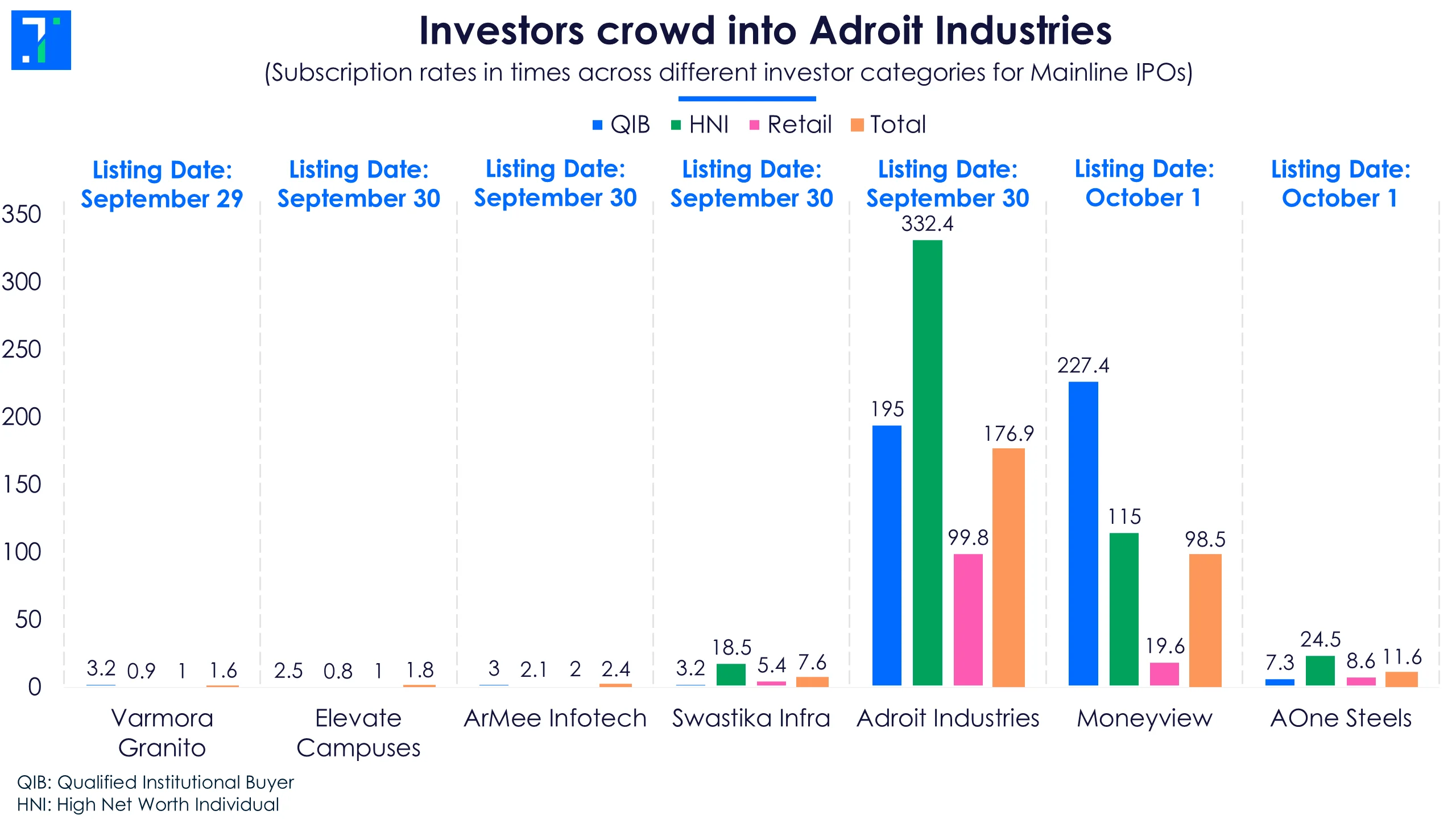
Elevate Campuses, a student accommodation operator, opened its Rs 2,100 crore IPO for subscription on September 23 and closed on September 25. It saw healthy investor demand with an overall subscription of 1.8x. The company plans to use the capital to acquire K-12 entities and reduce debt. The shares will debut on September 30.
Varmora Granito, a manufacturer of tiles and bathware, opened its Rs 708 crore IPO for subscription on September 22 and closed the issue on September 24. The issue saw a modest investor response with an overall subscription of 1.6x. The shares will list on September 29.
ArMee Infotech, an IT infrastructure and managed services company, opened its Rs 300 crore IPO for subscription on September 23 and closed the issue on September 25. The issue saw steady investor demand with an overall subscription of 2.4x. The stock will list on September 30.
Swastika Infra, a power transmission and distribution EPC company, opened its Rs 161.4 crore IPO for subscription on September 23 and closed the issue on September 25. The issue saw strong investor demand with an overall subscription of 7.6x. The shares will list on September 30.
Adroit Industries, an automotive and driveline components manufacturer, opened its Rs 150.7 crore IPO for subscription on September 23 and closed the issue on September 25. The issue saw exceptional investor interest with an overall subscription of 176.8x. The company plans to use the proceeds for capital expenditure at its Dewas facility. The stock will list on September 30.
Moneyview, a digital lending and financial services platform, opened its Rs 1,091.7 crore IPO for subscription on September 24 and will close on September 28. As of the final day, the issue saw a strong response, with an overall subscription of 98.5x. The company plans to use the capital to support loan disbursals and invest in its subsidiary. The shares will list on October 1.
AOne Steels, a manufacturer of steel products, opened its Rs 405 crore IPO for subscription on September 24 and will close on September 28. As of the final day, the issue saw a strong response, with an overall subscription of 11.6x. The stock will list on October 1.
Investor crowd into Adroit Industries
Ten SME issues are also in focus.
Himalaya Nutravedics and Anand Seamless will list on September 29, with Himalaya Nutravedics’ Rs 26.5 crore IPO subscribed 2.2x, while Anand Seamless saw more modest demand at 1.4x. Anand Seamless plans to use the proceeds to expand capacity at its Mehsana facility.
Liqvd Digital, Pooja Logistics, Coreintegra Consulting, S K Offset, and Unitec Fibres are scheduled to debut on September 30. Liqvd Digital’s Rs 39 crore IPO was subscribed 5.1x, while Unitec Fibres’ Rs 34.5 crore issue was subscribed 3.7x. Coreintegra Consulting, S K Offset, and Pooja Logistics saw healthy demand at 1.4x, 1.1x, and 3x, respectively. Liqvd Digital plans to acquire a stake in AdLift Marketing, while Pooja Logistics will use fresh capital to expand its fleet of refrigerated trucks.
Roopa Screen and Peshwa Wheat are set to list on October 1 after closing their issues on September 28. As of the final day, Roopa Screen's Rs 19.2 crore IPO was subscribed 253x, while Peshwa Wheat saw a subscription of 2.7x. Peshwa Wheat plans to invest in civil construction and machinery.
Green Asia Impex will close on October 1. As of September 28, the issue was subscribed 0.2x. The company plans to use the proceeds to support its overall business expansion. The stock will list on October 7.
From real estate to electronics: Twenty-eight IPOs enter the pipeline
Runwal Enterprises, a Mumbai-based real estate developer, will open its Rs 500 crore IPO for subscription from September 25 to September 29. The company plans to use the fresh capital for future project acquisitions. The stock will list on October 5.
German Green Steel Power, a vertically integrated iron and steel manufacturer, will launch its Rs 303.9 crore IPO from September 25 to September 29. The company plans to use the proceeds for capital expenditure at its Samakhiyali facility. The stock will list on October 5.
Orient Cables, a manufacturer of networking and optical fibre cables, will open its Rs 552 crore IPO from September 25 to September 29. The company plans to use the funds to purchase machinery and equipment. The stock will list on October 5.
AceVector, a digital commerce ecosystem operator comprising Snapdeal and Unicommerce, will launch its Rs 420 crore IPO from September 25 to September 29. The company plans to use the proceeds for organic and inorganic growth initiatives. The stock will list on October 5.
Shah Investors Home, a retail stockbroking and financial services firm, will open its Rs 90.2 crore IPO from September 28 to September 30. The price band is set at Rs 159–167 per share. The stock will list on October 6. SRIT, an IT and IT-enabled services company, will launch its Rs 218.4 crore IPO from September 28 to September 30. The price band is set at Rs 123–130 per share. The stock is scheduled to list on October 6.
Vishal Nirmiti, a manufacturer of pre-stressed concrete sleepers and civil engineering firm, will open its Rs 178 crore IPO from September 30 to October 5 at a price band of Rs 208–220 per share. The stock will list on October 8. Nityas Gems and Jewellery, a manufacturer of lab-grown diamond-studded gold jewellery, will launch its Rs 108.4 crore IPO from September 30 to October 5. The price band is set at Rs 70–75 per share. The stock will list on October 8.
Nityas Gems tops revenue growth; Shah Investor’s sees profit growth fall
Twenty SME IPOs are also lined up.
- Sai Urja Indo Ventures will launch its Rs 25 crore IPO from September 25 to September 29. The company plans to use the proceeds to diversify into renewable energy and introduce new service offerings. The stock will list on October 5.
- Bench Mark Infotech Services will open its Rs 42.4 crore IPO from September 25 to September 29. The price band is set at Rs 104–110 per share. The stock will list on October 5.
- Himalayan Solar will launch its Rs 68 crore IPO from September 25 to September 29. The company plans to use the proceeds to fund government-led solar water pumping projects. The stock will list on October 5.
- Dudani Retail will open its Rs 10.5 crore IPO from September 25 to September 29. The fixed-price issue is set at Rs 29 per share. The stock will list on October 5.
- Pind Hospitality will launch its Rs 17.8 crore IPO from September 28 to September 30. The company plans to use the funds to set up a hotel-cum-banquet hall in Lonavala. The stock will list on October 6.
- Shivchem Agro will open its Rs 14 crore IPO from September 28 to September 30. The price band is set at Rs 59–62 per share. The stock will list on October 6.
- Acme Universal Safezone 9 will launch its Rs 35.9 crore IPO from September 28 to September 30. The company plans to use the proceeds for the installation of additional machinery and solar power plants. The stock will list on October 6.
- Black Opal Consultants will launch its Rs 55.1 crore IPO from September 29 to October 1. The company plans to use the proceeds for securing sales and marketing mandates and investing in Aurika Developers to finance its Ayodhya project. The stock will list on October 7.
- Papadmalji Agro Foods will open its Rs 20.2 crore IPO from September 29 to October 1. The company plans to use the funds to set up a new manufacturing facility in Bachhasar. The stock will list on October 7.
- VANS Electroengineerings will open its Rs 34 crore IPO from September 29 to October 1. The price band is set at Rs 112–118 per share. The stock will list on October 7.
- Eventions will launch its Rs 38.1 crore IPO from September 30 to October 5. The price band is set at Rs 112–118 per share. The stock will list on October 8.
- Dove Soft will launch its Rs 73.3 crore IPO from September 30 to October 5. The company plans to use the proceeds to upgrade its IT infrastructure. The stock will list on October 8.
- SJP Ultrasonics will open its Rs 23.5 crore IPO from September 30 to October 5. The fixed-price issue is set at Rs 67 per share. The stock will list on October 8.
- Omara Ventures will open its Rs 42 crore IPO from September 30 to October 5. The company plans to use the funds for capex to renovate and expand its jewellery boutique. The stock will list on October 8.
- EverestIMS Technologies will launch its Rs 48.6 crore IPO from September 29 to October 5. The company plans to use the proceeds for product development and expanding its sales team. The stock will list on October 8.
- Shree TNB Polymers will open its Rs 31.2 crore IPO from September 28 to October 5. The proceeds will be used for the purchase and installation of solar panels and rooftop systems. The stock will list on October 8.
- Sollfege Smart Electronics will launch its Rs 21.8 crore IPO from September 30 to October 5. The company plans to use the capital to open new retail stores. The stock will list on October 8.
- Paramount Syntex will open its Rs 81.8 crore IPO from September 30 to October 6. The company will use funds for capex towards the purchase of machinery at existing facilities. The stock will list on October 9.
- TNA Solutions will launch its Rs 37.9 crore IPO from September 30 to October 6. The company plans to use the proceeds to scale up its IT services. The stock will list on October 9.
- Acme Industries will open its Rs 121.7 crore IPO from September 30 to October 6. The proceeds will be used to fund the capex towards the purchase of additional plant & machinery. The stock will list on October 9.