My Newsfeed

Market closes higher amid strong buying in steel stocks
By Trendlyne Analysis

Nifty 50 closed at 26,127.55 (188.7, 0.7%), BSE Sensex closed at 85,220.60 (545.5, 0.6%), while the broader Nifty 500 closed at 23,865.60 (196.8, 0.8%). Market breadth is highly positive. Of the 2,605 stocks traded today, 1,790 were in the positive territory, and 758 were negative.

Indian indices closed higher after rising throughout the day. The Indian volatility index, Nifty VIX, fell 2.1% and closed at 9.5 points. Steel stocks such as JSW Steel, Tata Steel, and Jindal Steel ended higher after the government imposed a three-year anti-dumping duty on non-alloy and alloy steel flat products.

Nifty Smallcap 100 and Nifty Midcap 100 closed higher. Nifty Oil & Gas and Nifty Commodities were among the top index gainers today. According to Trendlyne’s sector dashboard, Oil & Gas emerged as the best-performing sector of the day, with a rise of 2.3%.

Asian indices closed mixed. European indices are trading lower. US index futures are trading lower as investors turn cautious after the Federal Reserve’s December meeting minutes show divisions over the recent 25-bps rate cut and the pace of rate adjustments in 2026. US markets will be closed on January 1 for New Year’s Day.

  • Money flow index (MFI) indicates that stocks like Poly Medicure, Honeywell Automation, Eris Lifesciences and Akzo Nobel are in the oversold zone.

  • Kiri Industries surges as it sells its entire 37.6% stake in DyStar to Zhejiang Longsheng for about $689 million (around Rs 6,187 crore).

  • Hyundai Motor India announces a price hike of around 0.6% for its vehicles, effective January 1, due to rising precious metal and commodity prices.

  • Vodafone Idea hits a 52-week high of Rs 12.8 as reports emerge of Cabinet approval for adjusted gross revenue (AGR) relief. The package freezes Rs 87,695 crore of AGR dues and reschedules payments over FY32–41. The stock later falls sharply as the relief falls short of expectations for a 50% waiver.

  • Swiggy and Eternal (Zomato) offer additional incentives to delivery partners amid a strike called by the gig workers' union on New Year's Eve. Zomato offers payouts of Rs 120-150 per order during peak hours and promises earnings of up to Rs 3,000 over the day. Meanwhile, Swiggy offers earnings of up to Rs 10,000 across December 31 and January 31.

  • Hindustan Petroleum Corp rises sharply to its 52-week high of Rs 496 as crude oil prices ease, improving the outlook for margins and fuel demand. Separately, HPCL partners with V-GREEN, a VinFast group company, to jointly set up EV charging stations across its fuel outlets.

  • Tega Industries receives NSE & BSE approval for preferential issue of 85.9 lakh shares to its promoters & non-promoters.

  • ICICI Direct maintains a ‘Buy’ on Titan with a target of Rs 4,715. The launch of the ‘beYon’ brand marks Titan’s entry into lab-grown diamonds, offering affordable options for Gen Z and working women. While unlikely to replace natural diamonds, it is expected to create a new consumer segment and improve the jewellery mix. Revenue and net profit are projected to grow at a CAGR of 18% and 23%, respectively, over FY26–28.

  • Telecos, including Bharti Airtel, Vodafone and Jio, request the Department of Telecommunications (DoT) over the denial of right of way (RoW) by Navi Mumbai International Airport (NMIAL) to install telecom infrastructure. NMIAL directed the telcos to mandatorily utilise its network at expensive and commercially unsustainable costs.

  • Waaree Energies secures an order to supply 1,500 MW of solar modules to a "renowned" electric utility company, with deliveries scheduled for FY27. Separately, the company has entered the futures and options (F&O) segment, with contracts available for trading.

  • Dynacons Systems surges as it secures a Rs 249.2 crore enterprise applications platform (EAP) order from the Reserve Bank of India. The five-year contract covers implementation, maintenance, and learning services for the RBI’s EAP software.

  • Solar Industries India is rising as it secures an order worth Rs 1,746 crore from Coal India to supply bulk explosives.

  • The Indian IPO market raises a record Rs 2 lakh crore in 2025 through over 365 IPO listings. The mainboard IPOs contribute to 94% of the funds raised, with 106 listings during the year. Meanwhile, the small & medium enterprises (SME) segment issued 259 listings.

  • Adani Green Energy is rising as it adds 307.4 MW capacity at Khavda, Gujarat, raising total renewable capacity to 17,237.2 MW.

  • IFCI rises sharply after it sells its 10% stake in North Eastern Development Finance Corp (NEDFi). The company monetises 1 crore shares in NEDFi for Rs 121.8 crore, against an acquisition cost of Rs 10 crore.

  • Steel stocks like JSW Steel, Tata Steel and Jindal Steel rise sharply as the government imposes a three-year anti-dumping duty on non-alloy and alloy steel flat products. The duty remains 12% in 2025-26, then reduces to 11.5% and 11% over the next two years.

  • The Global Trade Research Initiative (GTRI) believes that the EU's carbon border adjustment mechanism (CBAM) tax will impact Indian steel and aluminium exporters. It notes that the CBAM's complex data and verification requirements will sharply raise compliance costs, pushing many smaller exporters out of the EU market. It adds that the Indian exporters may have to cut prices by 15-22% to provide an additional margin to EU importers so they can pay the tax. 

  • Power Grid Corporation of India is rising as it secures an order to set up a 2,000 MWh battery energy storage system in Andhra Pradesh, including a 150 MW unit at Kalikiri.

  • Shakti Pumps (India) surges as it receives an order worth Rs 170.3 crore from Madhya Pradesh Urja Vikas Nigam (MPUVNL) to supply 4,840 off-grid solar photovoltaic water pumping systems (SPWPS).

  • Privi Speciality Chemicals is plunging as its promoter, Vivira Investment and Trading, reportedly plans to sell 24.7 lakh shares (6.3% stake) worth Rs 700 crore at a price of Rs 2,835-2,850 per share.

  • Multi Commodity Exchange is rising as Morgan Stanley upgrades the stock to an 'Equalweight' rating from 'Underweight' with a higher target price of Rs 11,135 per share. The brokerage notes that the company's valuation remains elevated but believes that the strong price action in gold and silver will drive average daily transaction revenue growth, helping valuations to normalise.

  • Apollo Micro Systems surges as its subsidiary, IDL Explosives, receives orders worth Rs 420.9 crore. This includes a long-term contract to supply bulk explosives to Coal India subsidiaries and an export order for cartridge explosives.

  • Premier Energies is rising as it secures orders worth Rs 2,307.3 crore in Q3 from domestic independent power producers and other major customers in India. The orders support revenue visibility and back the company’s capacity expansion plans to scale solar cell capacity to 10.6 gigawatts and solar module capacity to 11.1 gigawatts by September 2026.

  • InterGlobe Aviation is falling after receiving a demand order worth Rs 458.3 crore from the Delhi GST Authority for FY19-23.

  • Bharat Forge is rising as it secures an order worth Rs 1,661.9 crore from the Ministry of Defence (MoD) to supply 2.6 lakh close-quarter battle (CQB) carbines to the Indian Army.

  • Nifty 50 was trading at 25,971.05 (32.2, 0.1%), BSE Sensex was trading at 84,675.08 (-20.5, 0.0%), while the broader Nifty 500 was trading at 23,710.45 (41.7, 0.2%).

  • Market breadth is in the green. Of the 1,860 stocks traded today, 1,029 showed gains, and 613 showed losses.

Riding High:

Largecap and midcap gainers today include Hindustan Petroleum Corporation Ltd. (497.85, 6.2%), JSW Steel Ltd. (1,165.50, 4.9%) and Steel Authority of India (SAIL) Ltd. (146.84, 4.1%).

Downers:

Largecap and midcap losers today include Vodafone Idea Ltd. (10.73, -11.0%), Hindustan Zinc Ltd. (612.45, -2.1%) and Swiggy Ltd. (386.25, -2.0%).

Crowd Puller Stocks

26 stocks in BSE 500 are trading on high volumes today.

Top high volume gainers on BSE included Graphite India Ltd. (641.15, 9.1%), Zydus Wellness Ltd. (452.40, 6.7%) and Mangalore Refinery And Petrochemicals Ltd. (150.98, 6.5%).

Top high volume losers on BSE were Vodafone Idea Ltd. (10.73, -11.0%) and Indus Towers Ltd. (419.40, -0.6%).

Deepak Fertilisers & Petrochemicals Corporation Ltd. (1,284.50, 6.2%) was trading at 15.8 times of weekly average. Gujarat Gas Ltd. (412, 5.3%) and IFCI Ltd. (52.51, 4.1%) were trading with volumes 10.0 and 7.3 times weekly average respectively on BSE at the time of posting this article.

BSE 500: highs, lows and moving averages

23 stocks made 52 week highs, while 5 stocks were underachievers and hit their 52 week lows.

Stocks touching their year highs included - Ashok Leyland Ltd. (179.70, 0.6%), Bank of Maharashtra (62.20, 2.8%) and Bharat Forge Ltd. (1,470.10, 1.1%).

Stocks making new 52 weeks lows included - Whirlpool of India Ltd. (897.70, 1.0%) and Crompton Greaves Consumer Electricals Ltd. (252.75, 0.5%).

32 stocks climbed above their 200 day SMA including IFCI Ltd. (52.51, 4.1%) and Metropolis Healthcare Ltd. (1,931.90, 3.9%). 5 stocks slipped below their 200 SMA including Eternal Ltd. (278, 0.3%) and Aadhar Housing Finance Ltd. (485.60, 1.2%).

logo
The Baseline
31 Dec 2025
By Anagh Keremutt

The Nifty 500 rose just 5.5% this year, reflecting uneven earnings growth, valuation concerns, and cautious foreign flows. This seemed like a slow, stagnant year for the stock market, despite strong GDP growth.

The market however, has moved sharply along selective themes. Investors favoured businesses linked to government spending, financial strength, technology, and reforms. As a result, some thematic indices saw strong gains.

Money poured into public sector banks, defence manufacturers, and metal companies building infrastructure. New-age themes like electric mobility and consumption also saw a boost.

Nikhil Khandelwal, MD of Systematix Group, said, “Indian equities are entering 2026 with market performance increasingly driven by earnings growth rather than liquidity. This makes sector selection and company fundamentals far more important than broad index exposure.”

In this edition of Chart of the Week, we break down how specific themes outperformed the broader market and why 2025 became a year where "what" you owned mattered far more than simply "being in" the market.

Financials lead 2025, thanks to structural strength

In 2025, the Nifty PSU Bank index rose over 28.3% as public sector banks strengthened their balance sheets and reduced non-performing assets (NPAs).

NPAs of PSU banks dropped sharply from over 9% in FY21 to around 2.6% by March 2025. Capital levels improved and returns steadily increased. Large banks like State Bank of India now offer good earnings visibility, while mid-sized banks are growing faster. This has built confidence across the sector.

This trend was also visible in the Financial Services 25/50 index, which rose 18% during the year. The Financial Services 25/50 index makes sure no single company dominates. No stock can be more than 25% of the index, and the top two can’t be more than 50%, so it shows the sector fairly.

Alongside lenders, financial market infrastructure companies also delivered steady gains. The Nifty Capital Markets index rose about 14.5%, mainly through rising participation. NSE trading accounts crossed 24 crore in November 2025, marking an annual increase of 20%. Individual investors accounted for about 18.8% of NSE’s total market capitalization in Q2FY26. This represents a 22-year peak in retail investor ownership.

Sudeep Shah of SBI Securities said, "This rally has been underpinned by a surge in equity market participation, record-breaking trading volumes, and a vibrant IPO pipeline." He adds, "As more retail investors joined the markets and F&O activity reached record levels, exchanges, brokers, and investment platforms earned more from transaction fees, margin loans, and other services."

PSU banks and capital market firms formed two sides of the same engine, one supplying credit to the economy, the other channeling savings into financial assets. This combination made financials a core pillar of thematic outperformance in 2025.

Defence and metals ride higher domestic demand

Another driver of returns in 2025 was India’s push toward self-reliance and domestic manufacturing. The Nifty India Defence index rose 15.7% in 2025 as defence spending moved from announcements to actual orders, backed by a record Rs 6.8 lakh crore budget.

Stock gains were led by Garden Reach Shipbuilders, MTAR Technologies and Bharat Electronics which rose 42.4%, 42% and 34.7%, respectively. Their growth was backed by a combined order book value of over Rs 75,700 crore.

The Nifty Commodities index gained 14.8% in 2025, driven by a rising cycle in global raw material prices. Unlike previous, more cyclical years, 2025 saw a steady climb as global demand for industrial inputs outpaced supply. 

The Nifty Metals index led the growth within commodities with a 26.2% surge, reaching record highs in late December. The primary driver was a global copper shortage that pushed prices to an all-time high of $12,960 per ton

Hindustan Copper more than doubled in value with an annual gain of 108%, while National Aluminium and Hindalco rose 48% and 43%, respectively, due to their focus on copper and aluminium for the electric vehicle transition. 

Discretionary spending jumps as consumers favour premium brands

Beyond finance and infrastructure, 2025 also marked a visible change in how Indians move and spend.

The Nifty EV & New Age Automotive index rose about 22.5% in 2025, driven by rapid charging infrastructure expansion and falling battery costs. Policy support and lower ownership expenses boosted the entire value chain, from component manufacturers to vehicle platforms.

Performance was led by Ashok Leyland in the electric commercial vehicles segment, which rose 62%, Maruti Suzuki which rose sharply within passenger cars, and TVS Motor which stood as the top gainer in the electric two-wheeler segment. Eicher Motors also rose sharply as it scaled EV operations for its first electric Royal Enfield model. 

The Nifty India New Age Consumption index gained around 17.9%, as urban spending shifted from basic staples to "aspirational" lifestyle brands.

Select turnarounds drove the rally. Nykaa jumped 65% as profits tripled in Q2FY26, helped by tighter costs and growth in its core beauty business. Telecom also staged a recovery, with Vodafone Idea rising 61% after the government converted a large part of its debt into equity, easing bankruptcy fears and enabling a fresh 5G rollout.

A Moneycontrol report noted, "Household spending on non-essentials has increased, as higher incomes drive consumers toward premium and discretionary purchases."

Together, modern mobility and new-age consumption reflected bigger structural changes in the economy. Investors backed companies aligned with these shifts, reinforcing the market’s preference for selective themes.

Market closes flat as gains in metal & auto stocks offset losses in other sectors
By Trendlyne Analysis

Nifty 50 closed at 25,938.85 (-3.3, 0.0%), BSE Sensex closed at 84,675.08 (-20.5, 0.0%) while the broader Nifty 500 closed at 23,668.80 (-13.3, -0.1%). Market breadth is in the red. Of the 2,608 stocks traded today, 1,094 were in the positive territory and 1,457 were negative.

Indian indices closed flat after switching between gains and losses as gains in metal and auto stocks offset losses in other sectors. The Indian volatility index, Nifty VIX, closed 0.4% lower at 9.7 points. Cupid closed 4.8% higher after its board approved setting up a new FMCG manufacturing facility in Saudi Arabia.

Nifty Smallcap 100 and Nifty Midcap 100 closed lower. Nifty Metal and Nifty PSU Bank were among the best-performing indices of the day. According to Trendlyne’s sector dashboard, Metals & Mining emerged as the highest-performing sector of the day, with a rise of 1.6%.

European indices are trading flat or higher. Major Asian indices closed with varied trends. US index futures are trading mixed, signalling a cautious start to the session amid continued pressure on tech stocks. Investors also await the Federal Reserve’s meeting minutes set to be released later today.

  • Relative strength index (RSI) indicates that Hindustan Copper is in the overbought zone.

  • Bajaj Finance's promoters, Siddhantnayan Bajaj and Sanjali Bajaj, acquire 18 lakh shares worth Rs 179.9 crore. The transactions were executed at an average price of Rs 997 per share.

  • Honasa Consumer surges as its promoter, Varun Alagh, acquires 18.5 lakh equity shares (or 0.6% stake) for Rs 50 crore at an average price of Rs 270 through a block deal, raising his holding to 32.5%.

  • Nazara Technologies is rising sharply as SBI Mutual Fund sells 48 lakh crore shares (2.4% stake) for Rs 216 crore through a bulk deal. The transaction was executed at an average price of Rs 240.1 per share.

  • PVR Inox is falling as its promoter & MD, Ajay Kumar Bijli, pledges 4 lakh shares in favour of Infina Finance and HSBC InvestDirect Financial Services. 

  • Motilal Oswal reiterates its ‘Buy’ rating on Apollo Tyres, with a target price of Rs 600 per share. The brokerage sees healthy demand in India across passenger vehicles, two-wheelers, and light commercial vehicles, while export demand remains strong. Although margins in India face near-term pressure due to higher promotional spending. It expects the company to deliver a 22% earnings CAGR over FY26-28.

  • Waaree Renewable Tech bags a revised order worth Rs 102.9 crore from pig iron and seamless tube manufacturers to develop a 35 megawatt peak ground-mounted solar power project.

  • Cupid rises sharply as its board approves setting up a new FMCG manufacturing facility in Saudi Arabia. The proposed plant is part of the company's expansion and aims to strengthen its presence across Saudi Arabia and the wider Gulf Cooperation Council (GCC) market.

  • 27 lakh shares (4.6% stake) in Taj GVK Hotels & Resorts, worth Rs 115 crore, reportedly change hands in a block deal at an average price of Rs 422 per share.

  • Punjab & Sind Bank announces an extraordinary general meeting (EGM) on January 21, 2026. The bank seeks shareholder approval to raise up to Rs 3,000 crore through a Qualified Institutional Placement (QIP). This will support lending growth, overall business expansion, and compliance with regulatory shareholding requirements.

  • Indian Overseas Bank is rising as it receives approval from the Reserve Bank of India to set up an International Financial Services Centre Banking Unit at GIFT City, Gujarat.

  • Orient Technologies surges over 14% as its shareholders approve a 1-for-10 bonus issue of shares.

  • Mangalam Drugs & Organics surges to its 5% upper circuit after investor Vijay Kedia buys 1.4 lakh shares worth about Rs 33.3 crore via a bulk deal. Kedia executed the transaction through Kedia Securities at an average price of Rs 24.2 per share. 

  • NBCC (India) concludes an e-auction of 417 residential units across Noida and Greater Noida, generating total sales of around Rs 1,045.4 crore. The company earns a 1% marketing fee on the transaction as part of its normal business operations.

  • Hindalco Industries is rising as its group company, AV Minerals, invests $750 million (~Rs 6,656 crore) in its subsidiary, Novelis, by acquiring 50 lakh shares at an average price of $150 per share.

  • Entero Healthcare Solutions is rising sharply as ICICI Prudential Mutual Fund buys 21.8 lakh shares (~5% stake) for Rs 207.3 crore through a bulk deal at an average price of Rs 950 per share.

  • Shyam Metalics & Energy is rising as its subsidiary, Ramsarup Industries, expands steel capacity by adding a 0.5 million tonnes per annum (MTPA) blast furnace. 

  • Gujarat Kidney and Super Speciality's shares debut on the bourses at a 5.3% premium to the issue price of Rs 114. The Rs 250.8 crore IPO received bids for 5.2 times the total shares on offer.

  • Waaree Energies is falling as its Chief Executive Officer (CEO), Amit Paithankar, tenders his resignation. The board appoints Jignesh Rathod as the new CEO, effective May 15.

  • Grasim Industries' board of directors approves the merger of Essel Mining & Industries (EMIL) with its subsidiary, Aditya Birla Renewables.

  • CLSA retains its 'Buy' call on Dixon Technologies, but lowers target price to Rs 15,800 per share. This indicates a potential upside of 33.2%. The brokerage believes the company's near-term outlook remains weak due to declining smartphone sales in India, market share losses for clients, and concerns around regulatory approvals. It expects flat topline YoY growth in Q3FY26, potentially leading to a guidance cut for FY26. 

  • Indostar Capital Finance is rising as its board approves the sale of a portion of its commercial vehicle (CV) loan book worth Rs 135.7 crore to Phoenix ARC for Rs 108.6 crore.

  • The government of Gujarat appoints Rajkumar Beniwal as the new Managing Director (MD) of Gujarat Narmada Valley Fertilizers & Chemicals, succeeding T. Natarajan, effective December 29.

  • Rail Vikas Nigam emerges as the lowest bidder for an order worth Rs 201.3 crore from East Coast Railway to set up a Periodic Overhaul (POH) wagon workshop with 200-wagon capacity at Kantabanji in Odisha.

  • Bharat Electronics is rising as it secures orders worth Rs 569 crore for radars, tank overhauling, communication equipment, fire control systems, simulators, antenna stabilisation systems, security software and related services.

  • Nifty 50 was trading at 25,908.05 (-34.1, -0.1%), BSE Sensex was trading at 84,557.40 (-138.1, -0.2%), while the broader Nifty 500 was trading at 23,635.35 (-46.8, -0.2%).

  • Market breadth is in the red. Of the 2,075 stocks traded today, 682 were in the positive territory and 1,325 were negative.

Riding High:

Largecap and midcap gainers today include Indian Overseas Bank (35.80, 5.8%), Steel Authority of India (SAIL) Ltd. (141.02, 5.2%) and Jindal Stainless Ltd. (836, 5.1%).

Downers:

Largecap and midcap losers today include Lloyds Metals & Energy Ltd. (1,294.30, -6.7%), Coromandel International Ltd. (2,265.50, -4.2%) and GlaxoSmithKline Pharmaceuticals Ltd. (2,384.20, -3.8%).

Movers and Shakers

111 stocks in BSE 500 are trading on high volumes today.

Top high volume gainers on BSE included Asahi India Glass Ltd. (1,037.60, 7.7%), Indian Overseas Bank (35.80, 5.8%) and Honasa Consumer Ltd. (291.35, 5.2%).

Top high volume losers on BSE were Lloyds Metals & Energy Ltd. (1,294.30, -6.7%), Caplin Point Laboratories Ltd. (1,790.70, -5.4%) and PTC Industries Ltd. (18,213, -5.0%).

TVS Holdings Ltd. (13,588, -2.0%) was trading at 12.9 times of weekly average. Godrej Industries Ltd. (967.70, -2.8%) and GlaxoSmithKline Pharmaceuticals Ltd. (2,384.20, -3.8%) were trading with volumes 12.5 and 11.8 times weekly average respectively on BSE at the time of posting this article.

BSE 500: highs, lows and moving averages

12 stocks made 52 week highs, while 12 stocks were underachievers and hit their 52 week lows.

Stocks touching their year highs included - AIA Engineering Ltd. (3,920, 2.2%), Ashok Leyland Ltd. (178.63, 2.1%) and Canara Bank (154.03, 2.1%).

Stocks making new 52 weeks lows included - ACC Ltd. (1,732.10, 0.4%) and Colgate-Palmolive (India) Ltd. (2,053.40, -0.8%).

13 stocks climbed above their 200 day SMA including Hexaware Technologies Ltd. (762.45, 2.9%) and  JM Financial Ltd. (148.26, 2.8%). 28 stocks slipped below their 200 SMA including Lloyds Metals & Energy Ltd. (1,294.30, -6.7%) and Intellect Design Arena Ltd. (955.70, -4.2%).

Market closes lower, dragged down by foreign investor outflows and higher crude prices
By Trendlyne Analysis

Nifty 50 closed at 25,942.10 (-100.2, -0.4%), BSE Sensex closed at 84,695.54 (-345.9, -0.4%) while the broader Nifty 500 closed at 23,682.10 (-98.2, -0.4%). Market breadth is sharply down. Of the 2,640 stocks traded today, 816 were on the uptrend, and 1,776 went down.

Indian indices closed lower after extending losses in the afternoon session, due to foreign investor outflow and higher crude prices. The Indian volatility index, Nifty VIX, closed 6.2% higher at 9.7 points. Coforge closed higher after its board approved acquiring US-based AI firm, Encora, in a share swap deal worth Rs 17,032 crore.

Nifty Smallcap 100 and Nifty Midcap 100 closed in the red, tracking the benchmark index. Nifty Smallcap 250 Quality 50 and S&P BSE SME IPO were among the worst-performing indices of the day. According to Trendlyne’s sector dashboard, Hardware Technology & Equipment emerged as the lowest-performing sector of the day, with a fall of 1.5%.

European indices are trading mixed. Major Asian indices closed with varied trends. US index futures are trading flat or lower, signalling a cautious start to the session as investors await the Federal Reserve’s decision on a possible rate cut on Wednesday.

  • Money flow index (MFI) indicates that stocks like Capri Global Capital, Siemens Energy, ACC and United Breweries are in the oversold zone.

  • Diamond Power Infrastructure receives an order worth Rs 66.2 crore from Hild Projects to supply power cables.

  • Linde India's board of directors appoints Milan Sadhukhan as the Managing Director (MD) for three years, succeeding Abhijit Banerjee, effective January 1.

  • Steel Strips Wheels plans to expand its manufacturing capacity with a Rs 300 crore alloy wheels unit and a Rs 120 crore aluminium steering knuckles facility in Gujarat. The expansion addresses growing demand in domestic and export automotive markets.

  • Mobile retailer, SS Retail, files a Draft Red Herring Prospectus (DRHP) with SEBI through the confidential pre-filing route, aiming to raise Rs 500 crore via an Initial Public Offering (IPO). The offering will comprise a fresh issue of shares worth Rs 300 crore and an offer for sale of Rs 200 crore by promoters.

  • Arfin India hits an all-time high of Rs 71 as it secures a Rs 321 crore order from Diamond Power Infrastructure. The contract covers the supply of 11,000 metric tonnes of aluminium conductors over 11 months till November 2026.

  • Tata Steel receives a Goods and Services Tax demand of Rs 890.5 crore, along with an equal penalty and interest, from the Joint Commissioner of Central Goods and Services Tax and Central Excise, Jamshedpur, for alleged irregular Input Tax Credit claims during FY19-21.

  • Vedanta emerges as the successful bidder for the Depo Graphite–Vanadium block under Tranche IV of the Ministry of Mines’ critical mineral auctions. The block supports India’s efforts to increase the domestic supply of key minerals.

  • Rakesh Markhedkar, CMD of Vikran Engineering, expects an order inflow of Rs 2,000 crore in the near term and targets an order book of Rs 5,500-7,000 crore by the end of FY26.  

  • John Cockerill India rises sharply after investor Ramesh Damani buys 27,500 shares worth about Rs 13 crore via a bulk deal. The transaction was executed at an average price of Rs 4,704.5 per share.

  • Sangam (India) signs a contract with IB Vogt Solar to develop a 27 MW solar power project. The deal marks the company’s entry into renewable energy, diversifying beyond its core textile business.

  • Prabha Energy's board of directors approves raising Rs 190 crore through a rights issue of equity shares.

  • Ravi Chawla, MD & CEO of Gulf Oil Lubricants, retains his FY26 margin guidance of 14–16% despite pressure from rupee depreciation. He notes that partial price hikes passed on to customers have helped offset the impact, and adds that the company is planning to expand into the AC/DC chargers segment. 

  • SEPC rises sharply as it receives a Rs 230 crore order from MOIL, a Government of India undertaking. The contract involves the design and construction of the third vertical shaft at Chikla Mine in Maharashtra, covering the complete development of mining infrastructure.

  • Punjab National Bank reports a Rs 2,434 crore borrowal fraud to the RBI involving the former promoters of SREI Equipment Finance and SREI Infrastructure Finance. The lender says it has made 100% provisions for the entire outstanding exposure related to the two entities.

  • Jindal Steel is rising as it plans to double structural steel manufacturing capacity at its Raigarh facility to 2.4 million tonnes per annum (MTPA) from 1.2 MTPA by mid-2028. The expansion improves domestic availability of heavy and ultra-heavy structural steel sections.

  • Timex Group India is falling sharply as its promoter plans to sell 45.1 lakh shares (4.5% stake) through an offer for sale (OFS) at a floor price of Rs 275 per share. The promoters also have the option to sell an additional 4.5% stake in case of oversubscription. 

  • Kotak Mahindra Bank's board of directors sets January 14 as the record date for its 1:5 stock split.

  • Larsen & Toubro's transportation infrastructure business secures an order worth Rs 1,000–2,500 crore for Phase 2 of the Hyderabad greenfield radial road project. The order includes building a six-lane road in Ranga Reddy district, along with a viaduct, bridges, underpasses, service roads, and related infrastructure.

  • VA Tech Wabag secures an order worth Rs 250–600 crore from the Saudi Water Authority for the engineering, procurement, and construction of an advanced brackish water reverse osmosis plant. The 50 million litres per day facility is located in Aljouf, Saudi Arabia.

  • Defence stocks like Garden Reach Shipbuilders, Mishra Dhatu Nigam, and Mazagon Dock Shipbuilders are rising as the Defence Acquisition Council (DAC) allows defence forces to sign contracts under emergency procurement till January 15.

  • Arvind Fashions plans to acquire Flipkart’s 31.3% stake in Arvind Youth Brands for Rs 135 crore. After the transaction, the business will become a wholly-owned subsidiary.

  • Ceigall India surges as its wholly-owned subsidiary, Ceigall Infra Projects, receives an order worth Rs 1,089 crore from Madhya Pradesh Road Development Corp (MPRDC) to construct the Indore–Ujjain green field four-lane highway.

  • Solarworld Energy Solutions surges over 10% as it secures an order worth Rs 725.3 crore from NTPC Renewable Energy to develop a 250 MW grid-connected solar PV project.

  • Coforge is rising as its board of directors approves acquiring Encora in a share swap deal. Under the agreement, Coforge will issue 9.4 crore shares worth Rs 17,032 crore at an issue price of Rs 1,815.9 per share.

  • Nifty 50 was trading at 26,050.50 (8.2, 0.0%), BSE Sensex was trading at 85,004.75 (-36.7, 0.0%), while the broader Nifty 500 was trading at 23,781.20 (1.0, 0%).

  • Market breadth is in the red. Of the 2,200 stocks traded today, 891 were gainers and 1,218 were losers.

Riding High:

Largecap and midcap gainers today include NTPC Green Energy Ltd. (95.04, 2.2%), Tata Steel Ltd. (172.30, 1.9%) and Tata Consumer Products Ltd. (1,195.20, 1.7%).

Downers:

Largecap and midcap losers today include Indian Railway Finance Corporation Ltd. (126.35, -5.5%), Rail Vikas Nigam Ltd. (367.60, -5.3%) and Dixon Technologies (India) Ltd. (11,857, -3.8%).

Movers and Shakers

20 stocks in BSE 500 are trading on high volumes today.

Top high volume gainers on BSE included HEG Ltd. (600.25, 7.2%), HFCL Ltd. (64.85, 5.5%) and Graphite India Ltd. (601.75, 3.3%).

Top high volume losers on BSE were Asahi India Glass Ltd. (963.90, -3.2%), Gujarat State Petronet Ltd. (292.75, -1.4%) and Bata India Ltd. (940.85, -1.0%).

Aptus Value Housing Finance India Ltd. (278.10, -1%) was trading at 6.2 times of weekly average. Swan Corp Ltd. (476.85, 1.9%) and C.E. Info Systems Ltd. (1,714, 2.1%) were trading with volumes 5.5 and 4.6 times weekly average respectively on BSE at the time of posting this article.

BSE 500: highs, lows and moving averages

11 stocks overperformed with 52 week highs, while 8 stocks tanked below their 52 week lows.

Stocks touching their year highs included - City Union Bank Ltd. (298.95, 2.3%), Eicher Motors Ltd. (7,275.50, -0.7%) and Hindalco Industries Ltd. (865, -0.9%).

Stocks making new 52 weeks lows included - ACC Ltd. (1,725.20, -0.6%) and Colgate-Palmolive (India) Ltd. (2,070.10, -0.8%).

9 stocks climbed above their 200 day SMA including Honasa Consumer Ltd. (277, 3.2%) and Housing and Urban Development Corporation Ltd. (226.75, 2.3%). 18 stocks slipped below their 200 SMA including Indian Railway Finance Corporation Ltd. (126.35, -5.5%) and Jupiter Wagons Ltd. (337.70, -2.8%).

logo
The Baseline
26 Dec 2025
Five Interesting Stocks Today - December 26, 2025
By Trendlyne Analysis

1. Fortis Healthcare:

Thishealthcare company jumped 5.4% in two trading sessions after announcing plans toacquire People Tree Hospital in Bengaluru. Fortis Healthcare is buying the 125-bed multi-speciality hospital for Rs 430 crore through its subsidiary, International Hospital.

Fortis plans to inject an additional Rs 410 crore over three years to expand the hospital. The deal includes an adjacent 0.8-acre land parcel, enabling the hospital to scale from 125 to over 300 beds. MD & CEO Ashutosh Raghuvanshisaid, “The deal complements the company’s cluster-focused growth strategy in Bengaluru with an overall potential to scale up to over 1,500 beds across seven facilities over the next three years.”

InQ2FY26, revenue climbed 17.3% YoY, while net profit surged 82.4%, powered by its hospital business. Hospital revenue grew 19.3%, fueled by higher bed occupancy, and now makes up 85% of total revenue. Average revenue per bed also improved, thanks to a better speciality mix and strong oncology performance.

Looking ahead, Fortis’s expansion strategy focuses on adding beds within its existing strongholds. After adding 550 beds in H1FY26, the companytargets another 400–500 beds in FY26 and 300–400 more in FY27, through existing facility upgrades. Key projects include capacity additions in Gurugram, Noida, and Greater Noida, with a new hospital planned for Lucknow.

The move earned a "Buy"upgrade from JM Financial, which set a target price of Rs 1,093. The brokerage highlights the hospital's location in a supply-strapped area of North-West Bengaluru, perfectly positioned to capture rising demand. Analysts forecast the hospital's revenue will nearly double to Rs 130 crore by FY27 from Rs 75 crore in FY25. They note that with a second tower operational, its contribution could reach Rs 600 crore and achieve healthy margins by FY32. For Fortis overall, revenue and EBITDA are projected to compound annually at 17% and 26% respectively, through FY28.

2. Phoenix Mills:

Thisrealty stock gained 3% last week after ICICI Directreiterated its ‘Buy’ rating with a higher target price of Rs 2,210, implying an upside of 19%. The brokerage expects demand at Phoenix Mills’ malls to remain firm during the festive and holiday period. Mall spending is growing at close to 20% a year, supported by higher footfalls. 

The demand trend is supported by traction across major retail categories such as entertainment, fashion, and jewellery. A gradual shift toward premium brands has improved store performance and overall spending quality. Based on current trends, ICICI Direct expects the company to achieve its double-digit growth guidance for the ongoing financial year. This stable operating performance provides a base for long-term expansion.

Phoenix Mills plans to scale up its portfolio across retail, offices, and hotels over the coming years. New developments and expansion are expected to drive growth. The company’s balance sheet remains strong, supported by healthy cash flow and low debt. Lease renewals across properties also offer scope for higher rents without significant additional investment.

Recent financials underline this strength. InQ2FY26, revenue rose 22% YoY to Rs 1,115 crore, driven by a recovery in housing sales. Net profit jumped 39%, aided by new mall ramp-ups and tighter cost control in hotels. Looking ahead, Forecaster estimates revenue to rise about 10% in Q3FY26, with a net profit growth of over 40%.

Management sounds upbeat. CEO Varun Parwalsaid the company “plans to add 1–2 million square feet of retail space” each year, while retail head Rashmi Sen pointed to a stronger focus on experiential food and beverage offerings. CFO Kailash Gupta noted that the “average cost of debt has been cut by nearly 10%”, improving the company’s ability to fund growth while keeping finances stable.

3. Aadhar Housing Finance:

This housing finance company rose 1.3% on December 24 after CEO Rishi Anand said AUM is set to grow 20–22% this year, supported by government stimulus and demand from individuals buying homes to live in, rather than speculative purchases by investors focused on resale or rental. He added that H2 is shaping up better than H1, with momentum improving as the year progresses.

The company sees disbursement growth of over 20% in Q3. Asset quality remains stable, with gross NPAs guided at around 1.1% for FY26, improving from about 1.4% in H1. Management also said recent rate cuts will be passed on to customers by the end of the quarter, alongside a gradual easing in the cost of funds.

Anand said, “We see enough demand and balance sheet strength to sustain 20–22% growth over the next three years, which should help us double our AUM in about three and a half years.” 

Separately, the Competition Commission of India (CCI) on November 7 approved Blackstone’s plan to acquire up to 80.2% stake in Aadhar Housing Finance. Analysts say the move could improve access to capital, strengthen governance, and increase competition as global investors step up exposure to Indian housing finance.

Trendlyne’s Forecaster expects Aadhar Housing Finance’s net profit to rise 19.6% to Rs 1,091 crore in FY26, with revenue growing 31.2%. The stock appears in a screener of companies with expensive valuations, as its price-to-earnings (PE) ratio is above the industry average.

ICICI Direct has a ‘Buy’ rating on Aadhar Housing Finance with a target price of Rs 600. The brokerage highlights the company’s stable performance and disciplined lending, and expects the company to deliver 20% annual growth despite industry challenges.

4. Granules India:

The stock of this pharmaceutical company rose by over 6% in the past week after its board approved a massive fundraising plan. The company aims to raise up to Rs 1,462.5 crore through 2.5 crore convertible warrants priced at Rs 585 each, alongside an additional Rs 300 crore via the issue of 51.3 lakh equity shares to non-promoter investors.

Adding to the momentum, the company received tentative USFDA approval on December 22 for its Amphetamine tablets, which target attention-deficit hyperactivity disorder (ADHD), a market valued at $172 million. CMD Krishna Prasad Chigurupati noted that this move “strengthens Granules’ US generics portfolio” and underscores their commitment to “complex dosage forms and value-driven healthcare solutions.”

The company's financial health showed a significant turnaround in Q2, posting a net profit of Rs 120.6 crore compared to a loss of Rs 41.4 crore in the same period last year. This recovery was fueled by strong performance in North America and 7% sequential growth in the formulations business. 

Trendlyne’s Forecaster projects its net profit to grow by 7.4% in Q3FY26 as the company continues to invest in R&D and its CDMO segment. The stock appears in a screener of companies that have shown relative outperformance as compared to the industry over the past month.

Management confirmed that its CDMO platform, which it established through its 2025 acquisition of Senn Chemicals AG, is now fully operational, supported by R&D integration with IIT Hyderabad. The platform is expected to hit profitability by Q4FY26. It also expects 1-2 approvals in controlled substance formulations within 2-3 years.

ICICI Direct has maintained a ‘Buy’ rating on the stock with a target price of Rs 660. The brokerage highlighted the acquisition of Senn Chemicals AG, which has opened new revenue streams in peptide development, though it cautioned that pricing pressures in the US and other regulated markets remain a potential risk.

5. GE Vernova T&D India (GE T&D)

This industrial machinery firm climbed 7.4% over the past week after securing a 2,500-megawatt (MW) power transmission order from AESL Projects. Power Grid Corporation of India estimates the project cost at about Rs 19,000 crore. Under the contract, GE T&D will set up a terminal station to transmit power from Khavda to South Olpad.

Earlier, on December 17, the company also won a maintenance order from Power Grid to refurbish the 2*500 MW transmission lines at Chandrapur, strengthening its position in high-voltage transmission upgrades. 

Commenting on opportunities in transmission & distribution, MD & CEO Sandeep Zanzaria said, “The government plans to add up to 136 GW of hydro, pumped storage and conventional capacity by 2035, and nearly 100 GW of nuclear capacity by 2047.” He noted that every new power plant needs new transmission lines, which creates steady demand for the industry.

To capitalise on this opportunity, GE T&D plans a Rs 800 crore capex over the next three years. This investment will go towards expanding manufacturing capacity at its Vadodara, Padappai, and Hosur plants to meet rising demand from home and abroad.

In Q2FY26, the company reported strong operational performance. Revenue rose 40% YoY on improved execution across domestic and export orders, while net profit surged 107%. The sharp profit growth reflected a richer product mix and lower employee costs. Both revenue and profit beat Forecaster estimates by a wide margin.

Yes Securities initiated coverage on GE T&D with an ‘Add’ rating and a target price of Rs 3,200. The brokerage highlights Europe—now contributing about 35% of revenue—as a key driver of export growth, noting that local equipment suppliers are operating at near-full capacity. It expects transformer capacity additions to remain elevated through FY29. The analysts project revenue and net profit CAGRs of 30% and 39% over FY26-28.

Trendlyne's analysts identify stocks that are seeing interesting price movements, analyst calls, or new developments. These are not buy recommendations.

Market closes lower, dragged down by losses in IT & auto stocks
By Trendlyne Analysis

Nifty 50 closed at 26,042.30 (-99.8, -0.4%), BSE Sensex closed at 85,041.45 (-367.3, -0.4%) while the broader Nifty 500 closed at 23,780.25 (-70, -0.3%). Market breadth is in the red. Of the 2,613 stocks traded today, 1,016 showed gains, and 1,543 showed losses.

Indian indices closed lower after falling in the morning session. The Indian volatility index, Nifty VIX, fell 0.7% and closed at 9.1 points. KNR Constructions closed 4.6% higher after signing an agreement to sell its entire stake in four highway infrastructure special purpose vehicles to Indus Infra Trust for Rs 1,543 crore.

Nifty Smallcap 100 closed flat, while Nifty Midcap 100 closed lower. Nifty IT and Nifty India Digital were among the top index losers today. According to Trendlyne’s sector dashboard, Hardware Technology & Equipment emerged as the worst-performing sector of the day, with a fall of 1%.

Asian indices closed mixed. Major European markets are closed for Boxing Day. US index futures are trading mixed, indicating a cautious start to the trading session. Brent crude futures are trading higher as the US increases pressure on Venezuelan oil exports and conducts airstrikes against Islamic State militants in Nigeria’s Sokoto state in coordination with local authorities.

  • Gujarat Industries Power is rising as it expands solar capacity by 135 MW, taking total commissioned capacity to 600 MW at the 2,375 MW Khavda Renewable Energy Park in the Great Rann of Kutch.

  • NBCC rises sharply as it signs a memorandum of understanding (MoU) with the Mumbai Port Authority to act as executing agency for development works, including a central government offices (CGO) complex. Separately, the company enters overseas real estate by acquiring land in Dubai for Rs 37 crore through its subsidiary, NBCC Overseas Real Estate.

  • Manappuram Finance approves an equity investment of up to Rs 250 crore in its subsidiary, Asirvad Micro Finance. The fund infusion supports capex and working capital needs of the subsidiary, which operates in microfinance, gold loans, and micro, small and medium enterprise (MSME) lending.

  • Ramneek Sehgal, Chairman & MD of Ceigall India, expects top-line growth of 10-15% in FY26, supported by a ramp-up in order execution. He adds that the company has already achieved its annual order inflow target of Rs 5,000 crore. 

  • Colgate-Palmolive (India) faces a Rs 267.6 crore tax demand from the Income Tax Department over alleged transfer pricing and expense disallowance issues for FY22.

  • SRF rises after India imposes a five-year anti-dumping duty on R134A refrigerant imports from China. SRF, the only domestic supplier with 20,000 tonnes annual capacity, benefits as every $1 per kg increase in prices can lift FY27 EBITDA by about 2%.

  • Indian Railway Finance Corporation surges as it signs a Rs 9,821 crore loan agreement with Dedicated Freight Corridor Corporation of India to refinance its existing World Bank debt for the Eastern Dedicated Freight Corridor.

  • Defence stocks like Paras Defence & Space Technologies, Garden Reach Shipbuilders, and Data Patterns are rising as reports emerge that the Defence Acquisition Council (DAC) plans to approve Rs 80,000 crore of defence procurement deals.

  • Bondada Engineering is rising as it secures an order worth Rs 391.4 crore from NTPC Green Energy to set up a 300 megawatt solar photovoltaic project at Lalitpur. This engineering, procurement & construction (EPC) project includes operations & maintenance services for three years.

  • Coforge is reportedly in talks to acquire the digital engineering & development services provider, Encora, from Advent International for $2 billion (~Rs 17,957 crore).

  • Dilip Buildcon rises sharply as it wins two orders across road and power transmission segments. The company secures an Rs 3,400 crore engineering, procurement and construction road project in Bihar from Adani Road Transport for Bihar State Road Development Corp. It also emerges as the lowest bidder for an Rs 1,850 crore 400 KV power transmission project in Karnataka from REC Power Development and Consultancy.

  • Jefferies expects cables & wires stocks like Polycab India, Finolex Cables, and Havells India to hike prices by 6-8% due to an 18% surge in copper prices during Q3FY26. The brokerage adds that the hikes will drive near-term gains in inventory and channel stocking for the above-mentioned companies. 

  • Swiggy and Eternal (Zomato) are falling as the delivery partners reportedly call for an all-India strike on December 31, citing worsening working conditions. The partners are allegedly facing falling earnings, long & unpredictable working hours, unsafe delivery targets and arbitrary ID blocking. They are demanding a fair pay structure based on working hours & expenses, the withdrawal of the 10-minute delivery model, and better accident insurance, among others.

  • JK Cement emerges as the preferred bidder for the mining lease of the Kishanpura limestone block in Nagaur, Rajasthan. The block covers an area of 483 hectares.

  • Indian Energy Exchange is falling as the Central Electricity Regulatory Commission (CERC) is reportedly considering lowering the ceiling-based transaction fee to 1.3-1.5 paise per unit from 2 paise per unit.

  • Transport Corp of India's MD, Vineet Agarwal, maintains his revenue guidance of 10-12% growth in FY26, supported by improvements in quick commerce and multimodal logistics. He also expects a capex of Rs 1,000 crore over the next 3-4 years.

  • Vikran Engineering is rising sharply as it secures an order worth Rs 459.2 crore from NTPC Renewable Energy to establish a 400 MW AC grid-connected solar power project at Chitrakoot-1 in Uttar Pradesh.

  • The government of Gujarat appoints Avantika Singh Aulakh as the new Managing Director (MD) of Gujarat Gas, succeeding Milind Torawane, effective December 24.

  • A-1 surges to its 5% upper circuit as its board of directors approves a bonus issue of 3.5 crore shares in the ratio of 3:1, sets record date as December 31.

  • Midwest is rising as Motilal Oswal initiates coverage on the stock with a 'Buy' call and a target price of Rs 2,500 per share. This indicates a potential upside of 50%. The brokerage believes that as the company's quartz and heavy mineral sand (HMS) operations scale up, its operating cash flow will improve, supporting deleveraging and expansion opportunities. It expects the firm's revenue to deliver a CAGR of 12% over FY26-28.

  • Apollo Micro Systems is rising as it receives orders worth Rs 100.3 crore from a private company to supply unmanned aerial systems to the Ministry of Defence.

  • Ola Electric is rising sharply as it secures a sanction order worth Rs 366.8 crore from the Ministry of Heavy Industries, as an incentive under the PLI Scheme for auto components.

  • Strides Pharma Science is falling as it receives Form 483 with four observations from the US FDA following an inspection at its subsidiary, Strides Pharma USA's formulations facility in Chestnut Ridge, New York.

  • KNR Constructions surges as it signs an agreement to sell its entire stake in four highway infrastructure SPVs to Indus Infra Trust for Rs 1,543 crore.

  • Nifty 50 was trading at 26,131.05 (-11.1, 0.0%), BSE Sensex was trading at 85,225.28 (-183.4, -0.2%), while the broader Nifty 500 was trading at 23,855.45 (5.2, 0.0%).

  • Market breadth is neutral. Of the 2,154 stocks traded today, 1,033 showed gains, and 1,030 showed losses.

Riding High:

Largecap and midcap gainers today include Rail Vikas Nigam Ltd. (387.95, 12.2%), Indian Railway Finance Corporation Ltd. (133.64, 10%) and Indian Railway Catering & Tourism Corporation Ltd. (705.50, 3.8%).

Downers:

Largecap and midcap losers today include Coforge Ltd. (1,673.30, -3.7%), GE Vernova T&D India Ltd. (3,073.10, -2.9%) and Dixon Technologies (India) Ltd. (12,328, -2.4%).

Volume Rockets

20 stocks in BSE 500 are trading on high volumes today.

Top high volume gainers on BSE included Rail Vikas Nigam Ltd. (387.95, 12.2%), Indian Railway Finance Corporation Ltd. (133.64, 10%) and Hindustan Copper Ltd. (475.60, 9.0%).

Top high volume losers on BSE were HFCL Ltd. (61.47, -4.3%), Caplin Point Laboratories Ltd. (1,908, -3.2%) and Indian Energy Exchange Ltd. (135.36, -2.7%).

Indian Railway Catering & Tourism Corporation Ltd. (705.50, 3.8%) was trading at 7.1 times of weekly average. AstraZeneca Pharma India Ltd. (9,027, -1.5%) and Mastek Ltd. (2,113, -1.5%) were trading with volumes 6.8 and 6.4 times weekly average respectively on BSE at the time of posting this article.

BSE 500: highs, lows and moving averages

14 stocks overperformed with 52 week highs, while 5 stocks were underachievers and hit their 52 week lows.

Stocks touching their year highs included - Can Fin Homes Ltd. (925.35, -2.3%), City Union Bank Ltd. (291.10, -1.7%) and Eicher Motors Ltd. (7,324, 0.2%).

Stocks making new 52 weeks lows included - ACC Ltd. (1,735.30, -0.2%) and HFCL Ltd. (61.47, -4.3%).

16 stocks climbed above their 200 day SMA including Rail Vikas Nigam Ltd. (387.95, 12.2%) and Indian Railway Finance Corporation Ltd. (133.64, 10%). 11 stocks slipped below their 200 SMA including Coforge Ltd. (1,673.30, -3.7%) and Timken India Ltd. (2,988, -2.6%).

logo
The Baseline
24 Dec 2025
Nifty 50 in 2025: A market hit by policy and trade pressures
By Anagh Keremutt

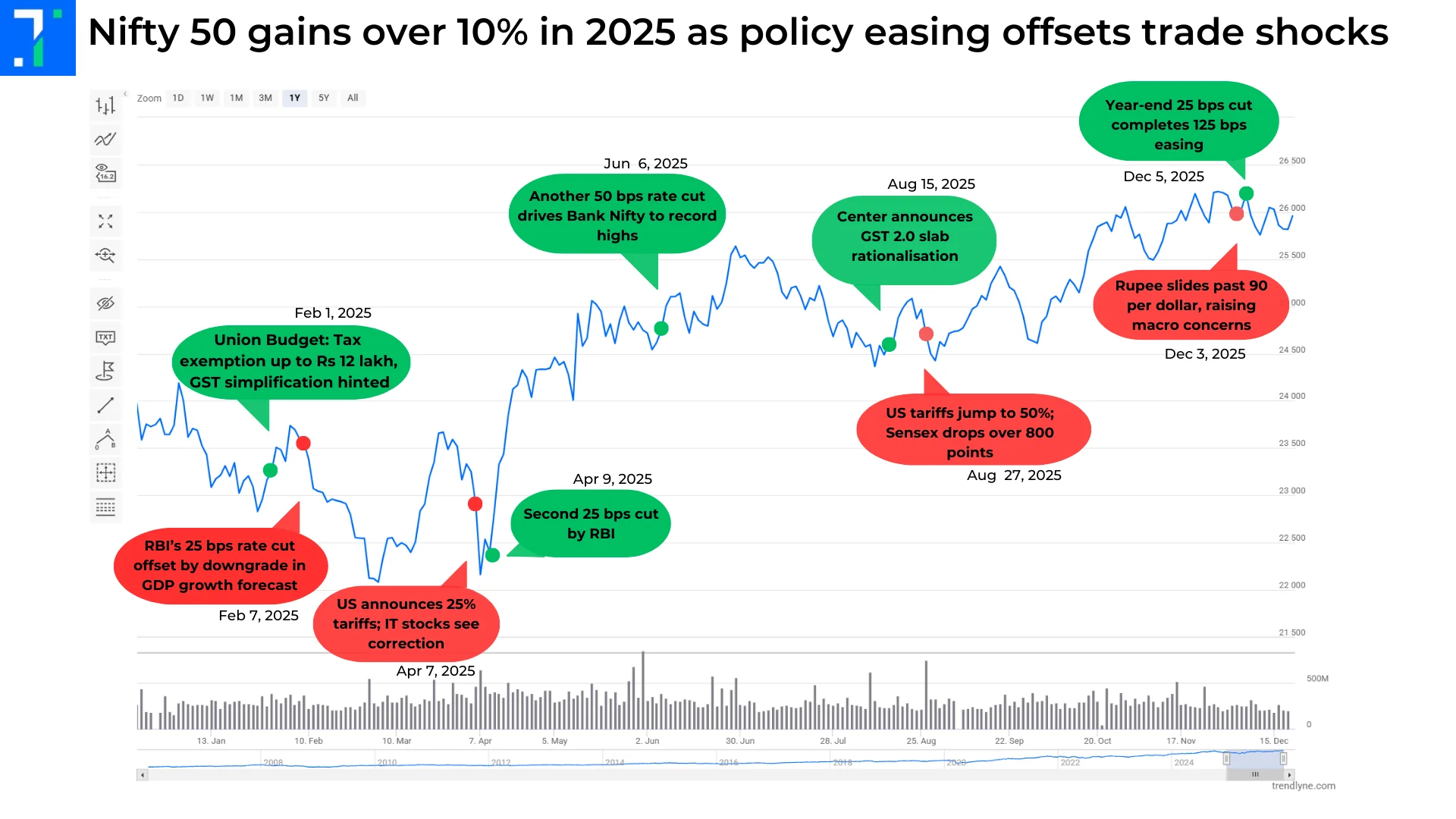
The Nifty 50 closed 2025 as one of the most unpredictable years in recent history. What began with optimism around steady growth turned over the months into a stop-start market, that struggled to find direction. By year-end, India lagged global peers, with the index delivering a modest 10.1% return.

That number doesn’t provide the full picture. There were long stretches this year where the market went nowhere, interrupted by sudden, sharp swings that tested investor patience. Unlike the smoother rallies of the past two years, 2025 felt like a constant tug-of-war between hope and fear.

Market stress was visible across earnings, valuations, and sentiment. Rajiv Batra of JPMorgan summed it up: “Indian equities were under pressure due to weak earnings, soft consumption, high valuations, trade headwinds and a weaker rupee,” noting that “policymakers are now clearly focused on reviving domestic growth.”

In this edition of Chart of the Week, we track how policy actions, global trade shocks, currency pressure, and earnings trends shaped the Nifty’s volatile journey through 2025—and why the year looks like a reset before a potential recovery.

An odd marriage: A resilient economy, a hesitant market

One of the biggest contradictions of 2025 was the gap between the economy and the stock market. While equities struggled, the broader economy held up better than expected. India’s services sector, which now contributes about 55% of total economic activity, played a stabilising role. Even as global trade slowed and manufacturing exports came under pressure, demand for services continued to grow.

The stock market, however, focused more on what could go wrong than right, given already high valuations. In H1CY25, analysts cut Nifty 50 EPS forecasts due to weak urban spending, banks seeing slower growth due to a high base, and soft global IT demand.

Valuations added another challenge. Stocks were not cheap enough to attract aggressive buying, but not expensive enough to justify extreme optimism. The result was a market stuck between strong long-term fundamentals and uncomfortable short-term realities.

RBI rate cuts: support came, but slowly

Policy support became the market’s main anchor in 2025, especially as global conditions worsened. The Reserve Bank of India took a clear pro-growth stance, cutting interest rates aggressively to support liquidity and confidence. Over the year, the RBI reduced the repo rate by a cumulative 125 basis points, taking it from 6.5% to 5.25% by December.

The first 25 bps cut in February, the RBI’s first rate reduction in five years, was met with caution. Alongside the rate cut, the central bank also lowered its GDP growth forecast by 20 bps to 6.4%, reinforcing concerns around slowing momentum. As investors focused on tariff-related risks and weaker growth signals, the Nifty slipped instead of rallying.

A second 25 bps cut in April came amid rising trade tensions, leading to an initial dip before a modest recovery led by banks and real estate stocks. June then marked a turning point. A larger 50 bps cut, along with a clear shift in the RBI’s stance, lifted sentiment. Banking stocks surged to record highs as expectations around credit growth and consumption improved.

By the time the final 25 bps cut arrived in December, the move was largely priced in. The Nifty barely reacted, ending the year in a cautious phase. Meanwhile, RBI Governor Sanjay Malhotra said India is in a rare “goldilocks” phase, with steady growth and controlled inflation. He added that rates are likely to stay low for longer, and any progress in trade talks—especially with the US—could lift growth by around half a percentage point.

Global trade shocks tested confidence, and exporters adapted

Global events remained a constant source of stress for Indian markets in 2025, with trade tensions—especially with the US—frequently unsettling investor confidence. In early April, the US imposed 25% tariffs on Indian goods, triggering a sharp fall in the Nifty. Export-heavy sectors were hit the hardest as investors quickly priced in weaker overseas demand.

The situation worsened in late August when tariffs were raised to 50% after India continued importing Russian oil. The market reacted sharply, with textiles, gems and jewellery stocks seeing heavy selling. These repeated trade shocks have deepened concerns about India’s export outlook and added to the market’s overall nervousness.

Currency pressure amplified the impact. The Indian Rupee weakened past Rs 90 to the dollar, making it one of the weakest-performing Asian currencies during this period. While a softer rupee can help exporters, it raises costs for energy imports and foreign debt repayments. Dilip Parmar of HDFC Securities noted that the rupee significantly underperformed regional peers, further weighing on sentiment.

Yet exporters did not stand still. Companies began shifting focus to alternative markets, and the data reflected this adjustment. Exports to China jumped 31% YoY in September–October, while shipments to Saudi Arabia and parts of Europe also increased. These moves helped cushion some of the damage from US tariffs.

By December, sentiment improved as talk of a potential US–India trade deal gained traction. The possibility of easing tariffs in exchange for higher Indian purchases of US energy helped calm markets and offered hope that the worst of the trade pressure may be nearing an end.

Tax relief gives consumption a boost

Alongside monetary support, fiscal measures played an important role. The Union Budget 2025 raised the personal income tax exemption limit to Rs 12 lakh, putting more money directly into household hands. While broader market reaction was muted on budget day, consumer-focused stocks responded positively in the weeks that followed.

JP Morgan estimated that the tax relief could add around 0.6% to GDP over time, gradually lifting consumption. The impact became more visible after the rollout of GST 2.0 in September. The tax structure was simplified into two main slabs—5% and 18%—replacing a complex system that businesses had long criticised.

The immediate effect was seen in consumer durables. Products like air conditioners and large televisions moved from the 28% bracket to the 18% bracket, leading to price cuts of 8–9%. Retailers reported a noticeable jump in footfalls and sales. To offset revenue loss, the government retained a steep 40% tax on luxury items such as premium SUVs.

Earnings bring a turning point

After months of uncertainty, October saw a change in the market's tone. The Nifty rose 4.5%, its strongest monthly gain of 2025, not due to policy announcements, but because earnings were better than feared. The steady stream of downgrades slowed, suggesting profits may have finally bottomed out.

Banks and auto companies led the recovery, reporting stable demand and improved cost control. The results were not spectacular, but they were “less bad” than expected—and that was enough. Motilal Oswal and other brokerages noted that the worst phase of earnings pressure appeared to be behind.

The October rally did not erase the damage of the year, but it shifted the investor mindset. As 2025 ended, the focus moved away from constant downside risks toward the possibility of a gradual recovery in 2026, making the year look less like a downturn and more like an overdue reset.

Market closes lower amid profit booking and foreign investor outflows
By Trendlyne Analysis

Nifty 50 closed at 26,142.10 (-35.1, -0.1%), BSE Sensex closed at 85,408.70 (-116.1, -0.1%) while the broader Nifty 500 closed at 23,850.25 (-44.9, -0.2%). Market breadth is in the red. Of the 2,614 stocks traded today, 1,082 were on the uptick, and 1,469 were down.

Indian indices closed lower after falling throughout the day. The Indian volatility index, Nifty VIX, fell 2% and closed at 9.2 points. Hindustan Copper closed 7.1% higher as copper hit a new all-time high of $12,159.5 per tonne. Concerns over copper supply, driven by mine disruptions, have pushed prices higher.

Nifty Smallcap 100 closed higher, while Nifty Midcap 100 closed lower. Nifty Capital Markets and BSE Oil & Gas were among the top index losers today. According to Trendlyne’s sector dashboard, Hardware Technology & Equipment emerged as the worst-performing sector of the day, with a fall of 1%.

Asian indices closed mixed. European indices are trading with varied trends. US index futures are trading flat, indicating a cautious start to the trading session. The US markets will close early today and remain shut tomorrow on account of Christmas. Brent crude futures are trading flat after rising 0.5% on Tuesday.

  • Money flow index (MFI) indicates that stocks like Honeywell Automation, United Breweries, Poly Medicure and Akzo Nobel are in the oversold zone.

  • VIP Industries surges over 10% as its promoter, the Piramal family, reportedly completes the transfer of their remaining stake to Multiples PE. Around 3.7 crore shares (25.9% equity), changed hands in multiple block deals. The Piramal family had earlier sold a 6.2% stake in September for Rs 343 crore.

  • GPT Infraprojects rises as it receives a Rs 199.2 crore railway contract from North Eastern Railway for bridge works in Uttar Pradesh. The firm also emerges as the lowest bidder for a Rs 670 crore road project awarded by the National Highways Authority of India.

  • KPI Green Energy is rising as it receives an order worth Rs 128.5 crore from NTPC to set up and operate a green hydrogen and waste-to-energy plant in Greater Noida.

  • Reliance Industries reportedly secures a one-month US concession, allowing it to receive oil cargoes from Rosneft despite sanctions. The company has a long-term agreement with Rosneft to buy 500,000 barrels per day for its 1.4 million bpd refining complex.

  • Geojit BNP Paribas downgrades Cipla to a 'Hold' call from 'Buy', with a target price of Rs 1,645 per share. This indicates a potential upside of 10.2%. The brokerage believes that the anticipated revenue erosion from Revlimid, increased R&D straining margins, and execution risk related to timely approvals could limit earnings visibility and margin recovery in the medium term. It expects the company to deliver a revenue CAGR of 7.4% over FY26-27.

  • Castrol India jumps over 2% after its parent, British Petroleum (BP), signs an agreement to sell a 65% stake in Castrol to Stonepeak at an enterprise value of $10 billion. The deal is expected to generate around $6 billion in net proceeds, including accelerated dividends, which BP plans to use entirely to reduce its net debt.

  • Punjab & Sind Bank's board of directors schedules a meeting on January 21 to consider a proposal to raise up to Rs 3,000 crore through a qualified institutional placement (QIP) of equity shares.

  • PL Capital maintains a 'Buy' rating on Adani Ports with a higher target price of Rs 1,876. The brokerage flags the NQXT port in Australia as a key milestone in the company’s international expansion. It notes NQXT as a high-quality, cash-generative deep-water export terminal with about 65% EBITDA margins and a remaining lease life of roughly 85 years. The asset is expected to scale to around AUD 400 million (~Rs 2,414 crore) in EBITDA over the next four years.

  • Ola Electric Mobility rises as its board approves a Rs 100 crore investment in its battery arm, Ola Electric Technologies. The subsidiary clears the allotment of optionally convertible redeemable preference shares to fund its battery-related activities.

  • Morgan Stanley retains an 'Underweight' rating on SBI Cards with a target price of Rs 700. The brokerage expects post-festive credit card spending growth to remain subdued at around 14% YoY, in line with pre-festive trends seen during April–August 2025. It believes high entry barriers and a strong win rate will support the company’s growth, while margin resilience is likely to be aided by the tonnage tax scheme (TTS).

  • Ajanta Pharma is rising sharply as it signs an in-licensing agreement with Biocon to market Semaglutide. As per the pact, Biocon will supply the drug to Ajanta for exclusive marketing in 23 countries and semi-exclusive marketing in three countries across Africa, the Middle East and Central Asia. Semaglutide improves glycaemic control in adults and has an estimated market size of $26 billion in 2024, according to IQVIA.

  • Investec maintains a 'Buy' rating on RBL Bank with a target price of Rs 430. The brokerage notes that the bank plans to deploy $1.5 billion of the $3 billion infusion from Emirates NBD to retire high-cost liabilities and support 30% loan growth in FY27. It expects potential rating upgrades to help narrow wholesale funding cost gaps versus larger peers.

  • GK Energy is rising as it secures an order worth Rs 276.9 crore from Maharashtra State Electricity Distribution Co (MSEDCL) to supply 10,000 off-grid DC solar photovoltaic water pumping systems.

  • Park Medi World rises as its board approves the acquisition of a 100% stake in KP Institute of Medical Sciences (KPIMS) for Rs 245 crore in an all-cash deal. The Agra-based hospital will become a wholly owned subsidiary, supporting the company’s expansion plans across North India.

  • Hindustan Copper surges to its all-time high of Rs 432 per share as copper makes a new all-time high of $12,159.5 per ton. Increased concern about copper supply, driven by mine disruptions, pushes prices higher.

  • Rishi Anand, MD & CEO of Aadhar Housing Finance, says the company is on track to deliver 20–22% growth in assets under management (AUM) in FY26 and is well capitalised for the next 2.5–3 years. He expects H2 to outperform H1, supported by strong demand and government initiatives, which are expected to add 3 crore affordable housing units.

  • Gujarat Narmada Valley Fertilizers & Chemicals is rising as it awards an order worth Rs 360 crore to Toyo Engineering India. The order is for the installation of an Ammonium Nitrate–II plant on a lump-sum engineering, procurement, and construction basis.

  • EPACK Durables is rising as its board of directors approves setting up a new air cooler manufacturing facility in Bhiwadi.

  • NTPC rises as its board of directors approves forming a 50:50 joint venture (JV) with EDF power Solutions India to set up pumped storage plants (PSPs). The board also sanctions forming a wholly owned subsidiary in Mauritius to develop power projects, including a floating solar photovoltaic (FSPV) project in the country.

  • JK Tyre & Industries announces the completion of its merger with subsidiary Cavendish Industries following the National Company Law Tribunal (NCLT) approval on November 20. As part of the merger, JK Tyre acquires an additional 12.5% stake in Cavendish from Valiant Pacific LLC, enhancing capacity utilisation and operational efficiency in the domestic tyre business.

  • Oswal Pumps is rising as it receives an order worth Rs 180 crore from Maharashtra State Electricity Distribution Co (MSEDCL) to supply and install 6,500 off-grid DC solar water pumping systems for farmers across Maharashtra.

  • Vikran Engineering surges more than 10% as it secures an order worth Rs 2,035.3 crore from Onix Renewables to set up 600 MW alternating current (AC) solar projects across Maharashtra.

  • Rail Vikas Nigam appoints Saleem Ahmad as its new Chairman and Managing Director (CMD), succeeding Sukhmal Chand Jain, effective December 23.

  • GAIL (India) signs a memorandum of understanding (MoU) with the Chhattisgarh government to set up a 12.7 lakh metric ton (LMT) urea manufacturing plant in the state. The company will locate the facility along its Mumbai–Nagpur–Jharsuguda Natural Gas Pipeline (MNJPL) corridor.

  • Nifty 50 was trading at 26,188.05 (10.9, 0.0%), BSE Sensex was trading at 85,533.11 (8.3, 0.0%), while the broader Nifty 500 was trading at 23,913.05 (17.9, 0.1%).

  • Market breadth is surging up. Of the 2,068 stocks traded today, 1,348 were on the uptick, and 636 were down.

Riding High:

Largecap and midcap gainers today include NTPC Green Energy Ltd. (93.27, 3.1%), Hindustan Zinc Ltd. (624.85, 2.5%) and Trent Ltd. (4,289.60, 2.4%).

Downers:

Largecap and midcap losers today include Coforge Ltd. (1,737.70, -2.4%), Persistent Systems Ltd. (6,353, -2.1%) and HDFC Asset Management Company Ltd. (2,656.10, -2.0%).

Crowd Puller Stocks

12 stocks in BSE 500 are trading on high volumes today.

Top high volume gainers on BSE included JBM Auto Ltd. (639.95, 10.7%), Manappuram Finance Ltd. (314.55, 6.7%) and IIFL Finance Ltd. (602.15, 5.1%).

Top high volume losers on BSE were Emcure Pharmaceuticals Ltd. (1,409.80, -1.2%) and Shyam Metalics and Energy Ltd. (824.10, -0.3%).

Castrol India Ltd. (189.39, 1.9%) was trading at 34.9 times of weekly average. Ajanta Pharma Ltd. (2,734.50, 2.5%) and HEG Ltd. (550.55, 2.1%) were trading with volumes 10.7 and 6.6 times weekly average respectively on BSE at the time of posting this article.

BSE 500: highs, lows and moving averages

22 stocks made 52 week highs, while 3 stocks were underachievers and hit their 52 week lows.

Stocks touching their year highs included - AIA Engineering Ltd. (3,941.90, 1.1%), Ashok Leyland Ltd. (175.31, -1.5%) and Bharat Forge Ltd. (1,450.50, -0.7%).

Stocks making new 52 weeks lows included - ACC Ltd. (1,739.40, -0.8%) and Jyothy Labs Ltd. (279.65, -0.5%).

14 stocks climbed above their 200 day SMA including JBM Auto Ltd. (639.95, 10.7%) and PNB Housing Finance Ltd. (966.30, 3.6%). 8 stocks slipped below their 200 SMA including The Bombay Burmah Trading Corporation Ltd. (1,862.70, -1.7%) and Angel One Ltd. (2,523.80, -1.3%).

logo
The Baseline
23 Dec 2025
Five stocks to buy from analysts this week - December 23, 2025
By Abdullah Shah

1. Vishal Mega Mart:

Motilal Oswal retains its ‘Buy’ call on this retail store chain with a higher target price of Rs 170 per share, an upside of 24.3%. Despite an 8.2% drop in the stock price last quarter, analysts Aditya Bansal and Avinash Karumanchi see strength in the stock. Vishal Mega Mart benefits from its diverse product mix, budget-friendly starting prices, major contribution from its own brands, and an efficient cost structure. These give it an edge over both offline and online value competitors.

Management remains confident in achieving double-digit same-store sales growth in FY26, driven by its unique offerings, with around 75% of revenue from its own brands, entry-level pricing, and a loyal customer base. Analysts add that the company's focus on offering premium products helps it capture a larger share of customer spending, particularly during festive seasons.

Bansal and Karumanchi point out that South India's profitability matches the national average, despite lower sales volume, thanks to strong demand for apparel. Encouraged by this performance, the company plans to open more stores in South India. They project Vishal Mega Mart will achieve a 20% revenue CAGR and a 30% net profit CAGR from FY26-28.

2. Waaree Energies:

Emkay reiterates its ‘Buy’ call on this solar module manufacturer, with a target price of Rs 4,260, an upside of 37.6%. Its share price has fallen 2.8% over the last month and 10.4% over the three months. Waaree's planned $30 million investment in United Solar Holding (USH) drives this recommendation. It grants Waaree access to a 1 lakh tonnes-per-year polysilicon plant in Oman. This supports partial backward integration in its solar supply chain.

The Oman plant offers cost benefits, lower energy expenses, and favourable trade terms with markets such as the US and India. This will help Waaree meet the 10-gigawatt wafer-ingot demand for its Nagpur facility. Management expects the plant to begin operations soon and reach full capacity within a year. This ensures long-term supply security and reduces reliance on Chinese polysilicon.

Waaree also added 5.1 gigawatts of module capacity in Gujarat during Q3, strengthening its domestic manufacturing. Analysts Sabri Hazarika and Arya Patel state that the USH investment will enhance scale, integrate the supply chain, and support global expansion. They expect this step to improve margins gradually. They also see Waaree well positioned to profit from rising global solar demand and clearer supply prospects.

3. Lumax Auto Technologies

ICICI Direct reiterates its ‘Buy’ rating on this auto parts & equipment producer with a target price of Rs 1,800 per share, an upside of 14.3%. Analysts Shashank Kanodia and Bhavish Doshi see benefits from the company’s strong position in the passenger vehicle (PV) ancillary segment, gains from premium products, and a robust order book.

Management notes that the PV segment generated 55% of the company’s sales in H1FY26, boosted by the acquisition of PV interior supplier International Automotive Components (IAC) India. Analysts add that this acquisition gave Lumax Auto’s product range a boost, particularly in plastic interior modules. It has also expanded business with original equipment manufacturers (OEMs) such as Mahindra & Mahindra.

With a 40% share of EV platforms in its Rs 1,360 crore order book and increasing content per vehicle, the analysts believe the company is well positioned to profit from volume growth and premiumisation among leading OEMs. Kanodia and Doshi write that GST 2.0 reforms will drive two-wheeler segment growth, led by volume recovery. They expect the company to deliver an 18.1% revenue CAGR and a 30.6% net profit CAGR from FY26-28.

4. Aditya Infotech

ICICI Securities maintains its ‘Buy’ call on this IT networking equipment manufacturer, with a target price of Rs 1,800 per share, a 15.9% upside. The stock has dropped 6.9% over the past month. Analysts Aniruddha Joshi and Manoj Menon believe Aditya Infotech will continue to gain market share, driven by stronger brand recognition and expanded manufacturing.

Management highlights increased brand-building investments. This includes expanding CP Plus Galaxy stores, which are their specialised outlets for advanced surveillance products, and more advertising. Analysts add that this brand push is crucial to attract consumers and support premium product offerings. The company's partnership with Qualcomm for AI-enabled video security solutions has differentiated its products and improved customer retention.

Joshi and Menon believe the company's planned capacity expansion in Kadapa and a new North India manufacturing unit will improve service speed, cut logistics costs, and enable faster market entry. Analysts add that successful partnerships with semiconductor players will boost product performance and long-term cost efficiencies. They expect the company to deliver revenue and net profit CAGRs of 24.3% and 65.2%, respectively, from FY26-28.

5. Shriram Finance

Axis Direct reiterates its ‘Buy’ call on this NBFC, with a target price of Rs 1,125, an upside of 17.5%. Analysts Dnyanada Vaidya and Abhishek Pandya cite MUFG Bank's planned strategic investment as the main driver of this positive outlook. MUFG intends to buy a 20% stake for roughly Rs 841 per share via a preferential allotment. 

This Rs 39,618 crore deal marks India's largest foreign direct investment in its financial services sector. The capital infusion will strengthen Shriram Finance's fundamentals. It is also expected to fuel faster growth in areas like new commercial vehicles and MSMEs. Management believes the partnership will boost capital reserves, simplify fundraising, and improve governance. MUFG-appointed directors will help guide the company's strategy.

Vaidya and Pandya expect lower funding costs, possibly due to a credit rating upgrade. If the deal closes in FY27, Shriram Finance's net worth could nearly double. They foresee a 17% CAGR in assets under management from FY26-28 and margins improving by 80-90 basis points in FY27-28. Although equity dilution might limit return on equity, analysts predict overall returns will rise due to better profitability.

Note: These recommendations are from various analysts and are not recommendations by Trendlyne.

(You can find all analyst picks here)

logo
The Baseline US
23 Dec 2025
Four trends that will shape the US stock market in 2026

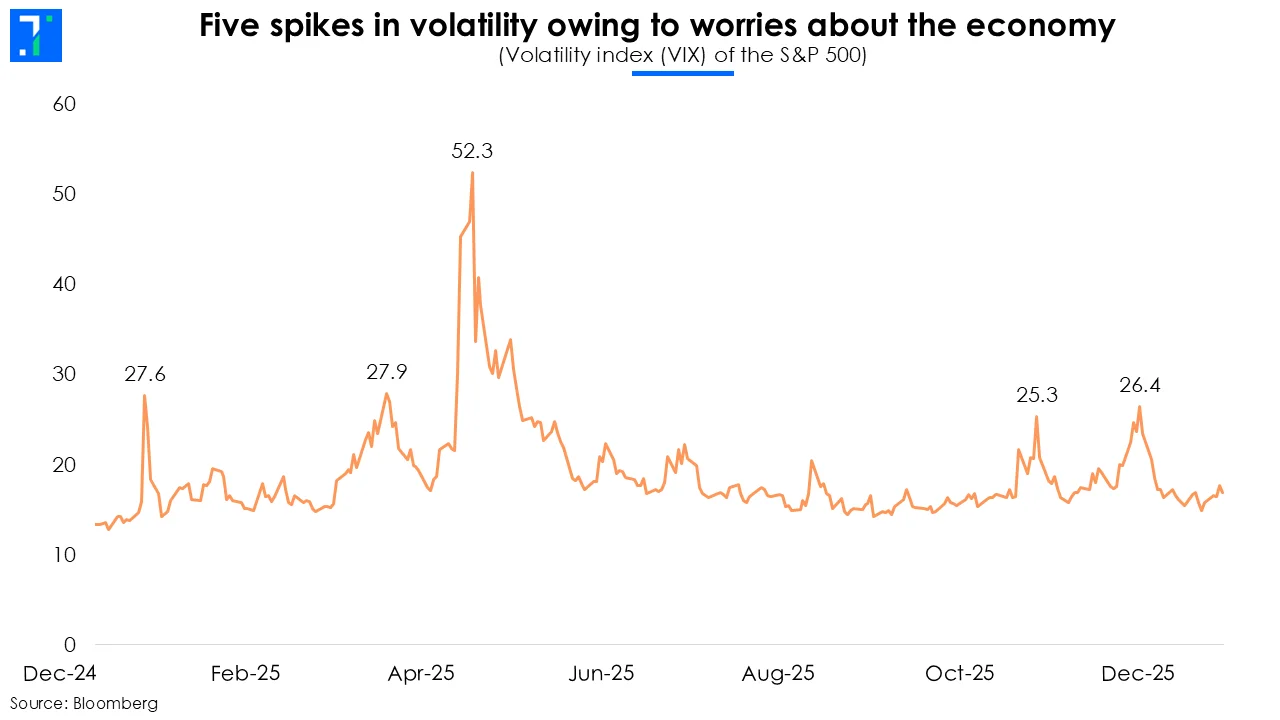
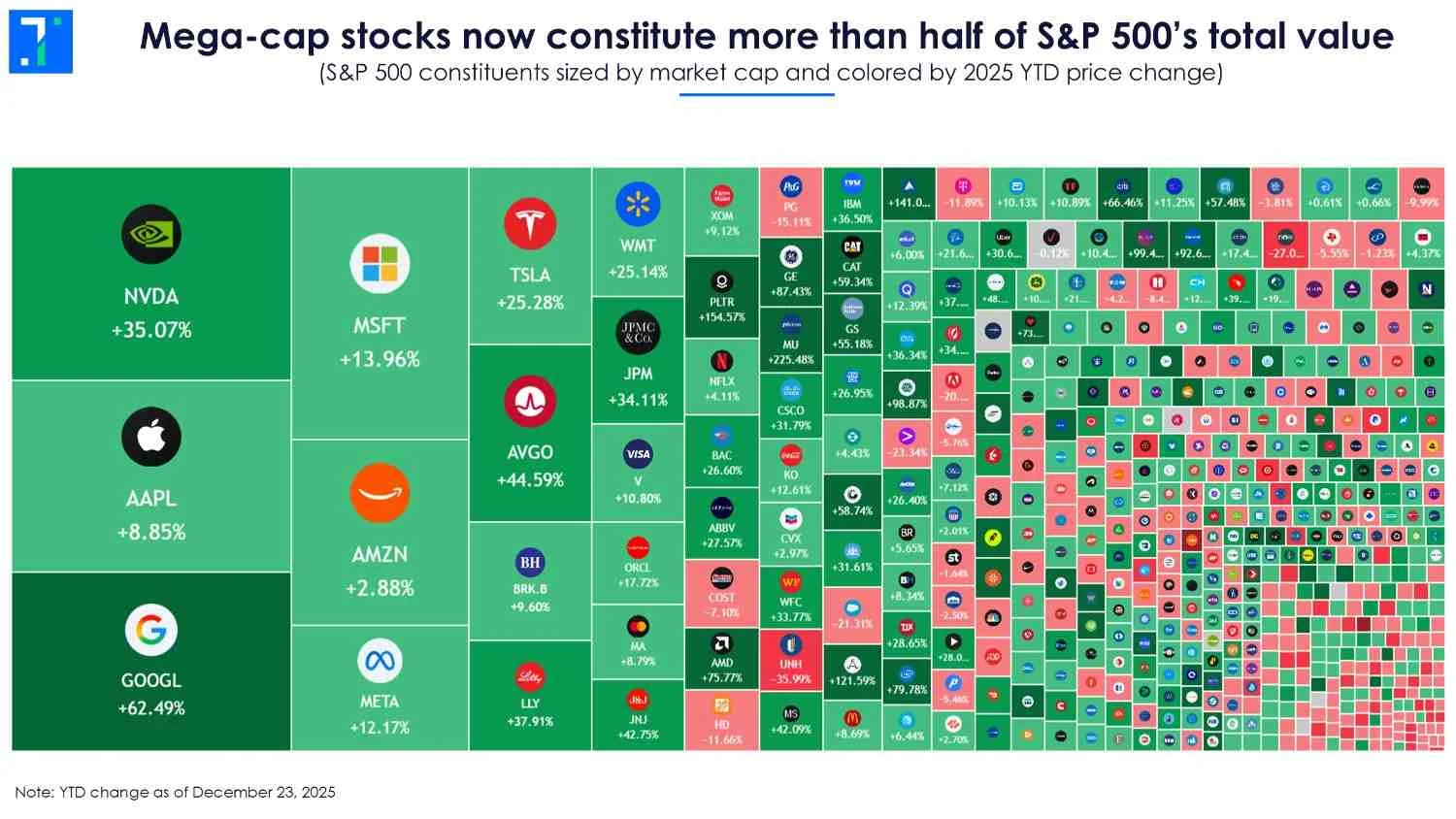
The US stock market in 2025 was a season of plot twists and jump scares. In April, the S&P 500 index corrected by over 10% due to the Trump tariffs. By June, it ripped to fresh highs after President Donald Trump softened his stance and investors piled headfirst into anything even remotely AI-related. So far in 2025, the index is up by more than 17%, reaching a level of 6,878 by December 23. But more than half of those gains came from a few mega-cap giants worth $200 billion or more.

This sets the stage for a very different 2026. According to David Kostin of Goldman Sachs, the easy phase is over. The era of rising multiples is ending, and the next leg of the bull market will lean less on hype and more on hard earnings growth.

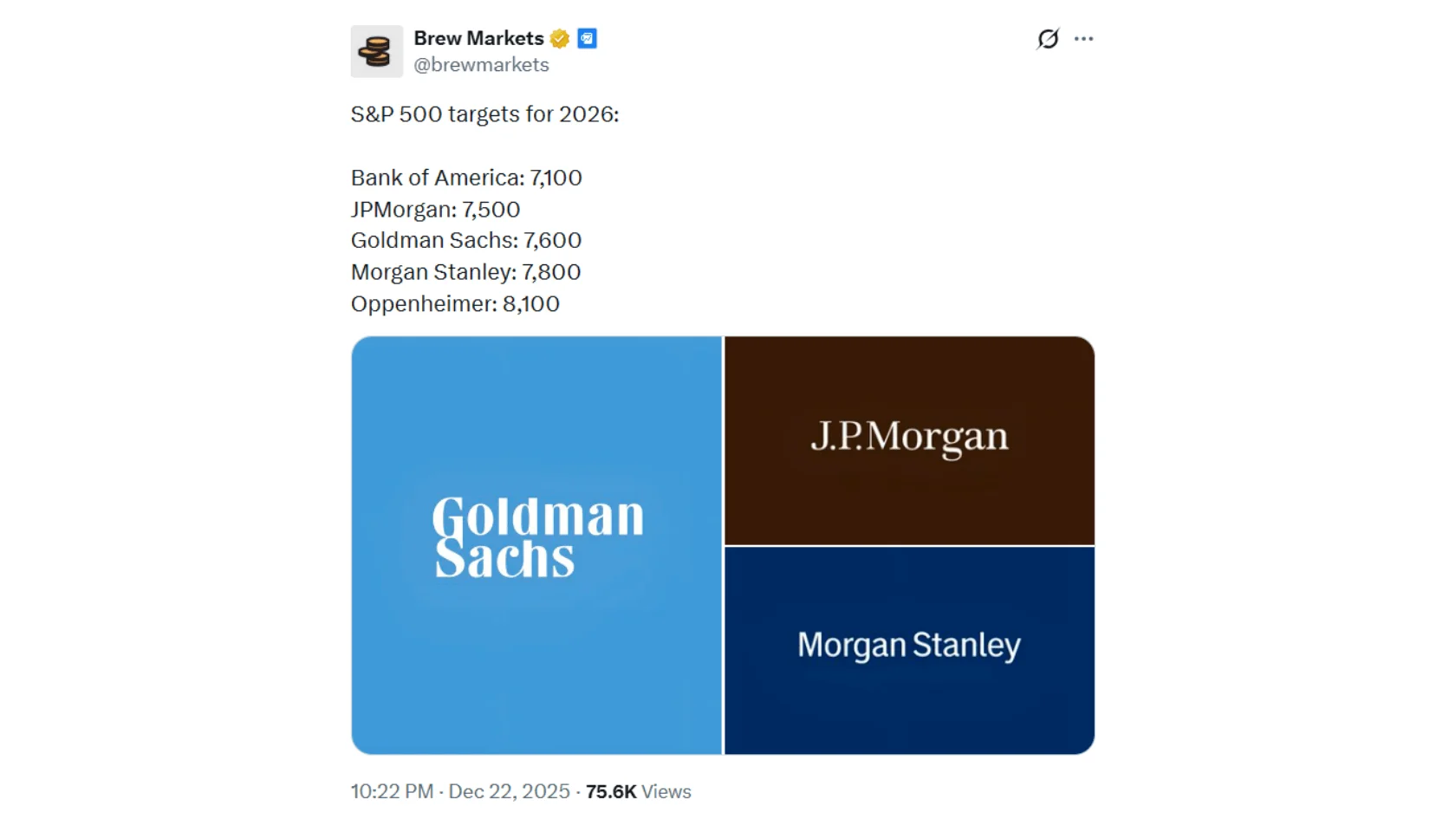
Not everyone is convinced returns will be exciting. Savita Subramanian of Bank of Americawarns that slowing share buybacks could cap S&P 500 gains at a modest 4% next year, with a target price of 7,100.

Jean Boivin of BlackRocksays, "The market is moving from a policy-driven phase to a productivity-driven one." He suggests that as capital spending translate into results, the focus must move toward infrastructure.

Let’s look at four trends that will shape 2026 returns.

  1. The AI bill comes due next year

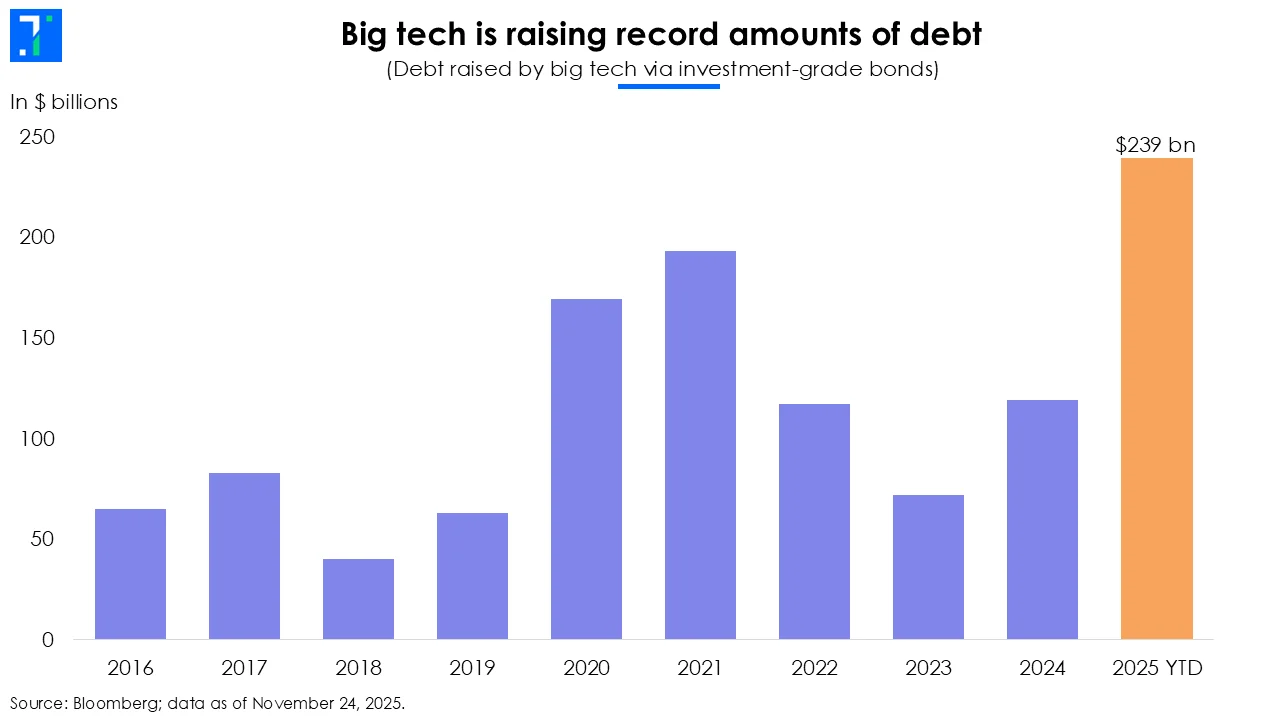
For the past three years, markets treated AI like a free lunch. Productivity gains were assumed, and valuations ran ahead of reality. By 2026, hyperscalers are expected to spend over $527 billion on capital expenditure, sharply higher than earlier estimates of $465 billion. The money is pouring into chips, data centers, and power-hungry infrastructure, to keep chatbots like ChatGPT, Gemini, and Claude running smoothly, and to make sure they’re ready to handle a (highly disruptive) shift of economic activity from humans to machines.

The final bill may run into the trillions. The financing is coming from venture capital, debt and, lately, unconventional circular financing arrangements that have raised eyebrows on Wall Street.

A flood of debt sales from Big Tech could weaken the credit market on both sides of the Atlantic. Wall Street underwriting to fund AI and data centers is soaring, but would-be creditors are starting to worry about being compensated for the risks of a bubble. Tech firms are expected to float as much as $1.5 trillion of debt by 2028.

Morgan Stanley warns that this could push up borrowing costs as investors may demand higher returns to absorb the supply. KKR’s Raj Agrawal says, “Some of these investments are likely not going to work out, that’s just the reality when you have this much capital moving this fast.”

The gap between infrastructure spending and revenue generation is increasingly visible. Many companies funded AI expansion with debt, introducing new balance-sheet risks. Debt-funded AI spending is widening the divide between leaders and laggards, pushing investors away from firms where capex growth is not matched by cash flow. This led Meta to shift its focus from open source models to money-making ones.

  1. Concentration risk rises as capital crowds into top companies

Beneath the noise is a structural problem: extreme concentration. Investors have crowded into “one dominant stock per sector” in search of safety. Nvidia in semiconductors and Eli Lilly in healthcare are prime examples. While fundamentals remain strong, overcrowding amplifies downside risk due to expensive valuation compared to its peers.

Dubravko Lakos-Bujas of JPMorgan says, “markets are becoming unbalanced, with too much money flowing into just a few popular stocks. When many investors pile into the same names, prices move more sharply." It also makes risk harder to manage, because in stressful periods, heavy selling can quickly push prices down.

2025 was “Trump 1.0 on steroids,” said Keith Lerner, chief investment officer and chief market strategist at Truist Advisory Services Inc., adding that he can’t recall another period when US political decisions triggered this much market volatility.

  1. AI’s appetite for power is raising electricity costs

The power bill shock isn’t over. As the US heads into 2026, electricity prices are moving higher. Throughout most of the year, US electricity bills rose faster than overall consumer prices. By September 2025, electricity bills were up 5.1% YoY, compared with a 3% rise in broader consumer inflation.

Retail power rates jumped 7.4% in September 2025, pushing prices to a record 18.1 cents per unit, the steepest increase in nearly two years. With fuel costs climbing and demand staying firm, power bills for homes, transport and businesses are likely to rise further next year.

Electricity demand is rising far faster in Texas and the Mid-Atlantic than the national average. While US power sales are expected to grow about 2.2% annually, Texas demand could jump around 11%, driven by data centres, factories and crypto mining, while PJM demand is set to rise 4% in 2026, led by Northern Virginia.

Data center expansion is the primary driver. Global electricity consumption by data centers is projected to grow 17% through 2026. “AI’s surging power demand growth will be testing grid limits,” says Eduard Sala de Vedruna of S&P Global Energy. Utilities are being forced into large-scale infrastructure upgrades to meet this demand.

  1. Diversification beyond mega-cap firms

The mega-cap firms now make up more than half of the S&P 500’s total value, a historic high. However, the market’s spotlight is shifting toward the “enablers” powering the AI boom. Industrial firms and semiconductor supply chains that provide copper, power equipment, cooling systems, and grid hardware are unglamorous but indispensable inputs to the AI and electrification buildout, and many still trade at far more reasonable valuations.

As a result, leadership is expected to rotate toward cyclical and value-oriented sectors. Solita Marcelli of UBS says, "Financials and healthcare are providing a broad foundation as policy uncertainty fades." Mike Wilson of Morgan Stanley adds that investors should favor "industrials and real assets" to capitalize on a "run-it-hot" economy focused on domestic manufacturing.

Semiconductor onshoring is driving a multi-year investment cycle. New US manufacturing plants are coming online, boosting demand for construction and engineering services. The push to make chips at home is driven by national security concerns flagged by the Trump administration. Because these factories are seen as critical infrastructure, spending is likely to continue even if the broader economy slows.

Thanks to these shifts, Michael Wilson of Morgan Stanley expects “market breadth to improve” as leadership shifts toward Financials and Industrials, describing 2026 as an “early-cycle” bull phase for the broader index.

The next phase of returns may favor companies solving physical bottlenecks. Power, cooling, and grid infrastructure providers are gaining attention. Denise Chisholm of Fidelity notes that “rotation and small caps” could outperform as leadership widens. In this environment, diversification is no longer just protection, but a source of opportunity.

The transition from 2025 to 2026 marks the end of the "imagination phase" of the AI bull market and the beginning of the "execution phase." While the previous year was defined by geopolitical plot twists and a narrow chase for mega-cap safety, the coming year will demand a different approach.