My Newsfeed

logo
The Baseline
24 Nov 2025
By Divyansh Pokharna

India’s federal system has long depended on both the Centre and the states working smoothly together. States handle around 60% of public spending — they run schools, hospitals, roads, welfare schemes, and local infrastructure. They prioritize spending based on local needs, and are considered more in sync with what their people need, compared with the Central government in Delhi, which is far from the constituents. But for years, the financial health of the states has been weakening, and recent reports show the problem is getting worse.

States’ debt touched 27.5% of GDP in FY25, far above the widely recommended limit of 20%. This affects how much they can budget for new projects, and future growth. A major turning point came in 2017, when GST was introduced, and states gave up many of their earlier taxing powers. This reduced their ability to raise money independently.

At the same time, routine expenses like salaries, pensions, subsidies, and even “freebies” now consume over 60% of their revenues, leaving far less room for development projects.

Adding to this, the way the Centre transfers money has also changed. More funds come with conditions, limiting how states can spend them. Devendra Pant, Chief Economist at India Ratings & Research, notes, “Because cesses and surcharges are not shared with states, the pool is shrinking — even if the Centre’s tax collections grow, the actual money that comes back to states keeps falling.”

Put simply, states are losing financial freedom, and this affects their ability to function effectively. In this edition of Chart of the Week, we look at why this is not just a money problem — it affects states’ independence and the historical way India has grown, where both the Centre and the states drive the economy together.

The squeeze begins with GST shifts

The stress on state finances comes from three forces: changes in tax powers after GST, rising day-to-day expenses, and changes in how the Centre shares revenue. The introduction of GST in 2017 was the biggest turning point. Before GST, states could set their own value-added tax (VAT) and sales tax rates. After GST, most of these powers moved to the GST Council.

As a result, combined (Centre + states) revenue from taxes replaced by GST fell from 6.5% of GDP in FY16 to 5.5% in FY25, well below the 15th Finance Commission’s target of 7%. For states alone, these revenues declined from 2.9% of GDP in FY16 to 2.3% in FY21 before recovering again, though this is still short of earlier levels.

Meanwhile, the cost of running state governments has increased. Salaries, pensions, and subsidies — especially in electricity and agriculture — have steadily reduced the funds available for development.

Adding to the strain, some states spend a lot on popular ‘freebie’ schemes, which are politically attractive but put heavy pressure on their budgets. Bihar’s free electricity scheme of 125 units per month will cost the government over Rs 19,000 crore in FY26. The recent election-time freebies are projected at Rs 33,000 crore, equal to about 13.1% of the state’s revenue expenditure, adding to its debt of about Rs 4.1 lakh crore.

Andhra Pradesh lets women, girls, and transgender people travel free on many state buses, costing nearly Rs 1,940 crore a year. When combined with other welfare and schemes, the state’s outlay rises to nearly Rs 69,400 crore in FY25, absorbing 29.4% of its revenue expenditure.

Karnataka faces similar pressure. Its five guarantee schemes, including free electricity under Gruha Jyothi and free bus travel under Shakti, cost over Rs 53,000 crore in the FY25 budget, taking up around 18% of the state’s revenue expenditure. These programs divert funds from infrastructure, hospitals, roads, and factories — areas that support long-term growth.

Another issue is the Centre’s increasing use of cesses and surcharges to raise revenue, which are not shared with states. Based on FY26 budget estimates, the Centre is projected to collect around 13.8% of its gross tax revenue through these non-shareable levies. Even the International Monetary Fund noted that “the states bear most of the responsibility for delivering essential public services … but raise much less revenue than the Centre.”

GST 2.0 further bites into revenues

Pressure on states increased after the GST 2.0 rate cuts in September 2025. In October 2025, 20 out of 36 states and UTs recorded a drop in GST collections: Himachal Pradesh by 17% YoY, Jharkhand 15%, Uttarakhand 13%, Andhra Pradesh 9%, and Rajasthan 3%.

Analysts estimate the GST changes may cause a revenue shortfall of Rs 40,000–80,000 crore, with states likely to absorb most of the loss. As one Congress MP said, “The states will lose half or more of this, but neither GST nor cess will flow to them.”

In short, reduced tax power, rising fixed costs, and tighter central funding have squeezed states just when they need to spend more on development.

How are budgets being reshaped?

Growing financial stress is changing how states design their budgets. As debt increases, interest payments rise, leaving less room for new investments.

Only three states—Gujarat, Maharashtra, and Odisha—are within the recommended debt limit of 20% of GDP. Many others are far over it, with some exceeding 30-40%. Himachal Pradesh’s debt is close to 40% of GDP, West Bengal is around 38%, and Rajasthan is about 36%. In addition, state guarantees to loss-making public enterprises, especially electricity distribution companies, add further pressure that is not always visible in headline numbers.

This creates a difficult cycle. Weak revenue forces states to borrow more, higher borrowing raises interest payments, and rising interest costs leave even less room for investment. It also puts more pressure on the Centre, since the overall system depends on both sides contributing to economic progress.

To help with this, the Centre introduced the Scheme for Special Assistance to States for Capital Investment (SASCI), which provides long-term, interest-free loans. Between FY21 and August 2025, states received about Rs 4 lakh crore through this program. Initially, most loans were unconditional, but now only 38% of the funds are untied; the rest require states to meet specific reform-linked conditions.

Northeastern states, along with Sikkim and West Bengal, depend heavily on these central loans. Meanwhile, industrial and services-heavy states like Telangana, Gujarat, Maharashtra, and Karnataka rely on them for less than 10% of their capital spending.

The Reserve Bank of India has also raised the seriousness of the problem, urging states to borrow in a more predictable, planned manner, as total state borrowing is expected to reach a record Rs 12 trillion in FY26.

Rising tensions over resource sharing

As finances tighten, long-standing debates over how national resources are shared have become sharper. The current system, based on factors like income levels and population, aims to balance development needs. But richer states such as Maharashtra, Gujarat, Tamil Nadu, and Karnataka argue that the formula returns far less than what they contribute.

For every Rs 100 Maharashtra contributes in direct taxes, it receives only Rs 6.8 back. Karnataka receives Rs 12.5. Lower-income states receive far more than they contribute. Bihar gets roughly Rs 771 back for every Rs 100 of central taxes it contributes, while Uttar Pradesh receives around Rs 293. Rajasthan and several Northeastern states are also major net gainers because they have greater development needs and weaker tax bases. 

This imbalance has sparked political tension. In September 2025, the Congress party used a Comptroller and Auditor General (CAG) report to accuse the Centre of practicing “coercive federalism.” It argued that the jump in state debt from Rs 17.6 lakh crore in 2013 to Rs 83 lakh crore in 2024 shows a deep imbalance in how resources are shared. 

The larger risk is clear: if financially stressed states cannot invest in infrastructure and development, regional gaps will widen and the balance of India’s growth model will break, leaving the Centre to carry most of the load


logo
The Baseline
21 Nov 2025
Five Interesting Stocks Today - November 21, 2025
By Trendlyne Analysis

1. Indian Hotels Co (IHCL):

Thishotel company rose 2.2% last week as it moved beyond its core hotel business and entered into the wellness space. The companyacquired a 51% stake in Atmantan (Sparsh Infratech), a Pune-based wellness resort, for Rs 240 crore. Sparsh recorded a turnover of Rs 77 crore in FY25, up 19% from last year.

With this deal, IHCL plans to build a wellness platform using Atmantan’s programs and expertise. The idea is to tap rising demand for wellness travel and add a business that earns better margins than regular hotel rooms. According to Jefferies, this step can “improve cross-selling potential and build a cycle-resilient business mix without stressing the balance sheet.”

InQ2FY26, Indian Hotels posted a 15% YoY rise in net profit to Rs 285 crore. Revenue grew 12%, supported by better room rates and higher management fees from its asset-light hotel network. Costs were largely under control, and despite weak air travel and fewer international tourists, the EBITDA margin improved by 90 bps to 30.8%, as average room rates saw a rise.

CEO Puneet Chhatwalsaid bookings for November and December remain strong, adding that the company expects solid growth in the next two quarters. He confirmed the outlook of double-digit revenue growth for FY26, supported by major diplomatic events and a busy wedding season.

CFO Ankur Dalwani guided for capex of over Rs 1,000 crore in FY26 and about Rs 1,200 crore in FY27. He added that the Clarks acquisition — a heritage hotel chain in North India — is likely to “add roughly Rs 100 crore in profits” over the medium term. Management contracts, where the company operates hotels it doesn’t own, continue to deliver margins above 70%.

ICICI Securitiesmaintains a Buy rating on the stock with a target of Rs 915, pointing to limited room supply in key markets. Strong room rates, upgraded premium hotels, and rising management fee income are expected to drive a 19.5% profit CAGR. This should take profits to around Rs 4,724 crore over the next three years.

2. Prestige Estates Projects:

Therealty giant jumped 3.2% on November 13 after announcing itsQ2FY26 results. Net profit skyrocketed 124% YoY to Rs 430.3 crore,beating Forecaster estimates. Revenue climbed 5.5%, fueled by steady demand for properties in Bengaluru, NCR, and Mumbai.

“We achieved a record-breaking sales of Rs 18,143 crore in the first half of this financial year, surpassing our entire FY25 sales in just 6 months,"said Executive Director Zayd Noaman. The NCR region alone drove 45% of H1 sales, a major pivot for the Bangalore-centric firm. With old inventory running low, new project launches powered 63% of bookings.

Prestige reaffirms its confident outlook for FY26, holding its presales guidance at Rs 27,000 crore, with most of it already secured in H1. The company is also expanding aggressively beyond its home turf, especially in West India. Management is earmarking Rs 8,000–10,000 crore in capex over the next three years to fuel growth in Mumbai and Pune. As part of this strategy, six Mumbai projects are already underway, with nearly 15 more planned for the region. Tariq Ahmed, chief executive officer for West India,said the strategy is to “expand more within Mumbai and explore other cities over time.” 

Despite this success, management is hitting the brakes on further price hikes. MD Irfan Razacksaid prices have “reached certain peaks” and raising them could crush demand and affordability. The focus, he noted, has shifted to maintaining sales volume and protecting the bottom line, not chasing higher prices.

Following the results, Axis Directreiterated its ‘Buy’ rating, pointing to a massive Rs 43,000 crore launch pipeline and the company’s clear roadmap for upcoming projects. The brokerage believes this pipeline will power the company to smash its FY26 presales guidance.

3.Jubilant Foodworks:

This QSR player gained 7.3% on November 14 following the announcement of its Q2 results. The company's net profit surged almost threefold to Rs 186 crore, helped by lower finance costs and a one-time gain of Rs 84.7 crore from the sale of a Russian subsidiary. 

Jubilant FoodWorks, through its step-down subsidiary Fidesrus BV, sold its 100% stake in Russian unit Pizza Restaurants LLC in July, as part of a strategy to focus on core markets (India, Sri Lanka, Bangladesh, and Nepal) and streamline overseas operations.

Meanwhile, revenue grew 18.7% YoY to Rs 2,355.4 crore, driven by new store openings and stronger performance from Domino's India. It features in a screener of stocks with increasing revenue for the past two quarters. During the quarter, Domino’s Pizza reported like-for-like or LFL growth of 9.1%.

Analysts noted that while most fast-food chains faced pressures from muted demand and subdued foot traffic, Jubilant FoodWorks stood out with growth powered by its delivery business. The company also highlighted that strong demand for its premium offerings in Tier-2/3 cities helped offset slower growth in major tech hubs like Hyderabad, Bengaluru, and Gurugram.

Commenting on the company’s performance, MD and CEO Sameer Khetarpal said, “We remain optimistic about our performance in the second half of the year, with our October performance already ahead of plan. We are targeting revenue growth in the mid-teens for the full year, supported by 5-7% growth at our existing stores.” The company also aims to increase its operating profit margin by 200 bps by FY28, driven by making its stores more productive, and reducing losses in its non-Domino's brands.

The company has continued to expand its store network in the second quarter, opening 81 new Domino’s outlets and taking the total to 2,321 stores in India.

HSBC upgraded its rating on Jubilant Foodworks to a ‘Buy’ with a target price of Rs 660. The brokerage attributes the recent stock correction, strong quality of the company's franchise, ongoing strategic initiatives, and moderating competition as reasons for the upgrade.

4. Multi Commodity Exchange of India (MCX):

The stock of this capital markets company scaled a fresh 52-week high of Rs 9,975 on November 20, riding the wave of stellar second-quarter results announced earlier in the month. Its net profit surged 41.5% to Rs 156.4 crore compared to last year, fueled by a boom in the futures segment. Revenue also climbed nearly 35%, as sharp price swings in gold and silver drove a flurry of trading activity on the platform.

The company’s Q2 net profit marginally missed Trendlyne's Forecaster estimate by 0.9% due to an increase in employee expenses and subdued participation from Portfolio Management Services (PMS) clients. Its stock features in a screener of companies with no debt.

The exchange saw a massive spike in volume in the quarter, with the average daily turnover for futures jumping 55% and options rising 25%. More people are participating, with active client numbers up 16%. To keep this momentum going, MCX introduced several new products, including new monthly contracts for Silver and Nickel, and options on its Bullion Index. Management confirmed they have a robust pipeline of future products with regulatory approvals already in hand.

CEO Praveena Rai noted a shift in who is trading, pointing out that while domestic mutual funds and large institutional funds are very active, portfolio management services are yet to catch up. Addressing the potential launch of weekly options, she clarified that they are still under evaluation with no set timeline, as the exchange carefully reviews market dynamics and regulations.

Brokerage firm ICICI Direct has assigned a ‘Hold’ rating to the stock with a target price of Rs 10,000. The firm views MCX as a solid play on commodity volatility, particularly in oil and gold. With healthy traction in options trading and a steady stream of new clients and products, analysts expect steady business growth over the long term.

5. Alkem Laboratories:

This pharmaceutical manufacturer’s stock touched a new 52-week high of Rs 5,868 on November 13 after posting strong Q2FY26 results. Net profit grew 11.1% YoY to Rs 765.1 crore, driven by lower raw material expenses and delayed research & development expenses. Revenue jumped 15.7% to Rs 4,104.7 crore, supported by improvements in both domestic and international markets. Both net profit and revenue beat Forecaster estimates by 5.5% and 6.4%, respectively.

Alkem Labs’ six therapies, including anti-infectives, gastrointestinal, and vitamins, minerals & nutrients, outperformed the Indian pharmaceutical market (IPM), helping the Indian business (70% of revenue) to grow. Recovery in the US business (19% of revenue) was driven by revenue from the launch of Sacubitril & Valsartan (medication used to treat chronic heart failure), and expansion in the contract development & manufacturing organisation (CDMO) vertical. Meanwhile, strong volume growth in Australia and Germany supported improvement in other international markets. 

Following the results, Alkem Labs’ Chief Executive Officer, Vivek Gupta, noted, “We upgrade the US business estimates to mid-single-digit growth from the earlier estimates of 5%, driven by 3-4 potential product launches in H2FY26. The US CDMO plant is also slated to be operational in Q3FY26. We believe that the Indian market will outperform the market growth rate, which is expected to be around 8-8.5%, by 100-150 bps.”

Post results, ICICI Securities maintained its ‘Buy’ call on Alkem Labs, raising its target price to Rs 6,600 per share, a 15.8% upside. The brokerage remains positive on the company, supported by a strong rebound in branded formulations and trade generics, along with better traction in Enzene (Alkem's biotech research arm) and medtech ventures. It expects the company to deliver revenue and EBITDA CAGRs of 11.5% and 14.9%, respectively, over FY26-28.

Trendlyne's analysts identify stocks that are seeing interesting price movements, analyst calls, or new developments. These are not buy recommendations

Market closes lower, dragged by a global sell-off
By Trendlyne Analysis

Nifty 50 closed at 26,068.15 (-124, -0.5%) , BSE Sensex closed at 85,231.92 (-400.8, -0.5%) while the broader Nifty 500 closed at 23,790.25 (-185.2, -0.8%). Market breadth is moving down. Of the 2,587 stocks traded today, 605 were on the uptick, and 1,934 were down.

Indian indices closed lower, dragged by a global sell-off, following mixed US jobs data. The Indian volatility index, Nifty VIX, rose 12.3% and closed at 13.6 points. Billionbrains Garage Ventures (Groww) closed higher as Q2FY26 net profit jumped 12.2% YoY to Rs 471.3 crore, helped by lower employee benefits expenses.

Nifty Smallcap 100 and Nifty Midcap 100 closed in the red, tracking the benchmark index. BSE Metal and Nifty India Defence were among the worst-performing indices of the day. According to Trendlyne’s sector dashboard, Telecommunications Equipment emerged as the lowest-performing sector of the day, with a fall of 2.3%.

European indices are trading lower, except Russia’s RTSI and MOEX indices, which are trading 1.9% each. Major Asian indices closed in the red. US index futures are trading lower, indicating a cautious start to the session after the US jobs data revealed a 10 bps increase in the unemployment rate to 4.4% in September. Meanwhile, BJ’s Wholesale Club Holdings, BitMine Immersion Technologies and IES Holdings are set to report their results later today.

  • Relative strength index (RSI) indicates that stocks like Jaiprakash Power, GMR Airport, M&M Financial, and Kirloskar Oil Engines are in the overbought zone.

  • Deven Choksey retains its 'Accumulate' rating on Sonata Software, with a target price of Rs 400 per share. This indicates a potential upside of 11.7%. The brokerage believes that steady momentum in healthcare and BFSI, along with AI-led modernisation programs and better delivery efficiencies, will support revenue and margin growth. It expects the company's net profit to grow at a CAGR of 12.9% over FY26-28.

  • Geojit BNP Paribas maintains its 'Buy' call on Avenue Supermarts (DMart), with a target price of Rs 4,650 per share. This indicates a potential upside of 14.6%. The brokerage believes the stock is well positioned for healthy growth, driven by plans for store expansion, particularly in North India, and by DMart Ready’s scale-up through additional fulfilment centres and improvements in delivery timelines. It expects the firm's revenue to deliver a CAGR of 18.6% over FY26-27.

  • Trident plans to invest Rs 2,000 crore in Punjab. It will allocate Rs 1,500 crore to expand terry towel production and upgrade paper facilities in Barnala, and Rs 500 crore to build a new corporate office and capacity-building centre in Mohali. The investment strengthens its presence and is expected to create 2,000 jobs.

  • The Nifty Metal index drops over 2% after the government extends exemptions from mandatory quality control rules for certain steel and stainless-steel grades. This move could lead to higher imports and put pressure on domestic prices.

  • Ddev Plastiks Industries is rising sharply as it plans to expand halogen free flame retardant (HFFR) and polyvinyl chloride (PVC) capacity by 30,000 metric tonnes per annum (MTPA) to 2.7 lakh MTPA at a capex of Rs 50 crore.

  • InterGlobe Aviation (IndiGo) rises as it approves a Rs 7,294 crore investment in its subsidiary IndiGo IFSC through equity and preference shares. The funds will be used to acquire aviation assets, helping the unit own aircraft instead of relying mainly on leases.

  • Kesar India is rising as it sells a land parcel in Mauza Takli, Nagpur, to Godrej Properties' subsidiary, Godrej Skyline Developers, for Rs 115.7 crore.

  • Challa Srishant, Managing Director of CCL Products, maintains his full-year EBITDA growth guidance of around 20%. He notes that recent strong growth was partly due to a low base from earlier plant shutdowns, better product mix, and higher contributions from small packs and freeze-dried coffee. Despite a planned shutdown slowing near-term growth, the overall outlook is positive, with coffee prices expected to ease as production recovers in Brazil and Vietnam.

  • Hindalco falls as a recent fire at Novelis’ Oswego plant on November 20 is expected to hit EBITDA by Rs 830–1,245 crore. The company says the loss is expected to be largely covered by insurance, and Novelis aims to restart the affected unit by year-end.

  • Mahindra & Mahindra is rising as its management guides for a 15-40% revenue growth across its businesses over FY26-30. The company will focus on exports in Oja-branded tractors, global pickup launches in the light commercial vehicle segment (LCV), and new launches in the utility vehicles segment. Management also raises guidance for LCV business revenue to 9% from 7% over FY26-30.

  • Billionbrains Garage Ventures (Groww) is rising sharply as its Q2FY26 net profit jumps 12.2% YoY to Rs 471.3 crore, helped by lower employee benefits expenses. However, revenue declines 7.7% YoY to Rs 1,070.8 crore due to a reduction in active clients. It features in a screener of stocks with the highest FII holdings.

  • India’s November flash composite PMI falls to a six-month low of 59.9 from 60.4 in October. The slowdown was primarily driven by softer factory output, which posted its weakest expansion since May amid fewer new orders. In contrast, the services sector recorded faster growth than in the previous month.

  • Reports suggest that 16 lakh shares (0.5% stake) of Max Financial Services, worth Rs 268 crore, have changed hands in a block deal at an average price of Rs 1,675.7 per share. Max Ventures Investment Holdings is likely the seller in the transaction.

  • Rites rises as it works with African lenders and India’s Exim Bank to help African nations finance retrofitted Indian locomotives. The company is also advancing its Bangladesh coach order, with prototypes due soon and the first set targeted for early next fiscal.

  • JSW Energy is falling as the Committee of Creditors (CoC) approves the resolution plan for the corporate insolvency resolution process of its stepdown arm, Raigarh Champa Rail Infrastructure (RCRIPL).

  • Nuvama Institutional Equities expects earnings for plastic pipe makers to remain under pressure in the coming quarters due to falling PVC prices, rising competition, and soft demand. It adds that a sharper-than-expected drop in PVC prices, driven by the absence of anti-dumping duty and the withdrawal of BIS norms, has further weakened industry conditions. The brokerage has given 'Hold' ratings to Astral and Supreme Industries.

  • Gujarat Pipavav Port rises as Causeway Emerging Markets Fund buys a 0.5% stake, acquiring 25.8 lakh shares for Rs 45.8 crore at Rs 177.6 each through the open market.

  • Capillary Technologies' shares debut on the bourses at a 0.9% discount to the issue price of Rs 577. The Rs 877.5 crore IPO received bids for 53 times the total shares on offer.

  • AWL Agri Business falls sharply as promoter Adani Commodities LLP plans to sell up to a 7% stake via block deals, with an offer size of Rs 2,501 crore and a floor price of Rs 275 per share.

  • Morgan Stanley maintains an 'Overweight' rating on Leela Palaces Hotels & Resorts with a target price of Rs 562. The brokerage notes that the company’s revenue per available room (RevPAR) is growing at three times the pace of the luxury industry and sees further upside. It notes that Leela’s pure luxury positioning supports strong pricing power and forecasts mid- to high-teens EBITDA growth for FY26.

  • Great Eastern Shipping secures contracts to sell a Suezmax crude oil tanker and to buy a secondhand Ultramax dry bulk carrier. The transactions are expected to be completed in H2FY26.

  • Sandur Manganese & Iron Ore receives National Company Law Tribunal (NCLT) approval for the merger of arms Euro Industrial Enterprises, Sandur Sales and Services, Sandur Udyog with Lohagiri Industrials.

  • Bharat Rasayan is rising as its board of directors sets December 12 as the record date for its 1:1 bonus issue and 1:2 stock split.

  • Tata Consultancy Services partners with private equity firm TPG Terabyte Bidco to invest up to Rs 18,000 crore in a joint venture named HyperVault AI Data Centre. The venture builds large AI-focused data centres across India, including liquid-cooled and high-density facilities.

  • Nifty 50 was trading at 26,138.75 (-53.4, -0.2%), BSE Sensex was trading at 85,347.40 (-285.3, -0.3%), while the broader Nifty 500 was trading at 23,913.50 (-62.0, -0.3%).

  • Market breadth is overwhelmingly negative. Of the 2,103 stocks traded today, 673 were gainers and 1,359 were losers.

Riding High:

Largecap and midcap gainers today include IndusInd Bank Ltd. (846.55, 2.1%), Escorts Kubota Ltd. (3,617.50, 1.7%) and Maruti Suzuki India Ltd. (16,010, 1.3%).

Downers:

Largecap and midcap losers today include Bharti Hexacom Ltd. (1,759.30, -4.2%), JSW Energy Ltd. (484.55, -4.0%) and Tube Investments of India Ltd. (2,884.40, -4.0%).

Movers and Shakers

12 stocks in BSE 500 are trading on high volumes today.

Top high volume gainers on BSE included DCM Shriram Ltd. (1,268.50, 8.0%), Five-Star Business Finance Ltd. (619.40, 4.4%) and Supreme Petrochem Ltd. (656.90, 3.3%).

Top high volume losers on BSE were Bharti Hexacom Ltd. (1,759.30, -4.2%), V-Guard Industries Ltd. (343, -1.4%) and AWL Agri Business Ltd. (274.10, -1.0%).

Alembic Pharmaceuticals Ltd. (901, 0.2%) was trading at 35.9 times of weekly average. Rites Ltd. (246.83, -0.3%) and TBO Tek Ltd. (1,710, 1.9%) were trading with volumes 13.4 and 8.3 times weekly average respectively on BSE at the time of posting this article.

BSE 500: highs, lows and moving averages

5 stocks took off, crossing 52 week highs, while 14 stocks hit their 52 week lows.

Stocks touching their year highs included - Bharti Airtel Ltd. (2,162.70, 0.2%), Eicher Motors Ltd. (7,134.50, 0.1%) and Mahindra & Mahindra Financial Services Ltd. (342.55, -1.2%).

Stocks making new 52 weeks lows included - Bata India Ltd. (1,000.40, -0.9%) and SKF India Ltd. (1,960, -1.3%).

3 stocks climbed above their 200 day SMA including The Ramco Cements Ltd. (1,010, 1.3%) and Alembic Pharmaceuticals Ltd. (901, 0.2%). 31 stocks slipped below their 200 SMA including JSW Energy Ltd. (484.55, -4.0%) and Tube Investments of India Ltd. (2,884.40, -4.0%).

Market closes higher, supported by foreign inflows
By Trendlyne Analysis

Nifty 50 closed at 26,192.15 (139.5, 0.5%), BSE Sensex closed at 85,632.68 (446.2, 0.5%) while the broader Nifty 500 closed at 23,975.45 (69.2, 0.3%). Market breadth is in the red. Of the 2,588 stocks traded today, 1,066 were gainers and 1,470 were losers.

Indian indices closed higher after rising throughout the day, with the Nifty 50 touching a new all-time high. This was driven by fresh foreign inflows, buoyed by strong Q2 results. The Indian volatility index, Nifty VIX, rose 1.3% and closed at 12.1 points. Fujiyama Power Systems' shares made their debut on the bourses at a 3.5% discount to the issue price of Rs 228. The Rs 828 crore IPO received bids for 2.1 times the total shares on offer.

Nifty Smallcap 100 and Nifty Midcap 100 closed flat. Nifty Auto and Nifty Financial Services closed in the green. According to Trendlyne’s Sector dashboard, Oil & Gas emerged as the best-performing sector of the day, with a rise of 1.3%.

European indices are trading in the green. Major Asian indices closed mixed. US index futures are trading higher, indicating a positive start to the session as investors await the key labour market report, following a six-week delay caused by the government shutdown. Meanwhile, Walmart, Intuit, Ross Stores, and Gap are set to report their earnings today.

  • Money flow index (MFI) indicates that stocks like Bank of India, Titan, Angel One, and Hero MotoCorp are in the overbought zone.

  • Goodluck India's subsidiary, Goodluck Defence & Aerospace, secures an export order worth $6 million (~Rs 53.2 crore) to supply M107 ready-to-fill shells.

  • Globus Spirits’ board approves raising up to Rs 500 crore through qualified institutional placement (QIP), preferential allotment, private placement, or a mix of these routes. The company also proposes increasing the foreign portfolio investor (FPI) limit to 20% of paid-up equity, subject to shareholder approval.

  • JK Tyre & Industries is rising as its subsidiary, JK Tornel, plans to sell 40 lakh shares of Cavendish Industries to Bengal & Assam Co and JK Fenner for Rs 130.6 crore.

  • HSBC initiates coverage on metal stocks, citing strong domestic demand, competitive resource advantages, and a supportive regulatory backdrop that together point to a sustained sector upswing. It starts coverage on Hindalco and Nalco with 'Buy' ratings. The brokerage also notes rising public and private capex in transport, industrial facilities, and housing, driving higher consumption of key metals such as aluminum, steel, zinc, and copper.

  • Tilaknagar Industries rises sharply as it expands the whiskey business with the launch of the premium Seven Islands Pure Malt Whiskey following the acquisition of Imperial Blue. The whiskey segment currently contributes to 4.7% of the company's total revenue. Whiskey accounts for 66% of total alcohol consumption in India, and the management aims to capture this market to boost revenue growth.

  • Keynote Capitals retains its 'Buy' call on Lemon Tree Hotels, with a higher target price of Rs 220 per share. This indicates a potential upside of 43.1%. The brokerage believes that the company's H2FY26 will remain strong, led by an increasing pipeline of asset-light management contracts and improvements in average room rates (ARR) and occupancy. It expects the hotel's revenue to deliver a CAGR of 15.5% over FY26-27.

  • Transrail Lighting is rising as it secures orders worth Rs 548 crore, including an international transmission line engineering, construction & procurement (EPC) project in a new country in the Middle East & North Africa (MENA) region. Other orders are in the railway and poles & lighting businesses.

  • Crude oil futures edge higher after official data shows a decline in US inventories for the week ending November 14. The US Energy Information Administration (EIA) reports that commercial crude stockpiles have declined by 3.4 million barrels to 424.2 million, about 5% below the five-year seasonal average.

  • Jaiprakash Power Ventures rises after lenders approve Adani’s bid for Jaiprakash Associates (JAL), which holds a 24% stake in JP Power. The approval increases expectations of a change in ownership at JAL, which could influence JP Power’s financial position and governance. Lenders selected Adani over Vedanta based on a higher upfront payout, and the plan now awaits NCLT review.

  • Zydus Lifesciences reportedly considers raising up to Rs 5,000 crore through a qualified institutional placement (QIP) of equity shares. The company plans to use the funds to reduce debt and explore acquisitions, particularly in the US specialty medicines segment.

  • Gujarat Industries Power is rising as it expands its solar capacity by 150 MW. This takes the total commissioned capacity to 465 MW under its 600 MW Solar Power Project at the Renewable Energy Park in Khavda, Great Rann of Kutch.

  • Choice Institutional Research maintains an 'Accumulate' rating on Radico Khaitan with a target price of Rs 3,340. The brokerage highlights that the company delivered its highest-ever volume growth of 37.7% YoY in Q2, supported by strong momentum in its popular segment. It notes the company's robust growth following its re-entry into the Telangana market and Andhra Pradesh’s shift to a free-market policy.

  • Reliance Industries rises as UBS maintains its Buy rating with a target price of Rs 1,820. The brokerage expects stronger refining trends to lift oil-to-chemicals (O2C) earnings and says Reliance’s diversified crude sourcing supports margins. It sees O2C EBITDA rising from Rs 29,500 crore in H1 FY26 to Rs 34,000 crore in H2 and further to Rs 64,800 crore in FY27.

  • Biocon is falling sharply as Citibank reportedly downgrades its rating to 'Sell' from 'Buy', and lowers the target price to Rs 360 per share. This indicates a potential downside of 8.6%. The brokerage believes that the stock is trading at a high valuation and expects its biosimilar sales to miss estimates due to price softening.

  • Fujiyama Power Systems' shares debut on the bourses at a 3.5% discount to the issue price of Rs 228. The Rs 828 crore IPO received bids for 2.1 times the total shares on offer.

  • Sunil Reddy Dodla, MD of Dodla Dairy, cuts his FY26 revenue growth guidance to 10–12% from the earlier 15%, citing weak H1 sales after a muted summer season. He expects margins to remain in the 8–9% range and aims to keep market share steady at 6.5%. Dodla also says production in Maharashtra is scheduled to begin in March 2027.

  • EPack Prefab Technologies is rising sharply as it signs a memorandum of understanding (MoU) with MASCOT South Asia LLP to expand pre-engineered building (PEB) capacity by 50,000 tonnes at a capex of Rs 110 crore.

  • Spicejet rises as it converts about Rs 35.4 crore owed to aircraft lessor GASL Aviation into shares. GASL receives 83.3 lakh shares, giving it a small stake in the airline. This reduces the company’s debt and strengthens its balance sheet.

  • Mahindra Holidays & Resorts rises sharply as it enters the luxury hospitality market with a new "Mahindra Signature Resorts" brand. The company plans about Rs 1,000 crore in capex and aims for 2,000 luxury resort keys by FY30. It is also expanding its vacation ownership business to 10,000 keys and rebranding Club Mahindra as “Club M,” with a new premium membership program.

  • Citi names Cummins India as its top industrial-sector pick, citing steady demand for power generators across real estate, construction, and infrastructure. It also notes that data-centre demand remains strong from colocation players. Citi views the industrial segment weakness in Q2 as temporary and expects a recovery in the railways, defence, and marine verticals.

  • NBCC (India) is rising as it secures an order worth Rs 2,966.1 crore from the Nagpur Metropolitan Region Development Authority (NMRDA) for project management consultancy to develop Naveen Nagpur phase-1.

  • Godrej Properties acquires a 3.8-acre land parcel in Bengaluru with a 2 million sq. ft. development area and a revenue potential of Rs 2,400 crore.

  • Va Tech Wabag is rising as it secures an order worth up to $75 million (around Rs 665 crore) from the Melamchi Water Supply Development Board, Government of Nepal, to build the Sundarijal Water Treatment Plant in the Kathmandu Valley.

  • CG Power & Industrial Solutions falls as it receives a demand order worth Rs 365.4 crore from the Income Tax (IT) Department for the assessment year FY19.

  • Nifty 50 was trading at 26,099.70 (47.1, 0.2%), BSE Sensex was trading at 85,470.92 (284.5, 0.3%), while the broader Nifty 500 was trading at 23,961.80 (55.5, 0.2%).

  • Market breadth is overwhelmingly positive. Of the 2,105 stocks traded today, 1,421 were in the positive territory and 620 were negative.

Riding High:

Largecap and midcap gainers today include Mahindra & Mahindra Financial Services Ltd. (346.60, 5.1%), Hitachi Energy India Ltd. (22,397, 3.6%) and Eicher Motors Ltd. (7,125.50, 3.3%).

Downers:

Largecap and midcap losers today include Biocon Ltd. (395.15, -3.7%), Hyundai Motor India Ltd. (2,337.30, -3.5%) and UCO Bank (31.05, -2.5%).

Volume Rockets

16 stocks in BSE 500 are trading on high volumes today.

Top high volume gainers on BSE included Mahindra & Mahindra Financial Services Ltd. (346.60, 5.1%), Natco Pharma Ltd. (869.30, 4.7%) and Indian Energy Exchange Ltd. (143.13, 4.4%).

Top high volume losers on BSE were Sun TV Network Ltd. (537.10, -4.1%), Sammaan Capital Ltd. (157.02, -1.6%) and Medplus Health Services Ltd. (781.35, -1.1%).

Radico Khaitan Ltd. (3,368, 4.3%) was trading at 26.3 times of weekly average. TBO Tek Ltd. (1,678, 4.2%) and IndiaMART InterMESH Ltd. (2,393.50, -0.8%) were trading with volumes 11.1 and 4.1 times weekly average respectively on BSE at the time of posting this article.

BSE 500: highs, lows and moving averages

17 stocks made 52 week highs, while 6 stocks were underachievers and hit their 52 week lows.

Stocks touching their year highs included - AIA Engineering Ltd. (3,839.60, 2.8%), Axis Bank Ltd. (1,285.20, 1.2%) and Bank of Baroda (288.25, -1.7%).

Stocks making new 52 weeks lows included - Tata Motors Passenger Vehicles Ltd. (359.80, -0.3%) and United Breweries Ltd. (1,740.60, -0.4%).

9 stocks climbed above their 200 day SMA including LMW Ltd. (15,583, 1.8%) and Mazagon Dock Shipbuilders Ltd. (2,829.50, 1.7%). 12 stocks slipped below their 200 SMA including Schneider Electric Infrastructure Ltd. (755, -3.5%) and L&T Technology Services Ltd. (4,331.30, -2.5%).

logo
The Baseline
20 Nov 2025
Inflation Is near zero. So why Is the RBI not cutting rates?
By Swapnil Karkare

At a mandi in Mandsaur, Madhya Pradesh, Babbu Malvi was trying to sell his onion harvest. He realised his 600 kgs of onions would fetch him just Rs. 1,200. “It doesn’t even cover my travel. I don’t have money left for a beedi,” he said.

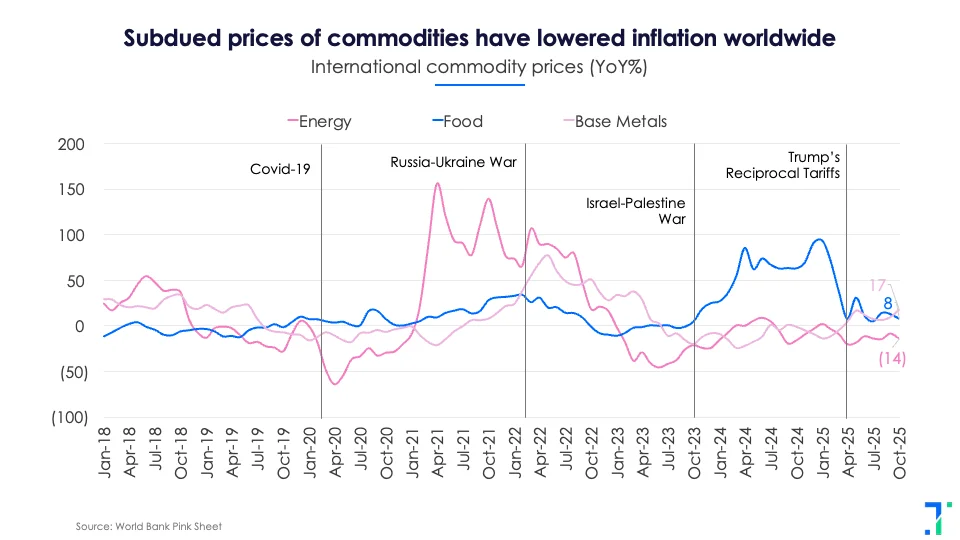
Onions make everyone cry: families when prices rise, farmers when they collapse. The price crash is happening across many items, from vegetables to steel and oil. And it has many things driving it.

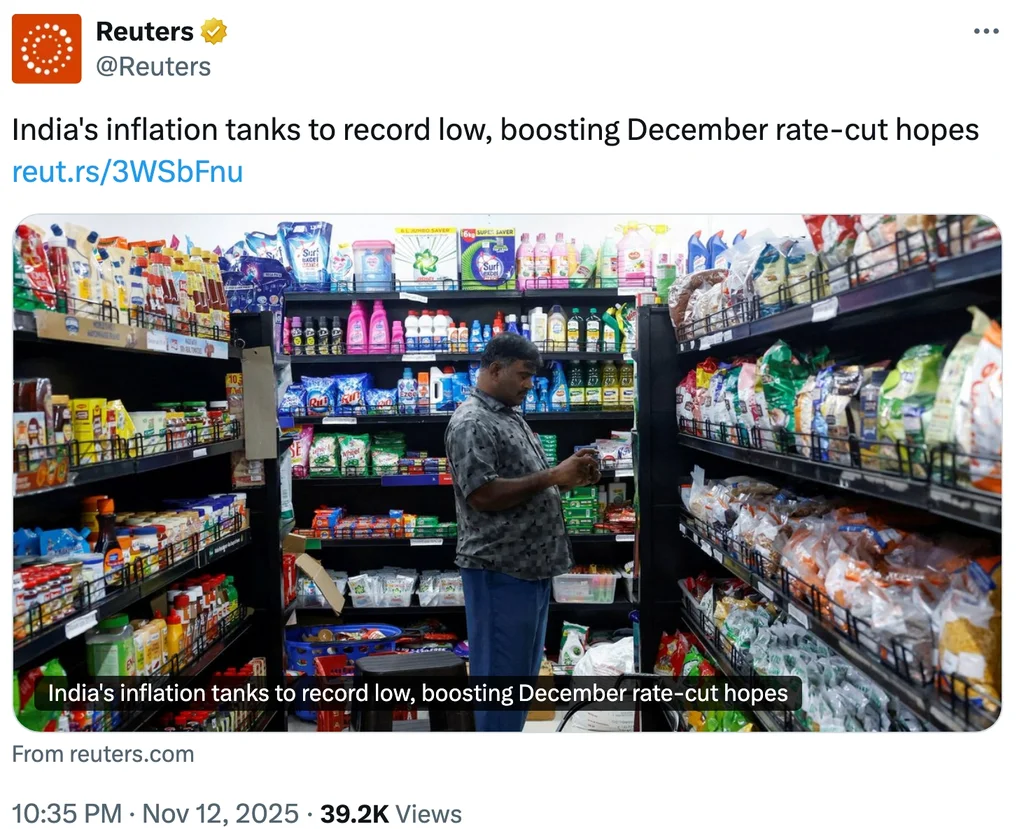
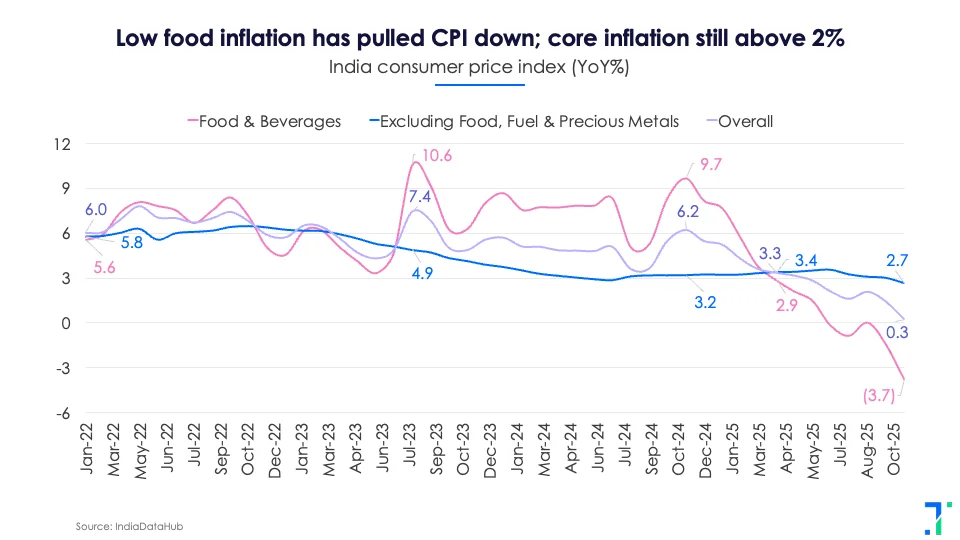
Food and commodity prices are falling so fast that they’re pushing wholesale and consumer inflation down across the world. India is getting pulled along. In October 2025, consumer price inflation (CPI) rose just 0.25% YoY, a multi-year low. Wholesale price inflation was negative for the third time this year. This has triggered high hopes for December interest rate cut from the RBI.

The problem with inflation is that it can be too high, and also too low. Both can cause different kinds of pain. And India's story of falling prices has several drivers.

Blame it on Beijing?

If you’re looking for a villain, China is happy to volunteer. Years of overcapacity have pushed China into deflation for the third straight year. Chinese customers are also suffering from a crash in property prices, and are not spending. With domestic demand too weak to absorb Chinese production, China has simply exported the problem. 

Export prices are down 25% since 2022, and China's share in global exports has climbed from 13% in 2018 to 18% today. China's goods-trade surplus with developing Asia has nearly doubled.

India is squarely in the blast radius of this Chinese export juggernaut, where we imported $91B worth of goods from them in the first nine months of 2025, up from $80B last year.

India's imports include electronics, plastics, metals, chemicals, machinery — basically the entire backbone of India’s manufacturing. And prices in these categories are tumbling everywhere you look:

  • PCs: –12%(Apr–Oct 2025)

  • PVC:–6%

  • Organic chemicals: –2%

  • Man-made fibres:–3%

  • Pig iron: –12%

  • Steel bars: –4%

  • Consumer electronics, appliances, auto components: –2%

When your biggest supplier slashes raw-material prices like this, domestic producers can’t keep up. They’ve asked for protection from the government, and India has responded with anti-dumping investigations on 30+ products, from steel to rubber. But these moves are band-aids that don’t shift wholesale inflation in the short term.

Logan Wright of the Rhodium Group says it bluntly: China’s deflation is systemic. A government stimulus won’t fix it. If India keeps importing from China, goods inflation will stay soft.

China aside, GST rate cuts have also cooled prices. And with food making up 40%+ of CPI, India’s inflation lives and dies by the farm. Right now, the farm sector has benefited from full water reservoirs, a solid monsoon, strong harvests, and stuffed government godowns. But bumper harvests have landed in the middle of a three-year global slide in food, fuel, and metal prices, and 2026 is likely to see a similar trend.

Some of the problem is self-inflicted, by our domestic policies. The Indian government's export bans on staples — wheat, rice, sugar, onions, you name it — keep domestic prices from rising, and also keep farmers poor by preventing them from exporting to more profitable markets. So these products flood the local market and tank prices. It’s the same consumer-first instinct that has stalled the India–US trade deal.

Look at onions: when exports were banned in 2024, wholesale prices in India crashed. In the UAE or Sri Lanka, farmers could’ve earned almost 10X the local rate. During this time, customs busted an onion-smuggling racket where onions were being labelled as grapes and exported, to evade the ban.

Some prices are still rising

Food prices may have dropped 4% YoY, but the rest of our monthly budget hasn’t got the memo. Housing prices have jumped 3%, health is up 4%, while education has risen 4% in the same period. This is core inflation — the slow-moving, stubborn part that excludes food, fuel, and metals. While goods are cooling rapidly, services have stayed expensive.

More and more, India’s inflation now dances to the tune of global commodity prices, not domestic trends. The RBI has limited control over that. 

RBI forecasts are missing the mark

This shift towards global factors is also confusing the RBI’s models. Since Feb 2025, the RBI has cut its FY26 inflation forecast by 220 bps — from 4.8% to 2.6%. Even those revised numbers have turned out too high.

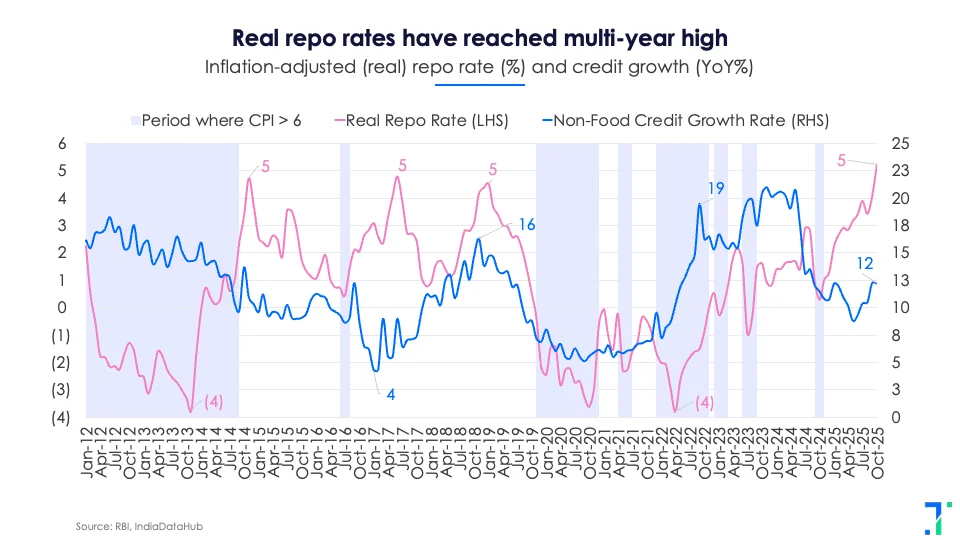
This matters, since the RBI sets its interest rates based on expected inflation. But by overestimating inflation for months, it kept interest rates much higher than needed. Emkay economist Madhavi Arora doubts these forecasts are useful anymore. The RBI seems to agree, as Governor Sanjay Malhotra has ordered a full review of the approach.

At these high interest rates, borrowing is expensive, so households and businesses pull back spending. A high repo rate also means that banks prefer parking cash with the RBI rather than lending it out. This  has been a big driving factor in the slowdown in private sector capex that the government has been so frustrated about. Credit growth has sunk overall. 

The economist Sanjeev Sanyal estimates the economy could save around 200 bps in financing costs with a rate cut, enough to break out of the low-spending loop.

RBI should (probably) be more aggressive

The RBI is facing one of the trickiest rate calls in recent memory. Inflation is near zero, but services inflation is sticky, and global forces like import costs and commodity prices are in the driver’s seat.

Still, with consumer demand still weak and prices likely to remain low, the RBI has room for a cut, and a chance to make up for months of forecasting misfires.

One thing that could slow a conservative Central Bank is if the upcoming GDP numbers blow past expectations. This would give the RBI another excuse to keep pressing the brakes.

As always,

The Trendlyne team 

Market closes higher, supported by gains in IT, Healthcare, and Banking sectors
By Trendlyne Analysis

Nifty 50 closed at 26,052.65 (142.6, 0.6%), BSE Sensex closed at 85,186.47 (513.5, 0.6%), while the broader Nifty 500 closed at 23,906.30 (81.7, 0.3%). Market breadth is in the red. Of the 2,593 stocks traded today, 1,017 were in the positive territory and 1,530 were negative.

Indian indices closed in the green after extending gains in the morning session. The Indian volatility index, Nifty VIX, declined 0.8% and closed at 12 points. Infosys closed 3.7% higher as its board of directors approved a buyback of 10 crore shares for Rs 18,000 crore at Rs 1,800 each.

Nifty Midcap 100 closed in the green, while Nifty Smallcap 100 closed in the red. Nifty IT and BSE IT Sector were among the top index gainers today. According to Trendlyne’s Sector dashboard, Software & Services emerged as the best-performing sector of the day, with a rise of 2.6%.

Asian indices closed mixed, while European indices are trading higher except France’s CAC 40 index. US index futures traded higher, indicating a positive start to the trading session. US tech stocks stayed under pressure on Tuesday amid worries about stretched AI-driven valuations and fading expectations of a December Fed rate cut. CME FedWatch now shows a 43.4% probability of a 25 bps cut at the December 10-11 meeting, down from 61.9% last week.

  • Relative strength index (RSI) indicates that stocks like GMR Airport, Canara Bank, Asian Paints, and 3M India are in the overbought zone.

  • Deven Choksey downgrades Ashok Leyland to an 'Accumulate' call from 'Buy', with a target price of Rs 156 per share. This indicates a potential upside of 7.4%. The brokerage cites the high valuation but remains positive on the stock, supported by improving freight activity, GST-led demand uplift, and healthy order growth across trucks, buses, and LCVs. It expects the company's revenue to grow at an 8.9% CAGR over FY26-28.

  • Sammaan Capital falls sharply after the Supreme Court orders the Central Bureau of Investigation (CBI) to file an FIR in a case alleging misuse of funds through dubious loans routed back to promoters. The court also noted that several agencies failed to adequately investigate the matter.

  • Bondada Engineering is rising as it enters a 5-year partnership with Adani Green Energy to develop renewable energy projects. The company also bags an order from Adani Green for 650 MW of solar energy works under the partnership.

  • Morgan Stanley expects the Reserve Bank of India to cut the repo rate by 25 basis points at its December 2025 policy meeting, citing continued downside surprises in headline CPI inflation. The brokerage then expects the RBI to become more data-dependent and shift to a “wait and watch” stance.

  • Tata Consultancy Services is rising as it secures a 5-year contract from the National Health Service (NHS) Supply Chain to upgrade its IT systems.

  • Knowledge Marine & Engineering Works bags a 15-year contract worth Rs 384.3 crore from Vishakhapatnam Port Authority for manning, operation, maintenance and technical management of a marine vessel.

  • NBCC (India) sells 609 residential units in Aspire Leisure Valley and Aspire Centurian Park, Greater Noida, for Rs 1,069.4 crore through an e-auction.

  • Vikas Jain of CLSA notes that India has been a rare underperformer in an otherwise strong global equity rally in 2025. However, he believes improving macro data, normalising valuations, and a slowdown in negative developments support a stance of “guarded bullishness.” He adds that downside risks appear limited, with valuations having corrected and the broader news flow stabilising.

  • Hindustan Unilever rises as it sets December 5 as the record date to determine eligible shareholders for its new ice-cream division, Kwality Wall’s (India). The demerger becomes effective on December 1, 2025.

  • Sagility falls as its promoter, Sagility BV, sells a 16.4% stake (or 76.9 crore shares) worth ~Rs 3,894.2 crore through the open market.

  • Marksans Pharma receives US FDA approval for its abbreviated new drug application (ANDA) for Loperamide Hydrochloride (HCL) tablets. The drug is a bioequivalent of the reference listed drug (RLD), Imodium A-D tablets of Kenvue Brands and is used to treat diarrhoea. It has an estimated market size of $300 million in the US as of 2024.

  • Vinati Saraf Mutreja, MD of Vinati Organics, says the company now produces the highest volume of antioxidants in India, with their revenue contribution expected to increase to 15–16% from about 12% currently. She projects revenue growth of 10–12%, margins of around 27%, and volume growth of over 15% for FY26. She notes that volumes are rising despite lower prices.

  • HCL Tech rises as it opens a new Calgary office and signs an MoU with Invest Alberta to strengthen its presence in Canada. The move increases delivery capacity in a market where it already serves over 50 clients.

  • Tenneco Clean Air India's shares debut on the bourses at a 27.2% premium to the issue price of Rs 397. The Rs 3,600 crore IPO received bids for 58.8 times the total shares on offer.

  • Infosys is rising sharply as its board of directors approves a buyback of 10 crore shares for Rs 18,000 crore at Rs 1,800 each.

  • Elara Capital upgrades SBI Cards and Payment Services to an 'Accumulate' rating and a higher target price of Rs 1,006. The brokerage highlights a clear improvement in asset quality, a stronger balance sheet, and better profitability prospects from FY27. It believes the stress cycle has largely passed and that SBI Cards is now in the final phase of balance-sheet cleanup, supporting a recovery in credit costs, cards-in-force (CIF) growth, and return ratios.

  • Azad Engineering rises as it signs a long-term agreement with Pratt & Whitney Canada to develop and make aircraft engine parts.

  • Computer Age Management Services' board of directors approves a 1:5 stock split, sets record date as December 5.

  • KP Energy is rising sharply as it signs a memorandum of understanding (MoU) with Inox Wind to jointly develop 2.5 GW of wind and wind-solar hybrid projects.

  • Morgan Stanley initiates coverage on LG Electronics India with an 'Overweight' rating and a target price of Rs 1,864. The brokerage views LG as a top-tier consumer durables franchise in India, noting its strong position in a highly competitive market. It highlights the company’s industry-leading margins and capital efficiency, and expects new capacity additions, along with rising export and B2B contributions, to drive revenue and margin growth.

  • Goel Construction is rising as it wins a Rs 173.3 crore order from Aditya Birla Group. The work includes civil and safety projects at the Pali Cement Works unit in Rajasthan.

  • KEC International is falling sharply as Power Grid Corp of India excludes the company from its tenders and award of contracts for nine months for alleged breach of contractual provisions.

  • Waaree Energies is falling as the Income Tax Department conducts a search at its offices and facilities in India.

  • GR Infraprojects is rising as it secures an order worth Rs 262 crore from Western Railways in the Vadodara division for gauge conversion of a 38.9 km track and related construction works.

  • Nifty 50 was trading at 25,884.85 (-25.2, -0.1%), BSE Sensex was trading at 84,658.57 (-14.5, 0.0%) while the broader Nifty 500 was trading at 23,801.45 (-23.2, -0.1%).

  • Market breadth is in the red. Of the 2,162 stocks traded today, 846 were gainers and 1,248 were losers.

Riding High:

Largecap and midcap gainers today include L&T Technology Services Ltd. (4,440, 9.0%), Linde India Ltd. (6,076.50, 6.7%) and Max Healthcare Institute Ltd. (1,164.40, 4.3%).

Downers:

Largecap and midcap losers today include Waaree Energies Ltd. (3,174.40, -3.3%), Tata Motors Passenger Vehicles Ltd. (360.85, -2.8%) and Biocon Ltd. (410.10, -2.7%).

Crowd Puller Stocks

21 stocks in BSE 500 are trading on high volumes today.

Top high volume gainers on BSE included L&T Technology Services Ltd. (4,440, 9.0%), Linde India Ltd. (6,076.50, 6.7%) and Latent View Analytics Ltd. (494.25, 5.2%).

Top high volume losers on BSE were Sammaan Capital Ltd. (159.55, -12.7%), KEC International Ltd. (710.35, -9.1%) and Concord Biotech Ltd. (1,448.70, -3.5%).

G R Infraprojects Ltd. (1081.90, -1.5%) was trading at 18.8 times of weekly average. Gland Pharma Ltd. (1,769.80, -1.1%) and Intellect Design Arena Ltd. (1,142.80, 5.0%) were trading with volumes 17.0 and 8.4 times weekly average respectively on BSE at the time of posting this article.

BSE 500: highs, lows and moving averages

14 stocks took off, crossing 52 week highs, while 13 stocks were underachievers and hit their 52 week lows.

Stocks touching their year highs included - AIA Engineering Ltd. (3,733.40, 0.6%), Bank of Baroda (293.30, 1.7%) and Bank of Maharashtra (61.14, 1.2%).

Stocks making new 52 weeks lows included - SKF India Ltd. (1,975.60, -0.1%) and Tata Motors Passenger Vehicles Ltd. (360.85, -2.8%).

7 stocks climbed above their 200 day SMA including L&T Technology Services Ltd. (4,440, 9.0%) and Max Healthcare Institute Ltd. (1,164.40, 4.3%). 19 stocks slipped below their 200 SMA including Campus Activewear Ltd. (263.25, -3.0%) and Sundram Fasteners Ltd. (960.05, -2.5%).

logo
The Baseline
18 Nov 2025
Five stocks to buy from analysts this week - November 18, 2025
By Ruchir Sankhla

1. Apollo Tyres:

ICICI Direct maintains its ‘Buy’ rating on this tyre manufacturer, with a target price of Rs 605, an upside of 15.7%. The company delivered strong Q2FY26 results, with revenue growing 6.2% YoY to Rs 6,860.8 crore. Analysts Shashank Kanodia and Bhavish Doshi believe that GST 2.0 reforms and expansion in Hungary will boost auto segment volumes, driving revenue growth in the near to medium-term.

Management expresses confidence in navigating industry challenges, focusing on margin expansion and growth plans. The company saw strong performance in the replacement and original equipment manufacturing (OEM) segments, and exports recovered. Analysts believe reducing GST on new tyres (28% to 18%) and tractor tyres (5%) will improve cost competitiveness and boost demand across OEM and aftermarket channels.

Kanodia and Doshi note that passenger car radial (PCR) capacity expansion will finish in FY27. They expect management to ramp up the plant's capacity to meet growing demand, adding that favourable raw material prices and robust replacement market demand will sustain its growth. They project Apollo Tyres to deliver an 8.2% revenue CAGR and a 37.3% net profit CAGR over FY26-27.

2. Tata Steel:

Axis Direct upgrades this steel manufacturer to a ‘Buy’ rating, with a target price of Rs 195, an upside of 13.1%. In Q2FY26, net profit surged 3.7 times YoY to Rs 3,101.8 crore, thanks to lower raw material and finance costs. Revenue increased 8.3%, driven by growth across all regions. Analyst Aditya Welekar highlights that India volumes rose to 5.6 million tonnes (MT) as the Kalinganagar Phase II plant in Odisha continued its ramp-up.

Management expects volume growth to improve as Kalinganagar reaches its full 5 MT capacity by the end of FY26. Additional capacity from the Ludhiana electric arc furnace in FY27 and from the Jamshedpur combi mill will support medium-term growth. The next major expansion involves scaling up Neelachal Ispat Nigam to 5 MT from 1.1 MT.

Welekar notes the company’s cost-cutting program has worked effectively, achieving savings of Rs 5,450 crore in the first half of FY26. He expects volume growth to continue as new capacity comes online, though overall volumes may moderate after FY26 until large expansion projects begin. Sustained cost optimisation and a better product mix will remain key drivers of strong earnings.

3. Biocon

Motilal Oswal reiterates its ‘Buy’ rating on this biotech company with a target price of Rs 480, an upside of 13.9%. In Q2FY26, the company reported 19.6% YoY revenue growth to Rs 4,295.5 crore, driven by the biosimilars segment, which now accounts for over 60% of total sales. EBITDA rose 22% to Rs 840 crore, due to better operating leverage after adding three new facilities last year.

Analysts Tushar Manudhane and Vipul Mehta note that biosimilars remain the key growth driver, showing strong performance across North America, Europe, and emerging markets, boosted by new launches and market share gains. The generics segment also rebounded with 24% growth, helped by new US and European launches and contributions from facilities capitalised in FY25.

Biocon continues to reduce debt. Management confirms full repayment of the remaining structured debt by January 2026, with lower interest costs starting in H2FY26.

Manudhane and Mehta expect the company to enter a clear scale-up phase. They project 16% revenue growth and 77% net profit growth over FY26–28, supported by stronger biosimilar traction, a broader generics pipeline, and ongoing deleveraging efforts.

4. Welspun Corp

Geojit BNP Paribas maintains its ‘Buy’ rating on this iron & steel producer, with a target price of Rs 1,150, an upside of 27.3%. In Q2FY26, the company reported 32.5% YoY revenue growth to Rs 4,373.6 crore. EBITDA rose 48%, and margins improved 140 basis points. Net profit jumped 53.2%, thanks to tighter cost control and improved operational efficiency.

The company’s US subsidiary secured $715 million (over Rs 6,300 crore) in line-pipe orders for natural gas and natural gas liquids projects. These orders offer revenue visibility through FY28 and strengthen the company’s position in the US energy infrastructure chain. Demand in this sector is rising due to new gas projects and growing data centre requirements.

The order book stands at Rs 23,500 crore, providing a multi-year pipeline across domestic and international markets. Analyst Mithun T Joseph states this visibility comes from rising demand for energy transportation systems and steady demand from industrial and water pipeline projects.

Joseph believes Welspun Corp is well-positioned to benefit from global spending in energy infrastructure, its large order book, margin improvement, and a disciplined cost structure. Despite recent investments, the company maintains a healthy balance sheet and improving returns.

5. DOMS Industries

Prabhudas Lilladher retains its ‘Buy’ rating on this stationary manufacturer, with a target price of Rs 3,085, an upside of 20.8%. The company delivered robust Q2FY26 results, with revenue jumping 23.8% and net profit growing 13.5% YoY. Analysts Jinesh Joshi and Stuti Beria note that healthy volume growth in the stationery segment (91.7% of revenue) amid new product launches across scholastic stationery, kits & combos, and office supplies supported revenue growth.

Management maintains its capex guidance at Rs 2,100-2,250 crore for FY26. This capex funds a 44-acre expansion project, enabling in-house tip production, in a bid to reduce procurement costs and boost margins. Extended monsoons delayed the expansion, but management expects production to start by Q1FY27. 

Joshi and Beria add that the company’s focus on capacity expansion in the core stationery business, widening the product basket, and strengthening the distribution network will drive top-line and profitability. They expect DOMS Industries to deliver a 22% revenue CAGR and a 24% net profit CAGR over FY26-28.

Note: These recommendations are from various analysts and are not recommendations by Trendlyne.

(You can find all analyst picks here)

Market closes lower, dragged by weakness in IT, Metal and Realty sectors
By Trendlyne Analysis

Nifty 50 closed at 25,910.05 (-103.4, -0.4%), BSE Sensex closed at 84,673.02 (-277.9, -0.3%) while the broader Nifty 500 closed at 23,824.65 (-129.9, -0.5%). Market breadth is moving down. Of the 2,593 stocks traded today, 753 were on the uptick, and 1,811 were down.

Indian indices closed lower after extending losses in the morning session. The Indian volatility index, Nifty VIX, rose 2.6% and closed at 12.1 points. Physicswallah's shares made their debut on the bourses at a 33% premium to the issue price of Rs 109. The Rs 3,480 crore IPO received bids for 1.8 times the total shares on offer.

Nifty Smallcap 100 and Nifty Midcap 100 closed lower. Nifty IT and Nifty Realty were among the top index losers today. According to Trendlyne’s sector dashboard, Diversified emerged as the worst-performing sector of the day, with a fall of 1.5%.

Asian indices closed in the red. European indices are trading lower, except for Russia’s RTSI and MOEX indices. US index futures are trading lower as investors turn cautious ahead of delayed economic releases. The Bureau of Labor Statistics said it will release the September jobs report on Thursday, followed by the real earnings report on Friday. Meanwhile, Home Depot, PDD Holdings, and Medtronic are set to report their results later today.

  • Money flow index (MFI) indicates that stocks like Kirloskar Oil Engines, Chennai Petroleum, CCL Products India, and Muthoot Finance are in the overbought zone.

  • Greaves Cotton partners with Europe’s Ligier Group to supply its 499cc diesel engines for the JS50 and Myli microcars. The engines will be used in light vehicles sold across several European markets.

  • Indian Renewable Energy Development Agency reportedly plans to raise Rs 3,000 crore through a qualified institutional placement (QIP) of equity shares.

  • Praj Industries rises as it signs a MoU with Allied Biofuels to build Central Asia’s largest ethanol-based clean-fuel refinery in Uzbekistan. The project will produce 890 tonnes of ethanol per day, which will feed into large-scale production of sustainable aviation fuel and green diesel.

  • Nomura upgrades Siemens to 'Neutral' with a higher target price of Rs 3,325. The brokerage raises its FY26–27 earnings estimates by 3%, supported by improving profitability in the mobility (MO) segment and steady order conversion across key verticals. Siemens’ order backlog stands at Rs 42,250 crore, up 6% YoY and slightly above estimates, providing strong revenue visibility.

  • Ajax Engineering's Q2FY26 revenue grows 47.7% YoY to Rs 44.8 crore, surpassing the Forecaster estimates by 28.5%. Net profit increases 15% YoY to Rs 39.1 crore during the quarter. The company appears in a screener of stocks where mutual funds increased their shareholding in the last quarter.

  • Bombay Burmah Trading Corp surges more than 10% as it terminates its agreement with MSTC to conduct an e-auction to sell its properties. The company cites the bidding process as unsuccessful and inconsistent with its strategies as the reason for the termination.

  • ICICI Direct retains its 'Buy' call on Ipca Laboratories, with a target price of Rs 1,660 per share. This indicates a potential upside of 15.9%. The brokerage remains positive on the stock, driven by its vertically integrated business model, strong domestic franchise, and diversified export business. It expects Ipca to deliver a net profit CAGR of 37.7% over FY26-27.

  • Jairam Sampath, CFO of Kaynes Technology, expects margins to remain strong at around 16% in FY26, helped by an improved business mix and the addition of high-margin segments. He targets $1 billion in revenue by early FY28. Sampath adds that OSAT (outsourced semiconductor assembly and test) revenue in FY27 could exceed Rs 1,000 crore, though this is lower than the earlier estimate of Rs 1,500 crore.

  • Solar Industries India, along with its subsidiaries, receives export orders worth Rs 1,400 crore from international clients to supply defence products.

  • Asian Paints' Managing Director and Chief Executive Officer, Amit Syngle, retains margin guidance at 18-20% during FY26, citing a reduction in raw material prices. He adds that this reduction will help the company to maintain its pricing strategy without needing hikes or concessions.

  • Pace Digitek secures a Rs 929.8 crore order from Maharashtra State Power Generation Co (MSPGCL) to build a 200 MWAC (megawatt alternating current) ground-mounted solar plant. The contract also covers design-to-commissioning work and three years of operations and maintenance.

  • Abhay Sol, Chairman and MD of Max Healthcare Institute, highlights plans to double bed capacity by 2030. He expects the upgraded CGHS portal to add about Rs 200 crore to annual revenue. Sol notes that Q2 profit benefited from GST cuts, while insurance and self-pay average revenue per occupied bed (ARPOB) rose 7–8% YoY. However, cash flows were soft due to delays in institutional receivables.

  • WeWork India Management rises sharply as Jefferies initiates coverage with a ‘Buy’ call and a target price of Rs 790, highlighting its lead as India’s largest flexible workspace operator. The firm plans to add 15,000–20,000 seats each year for the next three years. Jefferies also notes that WeWork India earns about twice as much per user as its listed peers and generates more revenue than it pays in rent. It says this strong gap supports faster growth and better profitability.

  • DCB Bank rises to its 52-week high of Rs 189.2 per share as Motilal Oswal retains its ‘Buy’ call with a higher target price of Rs 210. The management highlighted that net interest margins have bottomed and are likely to pick up. The brokerage notes steady loan growth, with increased focus on retail and gold lending, and believes the bank may benefit from improving margins and stronger earnings over the next few years.

  • AstraZeneca Pharma rises as it enters a partnership with Sun Pharmaceuticals to distribute and market Sodium Zirconium Cyclosilicate (SZC) in India. The drug is used to treat Hyperkalaemia and has an estimated market size of $1.3 billion as of 2024.

  • Morgan Stanley forecasts a 13% rise in the Sensex, with the index reaching 95,000 by December 2026. It notes that India’s long-term outlook is strengthening, supported by government policy measures and a cyclical recovery driven by the policy pivot. It holds an ‘overweight’ stance on consumer discretionary, industrials and financials, and ‘equalweight’ call on communication services, consumer staples and technology.

  • Physicswallah's shares debut on the bourses at a 33% premium to the issue price of Rs 109. The Rs 3,480 crore IPO received bids for 1.8 times the total shares on offer.

  • Emmvee Photovoltaic Power’s shares make a flat debut on the bourses at Rs 217. The Rs 2,900 crore IPO received bids for 1X the total shares on offer.

  • Mphasis is falling as its promoter, Blackstone, plans to sell 1.8 crore shares worth Rs 4,626 crore at a floor price of Rs 2,570 per share through BCP Topco IX.

  • Saurabh Gupta, Group CFO of Dixon Technologies, expects strong revenue growth and margin expansion by FY28. He says the company is closely monitoring smartphone demand and inventory levels, and adds that Chinese EMS players are steadily gaining share in India. Dixon has also trimmed its FY26 revenue guidance following a short-term disruption from the mid-August GST rate cut, which deferred consumer purchases and weighed on Q2 sales.

  • One97 Communications (Paytm) is falling after Elevation Capital reportedly plans to sell a 2% stake (or 1.3 crore shares) worth Rs 1,640 crore at Rs 1,281 per share.

  • Emcure Pharmaceuticals is falling sharply as Bain Capital reportedly plans to sell 38 lakh shares (or 2% stake) worth Rs 492.7 crore in the company through its subsidiary, BC Investments IV.

  • WPIL surges as its subsidiary receives an order worth Rs 426 crore from METSI KE MATLA JV for electro-mechanical and instrumentation work for the MCWAP2 water project of the Trans Caledon Tunnel Authority.

  • JSW Infrastructure rises as its arm enters a share subscription and purchase agreement (SSPA) with Minerals Development Oman (MDO) and South Minerals Port Co to acquire a 51% stake in Port Special Purpose Vehicle (SPV). The company plans to build and operate a port at a capex of Rs $419 million (~Rs 3,716 crore) through the SPV.

  • Nifty 50 was trading at 25,951.45 (-62, -0.2%), BSE Sensex was trading at 85,042.37 (91.4, 0.1%), while the broader Nifty 500 was trading at 23,890.80 (-63.8, -0.3%).

  • Market breadth is in the red. Of the 2,110 stocks traded today, 835 showed gains, and 1,194 showed losses.

Riding High:

Largecap and midcap gainers today include GMR Airports Ltd. (103.72, 6.2%), Mahindra & Mahindra Financial Services Ltd. (322.90, 2.8%) and Bharti Hexacom Ltd. (1,829.30, 2.5%).

Downers:

Largecap and midcap losers today include Cummins India Ltd. (4,252.40, -2.9%), Ipca Laboratories Ltd. (1,422.90, -2.9%) and SBI Cards and Payment Services Ltd. (867.35, -2.5%).

Movers and Shakers

25 stocks in BSE 500 are trading on high volumes today.

Top high volume gainers on BSE included Bombay Burmah Trading Corporation Ltd. (2,022.70, 9.8%), GMR Airports Ltd. (103.72, 6.2%) and Sapphire Foods India Ltd. (262.15, 4.3%).

Top high volume losers on BSE were Kaynes Technology India Ltd. (5,889, -5.6%), International Gemmological Institute (India) Ltd. (320.60, -5.1%) and One97 Communications Ltd. (1,295.50, -2.8%).

Akzo Nobel India Ltd. (3,381.70, 1.6%) was trading at 36.3 times of weekly average. Sundram Fasteners Ltd. (984.75, 2.5%) and Aster DM Healthcare Ltd. (681.05, 0.3%) were trading with volumes 12.2 and 9.8 times weekly average respectively on BSE at the time of posting this article.

BSE 500: highs, lows and moving averages

19 stocks overperformed with 52 week highs, while 6 stocks were underachievers and hit their 52 week lows.

Stocks touching their year highs included - Bharti Airtel Ltd. (2,149.20, 1.8%), Biocon Ltd. (421.60, 0.2%) and Can Fin Homes Ltd. (906.80, 1.6%).

Stocks making new 52 weeks lows included - Bata India Ltd. (1,014.80, 0.0%) and SKF India Ltd. (1,976.80, -4.1%).

8 stocks climbed above their 200 day SMA including Bombay Burmah Trading Corporation Ltd. (2,022.70, 9.8%) and Sundram Fasteners Ltd. (984.75, 2.5%). 14 stocks slipped below their 200 SMA including Alembic Pharmaceuticals Ltd. (913.55, -3.7%) and Star Cement Ltd. (229.45, -2.5%).

Market closes higher as Nifty Bank touches its all-time high
By Trendlyne Analysis

Nifty 50 closed at 26,013.45 (103.4, 0.4%), BSE Sensex closed at 84,950.95 (388.2, 0.5%) while the broader Nifty 500 closed at 23,954.55 (118.2, 0.5%). Market breadth is even. Of the 2,635 stocks traded today, 1,292 showed gains, and 1,301 showed losses.

Indian indices closed higher after extending gains in the afternoon session. The Indian volatility index, Nifty VIX, fell 1.6% and closed at 11.8 points. Narayana Hrudayalaya closed 14.5% higher after its Q2FY26 revenue jumped 17.2% YoY to Rs 1,667.8 crore, led by higher footfalls, better payor mix and strong demand in its clinic outreach model.

Nifty Smallcap 100 and Nifty Midcap 100 closed higher, tracking the benchmark index. Nifty PSU Bank and Nifty India Digital were among the best-performing indices of the day. According to Trendlyne’s sector dashboard, Hardware Technology & Equipment emerged as the highest-performing sector of the day, with a rise of 1.9%.

European indices are trading mixed. Major Asian indices closed with varied trends. US index futures are trading higher, indicating a positive start to the session as investors await the release of the US employment data, set to come out later this week. Meanwhile, Trip.com Group, AECOM and H World Group are set to report their results later today.

  • Relative strength index (RSI) indicates that stocks like Asian Paints, Canara Bank, Muthoot Finance, and 3M India are in the overbought zone.

  • V2 Retail rises as it reports a net profit of Rs 17.2 crore in Q2FY26 compared to a loss of Rs 1.9 crore in Q2FY25, helped by inventory destocking and lower raw materials and jobworking charges. Revenue grows 86.5% YoY to Rs 708.6 crore during the quarter. It features in a screener of stocks near their 52-week high with significant volumes.

  • SpiceJet rises as it expects its operational fleet to double by year-end and expand its network reach. The company plans to return its grounded Boeing aircraft to service, targeting up to eight jets by early 2026, with several set to rejoin the fleet this winter and into 2025.

  • Marico rises as Motilal Oswal retains its ‘Buy’ call, with a target price of Rs 850 per share. This indicates a potential upside of 15%. The brokerage remains positive on the stock, backed by strong domestic sales and solid growth in key brands like Parachute. It expects margins to improve as copra prices soften and sees profits growing steadily over the next two years.

  • India’s merchandise trade deficit widens to $41.7 billion in October from $32.2 billion in September. Commerce Secretary Rajesh Agarwal notes that goods exports declined by around $4 billion in October, marking the first drop this fiscal year, partly due to lower exports to the US.

  • KEC International secures multiple orders worth Rs 1,016 crore across the buildings & factories (B&F), oil & gas pipelines, transmission & distribution (T&D), and cables & conductors businesses.

  • NBCC (India) is rising as it secures an order worth Rs 498.3 crore from Damodar Valley Corp to construct an integrated township at the Chandrapura Thermal Power Station.

  • Inox Wind is falling as its Q2FY26 net profit misses Forecaster estimates by 24.6% despite surging 3.6x YoY to Rs 91.8 crore, helped by inventory destocking. Revenue jumps 56.3% YoY to Rs 1,162.5 crore, led by strong order execution. It shows up in a screener of stocks with expensive valuations according to Trendlyne valuation scores.

  • CLSA Technical Strategist Laurence Balanco reiterates his long-term bullish stance on the Nifty 50, maintaining a target of 37,375–37,400 despite near-term volatility. He notes that the index has completed two major bull cycles since the 2001 lows and believes the current uptrend still has several years to run, implying potential upside of more than 59% from current levels.

  • IdeaForge Technology surges as it wins over Rs 100 crore in new defence orders for unmanned aerial vehicles (UAVs) from the Indian Army and Ministry of Defence (MoD). The orders cover drones meant for tactical and surveillance operations.

  • Ahluwalia Contracts surges more than 10% as its Q2FY26 net profit jumps 103.2% YoY to Rs 78.6 crore, owing to lower construction and finance costs. Revenue grows 16.5% YoY to Rs 1,192.3 crore, led by an improvement in the contract work segment. It features in a screener of stocks with prices above short, medium and long-term moving averages.

  • Oil India is rising as its Q2FY26 revenue grows 11.4% YoY to Rs 8,911.3 crore, helped by improvements in the natural gas, refinery products, liquified natural gas, and pipeline transportation segments. However, net profit declines 29.1% YoY to Rs 1,428.8 crore due to higher inventory, employee benefits, contract, and finance costs. It appears in a screener of stocks with improving net cash flow over the past two years.

  • Varun Kapur, MD & CEO of Travel Food Services, says H1 performance was impacted by an unexpected drop in passenger traffic amid geopolitical disruptions, but sees a strong recovery in H2. He expects system-wide sales to reach around Rs 4,000 crore in FY27, with PAT margins steady at 25–26%. He also highlights that the company has added 50 QSR outlets over the past year.

  • Anant Raj is rising as it signs a memorandum of understanding (MoU) with the government of Andhra Pradesh to invest Rs 4,500 crore to develop data centres and cloud services.

  • Narayana Hrudayalaya is rising sharply as its Q2FY26 net profit grows 30.1% YoY to Rs 258.5 crore. Revenue jumps 17.2% YoY to Rs 1,667.8 crore, supported by an improvement in the medical & healthcare services segment. It appears in a screener of stocks with increasing revenue for the past three quarters.

  • Ashoka Buildcon falls as net profit declines 80.4% YoY to Rs 90.7 crore in Q2FY26, weighed down by a Rs 219.3 crore loss on the sale of stakes in five subsidiaries. Revenue declines 25.6% to Rs 1,851.2 crore, due to a smaller project base after recent asset sales and slower execution on ongoing works. It appears in a screener of companies with growing YoY costs for long-term projects.

  • UBS reiterates its 'Sell' rating on Bharat Forge with a higher target price of Rs 1,230. The brokerage notes that management expects a soft Q3, with recovery beginning in Q4. In Q2, the company saw weakness in the auto segment but strong momentum in defence. Margins stayed healthy, supported by tight cost control. UBS also highlights that the company is evaluating a restructuring of its EU steel business, with an update expected by the end of the fiscal year.

  • Siemens is rising as its Q2FY26 revenue beats Forecaster estimates by 6.3% after growing 16% YoY to Rs 5,171.2 crore, helped by improvements in the smart infrastructure, mobility, and digital industries segments. However, net profit declines 41.6% YoY to Rs 484.9 crore due to a high base effect in Q2FY25 from a one-time property gain. It appears in a screener of stocks with zero promoter pledge.

  • Max Healthcare's net profit surges 74% YoY to Rs 491.3 crore in Q2FY26. Revenue rises 25.1% YoY to Rs 2,135.47 crore, driven by higher patient volumes across its medical and healthcare services businesses. It appears in a screener of companies with high TTM EPS growth.

  • IRB Infrastructure Developers rises sharply as it bags a letter of award (LoA) worth Rs 9,270 crore from the National Highways Authority of India (NHAI) to construct highways in Uttar Pradesh.

  • Ravi Jakhar, Group CFO of Allcargo Logistics, expects PAT to grow about 20% from Q4FY26, supported by strict cost control and the scaling up of the express business. He adds that overheads were well managed in Q2, while Q3 revenue is likely to remain flat due to the strong festive-season base in Q2.

  • Indian Hotels enters a share purchase agreement to acquire a 51% stake in health and wellness resort operator, Sparsh Infratech, for Rs 240 crore.

  • GMR Power & Urban Infra is rising sharply as its Q2FY26 net profit surges 3.5x YoY to Rs 888.4 crore, helped by a Rs 1,023 crore exceptional gain. Revenue jumps 27.5% YoY to Rs 1,922 crore, helped by improvements in the power and smart meter infrastructure segments. It appears in a screener of newly affordable stocks with good financials and durability.

  • Tata Motors Passenger Vehicles is falling sharply as its Q2FY26 revenue declines 28.4% YoY to Rs 73,810 crore, due to the temporary shutdown of Jaguar Land Rover's operations caused by a cyber incident. However, net profit surges 22.8x YoY to Rs 76,170 crore, led by a Rs 82,616 crore gain from the demerger of the commercial vehicle business. It shows up in a screener of stocks with declining net cash flow.

  • Glenmark Pharmaceuticals is falling as its Q2FY26 net profit misses Forecaster estimates by 75.6% despite surging 72.3% YoY to Rs 610.4 crore, helped by a Rs 103.1 crore deferred tax return and lower raw material expenses. Revenue jumps 79.9% YoY to Rs 6,247.5 crore, supported by improvements in the North American and European markets. It features in a screener of stocks with high trailing twelve-month (TTM) EPS growth.

  • Nifty 50 was trading at 25,951.05 (41, 0.2%), BSE Sensex was trading at 84,700.50 (137.7, 0.2%), while the broader Nifty 500 was trading at 23,904.75 (68.4, 0.3%).

  • Market breadth is ticking up strongly. Of the 2,254 stocks traded today, 1,471 were in the positive territory and 695 were negative.

Riding High:

Largecap and midcap gainers today include Siemens Ltd. (3,232.60, 4.8%), Hero MotoCorp Ltd. (5,798.50, 4.7%) and PB Fintech Ltd. (1,819.80, 4.7%).

Downers:

Largecap and midcap losers today include Tata Motors Passenger Vehicles Ltd. (372.70, -4.7%), Bajaj Holdings & Investment Ltd. (12,150, -3.3%) and Astral Ltd. (1,465.70, -3.2%).

Volume Shockers

22 stocks in BSE 500 are trading on high volumes today.

Top high volume gainers on BSE included Narayana Hrudayalaya Ltd. (2,008.20, 14.5%), Maharashtra Scooters Ltd. (15,400, 7.4%) and Jubilant Ingrevia Ltd. (718.25, 5.2%).

Top high volume losers on BSE were Rainbow Childrens Medicare Ltd. (1308.20, -2.5%), Inox Wind Ltd. (146.11, -1.7%) and Glenmark Pharmaceuticals Ltd. (1,868.90, -1.4%).

SKF India Ltd. (2061.30, 0.8%) was trading at 42.2 times of weekly average. Atul Ltd. (6,016.50, 1.7%) and Elgi Equipments Ltd. (514.70, 2.6%) were trading with volumes 11.7 and 9.5 times weekly average respectively on BSE at the time of posting this article.

BSE 500: highs, lows and moving averages

25 stocks took off, crossing 52 week highs, while 5 stocks were underachievers and hit their 52 week lows.

Stocks touching their year highs included - Asian Paints Ltd. (2,887.90, -0.6%), Bank of India (147.35, 0.6%) and Bharat Petroleum Corporation Ltd. (374.25, 0.8%).

Stocks making new 52 weeks lows included - Bata India Ltd. (1,014.60, -1.2%) and Tata Motors Passenger Vehicles Ltd. (372.70, -4.7%).

24 stocks climbed above their 200 day SMA including Jubilant Ingrevia Ltd. (718.25, 5.2%) and Alembic Pharmaceuticals Ltd. (948.85, 5.0%). 6 stocks slipped below their 200 SMA including Chalet Hotels Ltd. (871.50, -1.4%) and UltraTech Cement Ltd. (11,775, -0.8%).

logo
The Baseline US
17 Nov 2025
 Markets are hitting the high notes, but the band looks a bit nervous

Plenty of CEOs are feeling at the top of the world this earnings season. One can expect the bar bills at Kokkari and Nobu to skyrocket as they celebrate. Of the 90% of listed companies that have reported results for the quarter, over 80% have beaten consensus earnings estimates. Most US indices, led by this positive momentum, soared to new all-time highs.

So why is sentiment so wobbly? Despite all the good news, the folks paid to analyze these companies are not exactly popping the champagne. A Citigroup index that tracks whether analysts are upgrading or downgrading their earnings estimates is barely in positive territory, sitting at just 0.15.

This index is considered a leading indicator for shifts in corporate earnings. Its weakness indicates analysts don't think that the good news will last, or that its broad enough to translate into meaningfully higher profitsin the near future. The vibes are not great. 

Take AMD, for instance. Its Q3 numbers came in ahead of estimates, and its Q4 outlook also beat the consensus. But the stock still tanked by over 3% on results day and has been trending downward since. It’s the same story for Palantir, Uber, and a long list of other tech darlings.

As Bloomberg analysts point out, the problem wasn't that the outlook was bad per se—it's that it wasn't spectacularly, unbelievably good. The outlook didn't clear the “most optimistic of estimates.”

This is the classic sign of a stock “priced to perfection.” The market has already baked in every possible piece of good news, and believed everything promised by top management. Now anything less than a miracle is a disappointment. This is the theme for just about every AI flagbearer.

As an investor, you must be thinking about what you should do at this moment. Michael Burry says,

“Sometimes, the only winning move is not to play.”

Interestingly, the photo Burry posted with this quote was not of himself, but of movie star Christian Bale, who played him in the film The Big Short. Has Burry bought into his own mythology, and is unwisely betting against market wisdom with his AI short? Or is the bubble really ready to burst?

The problem with pessimism

The investor and cofounder of Merrill Lynch, Charles Merrill, was worried about over-valuation and speculation in the 1929 stock market. He pulled all his funds out early that year, and warned other investors. But the stock market continued to rise by another 90% before it finally collapsed. The problem with being the pessimist in the room, is that people can hold on to their beliefs much longer than you think, against all evidence.

This time around, many investors are echoing Burry's warnings. Berkshire Hathaway's cash pile is rising every quarter. It now stands at a staggering $380 billion. When one of the world's most successful investors is hoarding cash instead of buying stocks, it pays to ask why.

Bubble, bubble, toil and trouble: the hype train has led to sky-high valuations

Why is everything so expensive if the smart money is on the sidelines? In a word: AI.

The argument that drove the spike in AI valuations, is that AI will contribute up to $15.7 trillion to global GDP by 2030, where $6.6 trillion would be from productivity gains and $9.1 trillion from increased consumption.

AI company CEOs like Sam Altman also talked up the prospect of Artificial General Intelligence coming at the end of the year (a promise that got advanced by another year at the start of every new year).

This optimism lit a fire under AI-tracking ETFs (like the Global X Artificial Intelligence Technology ETF and the iShares Future AI & Tech ETF), which are trading at an annual gain of around 30%. This frenzy has pushed the whole market into nosebleed territory with the S&P 500 trading at a P/E of 28, while the Nasdaq 100 index trades at a P/E of 37. Both indices are at record highs after surging more than 14% this year.

Not everyone is sounding the alarm. Robert Edwards, chief investment officer at Edwards Asset Management, said that he thinks big tech stocks still have “gas left in the tank.” But even he added, somewhat weakly, that it is “time for a rotation into other parts of the market.”

Interestingly, the Russell 2000 (a small-cap index) has gained nearly as much as the S&P 500 from its April lows. Analysts attribute this to speculative and momentum bets, as more than 40% of the small-cap index's constituents are loss-making firms. Meanwhile, the S&P Midcap 400 is trading at a gain of 3% year-to-date.

Value is getting harder to find

Legendary investor Howard Marks of Oaktree Capital notes that every time the S&P 500 has traded at a forward P/E above 23 (think the dot-com peak or the 2021 highs), the next decade for investors has been miserable. We're talking average annualized returns of just 2-3%.

The reason is that when valuations are this high, there's no room for them to go higher. You are completely dependent on earnings growth that, historically, almost never lives up to the hype.

It’s a stark reminder that investing at the right valuation is just as important—and maybe more important—than investing in a good company.

So, where is the value now? It's pretty scarce.

Trendlyne’s valuation score checks if a stock is competitively priced based on its P/E, P/BV, and share price, among other metrics. A score over 50 is a good initial filter for value. 

Right now, less than 12% of all listed stocks in the US market have a valuation score above 50.

Check out this screener to filter all the value stocks based on Trendlyne’s valuation score. You can also edit the query to make the criteria more stringent or more relaxed, as you like.

Finding the unicorns

That 12% figure—that only about one-tenth of the market is “at value”—tells you just how overstretched things are. The other problem is that a “cheap” stock in this market isn't necessarily a “good” stock. A lot of stocks are cheap for a reason!

To find real opportunities, you need to find the (rare) combination of all three:

  • Durability: A solid business with stable revenues, profits, low debt, and good cash flow. (Right now, over 900 stocks have a Durability score above 55).
  • Momentum: The stock is actually in an uptrend and showing buyer demand. (Over 1,110 stocks have a Momentum score above 60).
  • Valuation: It's not crazy expensive.

How many stocks in the entire market have all three? Trendlyne’s Strong Performers screener filters for exactly this: high durability, good valuation, and strong momentum.

The result? Less than 90 stocks.

That’s it. Less than 2% of all US stocks. That's how rare it is to find a high-quality, fairly-priced company these days, that also has the wind at its back. A few of the names that currently make the cut include Leidos Holdings, Western Digital, Great Lakes Dredge & Dock Corp., Enersys, and Invesco.

Do check out the screener at Trendlyne to make more such filters of your own.