My Newsfeed

Market closes higher amid decline in crude prices
By Trendlyne Analysis

Nifty 50 closed at 25,088.40 (263.0, 1.1%), BSE Sensex closed at 81,666.46 (943.5, 1.2%) while the broader Nifty 500 closed at 22,837 (225.7, 1%). Market breadth is in the red. Of the 2,609 stocks traded today, 1,155 were on the uptick, and 1,401 were down.

Indian indices closed higher after a volatile session, led by falling crude prices. The Indian volatility index, Nifty VIX, fell 8.8% and closed at 13.8 points. Pharmaceutical stocks such as Sun Pharma and Biocon ended higher after the government announced a Rs 10,000 crore capital expenditure plan over the next five years to boost biosimilar drug production and research.

Nifty Smallcap 100 and Nifty Midcap 100 closed higher. Nifty Capital Markets and BSE Power were among the top index gainers today. According to Trendlyne’s sector dashboard, Forest Materials emerged as the best-performing sector of the day, with a rise of 4.7%.

Asian indices closed mixed. European indices are trading with varied trends. US index futures are trading lower as investors tracked quarterly earnings and the upcoming monthly jobs report. Markets are also assessing the impact of President Donald Trump’s nomination of Kevin Warsh as the next Federal Reserve Chair. Brent crude futures traded lower after Trump said Iran was “seriously talking” with Washington, signalling easing tensions and reducing supply disruption concerns.

  • Money flow index (MFI) indicates that stocks like Newgen Software, Syngene International, Indian Energy Exchange and Poly Medicure are in the oversold zone.

  • Bharat Forge rises sharply as it announces plans to divest a 23% stake in step-down subsidiary JS Auto Cast Foundry for Rs 300 crore to Premji Invest’s PI Opportunities Fund. The capital infusion will support capacity expansion in the castings business.

  • Hyundai Motor India's Q3FY26 net profit grows 6.3% YoY to Rs 1,234.4 crore, owing to lower finance costs and inventory destocking. Revenue jumps 7.8% to Rs 18,217.1 crore, led by improvements in domestic and export sales due to lower GST and strong festive demand. It features in a screener of stocks where mutual funds are increasing their shareholding in the past month.

  • Steel Authority of India's (SAIL's) Q3FY26 net profit surges 163.6% YoY to Rs 374 crore, driven by lower raw materials and inventory expenses. Revenue jumps 11.4% to Rs 27,545.9 crore, led by strong sales volumes across plants and cost control measures. It appears in a screener of stocks with rising net cash flow and cash from operating activity.

  • Fitch Ratings says India’s Union Budget 2026–27 is broadly neutral for growth but signals a slower pace of fiscal consolidation. While strong GDP growth is improving several sovereign credit metrics, fiscal challenges persist as the budget gap remains wider than pre-Covid levels. Fitch forecasts FY27 growth at 6.4% and sees continued capex focus supporting near- and medium-term prospects.

  • Axis Direct downgrades KPIT Technologies to a 'Hold' call from 'Buy', with a lower target price of Rs 1,130 per share. This indicates a potential upside of 13.3%. The brokerage believes that the company's rising subcontracting cost and cross-currency headwinds will impact operating margins negatively. It expects the firm to deliver a revenue CAGR of 12.7% over FY26-27.

  • Clean Science & Technology plunges to its 52-week low of Rs 771.9 as its Q3FY26 net profit declines 30.1% YoY to Rs 45.9 crore due to higher inventory and employee benefits expenses. Revenue falls 6.7% to Rs 229.5 crore, amid muted demand, pricing and tariff pressures. It shows up in a screener of stocks where promoters are decreasing their shareholding.

  • Shipping stocks like Shipping Corp of India, Essar Shipping and Dredging Corp stand to benefit after the Union Budget announces steps to develop a ship-repair ecosystem and support seaplanes. The budget allocates Rs 10,000 crore for container manufacturing and outlines expansion of 20 waterways over five years.

  • Axis Securities maintains a 'Buy' rating on IDFC First Bank with a higher target price of Rs 110. The brokerage points to a strong Q3 performance, marked by improvements across key operational metrics and a positive medium-term outlook. It says operating leverage is starting to kick in, with cost ratios likely to decline as scale benefits build. NIMs are expected to stabilise at around 5.9% in FY27–28.

  • IT stocks like Tata Consultancy Services, HCL Technologies, and Infosys are in focus after the government raised the safe harbour limit for IT services to Rs 2,000 crore from Rs 300 crore, easing transfer pricing compliance.

  • Pharmaceutical stocks like Sun Pharmaceutical Industries, Biocon and Cipla are in focus as the government announces a Rs 10,000 crore capex over the next five years to boost the production and research for biologics and biosimilar drugs.

  • The Union Budget proposes restructuring Power Finance Corp and REC to improve the scale and efficiency of these state-run NBFCs. Power Finance Corp is the promoter of REC with a 52.6% stake. Analysts see the move as a step toward modernising business models and preparing for higher investments in the power sector.

  • Brokerages remain bullish on structurally strong themes such as defence, infrastructure, data centres, EVs and rare earths, despite a sharp post-Budget market sell-off. Top firms are repositioning portfolios ahead of what Goldman Sachs expects to be a "high-teen full-year returns" period, supported by an underlying earnings recovery. Analysts are working on to identify winners in a fiscal blueprint that prioritises strategic infrastructure over immediate consumption stimulus.

  • Electronics Manufacturing Services (EMS) stocks like Dixon Technologies and Syrma SGS Technology are rising as the government doubles budget for its electronics component manufacturing scheme (ECMS) to Rs 40,000 crore in FY27.

  • Anant Raj and E2E Networks rise sharply after the Union Budget proposes a tax holiday until 2047 for foreign companies offering cloud services globally using data centres in India. The proposal requires Indian customers to be served through local reseller entities.

  • ITC plunges to its 52-week low of Rs 302 as cigarette prices jump by Rs 22-55 per pack of 10 sticks. Distributors have started charging the old stock with the 40% GST despite the manufacturers yet to issue the revised MRP.

  • Maruti Suzuki India posts its highest-ever monthly sales in January, up 12% YoY, driven by a sharp rise in exports despite sluggish domestic demand. The carmaker sold 2.4 lakh units in total. Domestic sales, including light commercial vehicles, grew just 0.4% to 1,85,943 units, while passenger vehicle sales edged up 0.5% to 174,529 units, signalling muted demand after the initial boost from last September’s GST cut on small cars.

  • Bharat Dynamics is falling sharply as its Q3FY26 net profit plunges 50.4% YoY to Rs 72.9 crore due to higher raw materials and employee benefits expenses. Revenue declines 27.6% to Rs 663.8 crore, caused by a high base in Q3FY25 and a reduction in order execution. It shows up in a screener of stocks with increasing costs for long term projects.

  • Bank of Baroda's net profit rises 4.5% YoY to Rs 5,054.6 crore in Q3FY26. Revenue increases 2.7% YoY to Rs 31,749.5 crore, driven by improvements in the treasury and retail banking segments. The bank's asset quality improves as its gross and net NPAs contract by 39 bps and 2 bps YoY, respectively, during the quarter.

  • Sun Pharmaceutical Industries' Q3FY26 net profit jumps 16% YoY to Rs 3,368.8 crore, supported by lower inventory expenses, foreign currency gains and a Rs 321.6 crore tax return. Revenue grows 13.8% to Rs 16,099.4 crore, led by improvements in the Indian, emerging markets (EM), and rest of the world (RoW) formulations markets. It appears in a screener of stocks with rising revenue over the past three quarters.

  • Capital market stocks such as BSE, Groww and Angel One are in focus after Finance Minister Nirmala Sitharaman hikes the Securities Transaction Tax in Budget 2026. STT on futures was raised to 0.05% from 0.02%, and on options to 0.15% from 0.1%. Jefferies expects up to a 5% volume impact and a similar decline in average daily turnover.

  • Power Grid Corp of India is rising Q3FY26 net profit grows 8.4% YoY to Rs 4,185 crore. Revenue jumps 7.3% to Rs 12,599.1 crore, supported by improvements in the transmission, consultancy and telecom segments. It features in a screener of stocks with dividend yields higher than sector dividend yield.

  • Mahindra & Mahindra rises as its wholesales increase 24% YoY to 104,309 units in January, driven by strong demand for its SUV lineup. Passenger vehicle sales rise 25%, while exports jumps 5%.

  • HBL Engineering is rising as it receives an order worth Rs 575 crore from Integral Coach Factory, Chennai, to supply, test, and commission onboard KAVACH equipment.

  • Bajaj Auto's Q3FY26 net profit misses Forecaster estimates by 1.7% despite jumping 25.2% YoY to Rs 2,749.8 crore due to the impact of new labour codes. Revenue grows 23.1% to Rs 16,640.5 crore, supported by higher exports & EV sales, and lower GST rates. It appears in a screener of stocks with high promoter pledges.

  • Nifty 50 was trading at 24,806.35 (-19.1, -0.1%), BSE Sensex was trading at 80,555.68 (-167.3, -0.2%), while the broader Nifty 500 was trading at 22,554.45 (-56.9, -0.3%).

  • Market breadth is overwhelmingly negative. Of the 2,091 stocks traded today, 645 were on the uptrend, and 1,388 went down.

Riding High:

Largecap and midcap gainers today include Power Grid Corporation of India Ltd. (270.40, 7.6%), Hindustan Zinc Ltd. (610.10, 7.0%) and Waaree Energies Ltd. (2,795.10, 5.6%).

Downers:

Largecap and midcap losers today include Oil India Ltd. (483.30, -3.7%), Shriram Finance Ltd. (962.10, -3.6%) and PB Fintech Ltd. (1,563.30, -3.5%).

Volume Rockets

13 stocks in BSE 500 are trading on high volumes today.

Top high volume gainers on BSE included Latent View Analytics Ltd. (457.20, 9.4%), Campus Activewear Ltd. (272.30, 6.7%) and Godrej Agrovet Ltd. (554.10, 6.7%).

Top high volume losers on BSE were C.E. Info Systems Ltd. (1,244.20, -2.5%), ZF Commercial Vehicle Control Systems India Ltd. (14850, -2.4%) and LIC Housing Finance Ltd. (496.35, -2.2%).

Can Fin Homes Ltd. (925, 3.0%) was trading at 7.4 times of weekly average. Clean Science & Technology Ltd. (799.70, -1.0%) and Ipca Laboratories Ltd. (1,439.90, 2.6%) were trading with volumes 6.6 and 4.6 times weekly average respectively on BSE at the time of posting this article.

BSE 500: highs, lows and moving averages

1 stock took off, crossing 52 week highs, while 43 stocks tanked below their 52 week lows.

Stock touching their year highs included - Aether Industries Ltd. (1,038, 3.2%).

Stocks making new 52 weeks lows included - ACC Ltd. (1,637.90, 1.1%) and Amara Raja Energy & Mobility Ltd. (816.40, -1.3%).

20 stocks climbed above their 200 day SMA including Latent View Analytics Ltd. (457.20, 9.4%) and Campus Activewear Ltd. (272.30, 6.7%). 24 stocks slipped below their 200 SMA including Apollo Tyres Ltd. (483.05, -0.9%) and Choice International Ltd. (748.55, -0.8%).

logo
The Baseline
30 Jan 2026
Five Interesting Stocks Today - January 30, 2026
By Trendlyne Analysis

1. GE Vernova T&D India:

This power distribution company rose 22% over the past week after reporting a sharp improvement in margins. EBITDA margin rose 10% points YoY to 26.7%, driven by higher volumes, better pricing, and execution of high-margin orders. The company’s management upgraded its FY26 margin guidance to the higher end of the 20s from the mid-20s earlier.

Revenue rose 58%, while net profit more than doubled. Both were ahead of Forecaster estimates. Order bookings during the quarter stood at Rs 294 crore, up 41%, supported by steady demand in the transmission and distribution segment. The order book stood at Rs 14,380 crore at the end of the quarter.

The domestic order pipeline is supported by tariff-based competitive bidding across states and rising investments in renewable-linked transmission capacity. Exports, which make up 14% of the order book, have moved slower due to delays in project approvals and changes in timelines at overseas project sites. These orders are now expected to be executed in H2FY27.

The company has outlined a capex of Rs 1,000 crore through FY28, mainly to expand capacity in transformers, reactors, and substation equipment.

MD & CEO Sandeep Zanzaria said, “We do not see near-term pressure on profitability despite commodity volatility. Margins are holding due to better contract terms and cost discipline, and we expect execution to remain strong over the next few years, supported by the order backlog.”

Prabhudas Lilladher raised the target price to Rs 4,050, citing a healthy order pipeline in the power sector and management’s focus on margin improvement. They expect the company’s revenue and net profit to grow by 27% and 18.2% respectively over FY26-28.

2. Bharat Electronics:

Thisdefence company surged 8.9% on January 28 after posting strongQ3FY26 results. Revenue rose 24% YoY and net profit grew 21%, beatingForecaster estimates. Growth was driven by faster execution of major projects in missile defence, surveillance, radar, and electronic warfare, contributing over Rs 5,000 crore.

So far this year, the company has locked down Rs 19,300 crore in new orders. Chairman and Managing Director Manoj Jainsaid the company is “more than 90% confident” of landing the massive Rs 30,000 crore Quick Reaction Surface-to-Air Missile (QRSAM) deal by Q4. Even without it, the company expects to beat its annual target of Rs 27,000 crore.

On deliveries, Jainsaid, “This year, we are targeting around 95% of our items to deliver on time. Next year, we want to make it 100%.” Imported semiconductors are causing most delays. To fix this, BEL is designing alternative chips and manufacturing key components in-house to reduce its reliance on imports.

BEL’s order book stands at Rs 73,450 crore, dominated by defence projects. The company aims to increase its non-defence revenue contribution to over 15% in the long term, up from the current 6–7%, and triple its exports to 10%. To meet these goals, BEL isexpanding into new areas such as railways and metro systems, aviation electronics, data centres, and cybersecurity solutions.

Looking ahead, BEL maintained its revenue growth guidance of over 15% for FY26 and expects full-year EBITDA margins to remain around 27%. R&D spending isprojected to surpass Rs 1,700 crore this year and Rs 2,000 crore next year. This investment will support homegrown technology, reduce dependence on imports, and improve efficiency in executing large defence programs.

Post results, Jefferiesmaintained its Buy rating with a target price of Rs 565, citing strong revenue visibility. It noted that the India–EU deal could support R&D and potentially lead to new orders. They added that more clarity on this opportunity should emerge over the next three to six months.

3. Godrej Consumer Products:

This FMCG stock fell 7.3% last week after its Q3FY26 profit missed Forecaster estimates by 15.7%. The miss reflected continued weakness in overseas markets and lower-than-expected contribution from other income. Indonesia, which contributes about 12% of consolidated revenue, remained the key drag as pricing pressure persisted through the quarter. 

Revenue rose 9% YoY to Rs 4,099 crore, supported by volumes and market share gains across air fresheners, fabric care, household insecticides and hair colour in India. However, overall domestic growth fell short of expectations. Rural demand recovery remained slow, and pricing moves in soaps and home care were limited.

Net profit was flat at Rs 498 crore, with operating gains offset by lower other income and exceptional charges. Operating performance improved on the back of cost discipline, lower advertising intensity and supply-chain efficiencies. 

Management expects conditions to improve gradually. CEO Sudhir Sithapati said, "India’s volume growth, currently in the mid-single digits, is expected to improve by around 200 bps over the next two years as affordability improves and demand normalises.” Operating margins are expected to remain at around current levels of 26%.

On overseas markets, Sithapati said, "Pricing pressure in Indonesia is showing early signs of stabilisation, and we expect a more meaningful recovery from FY27 as competitive intensity eases."

Motilal Oswal reiterated its ‘Buy’ rating and raised its target price to Rs 1,450, citing improving volume growth in India, market share gains in home care, and a recovery in personal wash driven by better affordability. It expects revenue to grow at an 11% CAGR through FY28, with margins supported by easing palm oil prices, supply-chain efficiencies, product mix gains and lower media costs.

4. UltraTech Cement

This cement manufacturer’s stock price climbed 2.8% over the past week after reporting strong Q3FY26 performance. Revenue jumped 26% YoY, while net profit rose 17.1%, driven by higher domestic sales of both grey and white cement. The company also beat Forecaster estimates on both the top line and bottom line during the quarter.

Demand remained broad-based across rural and urban markets. Infrastructure projects such as expressways, metros, and airports supported sales volumes, while housing demand stayed resilient despite elections and an extended monsoon. Lower interest rates and sustained government spending boosted cement consumption across regions despite the headwinds.

UltraTech also continued to strengthen its business mix. Overseas operations improved as the ready-mix concrete (RMC) segment expanded. Recent acquisitions of Kesoram Industries and Indian Cements have added scale and deepened the company’s regional footprint, strengthening its overall portfolio.

Profitability improved despite cost pressures, driven by growth in the higher-margin RMC segment. EBITDA margin expanded by 165 basis points, even as pet coke, coal, labour costs, and currency weakness weighed on expenses. Management indicated that it plans to pass on higher input costs through price hikes, supported by strong underlying demand, to protect margins.

Outlining the expansion roadmap, Business Head and CFO Atul Daga said, “We maintain our guidance of Rs 9,500–10,000 crore in capex for FY26. With Rs 7,200 crore already utilised in 9MFY26, we have planned a capex of Rs 2,500 crore in Q4.” The company plans to add 8–9 million tonnes of capacity in Q4FY26 and aims to lift total capacity by about 21% by FY28.

Following the results, ICICI Direct reiterated a ‘Buy’ rating on the stock with a target price of Rs 1,500, implying an upside of 18%. The brokerage cited UltraTech’s diversified market presence, disciplined capex execution, and relatively lower earnings volatility. Analysts expect the company to deliver annual revenue growth of 14.2% and net profit growth of 36.8% over FY26–28.

5. JSW Energy:

The stock of this power & electric utilities company declined over 6% in the past week following a lukewarm Q3FY26 performance. While year-on-year growth remained healthy, net profit dropped 40.4% sequentially to Rs 419.9 crore, driven by high finance and depreciation costs. Revenue also dipped 20.2% to Rs 4,254.5 crore. It appears in a screener of stocks having expensive valuations according to the Trendlyne valuation score.

Quarterly revenue missed Trendlyne’s Forecaster estimates by 9.7% due to lower power generation at the Ratnagiri, Barmer, and KSK Mahanadi plants. Total generation fell 25% compared to the previous quarter, largely due to a seasonal "high base" in Q2. During that period, the Indian monsoon typically maximizes output from the company’s hydro and wind-heavy portfolio, making the sequential decline a common seasonal trend.

Despite the dip, power sales surged 65% YoY to 11.1 billion units, significantly beating the industry's average decline of 0.1%. Around 82% of these sales were through long-term Power Purchase Agreements (PPAs). Growth was visible across the board: thermal generation rose 55%, solar and wind spiked 149%, and hydro increased 27%. Demand also showed signs of a strong rebound in late December and early January.

Thermal energy has emerged as a vital support for grid stability. State bids for thermal power reached 12.8 GW in the first nine months of the fiscal year, outstripping the 10.4 GW seen in renewable energy. CEO Sharad Mahendra noted that the industry is shifting “from plain-vanilla renewable energy towards a more balanced mix of thermal and storage solutions to ensure grid stability and energy security.”

Regarding expansion, the company is maintaining its goal to add 1.5 GW of fresh capacity during the second half of FY26. Having commissioned 125 MW in Q3, the management remains confident in its progress. Mr. Mahendra affirmed, “We are well on track... we will be meeting the guidance” for the current quarter, reinforcing the company’s ability to execute its infrastructure roadmap despite broader market fluctuations.

Axis Direct maintained its ‘Buy’ rating with a lower target price of Rs 603, citing JSW’s ambitious 2030 vision: 30 GW of generation and 40 GWh of storage capacity. Currently, the company has already secured 29.6 GWh of storage. While the brokerage flags risks like fluctuating short-term prices and PPA delays, it remains optimistic about JSW Energy’s role as a leader in India’s ongoing energy transition.

Trendlyne's analysts identify stocks that are seeing interesting price movements, analyst calls, or new developments. These are not buy recommendations.

Market closes lower, dragged by losses in metal, finance & banking stocks
By Trendlyne Analysis

Nifty 50 closed at 25,320.65 (-98.3, -0.4%), BSE Sensex closed at 82,269.78 (-296.6, -0.4%) while the broader Nifty 500 closed at 23,079.50 (-55.3, -0.2%). Market breadth is in the green. Of the 2,612 stocks traded today, 1,524 showed gains, and 1,031 showed losses.

Indian indices closed in the red after falling throughout the session. The Indian volatility index, Nifty VIX, rose 1.9% and closed at 13.6 points. Hindustan Aeronautics signed a Rs 1,800 crore contract with Pawan Hans to supply 10 Dhruv NG helicopters with spares and accessories. The agreement is scheduled for completion by 2027.

Nifty Midcap 100 closed in the red, while Nifty Smallcap 100 closed in the green. S&P BSE Telecom and Nifty Media were among the top index gainers today. According to Trendlyne’s Sector dashboard, Forest Materials emerged as the best-performing sector of the day, with a rise of 2.3%.

Asian indices closed mixed, while European indices are trading higher, except Russia’s MOEX & RTSI indices. US index futures traded in the red, indicating a cautious start to the trading session. US President Donald Trump is set to announce his nominee for the next Federal Reserve Chair later today, with several reports suggesting he will pick former Fed governor Kevin Warsh. Warsh, who lost out to current Chair Jerome Powell in 2017, has largely aligned with Trump’s recent calls for lower interest rates.

  • Relative strength index (RSI) indicates that stocks like Syngene International, OneSource Specialty Pharma, and Cohance Lifesciences are in the oversold zone.

  • Welspun Corp is falling as its Q3FY26 net profit declines 32.9% YoY to Rs 452.6 crore due to new labour codes. Revenue increases 25.4% to Rs 4,532.5 crore, led by higher sales in the steel products segment during the quarter. The company appears in a screener of stocks with improving cash flow from operations over the past two years.

  • Nestle India rises to its 52-week high of Rs 1,339.6 as its Q3FY26 revenue grows 18.6% YoY to Rs 5,667 crore, driven by improvements in the confectionery products and prepared dishes & cooking aids segments. Net profit jumps 45.1% to Rs 998.4 crore, helped by lower tax expenses and an exceptional items benefit of Rs 157 crore. It features in a screener of stocks with prices above short, medium and long-term moving averages.

  • Strides Pharma Science is rising sharply as its Q3FY26 net profit surges 129.8% YoY to Rs 202.1 crore, driven by lower raw materials, inventory, and finance costs. Revenue jumps 12.3% to Rs 1,301.5 crore owing to improvements in the regulated and growth markets. It appears in a screener of strong-performing, under-the-radar stocks.

  • HSBC says the Indian hospitality sector is in a sweet spot, with strong, broad-based and sustainable demand even as room supply lags. The brokerage initiates coverage on Chalet Hotels, ITC Hotels, and Leela Palaces with a 'Buy' rating. It expects EBITDA margins to expand by an average of 140 basis points over the next three years.

  • Indegene is rising as its Q3FY26 revenue grows 30.8% YoY to Rs 942.1 crore, driven by higher sales in the enterprise medical solutions and enterprise commercial solutions segments. However, net profit fell 6.2% to Rs 102.9 crore, missing Forecaster estimates by 7.5%. The company appears in a screener of stocks where mutual funds have increased their shareholding in the past month.

  • Atlanta Electricals secures orders worth Rs 288 crore from Karnataka Power Transmission Corp (KPTCL) and Datta Power Infra (DPIPL). KPTCL awards two orders worth Rs 146 crore to supply 13 transformers, and DPIPL places three orders worth Rs 142 crore for 10 transformers.

  • South Indian Bank plunges as Managing Director (MD) & Chief Executive Officer (CEO) PR Seshadri announces to step down after his term ends on September 30.

  • Jefferies maintains a 'Hold' rating on Dixon Technologies with a lower target price of Rs 11,350. The brokerage terms Dixon Tech’s Q3 results an operational miss, citing sharply weaker sales growth while PAT was aided by other income. It says valuations look stretched and flags risks such as the mobile PLI scheme ending in FY27, rising competition, and the likelihood of higher capex in FY26–27.

  • Hindustan Aeronautics signs a Rs 1,800 crore contract with Pawan Hans to supply 10 Dhruv NG helicopters with spares and accessories. The agreement is scheduled for completion by 2027.

  • Syrma SGS Technology is rising sharply as its Q3FY26 net profit surges 110.7% YoY to Rs 102.8 crore, helped by lower finance costs and inventory destocking. Revenue jumps 43% to Rs 1,274.5 crore, led by strong traction for electronic manufacturing services (EMS) in the domestic and export markets. It features in a screener of stocks with the highest recovery from their 52-week lows.

  • Vedanta is falling sharply as its Q3FY26 net profit misses Forecaster estimates by 6.3% despite jumping 61% YoY to Rs 5,710 crore due to higher raw materials and fuel expenses. Revenue grows 37.1% to Rs 23,861 crore, driven by a surge in metal prices and an improvement in the power segment. It appears in a screener of stocks with growing costs for long-term projects.

  • Manoj Bhat, MD & CEO of Mahindra Holidays, highlights company's target of expanding to 12,000 resort keys by FY30 and adding 2,000 keys under its new luxury brand, Mahindra Signature Resorts, backed by a Rs 1,000 crore investment. He also highlights the strategy of rebranding Club Mahindra to Club M, targeting premium vacation and faster inventory additions.

  • NTPC Green Energy falls sharply as its Q3FY26 revenue misses Forecaster estimates by 6.5% despite a 29% YoY rise to Rs 653.3 crore. Net profit drops 73.3% due to higher depreciation & amortization costs and losses from joint venture companies. It features in a screener of stocks with PE higher than industry PE.

  • Dixon Technologies is rising sharply as its Q3FY26 net profit jumps 67.8% YoY to Rs 287.3 crore. Revenue grows 3.3% to Rs 10,802.9 crore, led by improvements in the mobile & other EMS, and home appliances segments. It appears in a screener of stocks with high trailing twelve-month (TTM) EPS growth.

  • Swiggy is falling sharply as its Q3FY26 net loss expands 33.3% YoY to Rs 1,065 crore due to higher inventory, advertising and delivery expenses. However, revenue jumps 52.4% to Rs 6,244 crore, supported by improvements in the food delivery, quick commerce and supply chain distribution segments. It shows up in a screener of stocks with medium to low Trendlyne momentum scores.

  • An SBI report says India’s CPI revamp, including a base year change to 2023–24 from 2011–12, could raise headline inflation by 20–30 basis points. However, during periods of high food inflation, headline inflation under the new series could be 20–30 bps lower than under the old methodology. The mixed impact stems from a significant rebalancing of CPI weights.

  • Allied Blenders & Distillers is rising as its Q3FY26 net profit grows 15.7% YoY to Rs 66.5 crore, helped by inventory destocking and lower excise duty. Revenue increases 3% to Rs 1,003 crore, driven by improvement in the Prestige & Above (P&A) segment during the quarter. The company appears in a screener of stocks where mutual funds increased their shareholding in the last quarter.

  • ACME Solar Holdings is rising as its Q3FY26 revenue grows 42.3% YoY to Rs 496.8 crore, driven by higher power generation capacity and better capacity utilisation. Net profit rises 1.5% to Rs 113.7 crore, beating Forecaster estimates by 22.7%. The company appears in a screener of stocks underperforming their industry price change in the quarter.

  • V2 Retail is rising sharply as its board of directors schedules a meeting on February 3 to consider a proposal for a stock split.

  • Citi retains a 'Buy' rating on Vodafone Idea with a target price of Rs 14. The brokerage sees the completion of bank debt raising and the government’s AGR reassessment as key near-term catalysts. It cautions that while cash flows over the next two years appear comfortable, meeting the sharp rise in spectrum payments from FY29 will likely require a mix of refinancing, equity raising, or conversion of dues.

  • Great Eastern Shipping Co rises to its 52-week high of Rs 1,266.5 per share as its Q3FY26 net profit jumps 36.9% YoY to Rs 812.5 crore, owing to lower fuel, inventory, and finance costs. Revenue grows 15.7% to Rs 1,736.5 crore, driven by improvements in the shipping and offshore businesses. It features in a screener of affordable stocks with high RoE and momentum.

  • Tata Motors (TMCV) is falling as its Q3FY26 net profit declines 48% YoY to Rs 705 crore due to higher raw material expenses and exceptional loss from stamp duty and new labour codes. However, revenue jumps 15.4% to Rs 22,179 crore, led by higher commercial vehicle sales. It shows up in a screener of stocks with low Piotroski scores.

  • Godrej Properties is rising as it acquires an 8.5-acre land parcel in Pune with a 2.1 million sq. ft. development area and a revenue potential of Rs 2,000 crore.

  • Voltas is falling as its Q3FY26 net profit declines 35.7% YoY to Rs 85 crore due to inventory buildup and new labour codes. Revenue decreases 1.1% to Rs 3,070.8 crore, led by lower sales in the unitary cooling products and electro-mechanical projects segments during the quarter. The company appears in a screener of stocks with improving ROE over the past two years.

  • Nifty 50 was trading at 25,268.95 (-150.0, -0.6%), BSE Sensex was trading at 81,947.31 (-619.1, -0.8%), while the broader Nifty 500 was trading at 22,967.95 (-166.9, -0.7%).

  • Market breadth is overwhelmingly negative. Of the 2,121 stocks traded today, 435 were gainers and 1,615 were losers.

Riding High:

Largecap and midcap gainers today include Vodafone Idea Ltd. (11.17, 11.1%), Aurobindo Pharma Ltd. (1,207.70, 5.0%) and Abbott India Ltd. (27,565, 3.5%).

Downers:

Largecap and midcap losers today include Hindustan Zinc Ltd. (628.50, -12.1%), Vedanta Ltd. (681.55, -11.1%) and NTPC Green Energy Ltd. (86.17, -6.7%).

Movers and Shakers

29 stocks in BSE 500 are trading on high volumes today.

Top high volume gainers on BSE included RHI Magnesita India Ltd. (445.10, 8.0%), Signatureglobal (India) Ltd. (901.20, 7.7%) and Gabriel India Ltd. (933.40, 5.3%).

Top high volume losers on BSE were NTPC Green Energy Ltd. (86.17, -6.7%), Swiggy Ltd. (309.75, -5.5%) and Deepak Fertilisers & Petrochemicals Corporation Ltd. (1,055.80, -5.3%).

Vardhman Textiles Ltd. (432.35, 4.6%) was trading at 40.9 times of weekly average. Aurobindo Pharma Ltd. (1,207.70, 5.0%) and Syrma SGS Technology Ltd. (761, 5.1%) were trading with volumes 13.8 and 11.8 times weekly average respectively on BSE at the time of posting this article.

BSE 500: highs, lows and moving averages

7 stocks made 52 week highs, while 27 stocks hit their 52 week lows.

Stocks touching their year highs included - Axis Bank Ltd. (1,370.40, 0.5%), City Union Bank Ltd. (301.75, 3.5%) and Great Eastern Shipping Company Ltd. (1,202.40, 1.3%).

Stocks making new 52 weeks lows included - ACC Ltd. (1,636.90, -2.5%) and Akzo Nobel India Ltd. (2,800, 0.5%).

23 stocks climbed above their 200 day SMA including Blue Star Ltd. (1,816.90, 4.9%) and CreditAccess Grameen Ltd. (1,326.50, 4.6%). 14 stocks slipped below their 200 SMA including Home First Finance Company India Ltd. (1,178.70, -4.1%) and One97 Communications Ltd. (1,137.50, -2.6%).

logo
The Baseline
30 Jan 2026
Five stocks to buy from analysts this week - January 30, 2026
By Ruchir Sankhla

1. Dr. Reddy's Laboratories:

ICICI Direct maintains its ‘Buy’ rating on this pharma company, with a target price of Rs 1,490, an upside of 22.3%. Analysts Siddhant Khandekar and Shubh Mehta noted a decent Q3FY26 performance, though pricing pressure hurt the US business. Revenue grew 4.4% YoY, led by strong growth in Europe, India, Russia, and other world markets.

Management remains optimistic about long-term growth. It sees big opportunities in Glucagon-Like Peptide-1 (GLP-1) drugs, used for diabetes and weight loss, and plans to produce 12 million units by FY27 with a partner. They also plan several biosimilar launches in the US and Europe over the next two to three years, including Abatacept, Denosumab, and Rituximab, for chronic and immune-related diseases.

Khandekar and Mehta expect upcoming launches of the weight management drug, Semaglutide, in India, Canada, and Brazil over the next three to six months to support branded growth. They estimate US biosimilars revenue of about $285 million in FY28. R&D spending should be 7–8% of revenue, with a greater focus on complex products.

2. Jindal Stainless

ICICI Securities maintains its ‘Buy’ rating on this stainless steel manufacturer, with a target price of Rs 860, an upside of 4.6%. The company reported a strong Q3FY26, with net profit surging 26.6% YoY, driven by lower finance costs. Revenue increased 6.1%, led by stronger domestic sales. However, exports dropped to 5% of total volumes from 9% last quarter, impacted by new European carbon regulations.

Management reiterated FY26 volume growth guidance of 9–10%. Capacity utilisation continues to improve, with the Chromeni plant in Gujarat operating at about 75% and the Rathi facility in NCR at roughly 85%. The company also cut its net debt by Rs 200 crore. Ongoing projects in India and Indonesia are on track; the Indonesian nickel project became EBITDA-positive, and the Maharashtra greenfield project is expected to incur spending from FY27-28.

Analysts Vikash Singh and Pritish Urumkar foresee stable near-term performance. Strong domestic demand and lower interest costs will support this. Gradual debt reduction should boost cash flows and profitability. Long-term expansion plans beyond FY28 are still developing.

3. LTIMindtree:

Axis Direct retains a ‘Buy’ call on this IT consulting & software provider, with a higher target price of Rs 7,300 per share, a 22.2% upside. The stock reported mixed Q3FY26 results. LTIMindtree’s revenue increased 2.9% QoQ, driven by improvements in healthcare services, manufacturing & resources, and consumer segments. However, net profit fell 30.7% due to new labour laws. The company's order book jumped to $1.7 billion, fueled by a five-year contract from a US insurer.

Analysts Kuber Chauhan and Abhishek Bhalotia believe the company can deliver strong revenue growth, supported by its long-term order book. However, they remain cautious on short-term growth due to rising geopolitical unrest and supply constraints. Management noted lower spending from the top five clients due to a tech spending realignment, but expects this to stabilise in Q4FY26.

Chauhan and Bhalotia highlighted the company’s operating margin expansion of 20 bps, driven by the ‘Fit for Future’ program and a weaker Indian rupee. The company plans to replace ‘Fit for Future’ with ‘New Horizons’, aiming for both growth and cost efficiency in the medium to long-term. They expect LTIMindtree to deliver revenue and net profit CAGRs of 11.6% and 14.1%, respectively, over FY26-28.

4. Persistent Systems:

Anand Rathi upgrades this IT consulting & software company to a ‘Buy’ call, with a target price of Rs 7,587 per share, an upside of 25.7%. Persistent reported mixed Q3FY26 results as revenue increased 5.1% QoQ, but net profit declined 6.8%. Revenue growth stemmed from rising deal wins and improvements across business verticals, while new labour codes impacted profitability.

Analysts Sushovon Nayak and Apporva Khandelwal believe Persistent’s focus on deep domain expertise supports near-term margin growth and higher revenue from large clients. They added that clients increasingly choose vendors that deliver end-to-end AI-anchored programs, not just point AI solutions, which benefits the company’s platform-centric approach.

Nayak and Khandelwal noted that scaling AI-led, tool-driven deals expanded the EBITDA margin, despite a net profit decline. A weaker Indian rupee, lower sub-contracting costs, and higher utilisation also boosted margins. The company won multiple large transformation deals, along with repeat orders and expansions in BFSI and Hi-Tech, increasing revenue contribution from large clients. They expect Persistent to deliver revenue and net profit CAGRs of 18.3% and 28.5%, respectively, over FY26-28.

5. APL Apollo Tubes:

IDBI Capital upgrades this steel tube manufacturer to a ‘Buy’ rating, with a target price of Rs 2,260, an upside of 10.5%. This upgrade followed strong Q3FY26 results that surpassed Forecaster estimates. Revenue grew 7% YoY, driven by higher sales volumes. Growth came from general structural products and rust-proof sheets, amid soft demand in parts of the steel market.

Management boosted volume growth guidance to 20% for Q4FY26 and FY27. They aim for total volumes of 4.2 million tonnes (MT) with an EBITDA per tonne of about Rs 5,500. The company continues to expand capacity, planning to grow from 5 MT to 8 MT through both new (greenfield) and existing (brownfield) projects.

Analysts Ajit Sahu and Mohd Sheikh Sahil say APL Apollo’s Vision 2030 strategy focuses on specialty products to improve long-term profits. The company aims to reach 10 MT by FY30 by entering high-value specialty areas like electric vehicles, aerospace, and heavy engineering. They project that revenue and net profit will grow annually by 17.7% and 20.2% over the next two years.

Note: These recommendations are from various analysts and are not recommendations by Trendlyne.

(You can find all analyst picks here)

logo
The Baseline
29 Jan 2026, 04:58PM
By Anagh Keremutt

Between 2020 and 2022, millions of first-time investors entered India’s equity markets, helped by the post Covid boom, low brokerage costs, online trading platforms and market momentum. Trading felt easy and rewarding (at least at first).

But many new participants focused on short-term trading, especially derivatives, without fully understanding the risks or costs. As volatility returned to the market, losses in short term trading mounted. As speculators have backed off, the early wave of aggressive retail trading is giving way to more measured participation.

Higher taxes and stricter rules have also squeezed the margins so frequent trading now eats into capital. Regulators have intentionally made high-risk trading more expensive to prevent massive retail losses. 

Co-founder and CEO of Zerodha, Nithin Kamath, says, “The increase in securities transaction tax (STT) on options, reduction to only two weekly expiries, and the removal of exchange transaction charge rebates have made trading more expensive.”

In this edition of Chart of the Week, the focus is on why discount brokers are losing active users, while bank-backed broking platforms look stable.

Fewer traders, higher costs

The clearest evidence of the market reset is the fall in active retail traders. As of December 2025, the number of all active traders declined by 10.6% YoY to 4.5 crore. Zerodha’s active clients fell 15.6%, while Groww’s declined 7.8%. The decline reflects reduced trading activity rather than short-term volatility.

Brokers relying heavily on frequent retail trading are feeling the most heat. Lower volumes quickly translate into weaker revenues for these players. Nilesh Sharma, ED and President of SAMCO Securities, says, “Cutting fees is no longer a growth strategy—it’s a survival play. Brokers are now looking for other ways to earn, like charging for accounts and maintenance, just to stay afloat.”

This shift in the revenue mix has increased costs for investors, further reducing the appeal of frequent trading.

Broker strategies are also changing. For instance, Angel One highlighted during its Q3FY26 earnings call, a reduction in its reliance on derivatives. The share of F&O in Angel’s broking revenue fell 8.2 percentage points YoY to 44.3%, reflecting lower volumes and a conscious move toward more stable revenue streams.

Client growth at bank-owned platforms like SBICAP Securities and ICICI Securities is supported by their strong banking distribution channels. However, this may not translate into higher trading activity, as many accounts are opened as part of bundled banking relationships.

Cost structure also matters. Bank-backed brokers benefit from low-cost funding, allowing them to offer cheaper leverage. ICICI Direct’s MTF rates go as low as 9.7%, compared with 12.5–16.5% at many standalone brokers like Dhan. Growth at bank-owned platforms reflects their pricing and distribution advantages, not a revival of speculative trading.

Leverage concentrates in select, earnings-driven strategies

While mass retail trading has cooled, leverage itself has not disappeared. Its use has narrowed to specific segments and profiles. Dhiraj Relli, MD & CEO of HDFC Securities, said, “HNIs are using margin trading facilities (MTF) for short-term opportunities, backed by confidence in earnings.”

This reflects a shift from leveraged index and momentum trades to stock-specific positions. Leverage is increasingly tied to earnings visibility or event-driven trades rather than momentum-based speculation.

Shripal Shah, President at Kotak Securities, said, “MTF offers a more transparent and regulated way to use leverage, which many investors now prefer over derivatives.”

Data confirms the cooling in derivatives participation. Retail share in equity futures fell from about 29% in FY21 to below 18% in FY26 year-to-date. Index derivatives participation has stabilised, signalling the end of the post-pandemic surge in speculative activity.

NSE data shows that equity options premium turnover declined by about 25% in 2025, while equity futures average daily turnover fell by roughly 18%. This is not a short-term dip but a sustained reduction in retail risk-taking.

Investors choose patience over action

The good news is that money isn't leaving the market. The hunt is for safer ground, so instead of watching daily price swings, Indians are pouring record amounts into SIPs. In December 2025, SIP inflows hit a record Rs 31,002 crore, with total annual contributions crossing Rs 3 trillion for the first time.

Mutual fund participation is at an all-time high, with 23.5 crore accounts. More investors are committing to monthly investments, reducing the need for frequent rebalances.

“While overall AUM growth moderated due to debt fund outflows for liquidity needs and muted valuation gains, equity-led industry AUM still grew 19.9%, supported by higher participation and broader mutual fund adoption,” said AMFI chief executive Venkat Chalasani.

Higher-income investors are also allocating more to managed portfolios and private funds. These options limit day-to-day involvement and help smooth market swings.

Importantly, this shift has not weakened equity ownership. Domestic institutional investors recorded net equity inflows of about Rs 7.8 lakh crore in 2025, offsetting foreign selling. Individual investor share of NSE market capitalisation rose to nearly 18.8% in Q2FY26, even as foreign ownership fell to multi-year lows.

Retail behaviour is shifting from speed to stability, which is a long-term positive for the market. Fewer speculative trades, and steadier flows are reducing market noise and improving resilience. The frenzy has ended, but participation is becoming structurally healthier.

Market closes higher, supported by FII buying and gains in metal stocks
By Trendlyne Analysis

Nifty 50 closed at 25,418.90 (76.2, 0.3%), BSE Sensex closed at 82,566.37 (221.7, 0.3%) while the broader Nifty 500 closed at 23,134.80 (52.7, 0.2%). Market breadth is in the red. Of the 2,629 stocks traded today, 1,004 were gainers and 1,572 were losers.

Indian indices closed in the green after erasing losses in the morning session. The Indian volatility index, Nifty VIX, declined 1.2% and closed at 13.4 points. Finance Minister Nirmala Sitharaman tabled the Economic Survey 2026 in the Lok Sabha, projecting India’s growth at 6.8–7.2% in the coming year.

Nifty Midcap 100 & Nifty Smallcap 100 closed in the green, following the benchmark index. Nifty Metal and BSE Metal were among the top index gainers today. According to Trendlyne’s Sector dashboard, Metals & Mining emerged as the best-performing sector of the day, with a rise of 2.9%.

Asian indices closed mixed, while European indices are trading higher. US index futures traded in the green, indicating a positive start to the trading session. The Federal Reserve kept interest rates unchanged at 3.50%–3.75%, as expected, marking its first pause after three straight cuts. While analysts still expect two rate cuts later this year, they noted the lack of clear near-term easing signals and pointed to a split vote, with some policymakers dissenting in favor of lower rates.

  • Money flow index (MFI) indicates that stocks like OneSource Specialty Pharma, Cohance Lifesciences, United Breweries and Signatureglobal (India) are in the oversold zone.

  • Gillette India surges as its Q3FY26 net profit grows 36.9% YoY to Rs 172.5 crore, helped by lower raw material and finance costs. Revenue increases 15.2% to Rs 790 crore, driven by higher sales in the grooming and oral care segments during the quarter. The company appears in a screener of stocks underperforming their industry price change in the quarter.

  • Adani Power's Q3FY26 revenue falls 8.9% YoY to Rs 12,451.4 crore amid lower power realisations. Net profit declines 18.9% to Rs 2,479.6 crore during the quarter. It shows up in a screener of stocks with growing costs for long-term projects.

  • Subros is rising sharply as it secures an order worth Rs 1,280 crore from Maruti Suzuki India to supply local electric compressors (LECs). The compressors will be used by Maruti for its upcoming EV and hybrid vehicle programs.

  • Jefferies maintains its 'hold' rating on Maruti Suzuki with a lower target price of Rs 16,000. The brokerage remains positive on India’s passenger vehicle demand and Maruti’s export growth but is cautious on any meaningful improvement in domestic market share or margins. It notes that December-quarter results missed expectations due to higher employee costs from new labour codes, which were booked as regular expenses rather than exceptional items.

  • KPIT Technologies is falling as its Q3FY26 net profit declines 21.2% QoQ to Rs 133.3 crore due to higher raw materials, employee benefits & finance costs, and new labour codes. However, revenue grows 2.5% to Rs 1,651.6 crore, driven by an improvement in the UK & European market. It shows up in a screener of stocks where promoters are decreasing their shareholding.

  • Canara Bank falls sharply as its Q3FY26 net profit misses Forecaster estimates by 2.2% despite rising 25.6% YoY to Rs 5,155 crore, due to lower provisions. Revenue jumps 10.4%, helped by improvements in the treasury operations, retail and wholesale banking segments. The bank's asset quality improves as its gross and net NPAs decline 126 bps and 44 bps, respectively.

  • ICRA is rising as its Q3FY26 revenue grows 35.3% YoY to Rs 163.6 crore, driven by improvement in the research & analytics, and ratings segments. However, net profit fell 7.7% to Rs 54.9 crore due to the impact of new labour codes during the quarter. The company appears in a screener of stocks with improving book value per share over the past two years.

  • The Economic Survey 2026 notes that India significantly increased crude oil imports from United States, Brazil, and Nigeria during 9MFY26, while imports from Russia, Saudi Arabia, and Iraq declined. The share of crude imports from the US rose to 8.1%, up from 4.6% in the same period last year. The survey adds that global crude prices are likely to soften in FY27 amid oversupply concerns and highlights India’s stable energy demand, with crude oil imports rising 2.7% YoY.

  • Lodha Developers' Q3FY26 revenue jumps 15.2% YoY to Rs 4,775.4 crore, supported by new launches. Net profit grows 1.3% to Rs 956.9 crore, helped by a Rs 301.1 crore tax credit. It features in a screener of newly affordable stocks with good financials and durability.

  • Sansera Engineering enters a joint venture (JV) with Japan's Nichidai Corp to manufacture and sell aluminium and steel machine parts in India. Sansera will hold a 60% stake in the JV while Nichidai will hold the remaining stake.

  • Piramal Pharma is rising sharply as its subsidiary, Piramal Critical Care, enters an agreement to acquire Kenalog from Bristol-Myers Squibb for a total consideration of $100 million (~Rs 919.7 crore). However, it posts a net loss of Rs 136.2 crore in Q3FY26 compared to a net profit of Rs 3.7 crore in Q3FY25 due to higher raw materials & employee expenses, and the impact of new labour codes.

  • Finance Minister Nirmala Sitharaman tables the Economic Survey 2026 in the Lok Sabha, projecting India’s growth at 6.8–7.2% in the coming year. The survey says domestic drivers and macro stability keep risks broadly balanced. It highlights steady credit growth, strong corporate balance sheets, and benign inflation supported by favourable supply conditions and gradual GST rate rationalisation.

  • Sagility India is falling as its Q3FY26 EBITDA margin drops 100 bps YoY to 25.9% due to higher employee expenses and new labour codes. Revenue and net profit surge 35.7% and 23.4% during the quarter. The company features in a screener of stocks where promoter holding is decreased by over 2% QoQ.

  • Thyrocare Technologies is falling as its Q3FY26 net profit misses Forecaster estimates by 23.2% despite surging 51.8% YoY to Rs 29 crore. Revenue increases 17.9% to Rs 195.5 crore, driven by higher sales in the diagnostic testing services segment during the quarter. The company appears in a screener of stocks with improving ROE over the past two years.

  • Cochin Shipyard's Q3FY26 net profit declines 18.3% YoY to Rs 144.7 crore due to higher raw materials, sub-contracting, & finance costs and provisions. However, revenue jumps 19% to Rs 1,421.6 crore, driven by improvements in the ship building segment. It appears in a screener of stocks with an increasing trend in non-core income.

  • ABB India jumps over 9% after its Swiss parent, ABB Plc, reports a strong end to 2025, driven by robust growth in India, where orders surged 49% in Q4, while the US saw a 57% rise. Overall orders climbed 36% YoY to $10.3 billion, and revenues increased 13% to $9.1 billion.

  • Garden Reach Shipbuilders is rising as its Q3FY26 net profit jumps 73.9% YoY to Rs 170.8 crore, driven by lower inventory expenses. Revenue grows 45.8% to Rs 1,957.7 crore, supported by strong execution and healthy order wins. The company's Chairman & Managing Director, PR Hari, expects the order book to expand to Rs 50,000 crore by the end of FY26 from Rs 20,200 crore in Q2FY26.

  • eClerx Services is rising sharply as its Q3FY26 net profit jumps 49.9% YoY to Rs 205.4 crore. Revenue grows 25.8% to Rs 1,100.4 crore during the quarter. The company's board of directors approves a bonus issue in the ratio of 1:1.

  • Phoenix Mills is falling as its Q3FY26 net profit misses Forecaster estimates by 29.5% as it rises only 4.2% YoY to Rs 275.8 crore. Revenue increases 15% to Rs 1,121.2 crore, supported by growth in the property and residential segments during the quarter. The company appears in a screener of stocks outperforming their industry price change in the quarter.

  • Morgan Stanley maintains an 'Overweight' rating on Bharat Electronics with a target price of Rs 418. The brokerage highlights a strong FY26 outlook, supported by order inflows exceeding Rs 27,000 crore, revenue growth of around 15%, and EBITDA margins above 27%, driven by defence programmes such as QRSAM and Kusha. It also expects the export contribution to rise from about 3% to 4–5% in the near term and scale up to nearly 10% over the longer run.

  • Manorama Industries is rising sharply as its Q3FY26 net profit surges 137.2% YoY to Rs 72.3 crore, supported by lower employee benefits expenses. Revenue jumps 75.6% to Rs 374.1 crore, driven by a better product mix and capacity additions. The company's board of directors also approves a capex of Rs 460 crore to increase the production capacity of specialty fats over the next 2-3 years.

  • GE Vernova T&D India is rising sharply as its Q3FY26 net profit surges 103.8% YoY to Rs 290.8 crore owing to lower finance and depreciation & amortisation expenses. Revenue jumps 57% to Rs 1,71.4 crore led by strong project execution and new renewable energy capacity additions. Its board of directors appoints Sandeep Zanzaria as the Managing Director and Chief Executive Officer (CEO) for three years, effective April 17.

  • Gland Pharma surges as its Q3FY26 net profit grows 27.7% YoY to Rs 261.5 crore, helped by lower finance costs. Revenue increases 22.5% to Rs 1,695.4 crore, driven by higher sales in key international markets such as the US and Europe during the quarter. The company appears in a screener of stocks where mutual funds have increased their shareholding in the past two months.

  • Larsen & Toubro's Q3FY26 net profit declines 4.3% YoY to Rs 3,215.1 crore due to the impact of new labour codes. However, revenue grows 11.1% to Rs 72,890.7 crore, driven by improvements in the infrastructure and energy segments. It shows up in a screener of stocks with declining cash flow from operations over the past two years.

  • Nifty 50 was trading at 25,273.75 (-69, -0.3%), BSE Sensex was trading at 82,368.96 (24.3, 0.0%), while the broader Nifty 500 was trading at 23,057.35 (-24.8, -0.1%).

  • Market breadth is in the green. Of the 2,099 stocks traded today, 1,081 showed gains, and 957 showed losses.

Riding High:

Largecap and midcap gainers today include ABB India Ltd. (5,474, 8.5%), GE Vernova T&D India Ltd. (3,143, 8.2%) and Siemens Energy India Ltd. (2,481.50, 5.3%).

Downers:

Largecap and midcap losers today include Escorts Kubota Ltd. (3,292.30, -5.5%), Canara Bank (150.32, -4.7%) and Solar Industries India Ltd. (13,327, -4.2%).

Movers and Shakers

26 stocks in BSE 500 are trading on high volumes today.

Top high volume gainers on BSE included Gujarat Mineral Development Corporation Ltd. (618.35, 10.7%), ABB India Ltd. (5,474, 8.5%) and GE Vernova T&D India Ltd. (3,143, 8.2%).

Top high volume losers on BSE were Five-Star Business Finance Ltd. (443.55, -11.5%), Deepak Fertilisers & Petrochemicals Corporation Ltd. (1,090, -7.0%) and KPIT Technologies Ltd. (1,042.80, -5.7%).

Gland Pharma Ltd. (1,800.10, 6.5%) was trading at 29.7 times of weekly average. Gillette India Ltd. (8,301, 5.5%) and Star Health and Allied Insurance Company Ltd. (450, 2.2%) were trading with volumes 10.0 and 7.4 times weekly average respectively on BSE at the time of posting this article.

BSE 500: highs, lows and moving averages

23 stocks made 52 week highs, while 21 stocks hit their 52 week lows.

Stocks touching their year highs included - Bank of India (164.91, -1.5%), Canara Bank (150.32, -4.7%) and Coal India Ltd. (455.75, 2.6%).

Stocks making new 52 weeks lows included - Akzo Nobel India Ltd. (2,798, -1.1%) and Amara Raja Energy & Mobility Ltd. (830.15, -1.4%).

24 stocks climbed above their 200 day SMA including ABB India Ltd. (5,474, 8.5%) and Gland Pharma Ltd. (1,800.10, 6.5%). 14 stocks slipped below their 200 SMA including Motherson Sumi Wiring India Ltd. (42.15, -2.7%) and Sai Life Science Ltd. (827, -2.4%).

logo
The Baseline
29 Jan 2026, 07:12AM
Donald Trump tried to punish India's economy, but he may have saved it from its bad habits

Donald Trump had planned to be the villain of this story. When he slapped a 50% tariff on India in August 2025 as his friendship with PM Modi soured, the Indian stock market fell sharply, and the economy braced for impact. But recent reform moves by the government suggest that Trump's aggression may have pushed India into action.

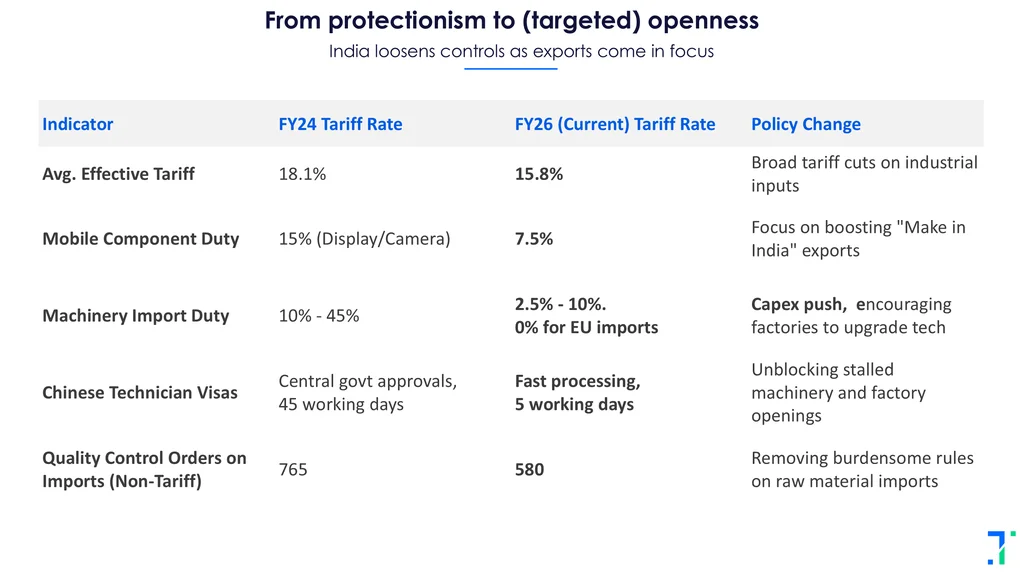
Since 2020, there were some discouraging signs around the Indian economy. It had started rebuilding the tariff walls of the 1970s, and average applied tariffs across imports crept up to 18.1%, the highest among major economies as the government pushed "Make in India". A major sticking point for Indian industry as tariffs rose, was the inverted duty structure, where India taxed raw materials higher than finished goods. 

It's still early days, but the signs are that India is back in reformist mode. India, long called the "sleeping giant", may have woken up and had some coffee, thanks to Trump. 

Ever since the US launched its trade war last year, the Indian government has made some important policy changes. It simplified GST, and implemented long pending labour reforms. In last year's budget, duties on mobile camera modules, open cells for TVs, and solar wafers were slashed. The result since then has been a surge in intermediate imports, and a rampup in India's electronics exports. 

The most sensitive pivot, however, is on China. After the deep freeze in India-China relations from 2020-2024, the Indian government is becoming a bit more realistic. Recognizing that Indian factories cannot run without Chinese machinery and sub-assemblies, the government liberalized the visa regime for Chinese technicians in December 2025. The Quality Control Orders (QCOs) on footwear and toys, which act as non-tariff barriers to these imports and rose in number from 51 in 2015 to over 700 in 2024, have been cut. 

The times, they are a'changing: India is reacting to a more competitive global market

The peak of India's new protectionist era was in 2023, when the Indian economy was a middle bencher in the global market. But Trump, the unintentional reformer, forced India’s hand. His tariffs shattered our complacency that we could coast on the China Plus One path without doing the hard, often unpopular work of reform. 

India has been reacting late, no question. The share of manufacturing in India's GDP has been stuck at the same level of around 17% over the past decade.  Vietnam in comparison, which invested heavily in manufacturing infrastructure over the last decade, managed to raise its GDP per capita to $4,280 while India's has grown more slowly, to $2,480.

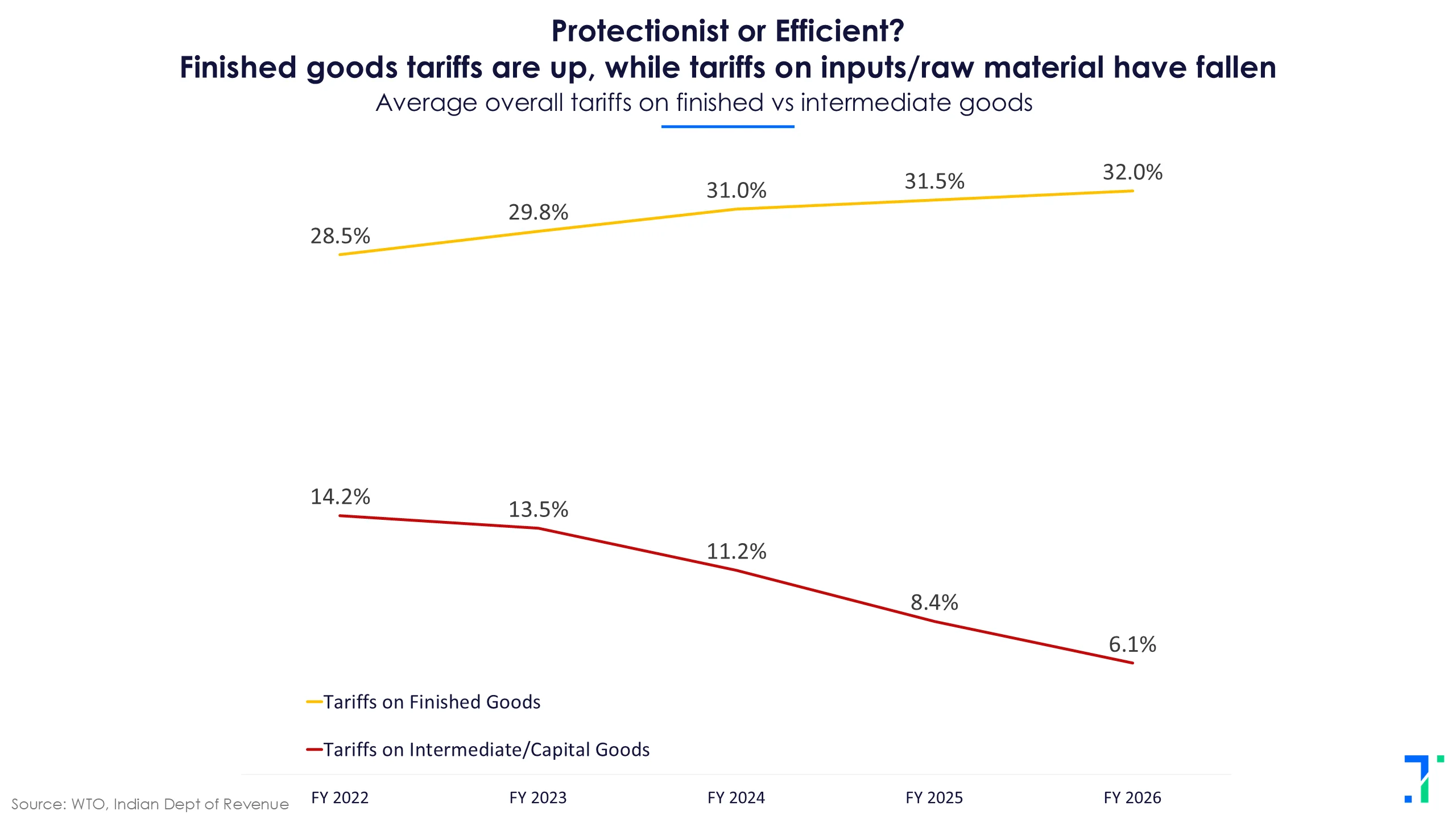
India's tariff cuts have been narrow, but show some clear priorities. It has slashed tariffs for intermediate goods that Indian factories need, while keeping it high for finished goods. For example, India has kept tariffs high on items like ready to wear clothing, footwear, toys, furniture, and cars (although this will fall following the EU deal).

But it has slashed tariffs for critical inputs like solar wafers, machinery, lithium ion batteries, chips and chemicals. This keeps Indian exporters and manufacturers competitive. 

The tariff gap between these two kinds of imports has steadily increased. India is increasingly protectionist on the supermarket shelf, and increasingly liberal on the factory floor. 

Sun Kings: the rise of solar

Global oil politics has become another increasingly sore spot for both India and China under Trump, as the US has aggressively penalized and sanctioned top oil exporters like Russia and Iran. The Trump administration has also  pivoted to "resource capture", by cornering the oil exports of countries like Venezuela. 

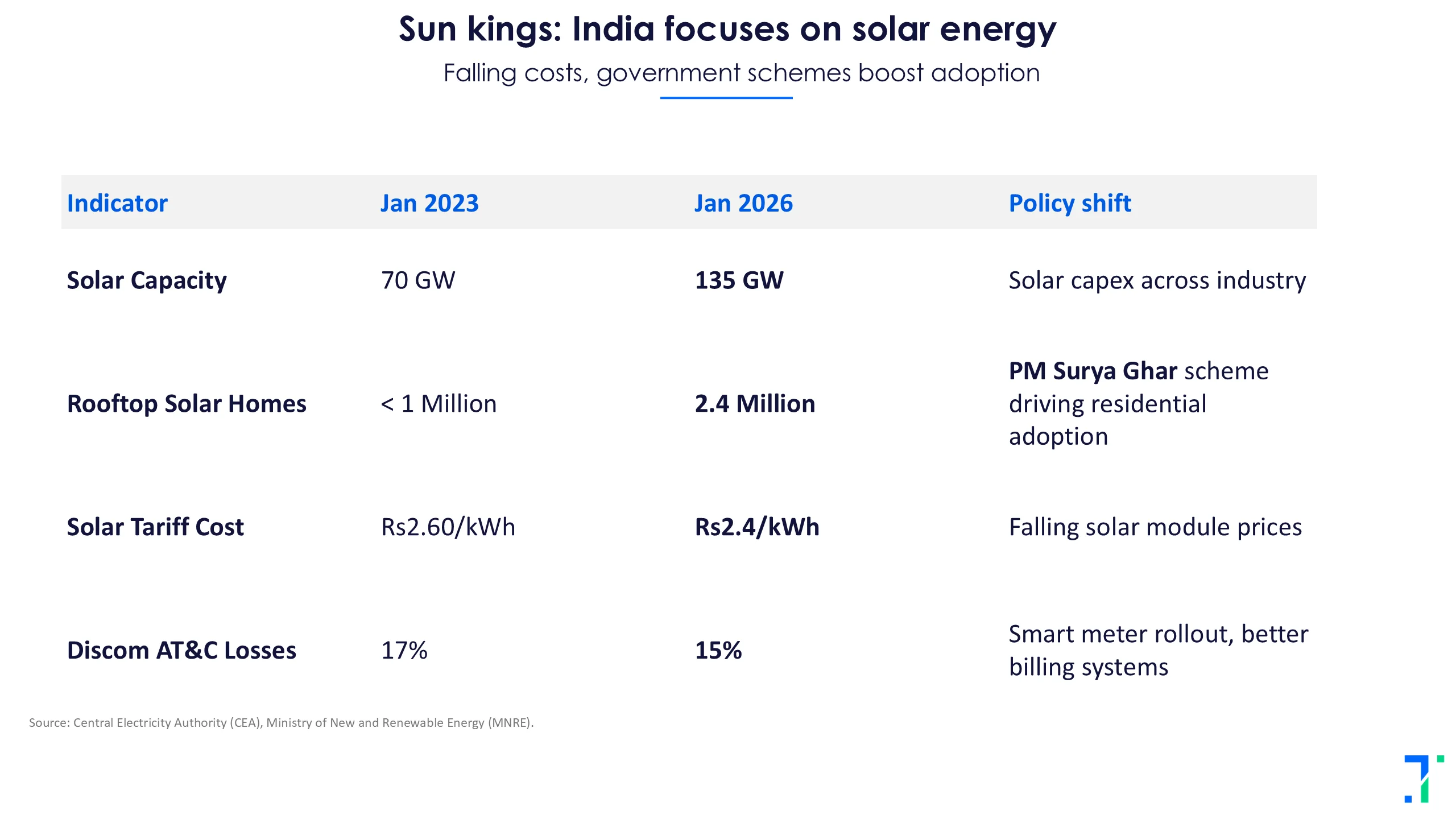
In response, both India and China are investing heavily in solar and renwable energy. While coal and oil are still primary energy sources, India's incremental energy growth is entirely green. One catalyst has been the PM Surya Ghar scheme, launched in early 2024. The scheme offers aggressive subsidies for homes to install rooftop solar, turning millions of middle-class roofs into mini-power sources. As of January 2026, 2.4 million households have joined.

Corporate India is also investing heavily. The EU’s Carbon Border Adjustment Mechanism (CBAM), which is a green tariff on carbon-intensive imports, is forcing Indian steel and cement makers in particular to commission captive solar parks, such as the one by JSW Steel in Vijaynagar, Karnataka and by Tata Power in Gujarat and Madhya Pradesh.

At the current rate of growth,  India is expected to add over 50 GW of new solar capacity in 2026 and become the world's second largest solar market, overtaking the US. 

One thing is for certain. When the Indian government started asking its industrialists, "Where does it hurt?" the list it got was a long one with many, many pain points. Trump may have kickstarted a process that has the potential to transform the Indian economy, from regulations to power to infrastructure.

Across sectors, there is a sense of renewed reform.  For example, as Trump has cracked down on H1Bs, India has turned to Global Capability Centres (GCCs) set up by multinational giants from JPMorgan to Boeing, which handle sophisticated operations from R&D to core processes. In 2025 alone, 140 new GCCs set up shop in India, many moving beyond Bangalore in search of tech talent to Tier-2 cities like Jaipur and Coimbatore.

Perhaps what Indians needed all along was a scarecrow, or a common enemy. In that case, the rise of Trump has been a spot of good news for reformers in India. 

Market closes higher on strong buying amid optimism over India–EU FTA
By Trendlyne Analysis

Nifty 50 closed at 25,342.75 (167.4, 0.7%), BSE Sensex closed at 82,344.68 (487.2, 0.6%) while the broader Nifty 500 closed at 23,082.10 (262.9, 1.2%). Market breadth is ticking up strongly. Of the 2,610 stocks traded today, 1,957 were gainers and 616 were losers.

Indian indices closed higher after rising throughout the day. The Indian volatility index, Nifty VIX, fell 6.4% and closed at 13.5 points. Vedanta surged to a new all-time high of Rs 732.6 after its board approved the sale of a 1.6% stake in its subsidiary, Hindustan Zinc, through an offer for sale.

Nifty Smallcap 100 and Nifty Midcap 100 closed higher. Nifty India Defence and BSE Capital Goods were among the top index gainers today. According to Trendlyne’s sector dashboard, Telecommunications Equipment emerged as the best-performing sector of the day, with a rise of 7.4%.

Asian indices closed mixed. European indices are trading with varied trends. US index futures are trading higher or flat as investors await the US Federal Reserve’s interest rate decision later today. The market widely anticipates no change, with the policy rate expected to remain within the 3.5-3.75% range.

  • Relative strength index (RSI) indicates that Vedanta is in the overbought zone.

  • Maruti Suzuki falls as its Q3FY26 net profit misses Forecaster estimates by 13.3% as margin pressure from higher discounting and sharp rise in operating cost. Revenue and net profit grow 28.7% and 4.1% YoY during the quarter. It appears in a screener of stocks underperforming their industry price change during the quarter.

  • CSB Bank plunges more than 10% as its Q3FY26 provisions surge 5.2x YoY to Rs 86.8 crore after gross NPA rises 38 bps YoY. However revenue jumps 25.6% to Rs 1,430.7 crore, driven by improvements in the treasury operations, and retail & corporate banking segments.

  • Graphite India is rising sharply as its board of directors approves an investment of Rs 4,330 crore to set up manufacturing of Synthetic Graphite Anode Materials (SGAM). SGAM is a key input used in the production of lithium-ion battery cells.

  • Rishab Jain, CFO of Bikaji Foods, expects margins to remain stable over the next few quarters. He guides for value growth of 14–16% and volume growth of up to 12% in FY27, and projects exports to expand by 30–35% over the next 2–3 years.

  • TVS Motor Co is rising sharply as its Q3FY26 net profit jumps 48.6% YoY to Rs 841.3 crore. Revenue grows 32.8% to Rs 14,745.2 crore, led by improvements in the premium portfolio, higher EV sales and global expansion. It features in a screener of stocks with increasing returns on equity (RoE) over the past two years.

  • Rail Vikas Nigam is rising as it emerges as the lowest bidder for an order worth Rs 242.5 crore from South Central Railway. The project involves upgrading the overhead electrification system from a single 25 kilovolt (kV) system to a dual 25 kV system on the Ongole to Gudur section of the Vijayawada division.

  • Suzlon Energy is rising as it secures a 248.9 MW wind power order from the ArcelorMittal Group. The order is part of a 550 MW hybrid project in Gujarat, with power supplied for captive use at ArcelorMittal Nippon Steel facilities in India.

  • Morgan Stanley maintains its 'Overweight' rating on Grasim with a target price of Rs 3,690. The brokerage expects Grasim to stay on track with the ramp-up of its paints business, with Birla Opus gaining 30–40 basis points of market share every quarter. It also expects UltraTech to perform well in the near term.

  • Motilal Oswal is surging as its Q3FY26 revenue jumps 5% YoY to Rs 2,120.1 crore, supported by improvements across the wealth management, capital markets, asset & private wealth management, and home finance segments. However, net profit remains flat at Rs 566 crore during the quarter. It appears in a screener of stocks with improving cash flow from operations over the past two years.

  • Mahindra Logistics surges as it swings to a net profit of Rs 3.3 crore in Q3FY26 compared to a loss of Rs 9 crore in Q3FY25. Revenue grows 19.1% YoY to Rs 1,898 crore, driven by improved performance in supply chain management and enterprise mobility services segments. The company appears in a screener of stocks with zero promoter pledge.

  • PC Jeweller's Q3FY26 net profit jumps 28.5% YoY to Rs 190.1 crore, driven by lower raw materials expenses. Revenue grows 31.7% to Rs 900.5 crore, owing to high demand during the wedding and festive season. It features in a screener of stocks with above line growth and below line valuations.

  • Oil India jumps over 8% as global crude prices surge to a four-month high, driven by geopolitical tensions such as the US–Iran and Russia–Ukraine conflicts, along with supply disruptions. Brent crude rose 0.4% to $67.9 a barrel, while US WTI rose 0.6% to $62.7 a barrel.

  • Oil & Natural Gas Corp surges to its 52-week high of Rs 266.2 per share as its joint ventures (JVs) with Japan's Mitsui OSK Lines secure ship-building contracts (SBCs) from Samsung Heavy Industries to construct two Very Large Ethane Carriers (VLECs).

  • Nesco is falling as its Q3FY26 net profit declines 4.8% YoY to Rs 104.6 crore due to higher finance costs and employee expenses. However, revenue increases 20% to Rs 247.9 crore, driven by improvement in the foods segment during the quarter. The company appears in a screener of stocks underperforming their industry price change in the quarter.

  • Tata Consultancy Services is rising as it plans to set up a delivery centre in Londrina, Brazil, with a capex of $37 million (~Rs 330 crore). The company expects the centre to create over 1,600 new jobs.

  • BNP Paribas analyst Kumar Rakesh says the finalized India–EU FTA will gradually cut tariffs on EU goods exported to India from 100–125% to 10%. He estimates that European car prices could fall by 7–8% and sees the recent sell-off in Indian auto stocks as an overreaction to the agreement.

  • Shadowfax Technologies' shares debut on the bourses at a 9.2% discount to the issue price of Rs 124. The Rs 1,907.3 crore IPO received bids for 2.7 times the total shares on offer.

  • Jayaswal Neco Industries is rising as it signs a memorandum of understanding (MoU) with the Maharashtra government to set up a 2 million tonnes per annum (MTPA) steel plant with a capex of Rs 12,262 crore.

  • Vedanta surges to a new all-time high of Rs 732.6 per share as its board of directors approves selling 6.7 crore shares (or 1.6% stake) in its subsidiary, Hindustan Zinc, through an offer for sale (OFS).

  • JM Financial initiates coverage on Thermax with a 'Reduce' rating and a target price of Rs 2,700. The brokerage flags concerns around execution risks in large industrial infrastructure projects and pressure on return metrics due to diversification into non-core segments. It notes that Thermax has been allocating more growth capital to areas such as solar assets, chemicals and bio-energy, which generate a much lower ROCE of about 5% versus the company’s blended ROCE of over 10%, while also carrying higher execution risks.

  • Vodafone Idea is rising as its Q3FY26 net loss declines 20% YoY to Rs 5,286 crore, helped by a Rs 1,228 crore gain from written back provisions. Revenue grows 1.3% to Rs 11,516 crore, led by an expansion of the 4G/5G subscriber base and higher average revenue per user (ARPU). It features in a screener of stocks with improving cash flow over the past two years.

  • Metro Brands surges as its Q3FY26 net profit grows 35.7% YoY to Rs 128.4 crore, led by inventory destocking. Revenue increases 15.4% to Rs 811.3 crore, driven by strong festive & wedding season demand during the quarter, coupled with a GST cut on footwear. The company appears in a screener of stocks outperforming their industry price change over the past quarter.

  • Caplin Point Laboratories is rising as its subsidiary, Caplin Steriles, gets US FDA approval for its abbreviated new drug application (ANDA) for Methylprednisolone Acetate Injectable Suspension. The drug treats inflammation across several medical conditions. It had sales of around $57.4 million in the 12 months ending November 2025, according to IQVIA.

  • Marico's Q3FY26 net profit grows 12% YoY to Rs 447 crore. Revenue jumps 26.1% to Rs 3,576 crore, supported by improvements in the domestic and international markets. It appears in a screener of stocks with high momentum scores.

  • Nifty 50 was trading at 25,321.75 (146.4, 0.6%), BSE Sensex was trading at 81,892.36 (34.9, 0.0%), while the broader Nifty 500 was trading at 22,964.35 (145.1, 0.6%).

  • Market breadth is overwhelmingly positive. Of the 2,103 stocks traded today, 1,653 were on the uptrend, and 384 went down.

Riding High:

Largecap and midcap gainers today include CG Power and Industrial Solutions Ltd. (581.95, 9.7%), Oil India Ltd. (490.50, 9.4%) and Solar Industries India Ltd. (13,916, 9.0%).

Downers:

Largecap and midcap losers today include Tata Consumer Products Ltd. (1,131.80, -4.7%), Asian Paints Ltd. (2,511.80, -4.2%) and Vishal Mega Mart Ltd. (119.86, -4.1%).

Volume Rockets

19 stocks in BSE 500 are trading on high volumes today.

Top high volume gainers on BSE included Tejas Networks Ltd. (339.05, 14.5%), Data Patterns (India) Ltd. (2,610.60, 13.6%) and Hindustan Copper Ltd. (633.40, 12.7%).

Top high volume losers on BSE were Vishal Mega Mart Ltd. (119.86, -4.1%), Concord Biotech Ltd. (1,187.60, -2.8%) and Maruti Suzuki India Ltd. (14,877, -2.4%).

International Gemmological Institute (India) Ltd. (319.85, 9.9%) was trading at 19.1 times of weekly average. Oil India Ltd. (490.50, 9.4%) and Force Motors Ltd. (18,983.10, 1.0%) were trading with volumes 12.4 and 9.3 times weekly average respectively on BSE at the time of posting this article.

BSE 500: highs, lows and moving averages

18 stocks made 52 week highs, while 15 stocks hit their 52 week lows.

Stocks touching their year highs included - Axis Bank Ltd. (1,319.80, 0.3%), Bharat Electronics Ltd. (453, 8.9%) and Coal India Ltd. (444.05, 5%).

Stocks making new 52 weeks lows included - Akzo Nobel India Ltd. (2,828.20, -2.5%) and Jyothy Labs Ltd. (247.90, 0.7%).

27 stocks climbed above their 200 day SMA including Syrma SGS Technology Ltd. (722.90, 10.0%) and Nippon Life India Asset Management Ltd. (839.50, 5.1%). 13 stocks slipped below their 200 SMA including Radico Khaitan Ltd. (2,746.80, -6.1%) and Home First Finance Company India Ltd. (1,190.90, -4.9%).

Market closes higher, buoyed by the EU trade deal
By Trendlyne Analysis

Nifty 50 closed at 25,175.40 (126.8, 0.5%), BSE Sensex closed at 81,857.48 (319.8, 0.4%) while the broader Nifty 500 closed at 22,819.25 (113.1, 0.5%). Market breadth is in the red. Of the 2,636 stocks traded today, 1,125 were in the positive territory and 1,452 were negative.

Indian indices closed higher after switching between gains and losses throughout the day, buoyed by a trade deal with the EU and strong Q3FY26 results. The Indian volatility index, Nifty VIX, closed higher at 14.5 points. Axis Bank surged to a new 52-week high as its Q3FY26 net profit jumped 4% YoY, helped by lower employee benefits expenses.

Nifty Smallcap 100 and Nifty Midcap 100 closed in the green, tracking the benchmark index. Nifty Metal and S&P BSE Services were among the best-performing indices of the day. According to Trendlyne’s sector dashboard, Transportation emerged as the highest-performing sector of the day, with a rise of 2.7%.

Asian indices closed higher, except for Indonesia’s IDX Composite index. European indices are trading with varied trends. US index futures are trading flat to higher ahead of key corporate earnings and a Federal Reserve interest rate decision. Brent crude futures are trading higher after falling 0.4% on Monday.

  • Money flow index (MFI) indicates that stocks like Aditya Birla Fashion, Indraprastha Gas, Adani Energy and Bata India are in the oversold zone.

  • Asian Paints is falling as its Q3FY26 net profit declines 4.6% YoY to Rs 1,059.9 crore due to higher inventory, employee benefits and depreciation & amortisation expenses. Revenue grows 3.9% to Rs 9,028 crore, helped by improvements in the decorative and coatings segments and strong exports. It shows up in a screener of stocks with high promoter pledges.

  • Godrej Consumer Products is falling sharply as its Q3FY26 net profit remains flat at Rs 497.9 crore due to higher inventory and employee benefits expenses. However, revenue jumps 7.9% to Rs 4,155 crore, led by improvements in the Indian and African markets. It features in a screener of stocks with declining book value over the past two years.

  • HCL Technologies is rising as it plans to acquire Singapore-based Finergic Solutions for SGD 19 million (Rs 137 crore) to strengthen its services in the financial and wealth management sectors.

  • Bernstein initiates coverage on Kotak Mahindra Bank with a 'Market Weight' rating and a target price of Rs 490. The brokerage points to a stable Q3 operating performance, with steady asset quality and largely unchanged core profitability. It notes that net interest margins remained at 4.5%, indicating a possible end to margin normalisation. While microfinance and credit card segments remained weak, loan growth outpaced peers and return on assets held at 1.9%.

  • Raymond is rising as its Q3FY26 revenue grows 19.5% YoY to Rs 557.2 crore, driven by aerospace & defence and precision technology & auto components segments. However, net profit drops 95% to Rs 3.6 crore as last year included earnings from discontinued operations following the Raymond Realty demerger. It appears in a screener of stocks with low debt.

  • Tata Consumer Products is rising as its Q3FY26 net profit jumps 37.9% YoY to Rs 384.6 crore, helped by lower finance costs. Revenue grows 14.5% to Rs 5,145 crore, driven by improvements in the domestic and international markets. It features in a screener of stocks with increasing revenue for the past four quarters.

  • Raymond Lifestyle is rising as its Q3FY26 revenue jumps 4.9% YoY to Rs 1,882.8 crore, driven by improvements in the textile, shirting and apparel segments. EBITDA margin expands 260 bps to 12.8%, led by lower inventory, manufacturing and employee benefits expenses. It appears in a screener of stocks with decreasing promoter pledge.

  • Axis Bank is reportedly exploring a bid to acquire the promoter stake in microfinance lender CreditAccess Grameen, after promoters initiated a process to sell their entire holding. Promoter entity CreditAccess India BV owns 66.28% of the company, with the stake valued at around Rs 14,000 crore, while the firm’s market capitalisation stands at about Rs 22,000 crore.

  • Textile firms like Welspun Living, KPR Mill and Trident are rising as the India–EU trade deal supports export outlook. The EU accounts for about $7.7 billion, nearly 20%, of India’s textile and apparel exports.

  • Waaree Renewable Technologies is rising as its board approves the acquisition of around 55% stake in Associated Power Structures (ASPL) for about Rs 1,225 crore. The deal expands the company’s presence and strengthens its capabilities across the renewable energy and energy efficiency segments.

  • Multi Commodity Exchange of India is rising sharply as its Q3FY26 net profit surges 150.6% YoY to Rs 401.1 crore. Revenue jumps 114.9% to Rs 697.1 crore, supported by higher average daily turnover (ADT) across segments. It appears in a screener of stocks with rising returns on equity (RoE), momentum and earnings yield.

  • Shares of Indian automakers such as M&M, Maruti Suzuki India and Tata Motors decline on concerns that the India–EU FTA, scheduled to be signed later in the day, may lead to sharp cuts in tariffs on European car imports. Reports suggest the government plans to lower import duties to around 40% from as high as 110%.

  • IndusInd Bank's Q3FY26 net profit plunges 90.9% YoY to Rs 128 crore due to higher provisions and employee benefits expenses. Revenue declines 13.7% to Rs 13,080.1 crore, caused by reductions in the treasury operations, retail and corporate banking segments. The bank's asset quality worsens as its gross and net NPAs increase by 131 bps and 36 bps, respectively.

  • Axis Bank surges to its 52-week high of Rs 1,333.2 per share as its Q3FY26 net profit jumps 4% YoY to Rs 7,010.7 crore, helped by lower employee benefits expenses. Revenue grows 5% to Rs 40,898.4 crore, attributed to improvements in the treasury operations, retail and corporate banking segments. It features in a screener of stocks with trailing twelve-month (TTM) PE lower than 3-, 5- and 10-year PE.

  • Rites secures a Rs 171 crore order from ICVL Mozambique to supply and maintain Cape Gauge diesel electric locomotives. The contract includes preventive maintenance and spare parts, with locomotive supplies to be completed within a 15-month timeline.

  • Investec maintains a 'Hold' rating on PVR Inox with a target price of Rs 1,238. The brokerage views the sale of the entire stake of the "4700BC" popcorn brand to Marico for Rs 227 crore as a strategic monetisation move that will strengthen the balance sheet and sharpen focus on the core cinema business. It adds that management expects no material impact on in-cinema food and beverage growth or the company’s overall growth outlook.

  • Zydus Lifesciences receives Form 483 with three observations from the US FDA after an inspection at its Ankleshwar manufacturing plant.

  • DCB Bank surges to a 5-year high of Rs 198 as its Q3FY26 net profit rises 22% YoY to Rs 184.7 crore. Revenue increases 11.4% to Rs 1,860.9 crore, driven by improvements in the retail, wholesale and treasury banking segments during the quarter. The bank's asset quality improves as its gross and net NPAs contract by 39 bps and 8 bps YoY, respectively.

  • JSW Energy is falling sharply as its Q3FY26 revenue misses Forecaster estimates by 9.7% despite growing 61.2% YoY to Rs 4,254.5 crore, helped by improvements in the thermal and renewables segments. Net profit surges 2.5x to Rs 419.9 crore, driven by a Rs 557 crore deferred tax credit. It shows up in a screener of stocks with high debt.

  • Umesh Revankar, Executive Vice Chairman of Shriram Finance, notes that MSME credit slowed in some segments in Q3 due to tariff uncertainties but expects government infrastructure spending to boost construction and heavy commercial vehicle financing. He projects a FY27 return on assets of about 3.5%, long-term net interest margins of 8.5–9%, and expects the MUFG Bank deal to be concluded by the end of FY26.

  • UltraTech Cement is rising as its Q3FY26 net profit grows 17.1% YoY to Rs 1,725.4 crore. Revenue jumps 26% to Rs 21,965.3 crore owing to improvements in domestic grey and white cement sales. It appears in a screener of stocks near their 52-week highs with significant volumes.

  • JSW Steel is rising as its Q3FY26 net profit surges 3x YoY to Rs 2,139 crore, supported by a Rs 1,439 crore deferred tax credit. Revenue jumps 11.4% to Rs 46,264 crore, led by higher steel sales. It features in a screener of strong performing, under the radar stocks according to Trendlyne's DVM scores.

  • Granules India is rising as its Q3FY26 net profit grows 27.7% YoY to Rs 150.2 crore, led by inventory destocking. Revenue increases 22% to Rs 1,387.9 crore, driven by higher sales from the finished dosages segment in North America and Europe during the quarter. The company appears in a screener of stocks outperforming their industry price change in the quarter.

  • Kotak Mahindra Bank is falling as its Q3FY26 net profit misses Forecaster estimates by 1.6% despite rising 4.3% YoY to Rs 3,446.1 crore. Revenue increases 3.5% to Rs 13,903.3 crore, driven by improvements in the retail, wholesale and treasury banking segments during the quarter. The bank's asset quality improves marginally as its gross and net NPAs contract by 20 bps and 10 bps YoY, respectively.

  • Nifty 50 was trading at 25,009.95 (-38.7, -0.2%), BSE Sensex was trading at 81,649.53 (111.8, 0.1%) while the broader Nifty 500 was trading at 22,644.20 (-62, -0.3%).

  • Market breadth is moving down. Of the 2,197 stocks traded today, 654 were in the positive territory and 1,460 were negative.

Riding High:

Largecap and midcap gainers today include Jindal Stainless Ltd. (810.05, 8.6%), Adani Enterprises Ltd. (1,959.50, 5.1%) and Axis Bank Ltd. (1,315.80, 4.6%).

Downers:

Largecap and midcap losers today include JSW Energy Ltd. (440.05, -7.9%), Godrej Consumer Products Ltd. (1,173.90, -5.4%) and Mahindra & Mahindra Ltd. (3,393.50, -4.2%).

Volume Rockets

33 stocks in BSE 500 are trading on high volumes today.

Top high volume gainers on BSE included Home First Finance Company India Ltd. (1,251.70, 12.5%), Aegis Vopak Terminals Ltd. (220.37, 9.5%) and KPR Mill Ltd. (910.20, 7.2%).

Top high volume losers on BSE were OneSource Specialty Pharma Ltd. (1,151.30, -19.6%), Syngene International Ltd. (489.70, -10.0%) and JSW Energy Ltd. (440.05, -7.9%).

EIH Ltd. (308.90, -4.2%) was trading at 9.7 times of weekly average. BASF India Ltd. (3,565, -2.0%) and Inventurus Knowledge Solutions Ltd. (1,632.40, -1.1%) were trading with volumes 8.0 and 7.1 times weekly average respectively on BSE at the time of posting this article.

BSE 500: highs, lows and moving averages

10 stocks took off, crossing 52 week highs, while 80 stocks tanked below their 52 week lows.

Stocks touching their year highs included - Axis Bank Ltd. (1,315.80, 4.6%), Hindalco Industries Ltd. (961.85, 1.2%) and Hindustan Zinc Ltd. (727.20, 4.1%).

Stocks making new 52 weeks lows included - Akzo Nobel India Ltd. (2,908, -1.0%) and Amara Raja Energy & Mobility Ltd. (828.05, -0.4%).

11 stocks climbed above their 200 day SMA including Home First Finance Company India Ltd. (1,251.70, 12.5%) and Sona BLW Precision Forgings Ltd. (487.80, 7.0%). 27 stocks slipped below their 200 SMA including Godrej Consumer Products Ltd. (1,173.90, -5.4%) and Hyundai Motor India Ltd. (2,173.40, -4.0%).

logo
The Baseline
23 Jan 2026
Five Interesting Stocks Today - January 23, 2026
By Trendlyne Analysis

1. Hindustan Zinc:

Thismetals and mining company rose 6.5% last week after itsQ3FY26 revenue and net profit beatForecaster estimates by 12% and 11.1% respectively. The beat came alongside strong silver prices, with operational gains adding to the upside.

Revenue rose 27% YoY to Rs 10,980 crore, driven by higher mined and refined metal volumes and supportive zinc and silver prices. EBITDA margins expanded by about 300 basis points, aided by lower power costs and higher usage of domestic coal. Stronger by-product realisations provided an added boost, partly offset by increased mine development activity.

Refined metal output rose 4% following capacity upgrades at existing smelters, while mined metal production also increased. Zinc’s cost of production fell to a five-year low. Silver now contributes to around 44% of profits, helped by improved recoveries. Its rising industrial usage has pushed silver prices and targets higher.

CEO Arun Misrasaid “Refined zinc and lead metal capacity is expected to rise by around 25% to ~1.4 million tonnes by FY29”, driven largely by brownfield expansions already under execution. This implies a greater share of earnings growth coming from volumes and throughput, reducing dependence on commodity price upside.

“Upcoming expansion projects will be largely funded through internal accruals,” CFO Sandeep Modi added. The company generated Rs 3,400 crore of free cash flow in Q3, resulting in a positive net cash position. He added that renewable energy is expected to account for ~40% of power usage next year, lowering power costs.

Motilal Oswal Financial Servicesreiterated its ‘Neutral’ rating and raised its target price to Rs 720, citing higher silver price assumptions. The brokerage said current valuations already factor in most of the operational and commodity upside and raised its FY26 profit estimates by 10%.

2. Tech Mahindra:

The stock of this IT consulting & software company rose over 2% on January 19 after it announced its Q3FY26 results. Revenue rose 8% YoY to Rs 14,371.5 crore, fueled by growth in IT and business process services (BPS), while net profit surged 14.1% to Rs 1,122 crore on the back of record deal wins in the quarter. It appears in a screener of companies that have shown relative outperformance as compared to their industry over the past month.

Its Q3 revenue surpassed Trendlyne’s Forecaster estimates by 1.5%, driven by an impressive surge in new business. The company secured a Total Contract Value (TCV) of $1,096 million, marking a 47% increase. This was headlined by a large $500 million "mega deal" in the Communications vertical with a leading European telecom provider. Management anticipates this contract will gradually ramp up starting in Q1FY27.

Segment-wise performance was varied: Manufacturing grew 11.7% thanks to aerospace and European automotive wins, while Communications rose 4.7%. However, BFSI dipped 0.8% due to seasonal furloughs. Total headcount fell by 3,098 to 1,49,616, and a $30 million one-time provision for India’s new labour codes has impacted the quarterly profit.

Operating margins improved by 100 basis points to 13.1%, aided by automation, better pricing, and improved utilization. Looking ahead, CEO Mohit Joshi shared his vision for the firm: “We expect to grow higher than the peer average by the end of FY27 while progressing towards a 15% EBIT margin for FY27. The strong quarter reinforces our confidence that we are on the right path and building sustained momentum towards our long-term aspirations.”

Axis Direct maintained its ‘Buy’ rating with a higher target price of Rs 1,870. The brokerage highlighted the strong deal pipeline and the company's focus on scaling its digital business. The brokerage remains optimistic about sequential growth, noting that the firm is effectively resolving client-specific issues across various sectors. The long-term outlook remains constructive as the company leverages its robust pipeline to drive sustained market performance.

3. JSW Infrastructure:

Theport operator’s stock jumped 5.8% on January 19 after a strongQ3FY26 report. Net profit grew 8.9% YoY, while revenue climbed 14.2%, beatingForecaster estimates, driven by higher cargo volumes. Stronger performance at its Goa and Maharashtra ports fueled this growth.

However, weaker volumes at the Paradip Iron Ore Terminal in Odisha partially offset these gains. MD & CEO Rinkesh Royblamed a “weak seaborne iron ore export market.” As a result, the company cut its full-year volume growth forecast to 5-6% from 8-10%. However, headded, “Recent monthly volumes are encouraging, with volumes rising in December.”

During the quarter, JSW Infra made two strategic moves to expand its reach. Itsigned a $419 million deal to build a new 27 million tonnes per annum (MTPA) port in Oman. This port will ship industrial minerals to India, feeding the nation's steel and cement plants.

The company also strengthened its logistics segment,acquiring three rail businesses for Rs 1,212 crore and adding 25 operational rakes. Management plans to grow the fleet to 110 rakes by FY30, building an integrated port-to-rail network.

Looking ahead, JSW Infrastructure continues to pursue a dual growth strategy. Itaims to increase port capacity to 400 MTPA by FY30 while growing its logistics revenue to Rs 8,000 crore. The company plans capital expenditure of Rs 3,500 crore for FY26, a reduction of Rs 2,000 crore from earlier projections. CFO Nagarajan J clarified that this adjustment reflects a shift in payment timings, not a cut in overall investment.

Following the results, Motilal Oswalreiterated its 'Buy' rating, citing consistent volumes, an improved cargo mix, and strong execution. The brokerage anticipates earnings growth from FY28, as major projects go live. Management projects that key expansions in Odisha, Jaigarh, and Dharamtar could nearly double earnings by FY28.

4. Havells India:

This electrical goods maker fell by over 10% last week after its Q3FY26 net profit missed Forecaster estimates by 9%, despite rising 8% YoY to Rs 301 crore. The miss was due to weak performance at the Lloyds consumer appliances business, which sells air conditioners, refrigerators, and washing machines, along with lower margins in the cable & wire (C&W) segment. Revenue grew 14%, supported by higher sales from switchgears, cables, and electrical consumer durables.

The cables business remained the largest contributor, recording a 33% sales growth. However, the management flagged cost pressure from higher copper prices and a weaker rupee, noting that the industry may need a 5–10% price hike to protect margins. Chairman & MD Anil Gupta said, “Higher input costs can hurt margins in the short term, but once channel inventory normalises, margins tend to stabilise over time.” EBITDA margin for the quarter stood at 9.2%.

Solar emerged as the company’s fastest-growing segment this quarter. After investing Rs 600 crore in PV module maker Goldi Solar in Q1FY26, the company is now focusing on solar distribution and commercial-and-industrial installations. Gupta expects this business to contribute up to 10% of overall sales over the next three to five years.

Capex stood at Rs 1,200 crore in 9MFY26. For FY27, the company guided capex at around Rs 1,000 crore, mainly for expansion in C&W and a new R&D centre.

Motilal Oswal has a ‘Neutral’ rating on the stock with a target price of Rs 1,590. The brokerage lists room air conditioners (RAC) inventory trends, price hikes, and raw material costs amid copper price swings as key factors to watch. It expects revenue and net profit to grow at a CAGR of 11% and 15%, respectively, over FY26–28.

5. South Indian Bank:

Thisprivate lender’s shares climbed to a new all-time high of Rs 46.8 after it reported itsQ3FY26 results. Revenue rose 8% YoY, supported by stronger treasury income and steady growth in retail banking. Net profit increased 9.5% as asset quality improved and bad loans declined. On January 17, the bank alsocut lending rates.

Loan demand remained healthy during the quarter, lifting net interest income (NII) by 1.3%. Growth came largely from retail, agriculture, and MSME loans, while corporate loans continued to form the largest share of the book at 40%. Retail loans accounted for 28%, agriculture 17%, and MSME 15%. 

Management is working to rebalance this mix by reducing the corporate share to about one-third of gross advances and expanding the other segments over time. The move will help the bank reduce its non-performing assets (NPAs). The rebalancing is already reaping rewards, with gross NPAs declining by 163 bps and net NPAs falling by 80 bps, reflecting tighter credit controls and recoveries.

On the liability side, higher CASA deposits supported overall deposit growth and helped improve the CASA ratio, easing funding costs. 

That said, higher provisioning and lower interest rates weighed on margins. Net interest margin (NIM) decreased by 33 basis points during the quarter. MD & CEO PR Seshadrisaid, “We expect NIM to stabilise at current levels of 2.9% in FY26, assuming no further repo rate cuts.” He added that the bank continues to target NII growth of over 12%, supported by seasonally strong trends in Q4FY26. While recent rate cuts could pressure margins, he believes deposit repricing should partly offset the impact.

Following the results, ICICI Directreiterated a ‘Buy’ rating and raised its target price to Rs 52, implying an upside of about 16%. The brokerage highlighted easing margin pressure, stable asset quality, and steady progress in reshaping the loan mix. It expects the bank to deliver annual growth of 8–9% in both NII and net profit through FY28.

Trendlyne's analysts identify stocks that are seeing interesting price movements, analyst calls, or new developments. These are not buy recommendations.