My Newsfeed

Market closes lower amid profit booking and foreign investor outflows
By Trendlyne Analysis

Nifty 50 closed at 26,142.10 (-35.1, -0.1%), BSE Sensex closed at 85,408.70 (-116.1, -0.1%) while the broader Nifty 500 closed at 23,850.25 (-44.9, -0.2%). Market breadth is in the red. Of the 2,614 stocks traded today, 1,082 were on the uptick, and 1,469 were down.

Indian indices closed lower after falling throughout the day. The Indian volatility index, Nifty VIX, fell 2% and closed at 9.2 points. Hindustan Copper closed 7.1% higher as copper hit a new all-time high of $12,159.5 per tonne. Concerns over copper supply, driven by mine disruptions, have pushed prices higher.

Nifty Smallcap 100 closed higher, while Nifty Midcap 100 closed lower. Nifty Capital Markets and BSE Oil & Gas were among the top index losers today. According to Trendlyne’s sector dashboard, Hardware Technology & Equipment emerged as the worst-performing sector of the day, with a fall of 1%.

Asian indices closed mixed. European indices are trading with varied trends. US index futures are trading flat, indicating a cautious start to the trading session. The US markets will close early today and remain shut tomorrow on account of Christmas. Brent crude futures are trading flat after rising 0.5% on Tuesday.

  • Money flow index (MFI) indicates that stocks like Honeywell Automation, United Breweries, Poly Medicure and Akzo Nobel are in the oversold zone.

  • VIP Industries surges over 10% as its promoter, the Piramal family, reportedly completes the transfer of their remaining stake to Multiples PE. Around 3.7 crore shares (25.9% equity), changed hands in multiple block deals. The Piramal family had earlier sold a 6.2% stake in September for Rs 343 crore.

  • GPT Infraprojects rises as it receives a Rs 199.2 crore railway contract from North Eastern Railway for bridge works in Uttar Pradesh. The firm also emerges as the lowest bidder for a Rs 670 crore road project awarded by the National Highways Authority of India.

  • KPI Green Energy is rising as it receives an order worth Rs 128.5 crore from NTPC to set up and operate a green hydrogen and waste-to-energy plant in Greater Noida.

  • Reliance Industries reportedly secures a one-month US concession, allowing it to receive oil cargoes from Rosneft despite sanctions. The company has a long-term agreement with Rosneft to buy 500,000 barrels per day for its 1.4 million bpd refining complex.

  • Geojit BNP Paribas downgrades Cipla to a 'Hold' call from 'Buy', with a target price of Rs 1,645 per share. This indicates a potential upside of 10.2%. The brokerage believes that the anticipated revenue erosion from Revlimid, increased R&D straining margins, and execution risk related to timely approvals could limit earnings visibility and margin recovery in the medium term. It expects the company to deliver a revenue CAGR of 7.4% over FY26-27.

  • Castrol India jumps over 2% after its parent, British Petroleum (BP), signs an agreement to sell a 65% stake in Castrol to Stonepeak at an enterprise value of $10 billion. The deal is expected to generate around $6 billion in net proceeds, including accelerated dividends, which BP plans to use entirely to reduce its net debt.

  • Punjab & Sind Bank's board of directors schedules a meeting on January 21 to consider a proposal to raise up to Rs 3,000 crore through a qualified institutional placement (QIP) of equity shares.

  • PL Capital maintains a 'Buy' rating on Adani Ports with a higher target price of Rs 1,876. The brokerage flags the NQXT port in Australia as a key milestone in the company’s international expansion. It notes NQXT as a high-quality, cash-generative deep-water export terminal with about 65% EBITDA margins and a remaining lease life of roughly 85 years. The asset is expected to scale to around AUD 400 million (~Rs 2,414 crore) in EBITDA over the next four years.

  • Ola Electric Mobility rises as its board approves a Rs 100 crore investment in its battery arm, Ola Electric Technologies. The subsidiary clears the allotment of optionally convertible redeemable preference shares to fund its battery-related activities.

  • Morgan Stanley retains an 'Underweight' rating on SBI Cards with a target price of Rs 700. The brokerage expects post-festive credit card spending growth to remain subdued at around 14% YoY, in line with pre-festive trends seen during April–August 2025. It believes high entry barriers and a strong win rate will support the company’s growth, while margin resilience is likely to be aided by the tonnage tax scheme (TTS).

  • Ajanta Pharma is rising sharply as it signs an in-licensing agreement with Biocon to market Semaglutide. As per the pact, Biocon will supply the drug to Ajanta for exclusive marketing in 23 countries and semi-exclusive marketing in three countries across Africa, the Middle East and Central Asia. Semaglutide improves glycaemic control in adults and has an estimated market size of $26 billion in 2024, according to IQVIA.

  • Investec maintains a 'Buy' rating on RBL Bank with a target price of Rs 430. The brokerage notes that the bank plans to deploy $1.5 billion of the $3 billion infusion from Emirates NBD to retire high-cost liabilities and support 30% loan growth in FY27. It expects potential rating upgrades to help narrow wholesale funding cost gaps versus larger peers.

  • GK Energy is rising as it secures an order worth Rs 276.9 crore from Maharashtra State Electricity Distribution Co (MSEDCL) to supply 10,000 off-grid DC solar photovoltaic water pumping systems.

  • Park Medi World rises as its board approves the acquisition of a 100% stake in KP Institute of Medical Sciences (KPIMS) for Rs 245 crore in an all-cash deal. The Agra-based hospital will become a wholly owned subsidiary, supporting the company’s expansion plans across North India.

  • Hindustan Copper surges to its all-time high of Rs 432 per share as copper makes a new all-time high of $12,159.5 per ton. Increased concern about copper supply, driven by mine disruptions, pushes prices higher.

  • Rishi Anand, MD & CEO of Aadhar Housing Finance, says the company is on track to deliver 20–22% growth in assets under management (AUM) in FY26 and is well capitalised for the next 2.5–3 years. He expects H2 to outperform H1, supported by strong demand and government initiatives, which are expected to add 3 crore affordable housing units.

  • Gujarat Narmada Valley Fertilizers & Chemicals is rising as it awards an order worth Rs 360 crore to Toyo Engineering India. The order is for the installation of an Ammonium Nitrate–II plant on a lump-sum engineering, procurement, and construction basis.

  • EPACK Durables is rising as its board of directors approves setting up a new air cooler manufacturing facility in Bhiwadi.

  • NTPC rises as its board of directors approves forming a 50:50 joint venture (JV) with EDF power Solutions India to set up pumped storage plants (PSPs). The board also sanctions forming a wholly owned subsidiary in Mauritius to develop power projects, including a floating solar photovoltaic (FSPV) project in the country.

  • JK Tyre & Industries announces the completion of its merger with subsidiary Cavendish Industries following the National Company Law Tribunal (NCLT) approval on November 20. As part of the merger, JK Tyre acquires an additional 12.5% stake in Cavendish from Valiant Pacific LLC, enhancing capacity utilisation and operational efficiency in the domestic tyre business.

  • Oswal Pumps is rising as it receives an order worth Rs 180 crore from Maharashtra State Electricity Distribution Co (MSEDCL) to supply and install 6,500 off-grid DC solar water pumping systems for farmers across Maharashtra.

  • Vikran Engineering surges more than 10% as it secures an order worth Rs 2,035.3 crore from Onix Renewables to set up 600 MW alternating current (AC) solar projects across Maharashtra.

  • Rail Vikas Nigam appoints Saleem Ahmad as its new Chairman and Managing Director (CMD), succeeding Sukhmal Chand Jain, effective December 23.

  • GAIL (India) signs a memorandum of understanding (MoU) with the Chhattisgarh government to set up a 12.7 lakh metric ton (LMT) urea manufacturing plant in the state. The company will locate the facility along its Mumbai–Nagpur–Jharsuguda Natural Gas Pipeline (MNJPL) corridor.

  • Nifty 50 was trading at 26,188.05 (10.9, 0.0%), BSE Sensex was trading at 85,533.11 (8.3, 0.0%), while the broader Nifty 500 was trading at 23,913.05 (17.9, 0.1%).

  • Market breadth is surging up. Of the 2,068 stocks traded today, 1,348 were on the uptick, and 636 were down.

Riding High:

Largecap and midcap gainers today include NTPC Green Energy Ltd. (93.27, 3.1%), Hindustan Zinc Ltd. (624.85, 2.5%) and Trent Ltd. (4,289.60, 2.4%).

Downers:

Largecap and midcap losers today include Coforge Ltd. (1,737.70, -2.4%), Persistent Systems Ltd. (6,353, -2.1%) and HDFC Asset Management Company Ltd. (2,656.10, -2.0%).

Crowd Puller Stocks

12 stocks in BSE 500 are trading on high volumes today.

Top high volume gainers on BSE included JBM Auto Ltd. (639.95, 10.7%), Manappuram Finance Ltd. (314.55, 6.7%) and IIFL Finance Ltd. (602.15, 5.1%).

Top high volume losers on BSE were Emcure Pharmaceuticals Ltd. (1,409.80, -1.2%) and Shyam Metalics and Energy Ltd. (824.10, -0.3%).

Castrol India Ltd. (189.39, 1.9%) was trading at 34.9 times of weekly average. Ajanta Pharma Ltd. (2,734.50, 2.5%) and HEG Ltd. (550.55, 2.1%) were trading with volumes 10.7 and 6.6 times weekly average respectively on BSE at the time of posting this article.

BSE 500: highs, lows and moving averages

22 stocks made 52 week highs, while 3 stocks were underachievers and hit their 52 week lows.

Stocks touching their year highs included - AIA Engineering Ltd. (3,941.90, 1.1%), Ashok Leyland Ltd. (175.31, -1.5%) and Bharat Forge Ltd. (1,450.50, -0.7%).

Stocks making new 52 weeks lows included - ACC Ltd. (1,739.40, -0.8%) and Jyothy Labs Ltd. (279.65, -0.5%).

14 stocks climbed above their 200 day SMA including JBM Auto Ltd. (639.95, 10.7%) and PNB Housing Finance Ltd. (966.30, 3.6%). 8 stocks slipped below their 200 SMA including The Bombay Burmah Trading Corporation Ltd. (1,862.70, -1.7%) and Angel One Ltd. (2,523.80, -1.3%).

logo
The Baseline
23 Dec 2025
Five stocks to buy from analysts this week - December 23, 2025
By Abdullah Shah

1. Vishal Mega Mart:

Motilal Oswal retains its ‘Buy’ call on this retail store chain with a higher target price of Rs 170 per share, an upside of 24.3%. Despite an 8.2% drop in the stock price last quarter, analysts Aditya Bansal and Avinash Karumanchi see strength in the stock. Vishal Mega Mart benefits from its diverse product mix, budget-friendly starting prices, major contribution from its own brands, and an efficient cost structure. These give it an edge over both offline and online value competitors.

Management remains confident in achieving double-digit same-store sales growth in FY26, driven by its unique offerings, with around 75% of revenue from its own brands, entry-level pricing, and a loyal customer base. Analysts add that the company's focus on offering premium products helps it capture a larger share of customer spending, particularly during festive seasons.

Bansal and Karumanchi point out that South India's profitability matches the national average, despite lower sales volume, thanks to strong demand for apparel. Encouraged by this performance, the company plans to open more stores in South India. They project Vishal Mega Mart will achieve a 20% revenue CAGR and a 30% net profit CAGR from FY26-28.

2. Waaree Energies:

Emkay reiterates its ‘Buy’ call on this solar module manufacturer, with a target price of Rs 4,260, an upside of 37.6%. Its share price has fallen 2.8% over the last month and 10.4% over the three months. Waaree's planned $30 million investment in United Solar Holding (USH) drives this recommendation. It grants Waaree access to a 1 lakh tonnes-per-year polysilicon plant in Oman. This supports partial backward integration in its solar supply chain.

The Oman plant offers cost benefits, lower energy expenses, and favourable trade terms with markets such as the US and India. This will help Waaree meet the 10-gigawatt wafer-ingot demand for its Nagpur facility. Management expects the plant to begin operations soon and reach full capacity within a year. This ensures long-term supply security and reduces reliance on Chinese polysilicon.

Waaree also added 5.1 gigawatts of module capacity in Gujarat during Q3, strengthening its domestic manufacturing. Analysts Sabri Hazarika and Arya Patel state that the USH investment will enhance scale, integrate the supply chain, and support global expansion. They expect this step to improve margins gradually. They also see Waaree well positioned to profit from rising global solar demand and clearer supply prospects.

3. Lumax Auto Technologies

ICICI Direct reiterates its ‘Buy’ rating on this auto parts & equipment producer with a target price of Rs 1,800 per share, an upside of 14.3%. Analysts Shashank Kanodia and Bhavish Doshi see benefits from the company’s strong position in the passenger vehicle (PV) ancillary segment, gains from premium products, and a robust order book.

Management notes that the PV segment generated 55% of the company’s sales in H1FY26, boosted by the acquisition of PV interior supplier International Automotive Components (IAC) India. Analysts add that this acquisition gave Lumax Auto’s product range a boost, particularly in plastic interior modules. It has also expanded business with original equipment manufacturers (OEMs) such as Mahindra & Mahindra.

With a 40% share of EV platforms in its Rs 1,360 crore order book and increasing content per vehicle, the analysts believe the company is well positioned to profit from volume growth and premiumisation among leading OEMs. Kanodia and Doshi write that GST 2.0 reforms will drive two-wheeler segment growth, led by volume recovery. They expect the company to deliver an 18.1% revenue CAGR and a 30.6% net profit CAGR from FY26-28.

4. Aditya Infotech

ICICI Securities maintains its ‘Buy’ call on this IT networking equipment manufacturer, with a target price of Rs 1,800 per share, a 15.9% upside. The stock has dropped 6.9% over the past month. Analysts Aniruddha Joshi and Manoj Menon believe Aditya Infotech will continue to gain market share, driven by stronger brand recognition and expanded manufacturing.

Management highlights increased brand-building investments. This includes expanding CP Plus Galaxy stores, which are their specialised outlets for advanced surveillance products, and more advertising. Analysts add that this brand push is crucial to attract consumers and support premium product offerings. The company's partnership with Qualcomm for AI-enabled video security solutions has differentiated its products and improved customer retention.

Joshi and Menon believe the company's planned capacity expansion in Kadapa and a new North India manufacturing unit will improve service speed, cut logistics costs, and enable faster market entry. Analysts add that successful partnerships with semiconductor players will boost product performance and long-term cost efficiencies. They expect the company to deliver revenue and net profit CAGRs of 24.3% and 65.2%, respectively, from FY26-28.

5. Shriram Finance

Axis Direct reiterates its ‘Buy’ call on this NBFC, with a target price of Rs 1,125, an upside of 17.5%. Analysts Dnyanada Vaidya and Abhishek Pandya cite MUFG Bank's planned strategic investment as the main driver of this positive outlook. MUFG intends to buy a 20% stake for roughly Rs 841 per share via a preferential allotment. 

This Rs 39,618 crore deal marks India's largest foreign direct investment in its financial services sector. The capital infusion will strengthen Shriram Finance's fundamentals. It is also expected to fuel faster growth in areas like new commercial vehicles and MSMEs. Management believes the partnership will boost capital reserves, simplify fundraising, and improve governance. MUFG-appointed directors will help guide the company's strategy.

Vaidya and Pandya expect lower funding costs, possibly due to a credit rating upgrade. If the deal closes in FY27, Shriram Finance's net worth could nearly double. They foresee a 17% CAGR in assets under management from FY26-28 and margins improving by 80-90 basis points in FY27-28. Although equity dilution might limit return on equity, analysts predict overall returns will rise due to better profitability.

Note: These recommendations are from various analysts and are not recommendations by Trendlyne.

(You can find all analyst picks here)

logo
The Baseline US
23 Dec 2025
Four trends that will shape the US stock market in 2026

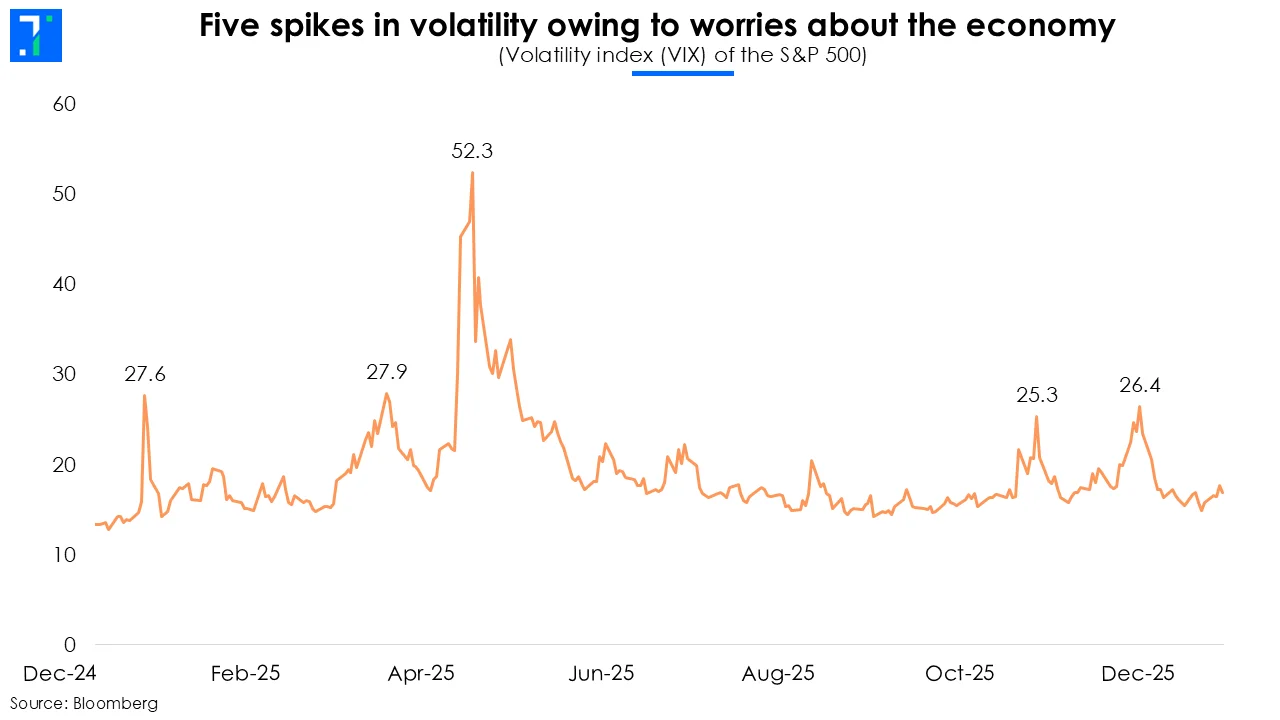
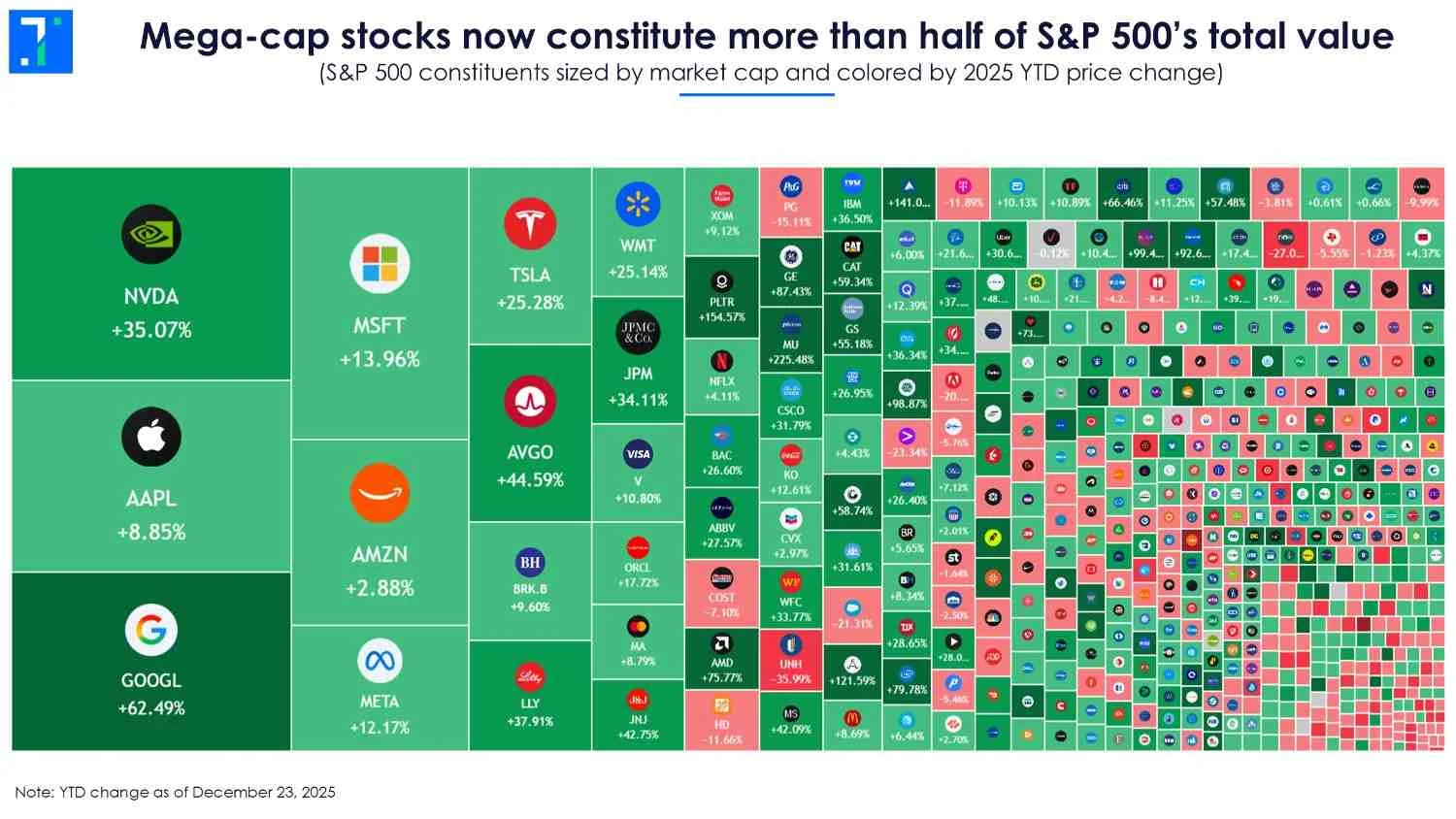
The US stock market in 2025 was a season of plot twists and jump scares. In April, the S&P 500 index corrected by over 10% due to the Trump tariffs. By June, it ripped to fresh highs after President Donald Trump softened his stance and investors piled headfirst into anything even remotely AI-related. So far in 2025, the index is up by more than 17%, reaching a level of 6,878 by December 23. But more than half of those gains came from a few mega-cap giants worth $200 billion or more.

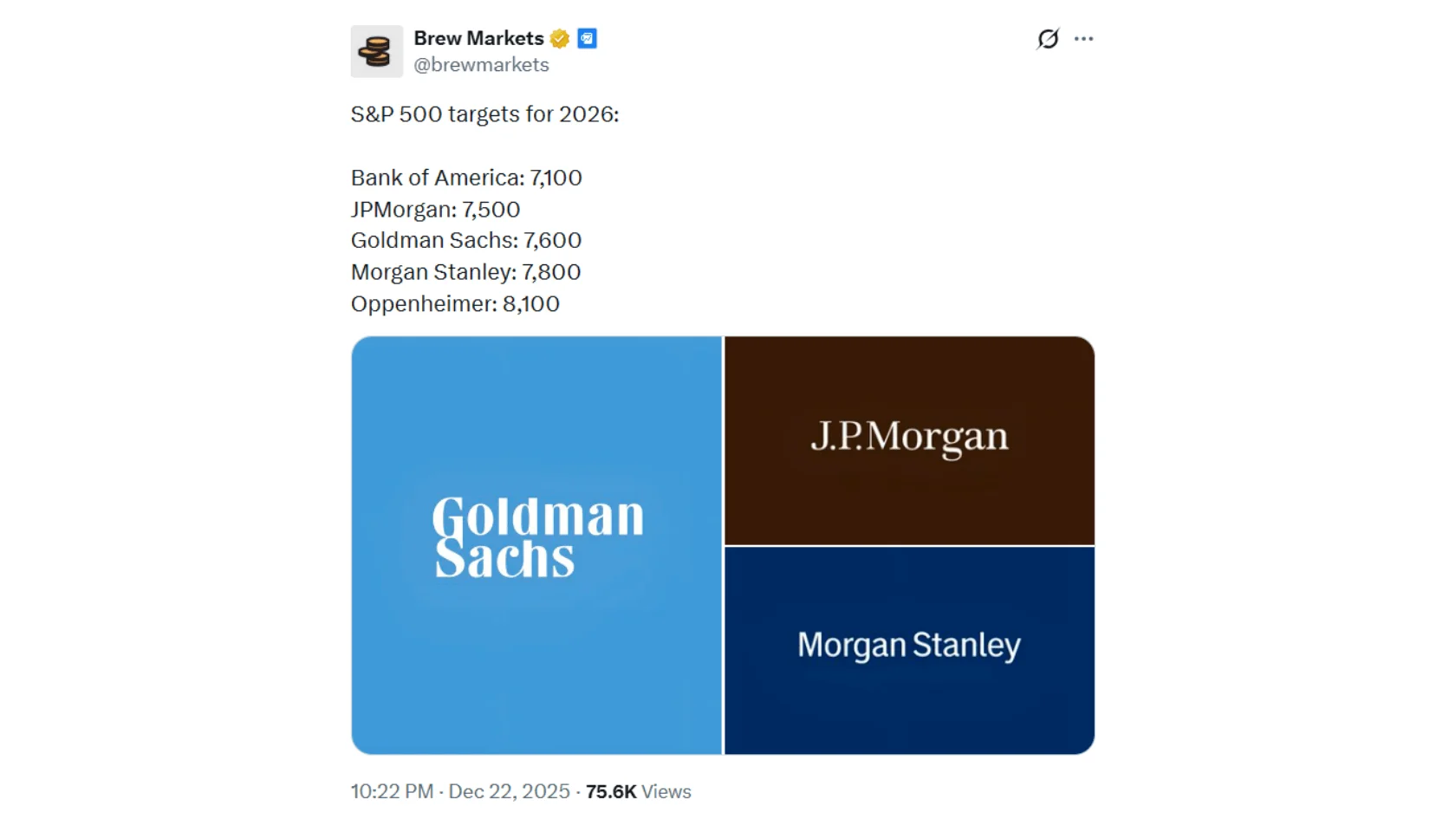
This sets the stage for a very different 2026. According to David Kostin of Goldman Sachs, the easy phase is over. The era of rising multiples is ending, and the next leg of the bull market will lean less on hype and more on hard earnings growth.

Not everyone is convinced returns will be exciting. Savita Subramanian of Bank of Americawarns that slowing share buybacks could cap S&P 500 gains at a modest 4% next year, with a target price of 7,100.

Jean Boivin of BlackRocksays, "The market is moving from a policy-driven phase to a productivity-driven one." He suggests that as capital spending translate into results, the focus must move toward infrastructure.

Let’s look at four trends that will shape 2026 returns.

  1. The AI bill comes due next year

For the past three years, markets treated AI like a free lunch. Productivity gains were assumed, and valuations ran ahead of reality. By 2026, hyperscalers are expected to spend over $527 billion on capital expenditure, sharply higher than earlier estimates of $465 billion. The money is pouring into chips, data centers, and power-hungry infrastructure, to keep chatbots like ChatGPT, Gemini, and Claude running smoothly, and to make sure they’re ready to handle a (highly disruptive) shift of economic activity from humans to machines.

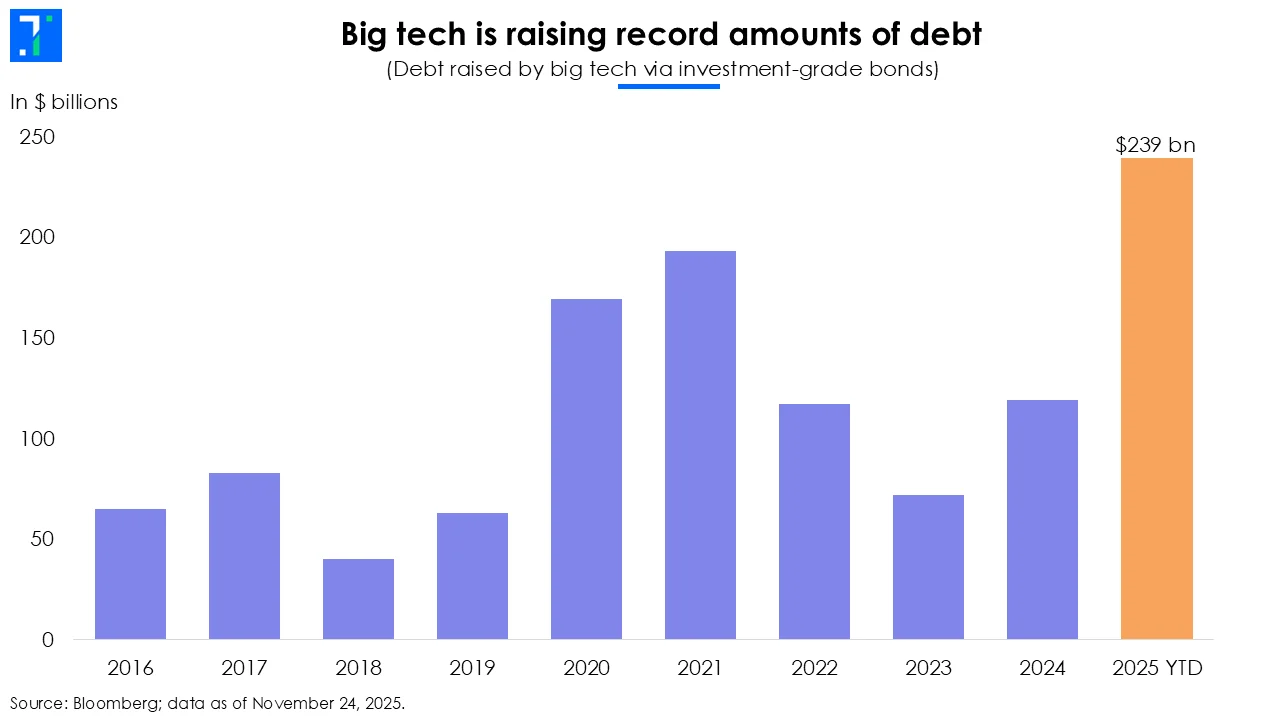
The final bill may run into the trillions. The financing is coming from venture capital, debt and, lately, unconventional circular financing arrangements that have raised eyebrows on Wall Street.

A flood of debt sales from Big Tech could weaken the credit market on both sides of the Atlantic. Wall Street underwriting to fund AI and data centers is soaring, but would-be creditors are starting to worry about being compensated for the risks of a bubble. Tech firms are expected to float as much as $1.5 trillion of debt by 2028.

Morgan Stanley warns that this could push up borrowing costs as investors may demand higher returns to absorb the supply. KKR’s Raj Agrawal says, “Some of these investments are likely not going to work out, that’s just the reality when you have this much capital moving this fast.”

The gap between infrastructure spending and revenue generation is increasingly visible. Many companies funded AI expansion with debt, introducing new balance-sheet risks. Debt-funded AI spending is widening the divide between leaders and laggards, pushing investors away from firms where capex growth is not matched by cash flow. This led Meta to shift its focus from open source models to money-making ones.

  1. Concentration risk rises as capital crowds into top companies

Beneath the noise is a structural problem: extreme concentration. Investors have crowded into “one dominant stock per sector” in search of safety. Nvidia in semiconductors and Eli Lilly in healthcare are prime examples. While fundamentals remain strong, overcrowding amplifies downside risk due to expensive valuation compared to its peers.

Dubravko Lakos-Bujas of JPMorgan says, “markets are becoming unbalanced, with too much money flowing into just a few popular stocks. When many investors pile into the same names, prices move more sharply." It also makes risk harder to manage, because in stressful periods, heavy selling can quickly push prices down.

2025 was “Trump 1.0 on steroids,” said Keith Lerner, chief investment officer and chief market strategist at Truist Advisory Services Inc., adding that he can’t recall another period when US political decisions triggered this much market volatility.

  1. AI’s appetite for power is raising electricity costs

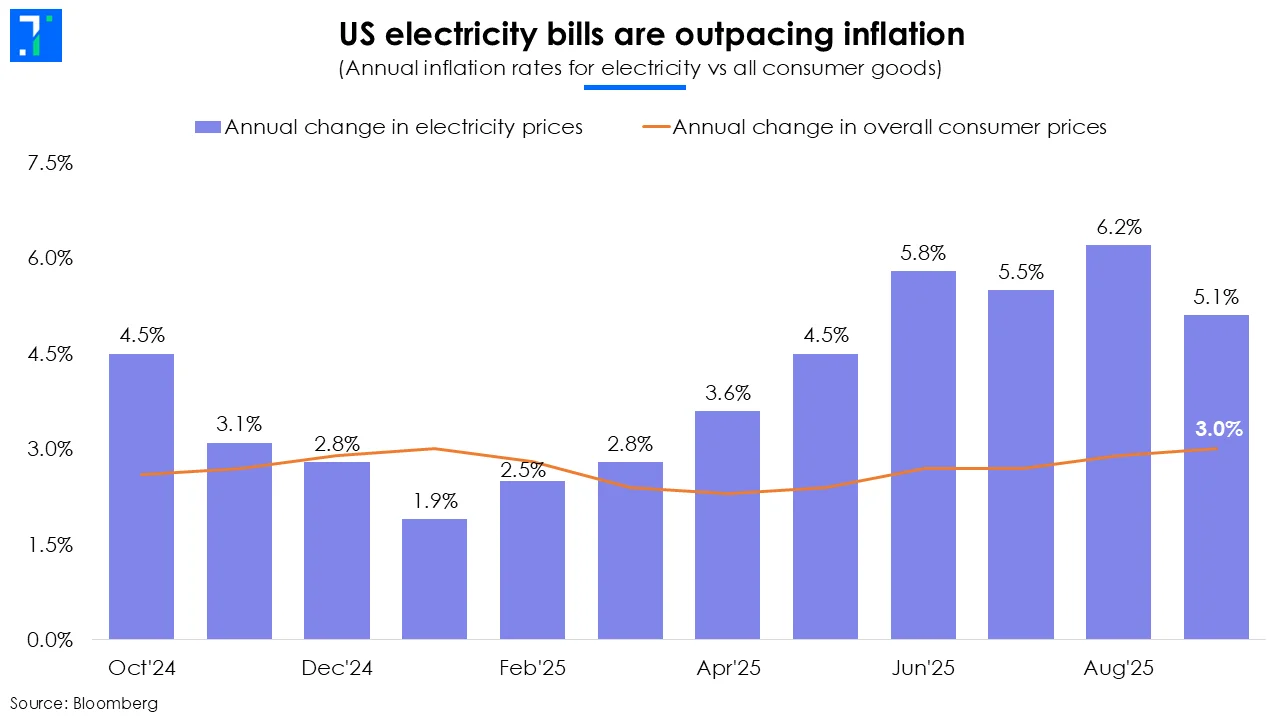
The power bill shock isn’t over. As the US heads into 2026, electricity prices are moving higher. Throughout most of the year, US electricity bills rose faster than overall consumer prices. By September 2025, electricity bills were up 5.1% YoY, compared with a 3% rise in broader consumer inflation.

Retail power rates jumped 7.4% in September 2025, pushing prices to a record 18.1 cents per unit, the steepest increase in nearly two years. With fuel costs climbing and demand staying firm, power bills for homes, transport and businesses are likely to rise further next year.

Electricity demand is rising far faster in Texas and the Mid-Atlantic than the national average. While US power sales are expected to grow about 2.2% annually, Texas demand could jump around 11%, driven by data centres, factories and crypto mining, while PJM demand is set to rise 4% in 2026, led by Northern Virginia.

Data center expansion is the primary driver. Global electricity consumption by data centers is projected to grow 17% through 2026. “AI’s surging power demand growth will be testing grid limits,” says Eduard Sala de Vedruna of S&P Global Energy. Utilities are being forced into large-scale infrastructure upgrades to meet this demand.

  1. Diversification beyond mega-cap firms

The mega-cap firms now make up more than half of the S&P 500’s total value, a historic high. However, the market’s spotlight is shifting toward the “enablers” powering the AI boom. Industrial firms and semiconductor supply chains that provide copper, power equipment, cooling systems, and grid hardware are unglamorous but indispensable inputs to the AI and electrification buildout, and many still trade at far more reasonable valuations.

As a result, leadership is expected to rotate toward cyclical and value-oriented sectors. Solita Marcelli of UBS says, "Financials and healthcare are providing a broad foundation as policy uncertainty fades." Mike Wilson of Morgan Stanley adds that investors should favor "industrials and real assets" to capitalize on a "run-it-hot" economy focused on domestic manufacturing.

Semiconductor onshoring is driving a multi-year investment cycle. New US manufacturing plants are coming online, boosting demand for construction and engineering services. The push to make chips at home is driven by national security concerns flagged by the Trump administration. Because these factories are seen as critical infrastructure, spending is likely to continue even if the broader economy slows.

Thanks to these shifts, Michael Wilson of Morgan Stanley expects “market breadth to improve” as leadership shifts toward Financials and Industrials, describing 2026 as an “early-cycle” bull phase for the broader index.

The next phase of returns may favor companies solving physical bottlenecks. Power, cooling, and grid infrastructure providers are gaining attention. Denise Chisholm of Fidelity notes that “rotation and small caps” could outperform as leadership widens. In this environment, diversification is no longer just protection, but a source of opportunity.

The transition from 2025 to 2026 marks the end of the "imagination phase" of the AI bull market and the beginning of the "execution phase." While the previous year was defined by geopolitical plot twists and a narrow chase for mega-cap safety, the coming year will demand a different approach.

Market closes flat, dragged down by losses in IT & telco stocks
By Trendlyne Analysis

Nifty 50 closed at 26,177.15 (4.8, 0.0%), BSE Sensex closed at 85,524.84 (-42.6, -0.1%) while the broader Nifty 500 closed at 23,895.15 (27.5, 0.1%). Market breadth is in the green. Of the 2,614 stocks traded today, 1,455 were in the positive territory and 1,110 were negative.

Nifty 50 closed flat after erasing the gains in the afternoon session. The Indian volatility index, Nifty VIX, declined 3.1% and closed at 9.4 points. Puravankara closed 6.6% higher as it acquired a 53.5 acre land parcel in Anekal Taluk, Bengaluru, with a revenue potential of Rs 4,800 crore.

Nifty Midcap 100 closed flat, while Nifty Smallcap 100 closed in the green. Nifty PSE and S&P BSE CPSE were among the top index gainers today. According to Trendlyne’s Sector dashboard, Metals & Mining emerged as the best-performing sector of the day, with a rise of 1.2%.

Asian indices closed mixed, while European indices are trading higher except Russia’s MOEX & RTSI indices. US index futures traded in the green, indicating a positive start to the trading session. Markets shift focus to a holiday-shortened week in the US that is expected to see lighter volumes. Brent crude oil futures are trading higher on heightened geopolitical risks following the US interception of an oil tanker near Venezuela and ongoing tensions in the Russia-Ukraine conflict, reviving concerns over potential supply disruptions.

  • Relative strength index (RSI) indicates Hindustan Zinc is in the overbought zone.

  • IRB Infrastructure Developers is rising as it emerges as the preferred bidder for the Rs 3,087 crore project from the National Highways Authority of India (NHAI) for tolling, operation, and maintenance of the Chandikhole–Bhadrak stretch of NH16 in Odisha.

  • Canara HSBC Life Insurance Co rises sharply after Investec initiates coverage with a Buy rating and a target price of Rs 225, implying a 69% upside. The brokerage cites strong premium growth and expects gains from HSBC’s plan to double its branch network and expand distribution.

  • Soma Papers & Industries surges to its 5% upper limit as its wholly-owned subsidiary, KS Smart Solutions, receives an order worth Rs 172.7 crore from the School Education Department, Government of Punjab. The order involves supplying and setting up computers and power backup systems in government schools.

  • Shailesh Chandra, MD & CEO of Tata Motors Passenger Vehicles, expects industry-wide EV volumes to reach 2 lakh units annually this year. He highlights TMPV's plans to launch five new EV models by FY30, including the Sierra EV and Punch EV in CY26, and add another three nameplates during FY27-30.

  • HFCL is rising sharply as its board of directors approves the qualified institutional placement (QIP) of equity shares at an issue price of Rs 65.8 per share.

  • Coal India is rising as it reportedly plans an initial public offering (IPO) worth Rs 1,300 crore of its arm, Bharat Coking Coal (BCCL), within the next two weeks. The proposed IPO is expected to be an offer-for-sale, with Coal India offloading a 10% stake.

  • Vardhman Special Steels plans to invest Rs 475 crore to set up a steel forging and machining facility in Ludhiana, enabling the company to expand beyond steelmaking into forged components.

  • PL Capital upgrades Aarti Industries to an 'Accumulate' rating with a target price of Rs 403. The brokerage says the company is transitioning from contract manufacturing to a partnership-led, innovation-driven platform, helped by collaborations across agrochemicals, polymers, energy and advanced materials. Its focus on differentiated chemistries and application-led solutions reduces dependence on China and strengthens its long-term positioning.

  • Motilal Oswal retains its 'Buy' call on Shriram Finance, with a target price of Rs 1,100 per share. This indicates a potential upside of 15.1%. The brokerage believes that MUFG's entry into the company de-risks its growth trajectory, expands its ability to serve a broader customer base across the commercial vehicle, micro, small & medium enterprises (MSME), and retail segments. It expects the firm to deliver an AUM CAGR of 18% over FY26-28.

  • Lloyds Enterprises falls sharply after its board approves the restructuring of its realty business. The company plans to merge Lloyds Realty Developers with Indrajit Properties. Post-merger, the realty business will be demerged into a new entity, Lloyds Realty, aimed at strengthening the balance sheet.

  • Welspun Corp is rising as it acquires 2.7 crore shares (4.1% stake) in its subsidiary, Welspun Specialty Solutions, from its promoters, MGN Agro Properties and Welspun Group Master Trust, for Rs 109 crore.

  • Metal stocks like NMDC, Hindustan Copper, and SAIL are rising, helped by a favourable global macro backdrop. Broad-based buying across ferrous and non-ferrous counters, coupled with incremental Chinese policy support for infrastructure has improved demand visibility for steel, copper, aluminium, and zinc. Tight base metal inventories have further limited downside risks despite uneven global growth.

  • Granules India’s board approves raising Rs 300 crore through the preferential issue of 51.3 lakh shares at Rs 585 per share, which will be allotted to investors across non-promoter categories.

  • Belrise Industries is rising sharply as its promoter group reportedly sells 5.8 crore shares (6.6% stake) for Rs 897 crore through a block deal.

  • Shakti Pumps (India) surges as it secures an order worth Rs 356.8 crore from Maharashtra State Electricity Distribution Co (MSEDCL) to supply and install 12,883 off-grid solar photovoltaic water pumps.

  • Morgan Stanley initiates coverage on Pine Labs with a target price of Rs 260. The brokerage highlights the company’s leadership in merchant payments and commerce solutions. It projects a 19% revenue CAGR through FY28, with EBIT margins expanding to ~20%, helped by its asset-light model and strong ecosystem partnerships. It also flags risks from execution challenges, rising competition, and potential regulatory changes in India’s digital payments space.

  • Larsen & Toubro's subsidiary, L&T Onshore, secures an order worth Rs 5,000-10,000 crore from Bharat Petroleum Corp. L&T will construct and commission a linear low-/high-density polyethylene (LLDPE/HDPE) swing unit comprising two trains of 575 KTPA each, at Bina in Madhya Pradesh.

  • Puravankara surges over 10% as it acquires a 53.5-acre land parcel in Anekal Taluk, Bengaluru, with a 6.4 million sq. ft. development area and a revenue potential of Rs 4,800 crore.

  • KSH International's shares debut on the bourses at a 3.6% discount to the issue price of Rs 384. The Rs 710 crore IPO received bids for 0.8 times the total shares on offer.

  • Ambuja Cements rises over 2% as its board approves a merger with group companies ACC and Orient Cement to streamline the Adani Group’s cement business. Under the swap, ACC shareholders will receive 328 Ambuja shares for every 100 shares held, while Orient Cement shareholders will get 33 Ambuja shares per 100 shares. The transaction is expected to be completed within a year.

  • Azim Premji's Prazim Trading and Investment acquires 5.1 crore shares (2.6% stake) in National Highways Infra Trust for Rs 754.2 crore at an average price of Rs 149.1 per share through a bulk deal.

  • Sanghvi Movers is rising sharply as its subsidiary, Sangreen Future Renewables, bags orders worth Rs 428.7 crore from independent power producers (IPPs) for civil works of 270.6 MW of wind projects.

  • Prestige Estates Projects acquires a 25-acre land parcel in Medavakkam, Chennai, with a 5 million sq. ft. development area and a revenue potential of Rs 5,000 crore.

  • Saatvik Green Energy surges as its subsidiary, Saatvik Solar Industries, receives an order worth Rs 486 crore from an Independent power producer (IPP) to supply solar PV modules.

  • Nifty 50 was trading at 26,159.05 (-13.4, -0.1%), BSE Sensex was trading at 85,690.10 (122.6, 0.1%), while the broader Nifty 500 was trading at 23,859.15 (-8.5, 0.0%).

  • Market breadth is in the green. Of the 2,090 stocks traded today, 1,139 were in the positive territory and 868 were negative.

Riding High:

Largecap and midcap gainers today include Cholamandalam Investment & Finance Company Ltd. (1,678.50, 5.9%), NMDC Ltd. (81.53, 3.8%) and Indian Railway Finance Corporation Ltd. (121.40, 3.8%).

Downers:

Largecap and midcap losers today include Coforge Ltd. (1,780.20, -4.7%), Schaeffler India Ltd. (3,795.90, -2.7%) and Mahindra & Mahindra Financial Services Ltd. (386.20, -2.1%).

Crowd Puller Stocks

30 stocks in BSE 500 are trading on high volumes today.

Top high volume gainers on BSE included Jupiter Wagons Ltd. (335.90, 8.2%), Ircon International Ltd. (169.30, 8.0%) and Godawari Power & Ispat Ltd. (258.95, 7.3%).

Top high volume losers on BSE were Coforge Ltd. (1,780.20, -4.7%), Latent View Analytics Ltd. (465.75, -3.7%) and ACC Ltd. (1,754.20, -1.6%).

Rites Ltd. (241.95, 4.0%) was trading at 20.6 times of weekly average. Alok Industries Ltd. (16.85, 5.1%) and IFCI Ltd. (52.97, 7.2%) were trading with volumes 18.4 and 16.2 times weekly average respectively on BSE at the time of posting this article.

BSE 500: highs, lows and moving averages

16 stocks overperformed with 52 week highs, while 1 stock hit their 52 week lows.

Stocks touching their year highs included - Ashok Leyland Ltd. (177.96, 0.5%), Bharat Forge Ltd. (1,460.20, 0.3%) and City Union Bank Ltd. (288.60, 1.9%).

Stock making new 52 weeks lows included - ACC Ltd. (1,754.20, -1.6%).

24 stocks climbed above their 200 day SMA including Jupiter Wagons Ltd. (335.90, 8.2%) and Ircon International Ltd. (169.30, 8.0%). 8 stocks slipped below their 200 SMA including Schaeffler India Ltd. (3,795.90, -2.7%) and PVR INOX Ltd. (1,024.70, -2.1%).

Market closes higher amid foreign investor inflows & rupee stabilization
By Trendlyne Analysis

Nifty 50 closed at 26,172.40 (206, 0.8%), BSE Sensex closed at 85,567.48 (638.1, 0.8%) while the broader Nifty 500 closed at 23,867.65 (190.1, 0.8%). Market breadth is overwhelmingly positive. Of the 2,628 stocks traded today, 1,790 were gainers and 780 were losers.

Nifty 50 closed in the green as the rupee recovered following RBI intervention and FIIs turned net buyers for the last three sessions. The Indian volatility index, Nifty VIX, rose 1.7% and closed at 9.7 points. Varun Beverages closed 3.6% higher as its board of directors approved acquiring a 100% stake in South Africa's Twizza Proprietary at an enterprise value of ~Rs 11,187 crore.

Nifty Midcap 100 & Nifty Smallcap 100 closed in the green, following the benchmark index. Nifty India Defence and Nifty IT were among the top index gainers today. According to Trendlyne’s Sector dashboard, General Industrials emerged as the best-performing sector of the day, with a rise of 1.9%.

Asian indices closed in the green, while European indices are trading mixed. US index futures traded in the green, indicating a positive start to the trading session. Last week’s softer-than-expected US inflation data raised hopes of earlier Fed rate cuts in 2026. UBS anticipates a 25 basis-point cut in Q1CY26 as policy moves towards a ‘neutral’ stance, with US inflation likely peaking in Q2 before stabilizing near the Fed’s 2% target.

  • Money flow index (MFI) indicates that stocks like Whirlpool, Capri Global Capital, Central Bank and Aster DM Healthcare are in the oversold zone.

  • BSE surges as it reportedly plans to launch additional monthly index option products to expand its market share and strengthen competitiveness in the index derivatives segment.

  • KEC International rises sharply after the Delhi High Court pauses Power Grid Corp’s nine-month ban on the company. The court also allows KEC to continue participating in tenders, providing temporary relief from the restriction imposed on November 18.

  • Cummins India rises sharply as it receives an order from the Income Tax Appellate Tribunal for FY17-18, granting relief on disputed tax adjustments worth Rs 210.3 crore.

  • A Union Bank of India report suggests the RBI may cut the repo rate by 25 basis points during its February policy meeting to 5%. The report highlights the central bank’s focus on benign inflation and subdued underlying price pressures, adding that inflation appears even more moderate after adjusting for the roughly 50 bps impact from gold.

  • Ceigall India is rising as it secures an order worth Rs 550 crore from Madhya Pradesh Urja Vikas Nigam (MPUVNL) to build 130 MW of solar power projects under the PM KUSUM-C scheme.

  • Rites surges as it signs a memorandum of understanding (MoU) with the Republic of Botswana to develop and modernise the country’s transport infrastructure.

  • UltraTech Cement receives an order from the joint commissioner of Central GST and Central Excise, Patna, directing it to pay Rs 390 crore in alleged tax dues. The demand relates to underpayment of GST and input tax credit issues during FY19-23.

  • Antique Stock Broking retains its 'Hold' rating on KPR Mill with a target price of Rs 1,062. The brokerage sees FY26 as a stable year for the company, driven by steady growth in its garment and sugar-ethanol businesses. It expects revenue to grow about 12% YoY, with operating margins largely steady, supported by recovering European demand, a stronger sugar-ethanol segment, and gradual normalisation of export markets.

  • Bondada Engineering rises sharply as it wins a Rs 945.1 crore order from NLC India for an 810 MW solar project at a solar park in Bikaner, Rajasthan. The work includes design, development, manufacture, installation, and three years of maintenance.

  • Emmvee Photovoltaic Power surges as it expands its solar module manufacturing capacity by 2.5 gigawatts (GW) at its Bengaluru factory. The company's total capacity now stands at 10.3 GW.

  • Akums Drugs & Pharmaceuticals is rising as 72.8 lakh shares (4.6% stake), worth Rs 311.5 crore, reportedly change hands in a block deal at an average price of Rs 428 per share.

  • BSE announces its semi-annual index reconstitution, effective today. The reshuffle impacts key indices, including the Sensex, where InterGlobe Aviation (IndiGo) replaces Tata Motors Passenger Vehicles following the demerger of Tata Motors’ commercial and passenger vehicle businesses. The BSE 500 also sees significant changes, with 32 additions and 32 deletions, with ITC Hotels and Reliance Power entering the index.

  • Dilip Buildcon rises as it emerges as the lowest bidder for a 1,363.6 MW grid-connected solar project awarded by Madhya Pradesh Urja Vikas Nigam. The project offers an engineering, procurement and construction (EPC) opportunity of about Rs 4,900 crore, with power sold to Madhya Pradesh Power Management Co under a 25-year power purchase agreement.

  • Indian Hotels Co is rising as it enters a binding agreement to sell its entire 25.5% stake in Taj GVK to the GVK-Bhupal family for Rs 592 crore. Post-deal, the GVK-Bhupal family’s stake will rise to about 75%.

  • John Cockerill India is rising as it plans to acquire a 100% stake in John Cockerill Metals International SA, Belgium, for about €50 million (around Rs 525 crore). The acquisition aims to consolidate and strengthen the John Cockerill Group’s metal business operations.

  • JM Financial initiates coverage on GMR Airports with a 'Buy' rating and a target price of Rs 120. The brokerage believes Indian aviation is set for strong growth, supported by rising incomes and higher leisure spending. It highlights a robust pipeline of new airport projects, a healthy aircraft delivery order book, and expectations of sharp growth in both domestic and international passenger traffic.

  • Craftsman Automation is rising as its subsidiary, DR Axion, plans to acquire Suprash Developers & Srikara Tech for Rs 145.8 crore to buy 52.8 acres of industrial land at Araneri Village in Sriperumbudur Taluk, Kancheepuram district, for a new manufacturing plant.

  • GE Vernova T&D India surges as it receives a 2,500-megawatt power transmission order from AESL Projects for the Khavda–South Olpad project.

  • Tata Chemicals is rising as its wholly owned subsidiary, Tata Chemicals International (TCIPL), plans to acquire Singapore-based Novabay for €25 million (around Rs 262 crore) to strengthen its capabilities in premium-grade products.

  • Morgan Stanley downgrades Titagarh Rail Systems to an 'Equalweight' rating and a lower target price of Rs 771. The brokerage attributes its cautious stance to weak freight demand and limited backlog visibility, noting that the stock has underperformed the Sensex by 21% over the past three months. While freight supports near-term earnings, the ~9,047-wagon order book provides visibility only through H1 FY27, making fresh passenger orders critical.

  • Concord Control Systems surges to its 5% upper limit as its wholly-owned subsidiary, Advanced Rail Controls, secures an order worth Rs 139.3 crore from Indian Railways to supply, install and commission the Loco wireless control system.

  • Granules India is rising as its subsidiary receives tentative approval from the US FDA for its abbreviated new drug application (ANDA) for Amphetamine Extended-Release Orally Disintegrating tablets. The drug is used to treat attention deficit hyperactivity disorder (ADHD) and has an estimated market size of approximately $172 million, according to IQVIA.

  • Fortis Healthcare rises as its subsidiary, International Hospital, plans to acquire a 125-bedded People Tree Hospital in Bengaluru, for Rs 430 crore, through the acquisition of TMI Healthcare. The deal includes a 0.8-acre adjacent land parcel, enabling expansion to over 300 beds, with an additional Rs 410 crore investment planned over the next three years.

  • Varun Beverages is rising as its board of directors approves acquiring a 100% stake in South Africa's Twizza Proprietary at an enterprise value of ZAR 2.1 billion (~Rs 11,187 crore). The company will carry out the acquisition through its subsidiary, The Beverages Co Proprietary.

  • Nifty 50 was trading at 26,093.90 (127.5, 0.5%), BSE Sensex was trading at 85,289.88 (360.5, 0.4%), while the broader Nifty 500 was trading at 23,786.80 (109.3, 0.5%).

  • Market breadth is highly positive. Of the 2,172 stocks traded today, 1,698 showed gains, and 411 showed losses.

Riding High:

Largecap and midcap gainers today include Solar Industries India Ltd. (12,620, 6.0%), GE Vernova T&D India Ltd. (3,097.80, 5.8%) and Mazagon Dock Shipbuilders Ltd. (2,544.80, 5.7%).

Downers:

Largecap and midcap losers today include Siemens Energy India Ltd. (2,616.50, -4.8%), Cholamandalam Investment & Finance Company Ltd. (1,584.90, -3.8%) and Dixon Technologies (India) Ltd. (12,845, -3.2%).

Crowd Puller Stocks

21 stocks in BSE 500 are trading on high volumes today.

Top high volume gainers on BSE included Jupiter Wagons Ltd. (310.45, 19.3%), Cochin Shipyard Ltd. (1,666.30, 7.6%) and Devyani International Ltd. (139.27, 6.4%).

Top high volume losers on BSE were Siemens Energy India Ltd. (2,616.50, -4.8%), Cholamandalam Investment & Finance Company Ltd. (1,584.90, -3.8%) and MphasiS Ltd. (2,887, -0.1%).

Rail Vikas Nigam Ltd. (332.50, 4.2%) was trading at 5.6 times of weekly average. Rites Ltd. (232.60, 2.7%) and Ircon International Ltd. (156.81, 2.5%) were trading with volumes 5.4 and 5.2 times weekly average respectively on BSE at the time of posting this article.

BSE 500: highs, lows and moving averages

25 stocks took off, crossing 52 week highs, while 1 stock were underachiever and hit their 52 week lows.

Stocks touching their year highs included - AIA Engineering Ltd. (3,939, 3.6%), Ashok Leyland Ltd. (177.05, 2.0%) and Bharat Forge Ltd. (1,457, 1.2%).

Stock making new 52 weeks lows included - PCBL Chemical Ltd. (308.80, 0.6%).

25 stocks climbed above their 200 day SMA including Lloyds Metals & Energy Ltd. (1,352.50, 4.0%) and Steel Authority of India (SAIL) Ltd. (130.06, 3.3%). 5 stocks slipped below their 200 SMA including Hexaware Technologies Ltd. (746.05, -5.9%) and Cholamandalam Investment & Finance Company Ltd. (1,584.90, -3.8%).

logo
The Baseline
19 Dec 2025
Five Interesting Stocks Today - December 19, 2025
By Trendlyne Analysis

1. 360 One Wam:

This capital markets company rose 1.5% on December 18 after Motilal Oswal reiterated its ‘Buy’ rating with a lower target price of Rs 1,350, implying an 18.5% upside. 360 ONE operates in wealth and asset management, catering to high-net-worth individuals (HNIs), ultra-HNIs, family offices, and institutions.

Motilal Oswal’s view is driven by India’s expanding base of people with fat wallets – the HNI and UHNIs, which benefits 360 ONE. More than 70% of its revenue comes from recurring fees, which provides earnings stability. Its asset management business is expected to grow its AUM to around Rs 1.3 lakh crore by FY28. Overall, the company’s consolidated revenue and net profit are expected to grow at around 21% CAGR through FY28.

The company’s recent deals have added scale and widened its range of services. The ET Money acquisition in June 2024 brought in about Rs 2,350 crore of assets and strengthened its digital reach. Broking firm B&K Securities, acquired in early 2025, adds roughly Rs 45 crore per quarter in transaction revenue. The UBS Wealth India deal contributed over Rs 5,200 crore in assets and improved access to offshore products.

The expansion is showing up in the numbers. In Q2FY26, revenue rose 32% YoY to Rs 813 crore, mainly due to higher recurring income. Net profit grew 28%, though margins slipped slightly because of higher technology spending and the impact of recent acquisitions.

CEO Karan Bhagat said, “We expect net inflows of 10–12% to continue over the next two years, supported by stable markets and higher productivity from new relationship managers. Transaction and brokerage revenue should grow 8–12%, even as the focus shifts to recurring income.” He added that the HNI business is on track to break even by Q3–Q4 next year as client additions and monetisation improve.

2. Indraprastha Gas (IGL):

The stock of this non-electrical utilities company climbed over 5% in the past week, driven by an upgrade from global brokerage Nomura, and a new single natural gas transportation tariff announced by the Petroleum and Natural Gas Regulatory Board (PNGRB). Effective January 2026, the new structure caps transportation charges at Rs 54 per MMBtu (metric million British thermal unit() for short distances of up to 300 km, and at Rs 102.9 per MMBtu for longer distances. This change is expected to reduce sourcing costs and help stabilise margins, particularly in markets located further from supply hubs.

Positive momentum was further supported by global gas prices hitting their lowest levels since March 2024, with Asia spot prices dropping to approximately $9.4 per MMBtu. These lower input costs could directly bolster unit margins if retail prices remain steady.

Financial performance remained solid, with Q2 revenue rising 8.9% YoY as volumes grew 3.2% to 9.2 million metric standard cubic meters per day (mmscmd). Trendlyne’s Forecaster projects IGL’s revenue to grow by 3.6% in Q3 on the back of tariff rationalisation and lower value added tax (VAT) on domestic gas sourced from Gujarat. The stock appears in a screener of companies which have shown relative outperformance compared to the industry over the past week.

Management has guided for volume growth of 6-7% for FY26. MD K. K. Chatiwal noted that H1 capex reached Rs 580 crore, with full-year plans of up to Rs 1,400 crore for their PNG infrastructure segment. He mentioned that the company is also looking at “another maybe Rs 700-800 crore” for potential diversification projects.

Nomura upgraded the stock to a ‘Buy’ rating with a target price of Rs 230, citing an improving risk-reward profile. The brokerage believes margins will find support from lower taxes and reduced transmission fees, while the completion of operational transitions should allow demand and volume growth to recover.

3. Crompton Greaves Consumer Electricals:

This household appliances player rose 2.6% on December 18 after Motilal Oswal initiated coverage with a ‘Buy’ rating and a target price of Rs 350 per share. The brokerage sees Crompton transitioning from a traditional electricals manufacturer to a brand-led, innovation-driven consumer company under its Crompton 2.0 strategy.

The brokerage believes the company's increased investment in advertising and promotions, combined with its focus on strengthening the brand and product portfolio, will be key to its future growth.

Crompton Greaves reported a mixed picture for its second quarter. Revenue edged up 1% YoY to Rs 1,916 crore, driven by higher sales volumes. However, its net profit took a hit, falling 43% to Rs 71.2 crore due to higher expenses and raw material costs.

The company's Butterfly appliances business performed well, while its electricals business faced pressures due to cooler than expected weather conditions. Crompton’s acquisition of Butterfly, where it now holds a 75% stake, has significantly strengthened its kitchen appliances portfolio.

Meanwhile, Crompton’s solar rooftop business has taken off, winning nearly Rs 500 crore in orders and giving the new division strong momentum. The company added that its solar pumps business is growing over 100% YoY, as its domestic market share climbed from 6% to 8%.

Management is betting big on this solar division, believing it could become the company’s second-largest business over the next few years. CFO Kaleeswaran Arunachalam said, “We are targeting Rs 2,000 crore in revenue from our solar business over the next 18–24 months, supported by recent large contract wins and a focus on expansion.”

Motilal Oswal expects a dip in earnings this year, mostly due to continued cool weather, but sees a clear path to improving profits and profitability in the medium term. The brokerage estimates a revenue CAGR of about 8% over FY26–28.

4. Leela Palaces Hotels & Resorts:

Thishotel chain surged 4.8% on December 16 after ICICI Securitiesinitiated a ‘Buy’ rating, with a 45.7% upside. The brokerage highlighted Leela's position to capitalise on India's shortage of new luxury hotel developments, and a widening demand-supply gap.

According to HVS Anarock, luxury hotel demand in India is set to soar 13.7% annually between FY26-28, while supply will lag at 8.8%. This supply crunch is expected to boost room rates and occupancy for existing hotels.

Leela’s portfolio is perfectly positioned to capture this trend. In FY25, the company's average revenue per available room (RevPAR) stood at Rs 15,306, 1.4 times higher than the luxury segment's industry average. The companycurrently operates 14 hotels with 4,090 rooms, blending owned and managed properties.

A pivotal strategic move came in late 2025 with Leela’s leap onto the global stage. In November, the companyacquired a 25% stake in the Dubai entity that owns Sofitel The Palm for Rs 437 crore. The property is set to be rebranded as a Leela, marking its first international flagship.

CEO Anuraag Bhatnagar projects major growth andsaid, “With a strong pipeline of over 1,500 rooms, we are well-positioned to capture this opportunity as we target approximately Rs 2,000 crore in EBITDA by FY30.” Leela is investing Rs 654.6 crore in room renovations and plans to surpass 5,000 operational rooms by FY30.

InQ2FY26, revenue climbed 12% YoY, fueled by higher occupancy and room rates. Owned hotels led this charge with 13% RevPAR growth.

However, the company's significant concentration risk is weighing on investor sentiment. With over 90% of revenue coming from just five properties, the company is vulnerable to regional disruptions. The stock has also faced headwinds since its debut, trading 5.3% below its June 2 IPO price.

5. Tata Consultancy Services (TCS):

This IT consulting & software company’s stock rose 2.8% over the past week after acquiring Coastal Cloud Holdings and delivering positive updates at its Investor Day 2025. On December 11, TCS’ board approved acquiring 100% of US Salesforce consulting firm Coastal Cloud Holdings and its subsidiaries for $700 million (approximately Rs 6,320.2 crore). This follows another acquisition in October of US-based Salesforce firm, ListEngage, for $72.8 million (approximately Rs 657.3 crore). 

On December 18, TCS discussed its evolution from a digital service provider to an AI-focused technology services provider. The company reported $1.5 billion in annualised AI services revenue, up 16% QoQ. The firm also announced plans to develop a sovereign AI data centre with up to 1 GW capacity, projecting capital expenditures of $6-7 billion over 5-7 years.

Speaking to analysts, TCS’ MD & CEO, K Krithivasan, said, “We aim to achieve an EBIT margin of 26-28% over the next few years, by shifting our revenue mix towards higher margin services and a focus on delivery execution.”

However, Motilal Oswal noted that management's higher-margin goals indicate more growth potential than guided.

The brokerage maintained its ‘Buy’ call on TCS, setting a target price of Rs 4,400 per share, a 34.1% upside. The brokerage believes the company’s growth visibility will improve as AI adoption moves from pilot programs to scaled, revenue-generating deployments. It expects the company to deliver a revenue CAGR of 6.7% over FY26-28.

In Q2FY26, TCS’s revenue grew 2.4% QoQ to Rs 66,666 crore, beating Forecaster estimates by 0.7%. Improvements across banking, financial services & insurance, communication, media & technology segments supported revenue growth. However, net profit declined 5.4% due to higher finance, employee benefits, and license expenses.

Trendlyne's analysts identify stocks that are seeing interesting price movements, analyst calls, or new developments. These are not buy recommendations.

Market closes higher on softer US inflation and foreign investor buying
By Trendlyne Analysis

Nifty 50 closed at 25,966.40 (150.9, 0.6%), BSE Sensex closed at 84,929.36 (447.6, 0.5%) while the broader Nifty 500 closed at 23,677.55 (186.1, 0.8%). Market breadth is surging up. Of the 2,596 stocks traded today, 1,768 showed gains, and 777 showed losses.

Indian indices closed higher after rising in the morning session. The Indian volatility index, Nifty VIX, fell 1.9% and closed at 9.5 points. ICICI Prudential Asset Management Co's shares made their debut on the bourses at a 20.1% premium to the issue price of Rs 2,165. The Rs 10,602.6 crore IPO received bids for 39.2 times the total shares on offer.

Nifty Smallcap 100 and Nifty Midcap 100 closed higher. S&P BSE IPO and Nifty India Defence were among the top index gainers today. According to Trendlyne’s sector dashboard, Telecommunications Equipment emerged as the best-performing sector of the day, with a rise of 3.4%.

Asian indices closed higher, except for Indonesia’s IDX Composite. European indices are trading mixed. US index futures are trading higher as softer inflation data raises hopes of easier monetary policy from the Federal Reserve next year. Brent crude futures are trading lower as optimism grows over potential progress in talks to end the Ukraine war, ahead of a US meeting with Russian officials this weekend.

  • Relative strength index (RSI) indicates that stocks like NCC, Power Finance Corp and SKF India are in the oversold zone.

  • Hexaware Technologies is rising as its board of directors approves the merger of its subsidiaries, Softcrylic Technology Solutions India and Mobiquity Softech, with itself.

  • Biocon is rising as it receives an establishment inspection report (EIR) with a voluntary action indicated (VAI) status from the US FDA for its facility in New Jersey, USA. The facility manufactures oral solid dosage (OSD) medicines, primarily tablets and capsules, for the US market.

  • Gujarat Ambuja Exports surges as it adds 30,000 tonnes per annum (TPA) capacity with the launch of India’s first maize starch–based fermentation plant for sodium gluconate in Hubli, Karnataka. The company plans to expand total capacity to 1.2 lakh TPA by 2028.

  • Goldman Sachs downgrades Hitachi Energy India to a 'Hold' rating with a target price of Rs 20,400. The brokerage believes much of the upside is already priced in, amid a slowdown in HVDC (high-voltage direct current) order momentum. Despite the downgrade, it remains constructive on the company’s medium- to long-term earnings outlook, and expects it to maintain ~50% share of the domestic HVDC market.

  • Motilal Oswal initiates coverage on Crompton Greaves Consumer Products with a 'Buy' call and a target price of Rs 350 per share. This implies a potential upside of 39.2%. The brokerage believes that higher investments in advertisement & promotional spending, and efforts to improve brand strength & product portfolio will support revenue and profitability growth. It expects the firm to deliver a revenue CAGR of 8% over FY26-28.

  • Hindustan Construction's (HCC's) 65:35 joint venture (JV) with Vensar Constructions Co (VCCL) secures an order worth Rs 901 crore from Northeast Frontier Railway (NFR). The contract involves constructing a 3.5 km tunnel on the Tupul-lmphal new Broad Gauge (BG) railway line.

  • NBCC (India) surges as it receives an order worth Rs 179.4 crore from the Indian Institute of Management, Sambalpur, for project management consultancy services for Phase II development of its campus.

  • Jeet Adani, Director at Adani Airports Holdings (AAHL), says the company has outlined a Rs 1 lakh crore capex plan over five years for air-side, terminal and city-side development across the Adani Group’s eight airports. He adds that AAHL is evaluating a public market listing between 2027-30, potentially through an IPO or a demerger.

  • Piramal Finance enters an agreement with Sanlam Emerging Markets Mauritius (SEMM) to sell its entire 14.7% stake in Shriram Life Insurance Co for Rs 600 crore. This divestment aligns with the company's focus on monetising non-core assets.

  • GPT Infraprojects rises sharply as it secures a Rs 1,804.5 crore contract from the Municipal Corp of Greater Mumbai to build a flyover in the city’s eastern suburbs. The project will be executed through a joint venture, with GPT holding a 26% share valued at Rs 469.2 crore.

  • Aeroflex Industries surges more than 10% as its board of directors approves expanding the liquid cooling skid, flexible stainless-steel hoses and stainless-steel braided hoses capacity. The company will increase the liquid cooling skid capacity for data centres by 13,000 units per year. It will also install robotic welding lines & automatic welding stations for flexible stainless-steel hoses, and set up an annealing plant for stainless-steel braided hoses.

  • Vivek Mathur, CFO of KFin Technologies, projects 15–17% revenue growth in FY26 and expects margins to remain in the 40–45% range. He anticipates market momentum to sustain over the next three quarters. Mathur believes AMCs are well-positioned to absorb the impact on profitability, adding that there are no discussions with mutual funds on revisiting registrar and transfer agent (RTA) charges.

  • Mishra Dhatu Nigam secures an order worth Rs 121.8 crore, taking its open order book to Rs 2,520 crore.

  • Shree Cements falls as it declares a lockout of its cement plant in Raipur, Chhattisgarh, due to the non-cooperation of workmen. The company estimates that the lockout will impact cement production by 10,000 tonnes per day.

  • Refex Industries is rising as its subsidiary, Venwind Refex Power, signs a contract with an independent power producer (IPP) to supply wind turbine generators for a 148 megawatt wind project in Tamil Nadu.

  • Jefferies initiates coverage on Billionbrains Garage Ventures (Groww) with a 'Buy' rating and a target price of Rs 180. The brokerage notes that, despite launching in FY21, Groww has emerged as India’s largest broker by active clients. It sees multiple growth levers that could drive a 35% EPS CAGR over FY26–28, led by client additions and market share gains, as well as a sharp scale-up in newer businesses such as margin trading facility and wealth management.

  • Park Medi World enters an agreement to acquire KP Institute of Medical Sciences (KPIMS) for Rs 245 crore. KPIMS has a total bed capacity of 360 beds across North India.

  • BLS International is rising sharply as the Delhi High Court (HC) quashes the Ministry of External Affairs' (MEA's) order barring the company from its tenders for two years.

  • ICICI Prudential Asset Management Co's shares debut on the bourses at a 20.1% premium to the issue price of Rs 2,165. The Rs 10,602.6 crore IPO received bids for 39.2 times the total shares on offer.

  • Macquarie initiates coverage on Lenskart Solutions with an 'Outperform' rating and a target price of Rs 530. The brokerage highlights the company’s vertically integrated supply chain, strong execution, and scope for market share gains in India and overseas. Key catalysts include faster margin expansion across geographies, improved global execution, and quicker adoption of smart glasses.

  • Amber Enterprises is rising as it plans to expand its research & development (R&D) centre in Punjab for heating, ventilation & air conditioning (HVAC) products at a capex of Rs 500 crore.

  • Bharat Petroleum Corp rises as its board of directors approves forming a 49:51 joint venture (JV) with Coal India (CIL) to set up a coal gasification project at Western Coal Fields, Maharashtra.

  • HCL Technologies plans to acquire Hewlett Packard Enterprise's (HPE's) Telco Solutions business for $160 million (around Rs 1,440 crore) to strengthen its network propositions to global communication service providers.

  • Bharti Airtel is rising as its board of directors appoints Shashwat Sharma as the Managing Director (MD) and Chief Executive Officer (CEO) for five years, succeeding Gopal Vittal, effective January 1.

  • Nifty 50 was trading at 25,925.10 (109.6, 0.4%), BSE Sensex was trading at 84,824.71 (342.9, 0.4%), while the broader Nifty 500 was trading at 23,581.45 (90.0, 0.4%).

  • Market breadth is surging up. Of the 2,070 stocks traded today, 1,416 were in the positive territory and 582 were negative.

Riding High:

Largecap and midcap gainers today include Tata Elxsi Ltd. (5,413.50, 8.0%), Waaree Energies Ltd. (3,025.60, 5.1%) and Coromandel International Ltd. (2,358.50, 4.9%).

Downers:

Largecap and midcap losers today include Adani Total Gas Ltd. (568.75, -2.3%), Voltas Ltd. (1,375.50, -1.9%) and HDFC Asset Management Company Ltd. (2,672.20, -1.9%).

Movers and Shakers

46 stocks in BSE 500 are trading on high volumes today.

Top high volume gainers on BSE included Tata Elxsi Ltd. (5,413.50, 8.0%), Authum Investment & Infrastructure Ltd. (2,908.50, 7.6%) and ITI Ltd. (313.80, 6.6%).

Top high volume losers on BSE were Tanla Platforms Ltd. (535.75, -5.1%), Blue Star Ltd. (1,781.40, -4.0%) and Siemens Energy India Ltd. (2,747, -3.3%).

JBM Auto Ltd. (572.10, 5.2%) was trading at 31.3 times of weekly average. BLS International Services Ltd. (325.30, 2.8%) and EIH Ltd. (366.85, 1.8%) were trading with volumes 18.3 and 13.6 times weekly average respectively on BSE at the time of posting this article.

BSE 500: highs, lows and moving averages

12 stocks hit their 52 week highs, while 17 stocks were underachievers and hit their 52 week lows.

Stocks touching their year highs included - Ashok Leyland Ltd. (173.56, 1.2%), Can Fin Homes Ltd. (936.60, 1.4%) and Federal Bank Ltd. (267.85, 0.9%).

Stocks making new 52 weeks lows included - ACC Ltd. (1,751.50, -0.2%) and HFCL Ltd. (64.12, -0.8%).

20 stocks climbed above their 200 day SMA including ITI Ltd. (313.80, 6.6%) and Waaree Energies Ltd. (3,025.60, 5.1%). 5 stocks slipped below their 200 SMA including Blue Star Ltd. (1,781.40, -4.0%) and Aditya Birla Sun Life AMC Ltd. (760.70, -3.0%).

Market closes flat as gains in financials & IT stocks offset losses in other sectors
By Trendlyne Analysis

Nifty 50 closed at 25,815.55 (-3, 0.0%), BSE Sensex closed at 84,481.81 (-77.8, -0.1%) while the broader Nifty 500 closed at 23,491.50 (-4.6, 0.0%). Market breadth is in the red. Of the 2,591 stocks traded today, 954 were on the uptrend, and 1,590 went down.

Indian indices closed flat after switching between gains and losses throughout the day, as gains in financials and IT stocks offset losses in other sectors. The Indian volatility index, Nifty VIX, closed 0.1% lower at 9.8 points. Ola Electric plunged to its 52-week low of Rs 30.8 as its founder & promoter, Bhavish Aggarwal, sold an additional 4.2 crore shares worth Rs 142 crore through a bulk deal.

Nifty Smallcap 100 and Nifty Midcap 100 closed higher. Nifty Capital Markets and Nifty IT were among the best-performing indices of the day. According to Trendlyne’s sector dashboard, Software & Services emerged as the highest-performing sector of the day, with a rise of 1.2%.

European indices are trading higher or flat. Major Asian indices closed with varied trends. US index futures are trading in the green, signalling a positive start to the session as investors await the US inflation data later today.

  • Money flow index (MFI) indicates that stocks like United Breweries, NCC, ACC and Honeywell Automation are in the oversold zone.

  • Nippon Life India Asset Management rises sharply after SEBI lowers mutual fund expense ratio limits and simplifies cost disclosure rules. The revised framework excludes taxes and regulatory charges from base expenses, enhancing transparency for retail investors across multiple mutual fund categories.

  • Aurobindo Pharma receives Form 483 with five observations from the US FDA following an inspection at its subsidiary, APL Healthcare's Unit-IV facility in Andhra Pradesh.

  • One97 Communications (Paytm) is rising as its subsidiary, Paytm Payments Services, receives approval from the Reserve Bank of India (RBI) to operate as a payment aggregator for offline payments and cross-border transactions.

  • Nikhil Nanda, CMD of Escorts Kubota, says the company is diversifying beyond tractors through aggressive product launches, capacity expansion, and exports to more than 100 countries. With GST reforms boosting demand and mechanisation at just 47% versus ~90% in developed markets, he sees substantial headroom for growth. Escorts Kubota is positioning India as a global manufacturing hub, backed by advanced facilities and plans to introduce 8–10 new products over the next three years.

  • Alembic Pharmaceuticals receives approval from the US FDA for its abbreviated new drug application (ANDA) for Travoprost Ophthalmic Solution. The drug is a therapeutic equivalent of Sandoz's reference listed drug (RLD), Travatan Z Ophthalmic Solution. It has an estimated annual market size of $61 million as of September 2025, according to IQVIA.

  • Patel Engineering is rising as it signs a memorandum of understanding (MoU) with the Government of Arunachal Pradesh to restore and develop the 144 MW Gongri Hydropower Project at a capex of Rs 1,700 crore.

  • Motilal Oswal initiates coverage on Astra Microwave Products with a 'Buy' call and a target price of Rs 1,100. This indicates a potential upside of 24.2%. The brokerage believes that the company is a long-term play in the defence electronics segment, with its revenue set to jump during FY27-30 as the Ministry of Defence awards larger orders. It expects the firm to deliver a revenue CAGR of 18% over FY26-28.

  • Nuvama downgrades SAIL to 'Reduce' with a lower target price of Rs 106. The brokerage raises concerns over excess flat steel supply in India and weak steel margins, weighing on earnings. It also flags rising debt from the upcoming 4.5-million-tonne-per-annum IISCO (Indian Iron & Steel Company) expansion, along with poor return ratios over the next three years.

  • Antony Waste Handling Cell surges as it secures two contracts worth Rs 1,330 crore from the Brihanmumbai Municipal Corp (BMC). The contracts involve municipal waste collection and transportation services for the city, and will be executed through a consortium led by the company’s subsidiary, along with two transport partners.

  • Prism Johnson is rising as its board approves the sale of its office property in Mumbai to Windsor Realty for Rs 165.9 crore.

  • KP Green Engineering is rising as it signs a memorandum of understanding (MoU) with the Republic of Botswana to develop renewable energy infrastructure at a capex of $4 billion (~Rs 36,000 crore). The company will also establish energy storage and transmission infrastructure to increase the country's renewable energy capacity to 5 GW.

  • Axis Securities initiates coverage on TCS with a 'Buy' rating and a target price of Rs 3,565. The brokerage believes the tech giant’s strategic shift from a digital to an AI-led enterprise is a major growth opportunity. It highlights strong financial momentum, noting that the AI Services segment is generating annualised revenue of $1.5 billion, up 16.3% QoQ.

  • SG Finserv is rising as it receives approval from the Reserve Bank of India (RBI) to undertake factoring business.

  • Max Healthcare Institute is rising as it plans to acquire a 100% stake in Yerawada Properties, Pune, for about Rs 200 crore. The acquisition expands the company’s presence in Maharashtra and supports the planned development of a hospital with around 450 beds.

  • Astrazeneca Pharma receives approval from the Central Drugs Standard Control Organisation (CDSCO) to import and market Datopotamab Deruxtecan powder. The drug is used to treat adults with breast cancer.

  • Hero MotoCorp declines as Jefferies downgrades the stock to an 'Underperform' rating with a lower target price of Rs 4,950. The brokerage notes that the company’s domestic two-wheeler market share fell to a 25-year low of 28% during April–November, due to a shift away from entry-level bikes and losses in the 110–125 cc segment. It cuts FY26–28 EPS estimates by 2–7% on weaker volumes, though it still expects a 5% increase in production volumes.

  • GMR Power & Urban Infra's board of directors approves raising Rs 800 crore through the preferential issue of 6.6 crore shares at an issue price of Rs 120.9 per share.

  • Ola Electric plunges to its 52-week low of Rs 31.4 as its founder & promoter, Bhavish Aggarwal, sells an additional 4.2 crore shares worth Rs 142 crore at an average price of Rs 34 per share through a bulk deal.

  • Multi Commodity Exchange's board of directors approves a 1:5 stock split and sets the record date as January 2.

  • Citi maintains a 'Buy' rating on 360 One Wam with a target price of Rs 1,615. The brokerage highlights healthy wealth segment inflows, driven by strong primary market sentiment and slower monetisation. It notes rising AMC flows, potential institutional mandate wins, and continued focus on product innovation. Citi also expects access to UBS clients and new product launches from Q1 FY27.

  • MTAR Technologies receives an order worth Rs 310 crore from Megha Engineering & Infrastructures to supply equipment for Kaiga 5 and Kaiga 6 civil nuclear reactors.

  • Cyient's subsidiary, Cyient Semiconductors, acquires a 60% stake in Kinetic Technologies for $93 million (~Rs 841 crore).

  • Syrma SGS Technology acquires a 60% stake in Elcome Integrated Systems for about Rs 235 crore to strengthen its market position through investments in complementary businesses.

  • Titagarh Rail Systems is rising as it receives an order worth Rs 273.2 crore from the Ministry of Railways for the design, manufacture, supply, testing, and commissioning of a rail-borne maintenance vehicle. The order also includes training for Indian Railways personnel, along with servicing and breakdown maintenance support.

  • Nifty 50 was trading at 25,782.65 (-35.9, -0.1%), BSE Sensex was trading at 84,518.33 (-41.3, -0.1%), while the broader Nifty 500 was trading at 23,452.65 (-43.4, -0.2%).

  • Market breadth is in the red. Of the 2,052 stocks traded today, 678 were gainers and 1,306 were losers.

Riding High:

Largecap and midcap gainers today include HDFC Asset Management Company Ltd. (2,722.90, 7.2%), PB Fintech Ltd. (1,835, 4.0%) and Mahindra & Mahindra Financial Services Ltd. (365.15, 3.8%).

Downers:

Largecap and midcap losers today include Hitachi Energy India Ltd. (18,160, -5.2%), Indian Oil Corporation Ltd. (161.75, -3.8%) and Cummins India Ltd. (4,385.40, -2.8%).

Volume Shockers

17 stocks in BSE 500 are trading on high volumes today.

Top high volume gainers on BSE included HBL Engineering Ltd. (818.85, 7.4%), HDFC Asset Management Company Ltd. (2,722.90, 7.2%) and Nippon Life India Asset Management Ltd. (915.65, 5.9%).

Top high volume losers on BSE were Westlife Foodworld Ltd. (522, -2.1%), Jindal Steel Ltd. (986, -1.6%) and Sapphire Foods India Ltd. (225.16, -1.4%).

Crompton Greaves Consumer Electricals Ltd. (255.65, 2.6%) was trading at 10.8 times of weekly average. Life Insurance Corporation of India (847.40, 0.3%) and Nuvama Wealth Management Ltd. (7,308, 1.9%) were trading with volumes 5.0 and 5.0 times weekly average respectively on BSE at the time of posting this article.

BSE 500: highs, lows and moving averages

10 stocks overperformed with 52 week highs, while 31 stocks were underachievers and hit their 52 week lows.

Stocks touching their year highs included - Ashok Leyland Ltd. (171.57, 3.3%), Can Fin Homes Ltd. (923.45, -0.1%) and Federal Bank Ltd. (265.40, 0.7%).

Stocks making new 52 weeks lows included - ACC Ltd. (1,754.90, -0.2%) and BASF India Ltd. (3,815.20, -0.4%).

4 stocks climbed above their 200 day SMA including Motilal Oswal Financial Services Ltd. (867.70, 4.1%) and Tata Consultancy Services Ltd. (3,280.80, 2.0%). 22 stocks slipped below their 200 SMA including Kalpataru Projects International Ltd. (1,120.20, -3.5%) and JSW Holdings Ltd. (19,850, -2.9%).

logo
The Baseline
18 Dec 2025
Global aviation is growing, but competition is not
By Divyansh Pokharna

Flying has become a routine event for millions. Planes are full, airports are busy, and most airlines are finally profitable again after years of recovery. Overall, the global aviation industry looks strong.

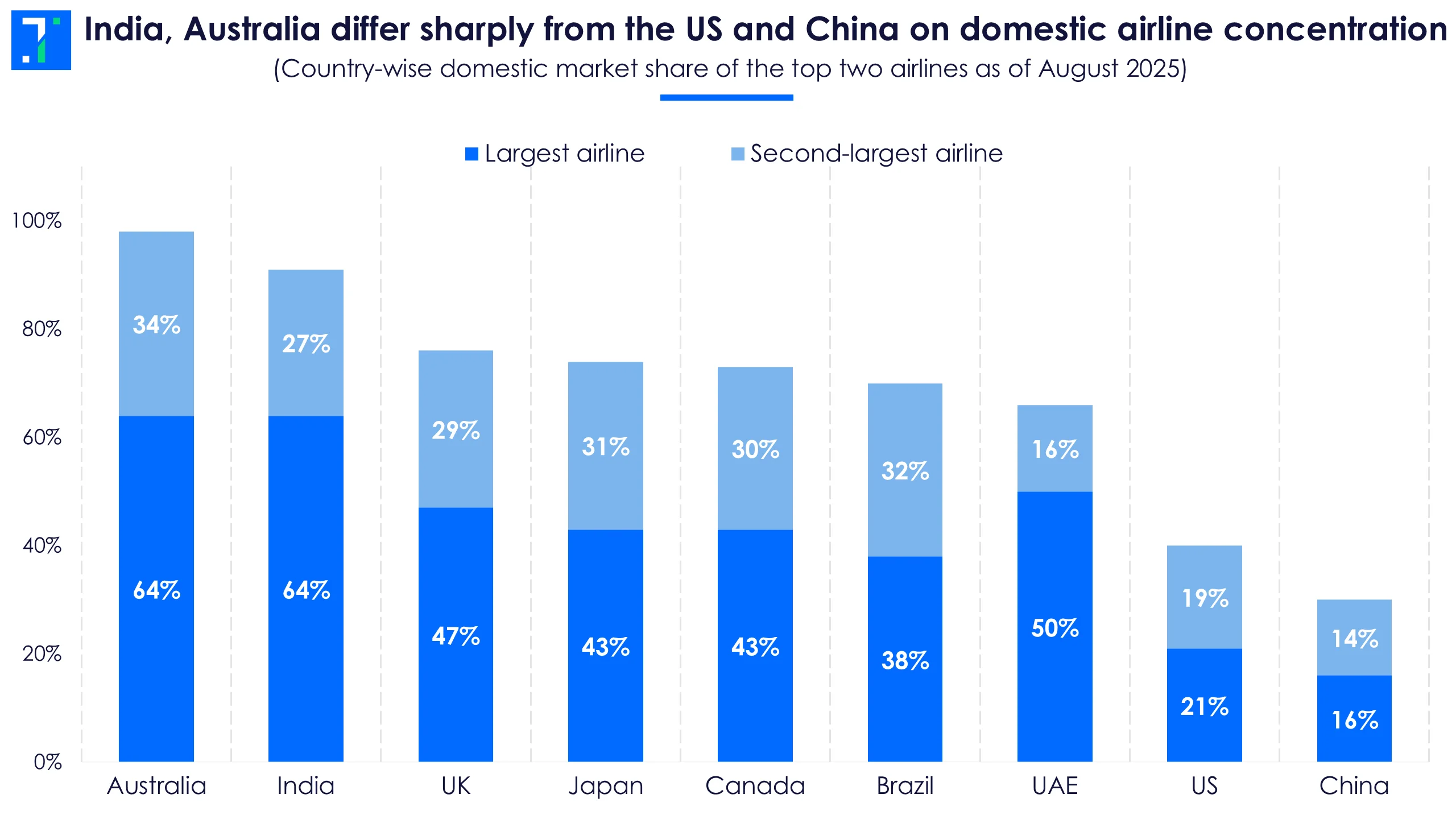
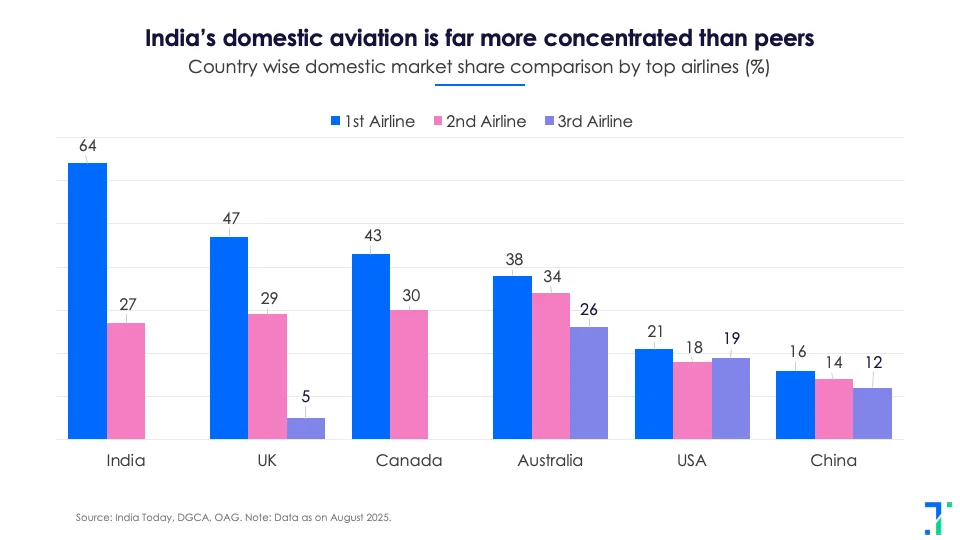
But behind these headlines, the industry is seeing some fundamental changes. In many of the largest countries, aviation no longer has a wide field of competitors. Instead, capacity is increasingly concentrated among a handful of large airlines. In some countries, three or four airlines share the skies. In many others, one airline holds a commanding majority share, with another acting as a distant second. 

This structure matters because of how it is impacting travellers. People catch a lot of flights, but no one actually likes flying. After the stress of airport security checks, where your favourite shampoo is thrown out if it is in the wrong sized bottle, travellers have to deal with tight legroom, uncomfortable seats, and terrible food. 

Where several strong airlines operate, passengers have choice, and at least some options in quality, legroom, and luggage policies. But when one or two airlines control most of the capacity, choices and safety nets disappear, and even a single operational issue can cause turbulence across the entire system, triggering cancellations, delays, and sudden fare spikes for everyday flyers.

India experienced this first-hand in December 2025. Operational issues at IndiGo, which carries the majority of domestic passengers, caused widespread cancellations. With no large alternative airline to absorb the shock, passengers were stranded, ticket prices on some routes skyrocketed, and the government had to impose fare caps.

“IndiGo’s size has grown to the point where operational setbacks pose systemic risk. If IndiGo or Air India gets into trouble, there will be mayhem in Indian aviation. The government needs to reduce jet fuel taxes and encourage more competition,” said Harsh Vardhan, chairman of Starair Consulting.

Too much flying power, too few players

Some aviation markets today are so dominated by one or two carriers that little room remains for smaller rivals.

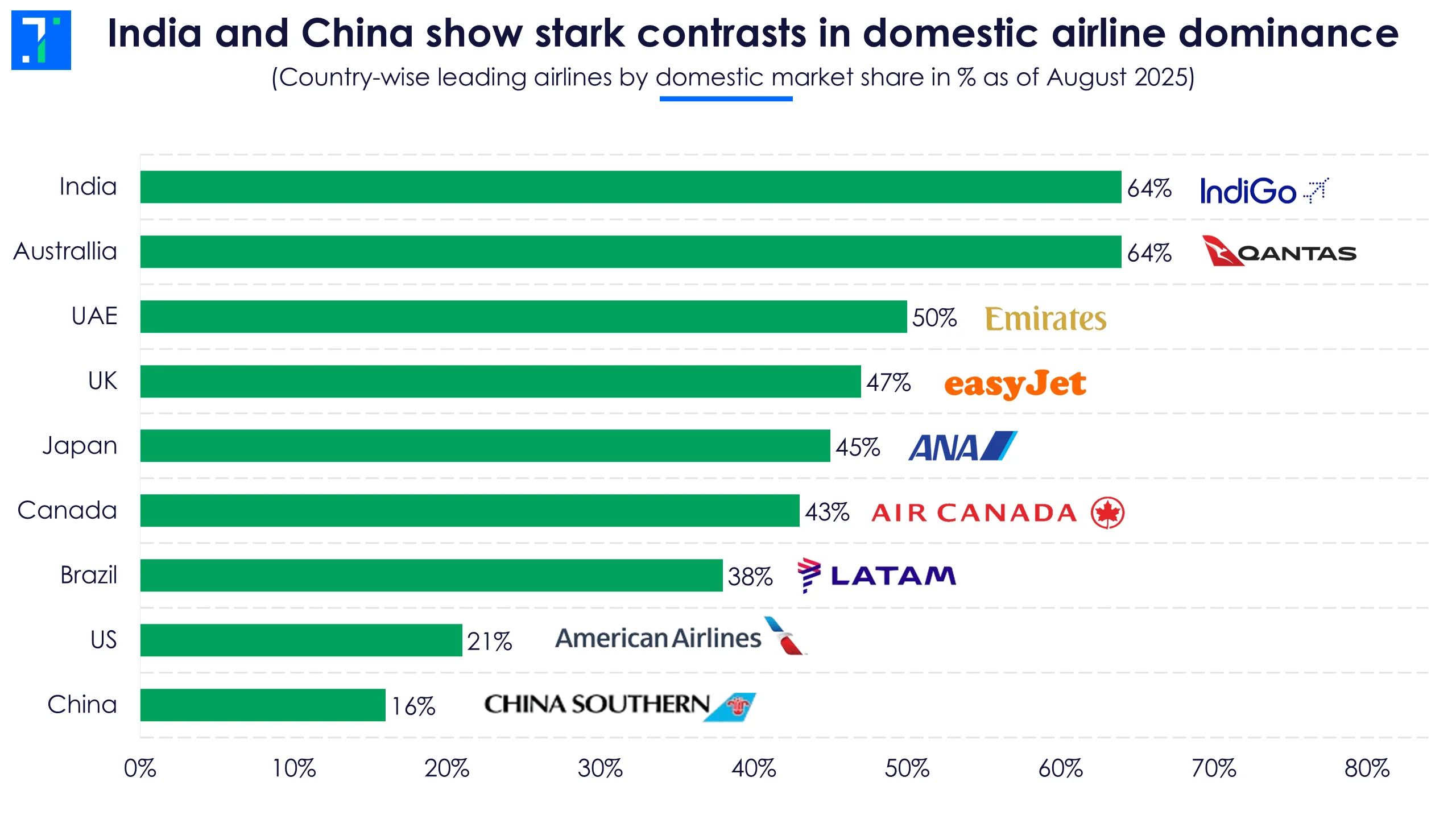
India is the clearest example. IndiGo and the Air India Group together control nearly all domestic flights. IndiGo’s growth improved domestic connectivity and helped keep fares competitive, yet this dominance also made the system fragile. 

Policymakers in India have acknowledged this challenge. After the IndiGo fiasco, Civil Aviation Minister K Rammohan Naidu remarked, “We need at least five airlines with around 100 aircraft each, so the country is not dependent on one or two carriers. This is essential to avoid monopoly and duopoly.”

Australia faces a similar problem. The Qantas Group (Qantas Airlines + Jetstar) and Virgin Australia control almost all domestic travel, with smaller carriers barely registering. Recent reports show that these two airlines control over 98% of domestic traffic, leaving passengers with few alternatives and limited bargaining power.

Canada presents another version of the problem. Air Canada and WestJet dominate different regions, and limit direct competition on many routes. A 2025 review pointed to high airport fees and regulatory barriers that protect the existing airlines. This has kept fares elevated and reduced passenger choice.

The UK, while more competitive than these markets, still feels the impact of concentration. EasyJet holds about 47% of total capacity, making it the largest carrier by a wide margin. Rivals like Ryanair and Jet2 provide alternatives, but when major airlines face disruptions, last-minute fares can still rise sharply during peak travel periods.

More airline companies mean fewer system-wide failures

Markets with a few strong competitors—rather than just two—handle crises much better.

The United States is the best example for a non-monopolistic aviation market. Four airlines — American, Delta, United, and Southwest — share most of the market. No single airline dominates completely. This balance prevents system-wide collapse.

North American carriers are competing by boosting premium offerings, with ~90% of widebodies now having premium economy. They are now fighting for customers based on reliability and comfort, not just the cheapest ticket.

Brazil fits here better than it appears at first glance. LATAM Brasil is the largest carrier with roughly 38% market share, but it does not control the market outright. GOL Linhas and Azul together ensure no single airline can dictate pricing unchecked. While competition on major routes is not fierce, the presence of three sizable players provides more stability than a two-airline system.

The UAE represents a different form of oligopoly. Emirates and Etihad dominate the market, but they compete globally rather than just domestically. Emirates is owned by Dubai’s Investment Corporation, alongside flydubai, which serves regional and domestic routes. Etihad is wholly owned by Abu Dhabi’s ADQ sovereign wealth fund.

State backing provides patient capital and strategic staying power, enabling both carriers to compete aggressively with global hubs like Qatar Airways, Lufthansa, and Turkish Airlines. The mix of a few dominant players, strong state support, and layered domestic competition makes the UAE airline market uniquely competitive.

When rails outspeed the skies

Aviation is also more balanced in markets where high-speed rail shares the load.

China’s airline market appears competitive, but high-speed rail has reshaped travel patterns. For journeys under 800 km, trains are faster and easier than flying. On the Beijing–Shanghai corridor, high-speed rail captured about 34% of airline passengers. This forces airlines to focus on longer routes and limits their pricing power on domestic sectors.

Japan looks like a classic two-airline market, which usually means high prices. But Japan is different. The Shinkansen bullet train keeps airlines in check. On routes like Tokyo–Osaka, trains carry over 80% of travellers. Airlines have to offer better service and sharper prices just to stay relevant.

This competition between trains and planes creates a rare result: high reliability and great service without crazy prices. It proves that the best check on an airline monopoly might not be another plane, but a fast train.

What does this mean for travellers?

Rising passenger numbers can hide deeper problems in aviation markets. When most flights are controlled by just a few airlines, even minor disruptions affect the entire system. For travellers, this often means higher fares and minimal options when flights are cancelled or delayed.

Governments are finally taking notice. Fare caps in India and competition reviews in Europe show increasing concern that aviation needs backup options, not just bigger airlines. As travel demand keeps rising, stable air travel will depend on policies that support real competition — through more airlines, easier airport access, and alternatives like high-speed trains.

logo
The Baseline
17 Dec 2025
Are Indian consumers running out of choices?
By Swapnil Karkare

Early December, usually a great time to travel, became a national nightmare this year across Indian airports. As IndiGo flights across the country were cancelled, the best laid plans fell apart. One student missed an engineering hackathon they were preparing for over the last several months. Many travellers missed exams, weddings, funerals, and long planned for international vacations.  Suitcases disappeared into the black hole IndiGo called the "check-in counter", so people couldn't even just give up and go back home. 

I escaped the chaos only because I was flying to Siliguri on a different airline, for my sixth wedding anniversary. But I saw the chaos at the terminal. The helpless ground staff stood there absorbing it all, one complaint at a time.

The silver lining, if we try to find one, is that people have now started talking about monopolies in Indian industry. India has several sectors where market power is concentrating very quickly into a few hands. If we don’t course-correct, it is very likely that the “IndiGo moment” will repeat elsewhere.


Competition is good, economists say. But the stock market doesn't reward it

Economists agree that competition in industries lowers prices, improves quality, and gives consumers more power. But investors actually prefer the opposite. The stock market loves companies with a “moat”: businesses that are so dominant, and with such high entry barriers that new players don't stand a chance. Warren Buffett for example, lovesCoca-Cola, Moody’s and Applecompanies that have either absorbed or killed most of their competitors, and are hyper-dominant in their sectors.

Palantir's Peter Thiel openly says that "competition is for losers". Even the economist Joseph Schumpeter, who gave us the idea of “creative destruction” as new companies replace old ones, eventually concluded that monopolies might be capitalism’s natural end state.

Consumers want choice, but markets reward dominance.


India is seeing a concentration of power across sectors

To measure competition, economists use the Herfindahl-Hirschman Index (HHI). A score below 1,500 means a competitive economy. Between 1,500 and 2,500 suggests moderate concentration. Anything above 2,500 is monopolistic and sets off alarm bells.

For the first time in over a decade, India has entered thehighly concentrateddanger zone. The HHI climbed from 1,980 in FY15 to 2,167 in FY20, and has crossed 2,532 in FY25.

Many Indian sectors now have a few companies with significant market power.  Telecom for example, has become a slugfest between Bharti Airtel and Reliance Jio. Aviation has IndiGo and Air India dominating. In steel, four companies control more than half the market. And in cement, the Aditya Birla Group and Adani Group now have more than 50% of the market, and are still acquiring smaller players. 

The concentration of market power gives companies pricing power, forcing consumers to pay more. It can also quickly reduce product options and quality. 


This is just the tip of the iceberg

Few sectors in India show the problem better than aviation. India's domestic airfares were 43% higher in early 2024 than in 2019. In Asia, only Vietnam saw a bigger jump.

Two decades ago, India had close to ten airlines. Today, IndiGo and Air India control nearly 90% of the market. On many routes, there’s only one choice, usually IndiGo, which makes it the default price setter.

Airports are also increasingly controlled by just two private players, Adani and GMR, alongside the Airports Authority of India. Adani’s rapid expansion across airports, ports, and even lounges wiped out Dreamfolks’ once-dominant lounge business almost overnight.

History has a warning for us. The US spent the early 20th century breaking up Standard Oil, regulating railroad barons like Vanderbilt and Gould, and placing utilities under strict oversight. The US government cracked down after these monopolies raised prices, shut out competitors, and held entire regional markets in the US hostage.

India appears to be learning that lesson now, the hard way.


A global pattern

Globally, the pattern right now is 'bigger is better'. In the US, monopolies are making a comeback. Markups — the gap between price and cost —have jumped nearly 3X since the 1980s as industries have consolidated and companies feel free to increase prices. 

For example, Bayer, Corteva, Syngenta, and BASF dominate global seeds and fertilisers. A few players control pharma generics and vaccines; VisaandMastercard handle 80% of card payments, China’s Alipayand WeChat Pay control 95% of QR payments within China, and even India’s open UPI has created two dominant apps, PhonePe and Google Pay.

This pattern of fewer players, higher profits and weaker competition is now visible across many industries globally, pointing to more “winner-take-most” markets. We must worry about it as we, the consumers, are the ones paying a hefty price.


Should India dismantle its giants?

Former RBI Deputy Governor Viral Acharya has been sounding the alarm on monopolistic markets for years. His research shows that market concentration in India surged after 2015, driven by an industrial strategy favouring “national champions.”

By 2021, India’s biggest business groups controlled nearly 18% of assets in non-financial sectors, up from 10% in the early 1990s. Meanwhile, the next five largest groups saw their share halve. The dominant companies didn’t just crowd out small players, they squeezed out other large competitors as well.

One option, Acharya argues, is dismantling such groups where necessary. Recently, former Maharashtra CM Prithviraj Chavan and the President of the Federation of Indian Pilots, Captain C S Randhawa, urged the government to break IndiGo into at least two separate airlines.

China offers an instructive example. In the 1980s, it split its state airline into six entities. Three major airlines—Air China, China Eastern, and China Southern—emerged. Even today, together they control less than half the market.


Can India reverse this trend?

A monopoly, like a weed, is difficult to remove once it's entrenched. Dominant companies will fight, lobby, and pay the media to make their arguments for them. India needs a Competition Commission that can act before market power turns into abuse. The IndiGo episode should be a broader wake-up call.

Currently, the Competition Commission of India (CCI) intervenes only after abuse such as overpricing, blocking rivals, or distorting markets. In sectors like aviation, digital platforms, logistics, and infrastructure, that often means that they step in too late, after rivals are weakened and consumer choice has already shrunk.

The solution lies in reform. Some work has already begun. A Standing Committee report submitted in August backs ex-ante rules, stricter scrutiny of acquisitions, faster enforcement, fewer court delays, and a stronger CCI with better funding and expertise. It also calls for reviving a National Competition Policy, so that encouraging competition explicitly shapes government policy across sectors. Now it remains to be seen that if our current billionaire businessmen will let this happen.