

The September end earnings season is in full swing, and India’s IPO market is more than keeping pace. The much-anticipated Jio Platforms IPO opened for subscription today, and in a decade of large IPOs, this one is the largest ever at a size of Rs 30,213 crore.
But the action isn’t limited to Jio. Reliance Industries is drawing some unusual bets of its own.
According to reports, two traders have taken exceptionally large positions in Reliance futures and options (F&O), each exceeding 3% of the stock’s market-wide position limit (MWPL).
“I would say this is the rarest of rare cases,” said Kruti Shah, a quant analyst at Equirus Securities, noting that she could not recall Reliance ever appearing on the MWPL list this way before.
Even Reliance’s payroll seems to have joined the IPO buzz. According to Bloomberg, Reliance credited October salaries to 420,000 employees 15 days earlier than usual, giving them earlier access to their money ahead of the Jio Platforms IPO.
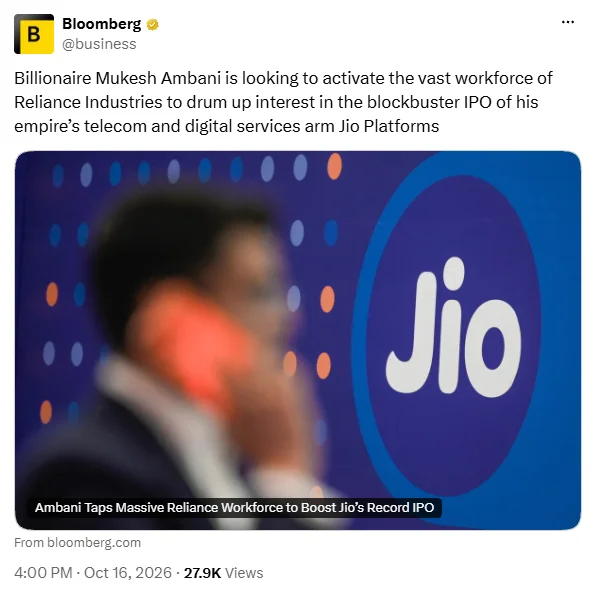
With Jio grabbing headlines and Reliance attracting big bets, you’d think the market had little room for another star.
But Indian IT stocks managed to steal the spotlight last week, posting their best weekly gain since 2008.
What sparked the rally? And is it the start of a comeback or just a temporary bounce?
Let’s dive in.
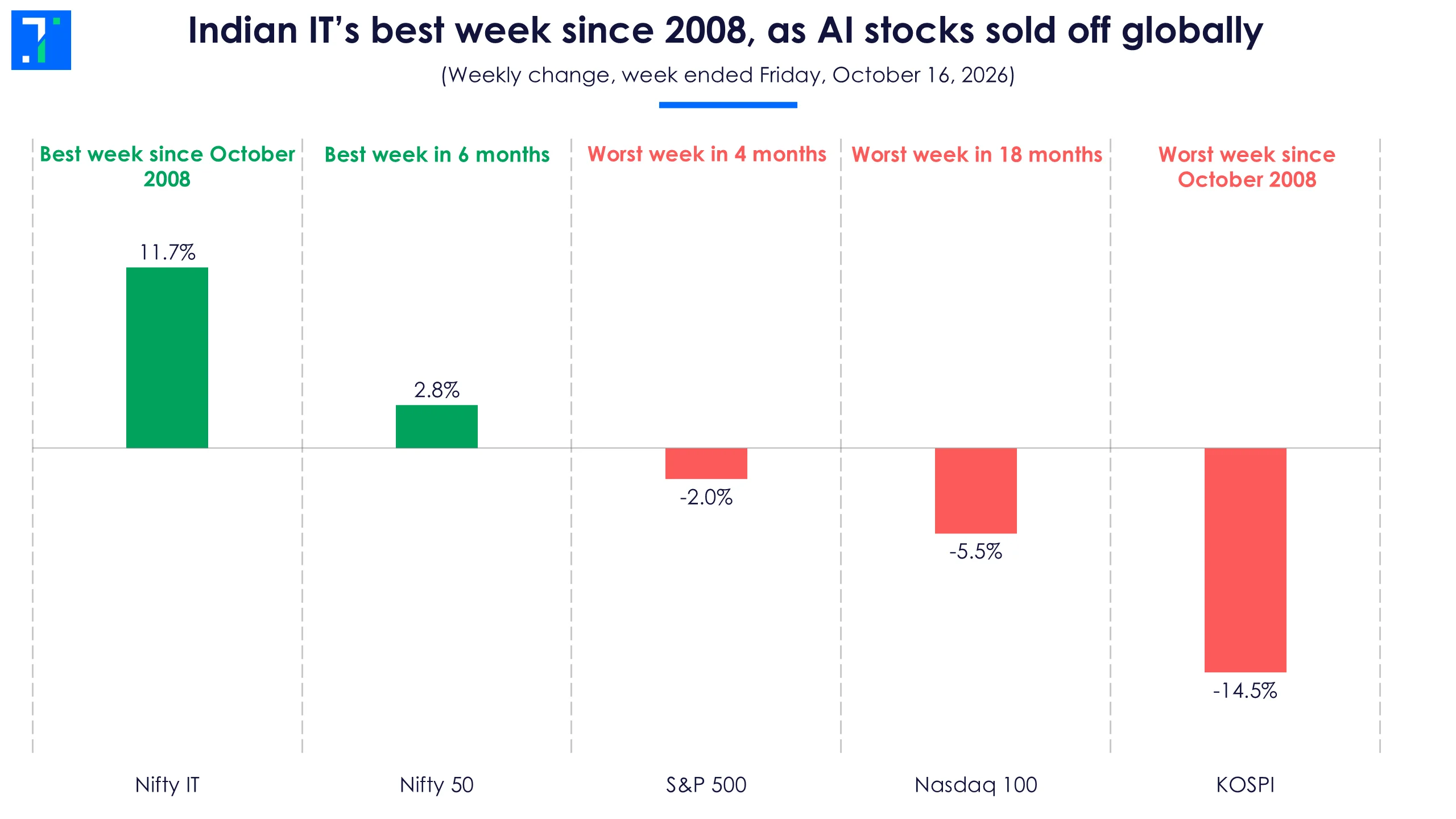
Indian IT’s best week since 2008, as the AI trade cracks
Nifty IT, which tracks India’s ten largest IT companies, rose 11.7% in the week ended October 16, its biggest weekly gain since October 2008. Better-than-expected earnings and strong commentary from IT CEOs drove the rally, lifting the Nifty 50 to its best week in six months.
The rally came as global AI stocks took a beating. The Nasdaq 100 fell 5.5%, its worst week in 18 months, while South Korea’s chip-heavy KOSPI dropped 14.5%, its worst week since 2008.
J.P. Morgan describes India’s equity market as emerging as the world’s largest, liquid “AI hedge”, a place investors rotate into when they cut crowded AI bets.
But IT has been a laggard even within India. Nifty IT has trailed the broader Nifty 500 and major global indices over three- and five-year periods.
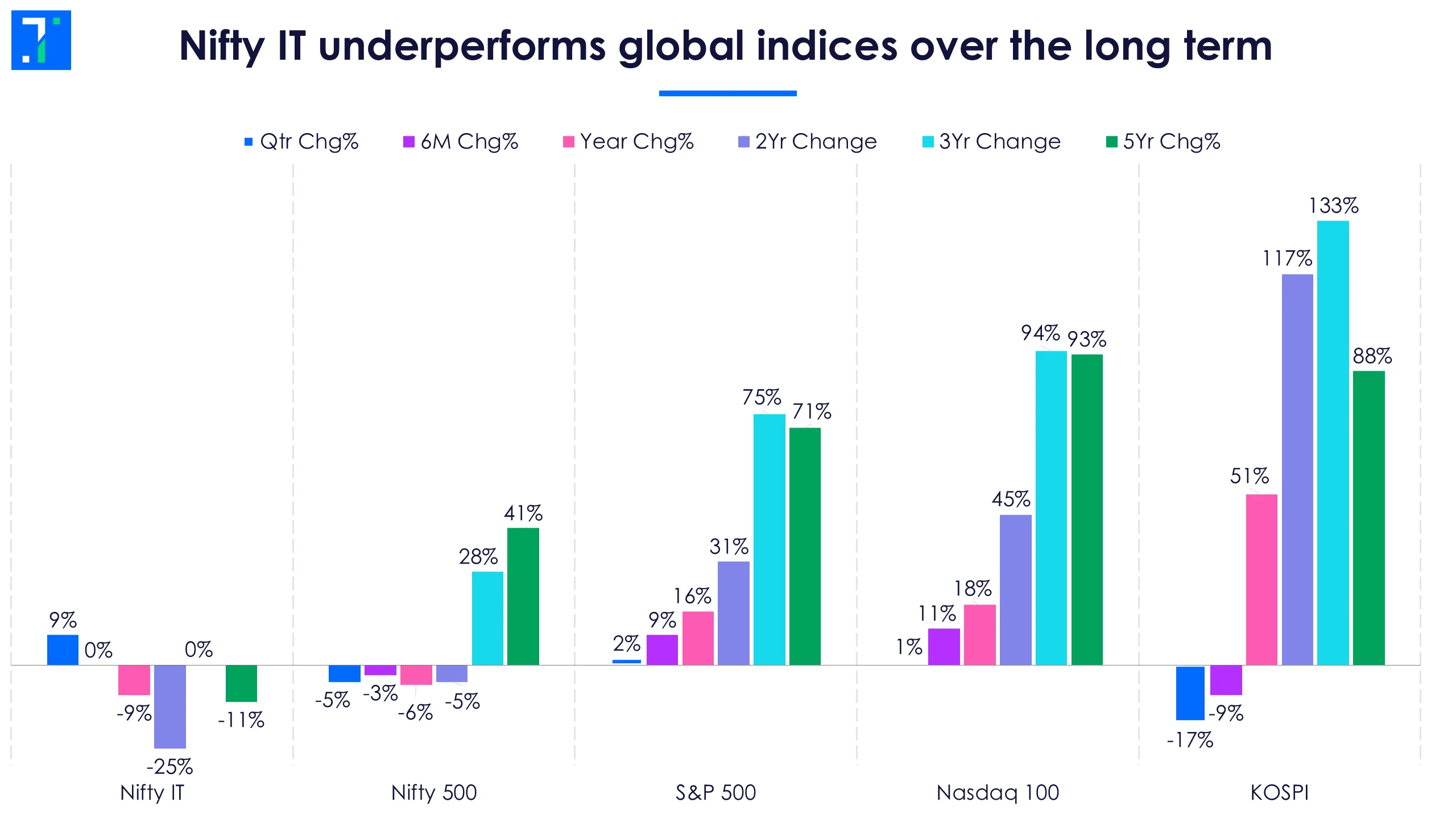
So, is this the start of a comeback for Indian IT, or just a bounce?
Jefferies believes Indian IT stocks could see a valuation re-rating as earnings resilience challenges pessimistic assumptions about long-term growth. “With IT firms still delivering growth despite weak macro and AI-driven disruption, investors are more willing to revisit their growth assumptions,” the brokerage said in a note.
Choice Institutional Equities says stronger organic growth and rising AI revenue are needed for a broader recovery, while Axis Direct warns that earnings forecasts must stop falling.
Kotak Neo highlights fresh opportunities in cybersecurity, AI governance and AI guardrails as clients open new budgets.
Q2 earnings offer signs of recovery, but demand is yet to turn
All four IT majors reported YoY and QoQ revenue growth in Q2. Tech Mahindra led the group, followed by HCLTech and TCS, while Wipro posted the slowest QoQ growth.
The results offered some relief to investors worried about AI disrupting traditional IT services, although modest QoQ growth implies the recovery is gradual.
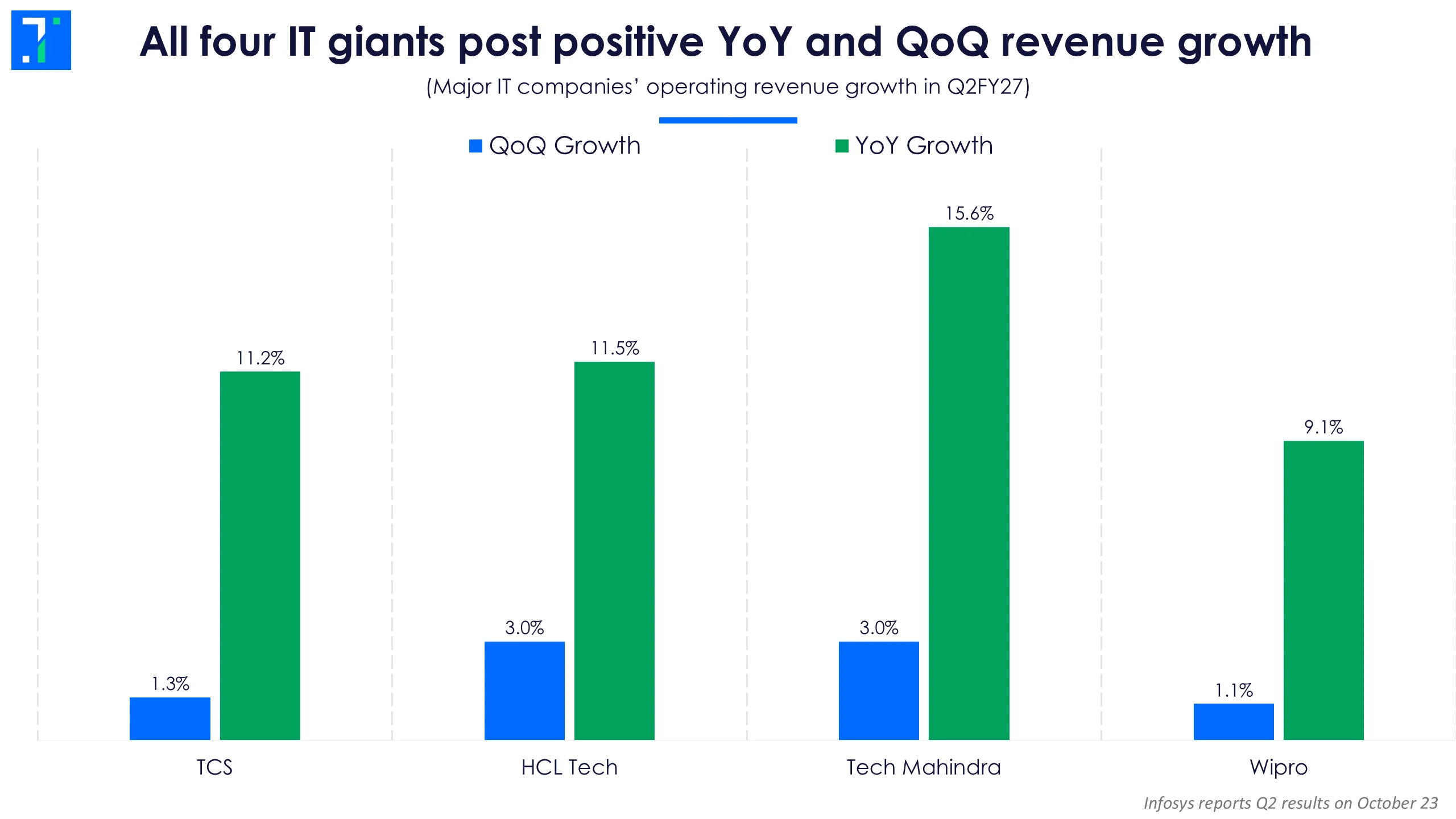
HCLTech’s revenue growth was driven equally by AI and its core business. It also raised the lower end of its FY27 revenue growth guidance from 1% to 2.5%.
AI is putting pressure on traditional IT services, as clients expect productivity gains that reduce the time and effort required for projects. CEO C Vijayakumar said, “We are able to offset AI-driven deflation in revenue by gaining market share in our core services and through our advanced AI offerings.”
TCS delivered broad-based growth, led by banking and financial services. CFO Samir Seksaria said that while some AI productivity gains are passed on to clients, “we are seeing better pricing on the AI revenues which we are generating.”
Tech Mahindra CEO Mohit Joshi pushed back against concerns that AI would erode IT services revenue by reducing the work needed for projects. Calling the revenue deflation debate “completely warped”, he argued that the opportunity lies in taking on a wider scope of responsibilities rather than delivering existing work more efficiently.
Profit growth also supported the recovery narrative.
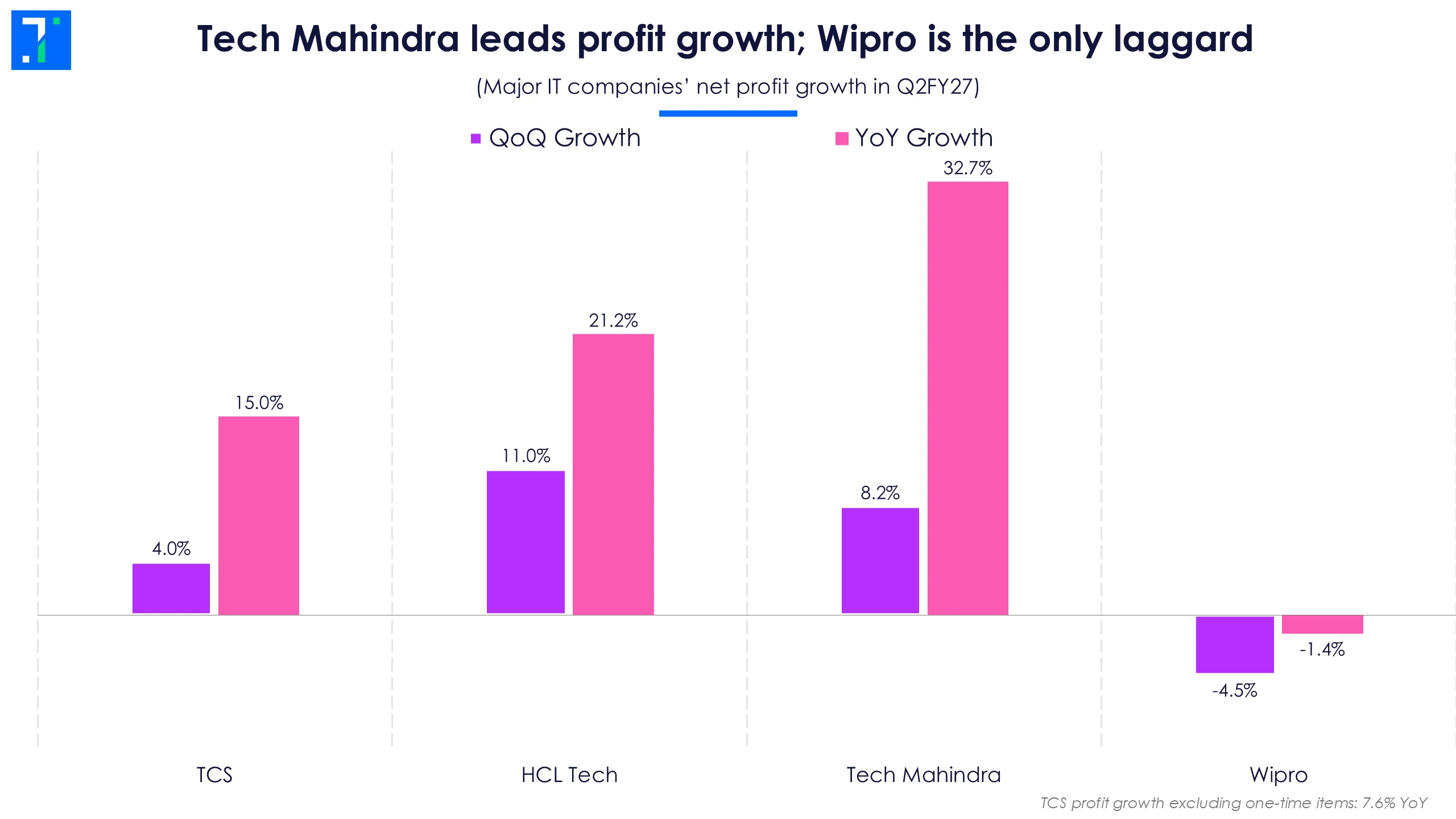
Net profit grew faster than revenue at three of the four companies, while Wipro's profit declined as lower other income weighed on the bottom line.
Brokerages turned more constructive after the results. Kotak said Tech Mahindra’s turnaround was on track. Nomura raised its revenue and earnings estimates for HCLTech, while Anand Rathi upgraded the stock to Buy, citing AI monetisation. Nuvama backed TCS’s investment push despite near-term margin pressure.
However, better quarterly results have yet to translate into a clear recovery in demand.
Better growth and rising AI revenue are encouraging, but clients remain cautious about spending and pricing pressures have not disappeared.
AI is no longer a side business at TCS and HCLTech
AI is emerging as a new revenue driver for Indian IT companies, rather than just a threat to traditional services.
TCS’s annualised AI revenue reached $3.1 billion, accounting for around 10% of revenue, double its share a year ago. HCLTech’s Advanced AI business generated $219 million in Q2, contributing 5.9% of revenue, up from 3.4% a year ago.
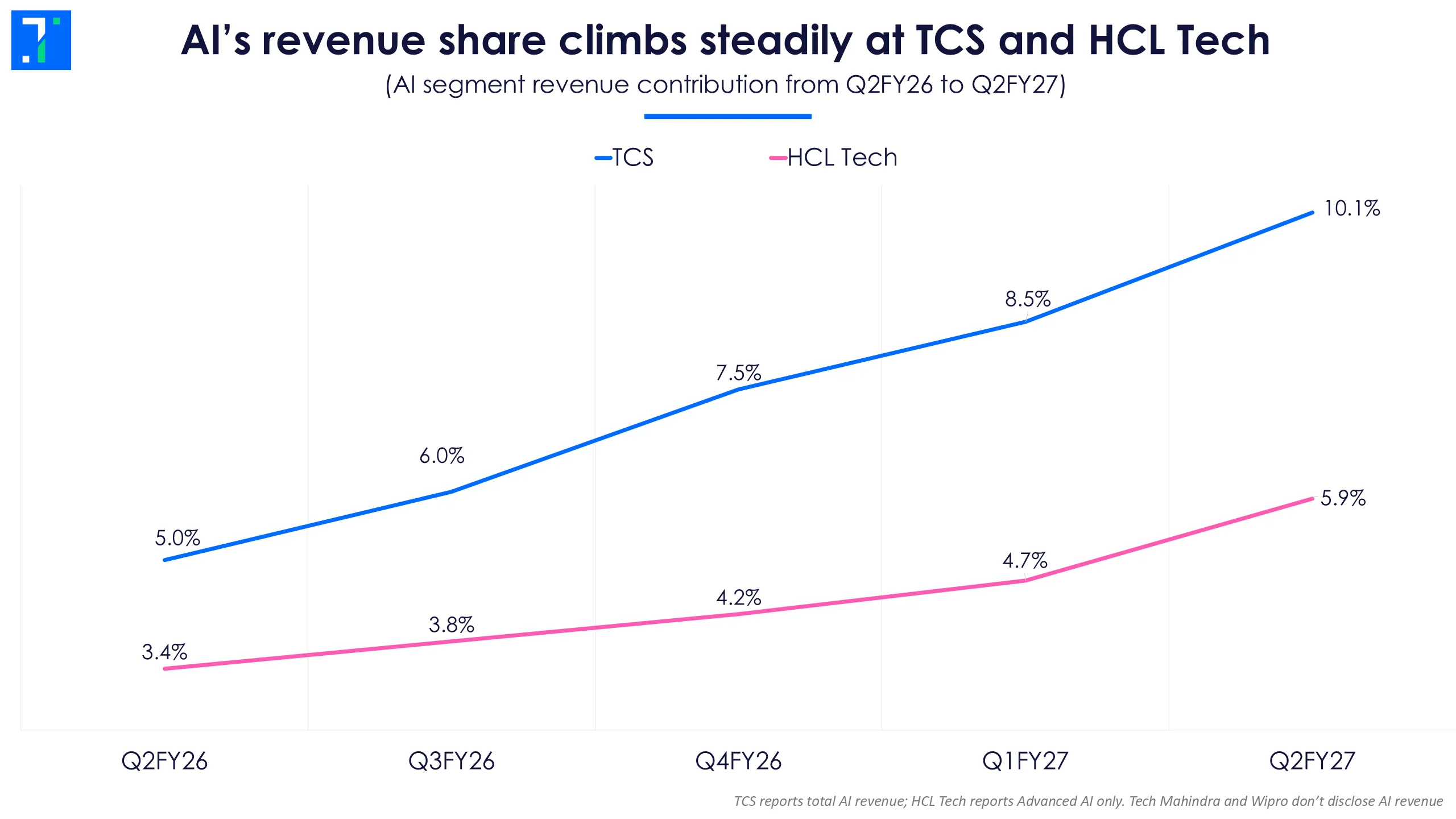
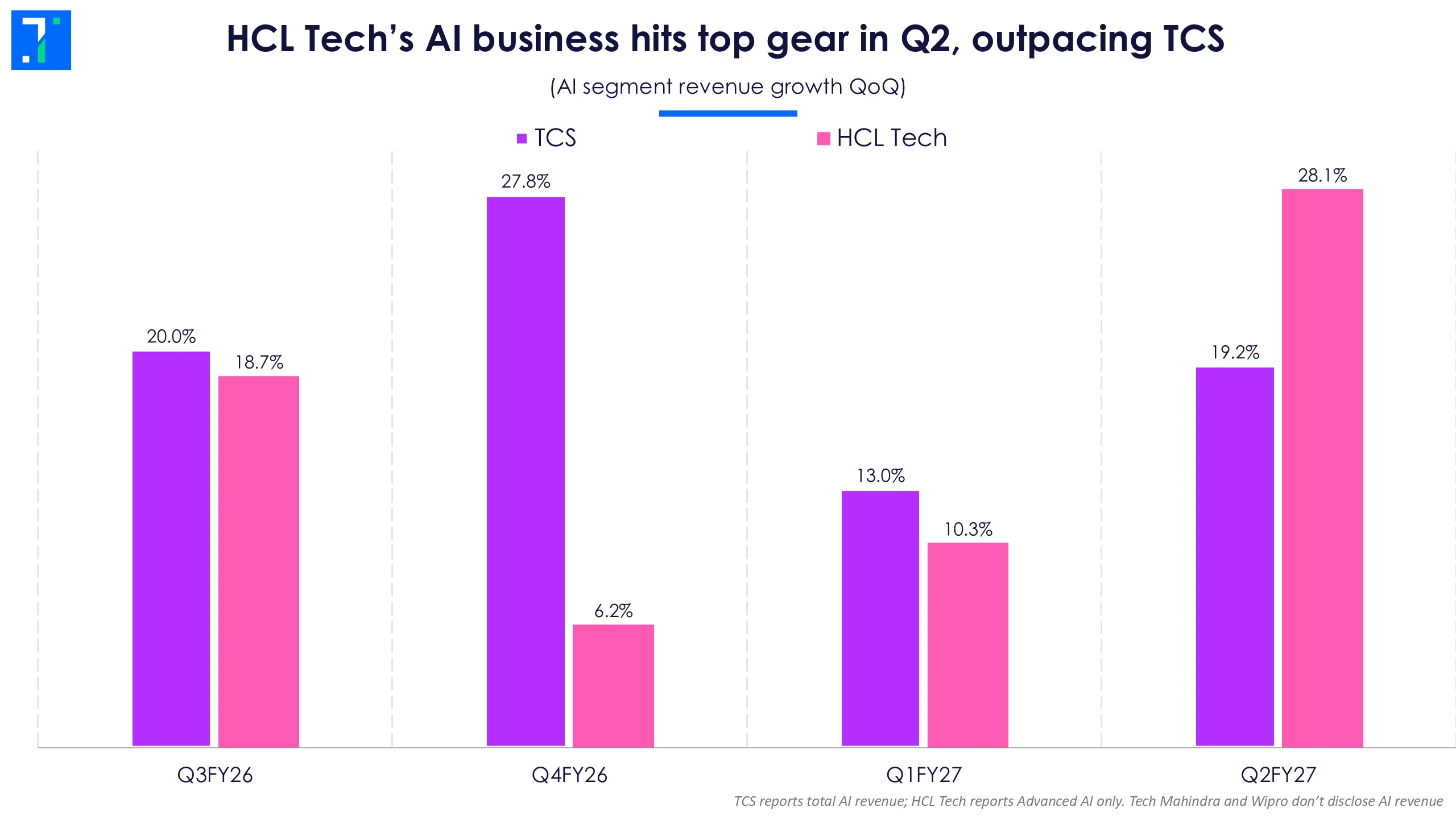
AI revenue is growing rapidly. HCLTech’s AI revenue grew 28% QoQ, outpacing TCS’s 19%, and 78% YoY. TCS’s AI business has more than doubled over the past year.
AI could also lift margins. TCS said its AI revenue comes in at a much higher margin than the company average. At HCLTech, Advanced AI added 32 basis points to the quarter’s margin expansion, and the CEO expects its services margins to eventually be at least 7%-10% higher than those of traditional services.
Tech Mahindra and Wipro do not disclose AI revenue separately.
IT stocks still trade below historical valuations
A week-long rally hasn't erased two years of valuation declines. TCS trades at a trailing PE of 17, around 40% below its five-year average. Infosys and Wipro are also trading well below their historical averages, while HCLTech is closer to its long-term valuation, reflecting its stronger growth.
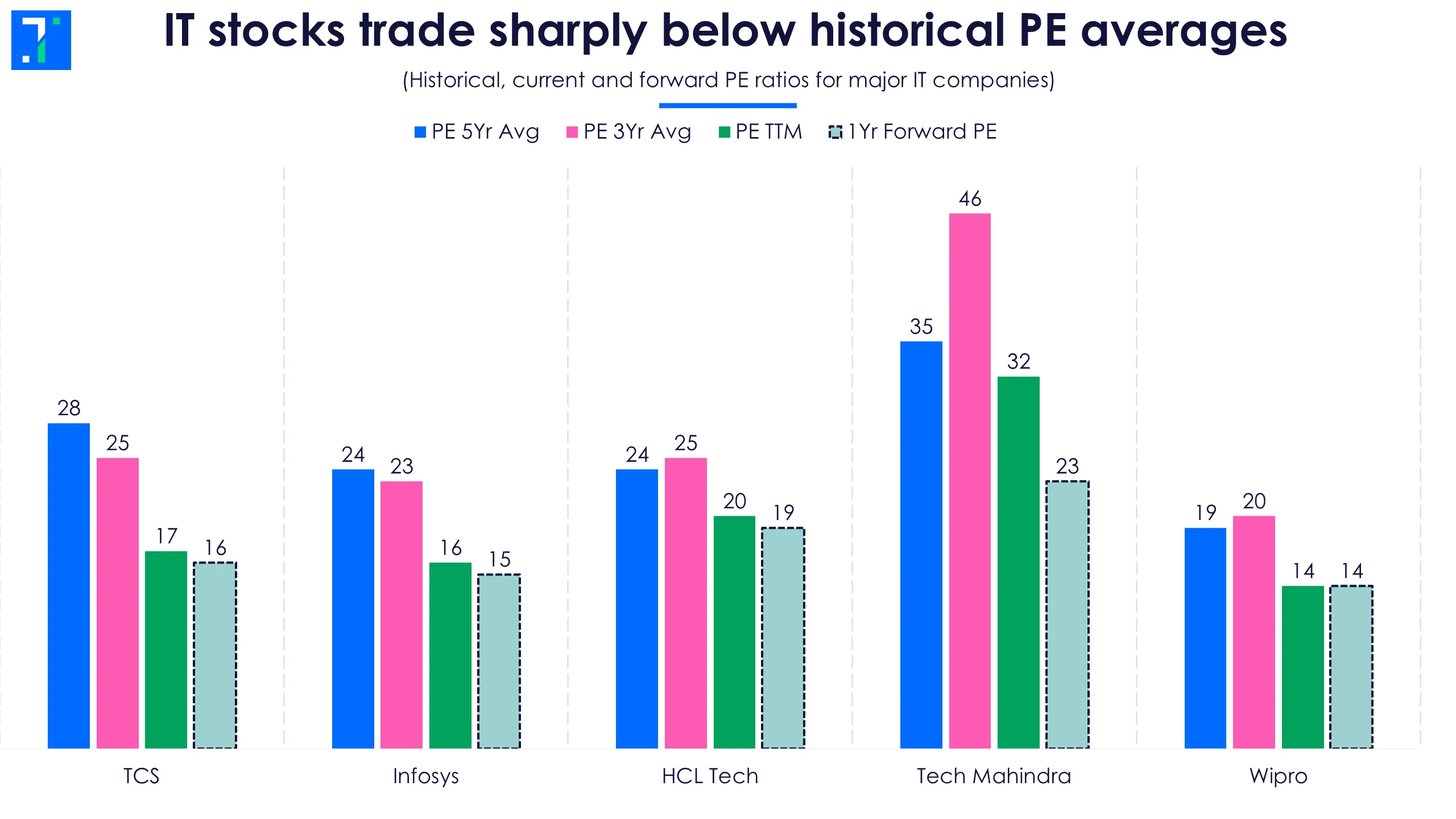
Tech Mahindra is the outlier. At a trailing PE of 32, it remains the most expensive of the five, though its forward PE drops to 23 as investors expect earnings to improve.
Trendlyne Forecaster estimates put forward valuations lower for most IT majors. The discount suggests investors remain cautious about AI disruption, leaving room for a re-rating if earnings and AI revenue growth hold up.
The next leg of the rally depends on whether AI revenue can grow fast enough to offset weakness in traditional services, and whether global investors continue to view India as a hedge against crowded AI trades.
Infosys reports its Q2 results on October 23. Its results and outlook will be the next test of whether Indian IT is turning a corner after a few bad years.