

Flashy screens, juicy market gossip, watching the Mumbai skyline from a high-rise office while I juggled phone calls: when I first started work at a stock market brokerage, this was the life I imagined. Movies like The Wolf of Wall Street made it look fast and glamorous.
But reality set in soon enough, that this is not what investing is. As my years in the stock market grew, it became clear that this job isn't meant to be exciting. In fact, excitement was usually a warning sign. The movies about the stock market were about as realistic as a Superman film.
The Nobel prize winning economist Paul Samuelson liked to say that investing should be boring. “Investing should be like watching paint dry. If you want excitement, take $800 and go to Las Vegas.”
Speaking of paint, the Asian Paints stock proves his point. This stock has been a boring compounder for decades. It doesn't double in a month like a crypto coin. But if you'd invested Rs. 10,000 in the stock in 2000 and forgot about it, it would be worth over Rs. 10 lakhs today, excluding dividends.
If 'boring' makes money, why do we chase short term trends and excitement so much?
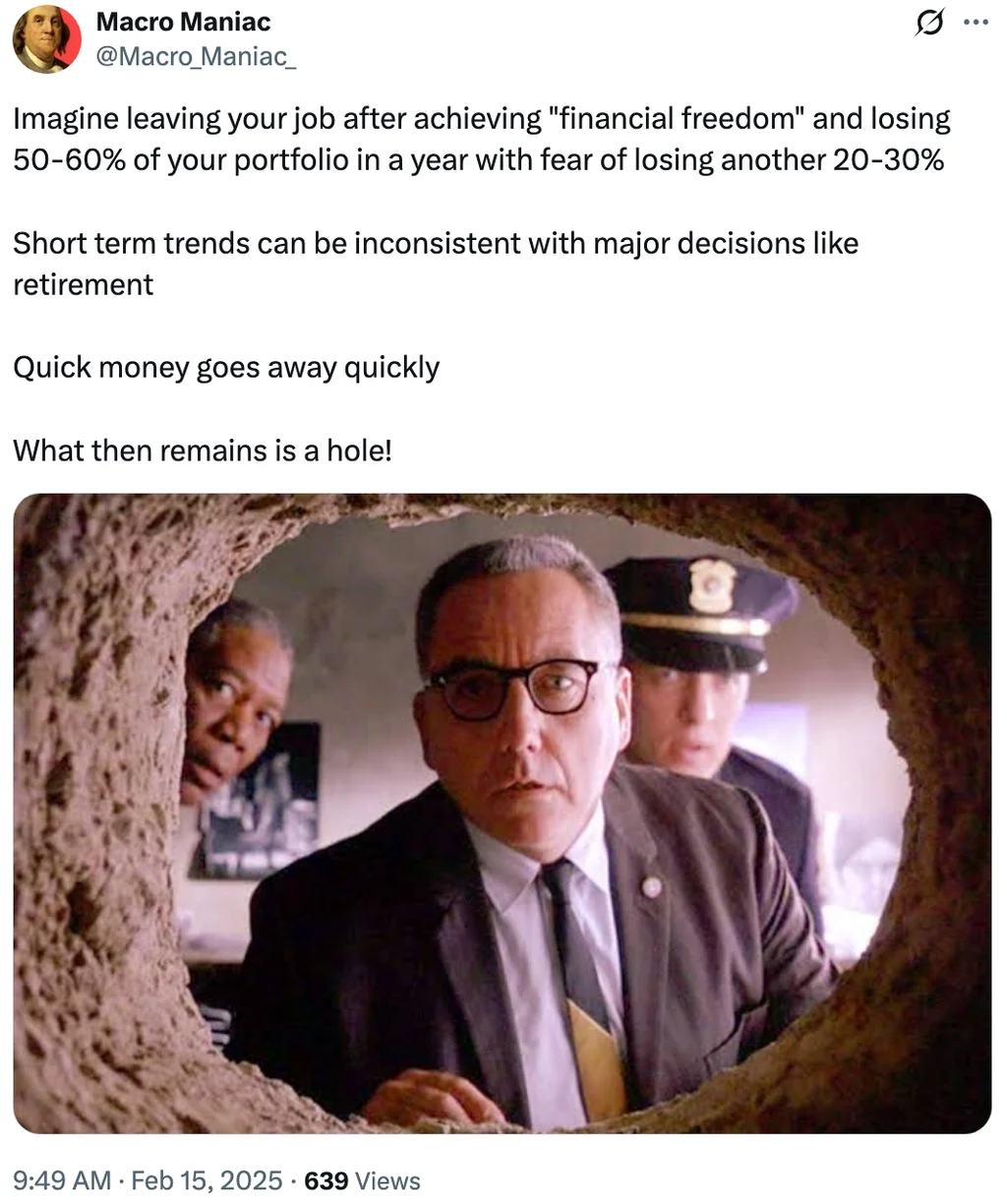
People are impatient, and the internet has made it worse
Humans aren't built to think about the long-term - we tend to be impulsive creatures. The part of the brain that helps us plan and be patient, the prefrontal cortex, evolved relatively late.
Andy Haldane, the former Executive Director at the Bank of England, has linked this late 'patience breakthrough' to prosperity. He argues that people didn't progress out of just skill or hard work, but because human society as a whole learned to hold off on immediate pleasures, and plan for the future.
But impatience still stalks us every day, and the internet has not helped. We hear buzz about AI or defence stocks, or a smallcap rumour, and we often don't stop to consider before we rejig our portfolios.
Even experienced fund managers face this challenge. Because they have to show results every quarter, they end up chasing what’s hot right now. We say we want long-term wealth, but a small decline causes panic and a short rally feels meaningful.
Based on the math however, such FOMO is bad for you. A popular story about the US brokerage Fidelity suggests that the best investor is the dead investor: in an internal study, Fidelity reportedly found that their best performing investor accounts belonged to people who were dead, or had forgotten their passwords.
Fidelity never publicly confirmed this, but other studies show that investor accounts that trade the most tend to see lower returns than the overall market. Charlie Munger sums it up well: “The big money is not in the buying or the selling, but in the waiting.” Crypto or meme stocks might seem exciting, but sticking to steady options like index funds and long-term picks is what really grows money in the long run.
Beta as a boredom metric
One way to quantify boring investing is to look at a metric like beta, which measures a stock’s volatility compared to the overall market.
A stock with a beta of 2 typically moves at double the volatility of the index, moving 10% when the market moves 5%. A beta of 0.5 means a 2.5% move when the index moves 5%. So low-beta stocks have lower volatility than the index.
These so-called ‘boring’ stocks with low beta tend to deliver steady returns with lower risk. In the US, high-beta stocks gave about 30% more returns than low-beta ones in the last 50 years, but they came with almost triple the risk. After accounting for all that risk, the extra reward isn’t that great. In fact, avoiding the highest beta stocks could have given 5–6% more in returns each year.
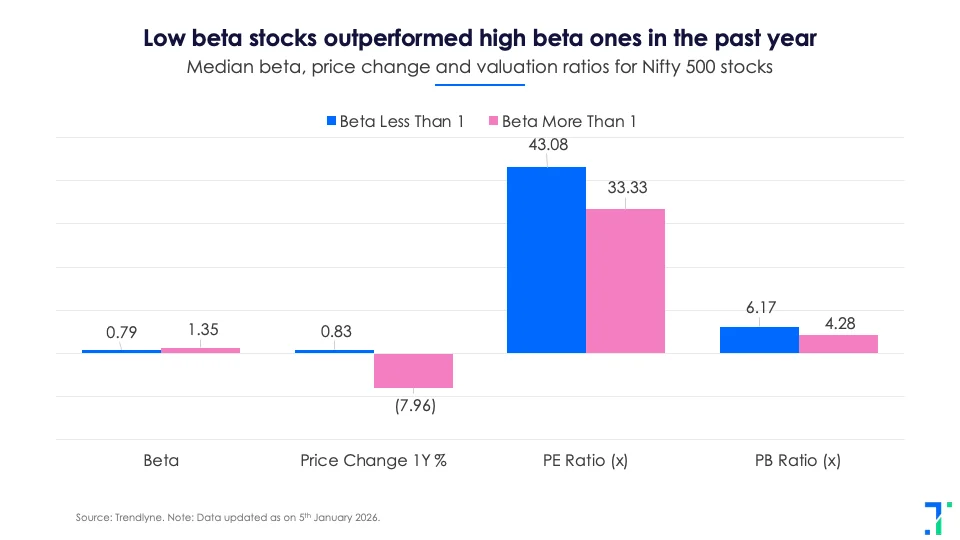
I ran a simple beta analysis on Nifty 500 stocks for the past year. Low-beta stocks easily outperformed the high-beta ones in what we all know was a pretty volatile market.
In the past year, stocks with a beta under 1 (and median 0.79) posted positive median returns, whereas those with a beta over 1 (median 1.35) ended up with negative median returns. It contradicts the idea that higher-risk stocks should earn higher returns.
Valuations reinforce this point. Low-beta stocks traded at higher median P/E and P/B multiples. It seems that investors are paying a premium for stable cash flows, and downside protection.
Resisting the urge
For the last couple of years, SEBI has been issuing warnings about how the vast majority of young traders lose money in derivatives trading. But are people listening, when in the age of online trading and finfluencers, stock trading offers an easy dopamine rush? Holding back becomes a deliberate, conscious choice.
I leave you with a sports story: the economist Michael Bar-Eli did a famous analysis in 2009 on the performance of football goalkeepers. Statistically, he found that a goalkeeper's best chance of saving a penalty kick is to stay in the center of the net. This gives them a 33.3% save rate.
But in real life, goalkeepers stay in the center only 6.3% of the time, and dive left or right 94% of the time. Why? Because if they stand still and give up a goal, it looks like they didn't try. Even if they dive and miss, it seems like they "did something."
So next time you get a "trade now" notification, consider how an unnecessary dive can cost you the match.