

“Where is India’s Nvidia?” is a question I have heard many analysts ask. But to me, this is an unfair framing for say, an Indian company that has spent years trying to build a better electric motor.
When we talk about innovation, we think about a sleekly marketed brand, and maybe a charismatic founder (some signature clothing like a grey t-shirt or a leather jacket is a bonus). The press coverage will show queues of people outside stores, etc. So a specialised chemical manufacturer, or a new kind of banking software starts with a PR disadvantage. Nobody has ever queued up overnight for a better loan-management system.
My point is, innovation that makes money doesn’t need consumer fame. It has to solve a hard problem, and persuade customers at scale to pay.
I watched the September quarter results from this perspective. What are India's innovative companies building, and how much of it is already showing up in the numbers?
Four businesses have gone beyond promises and pitch decks.
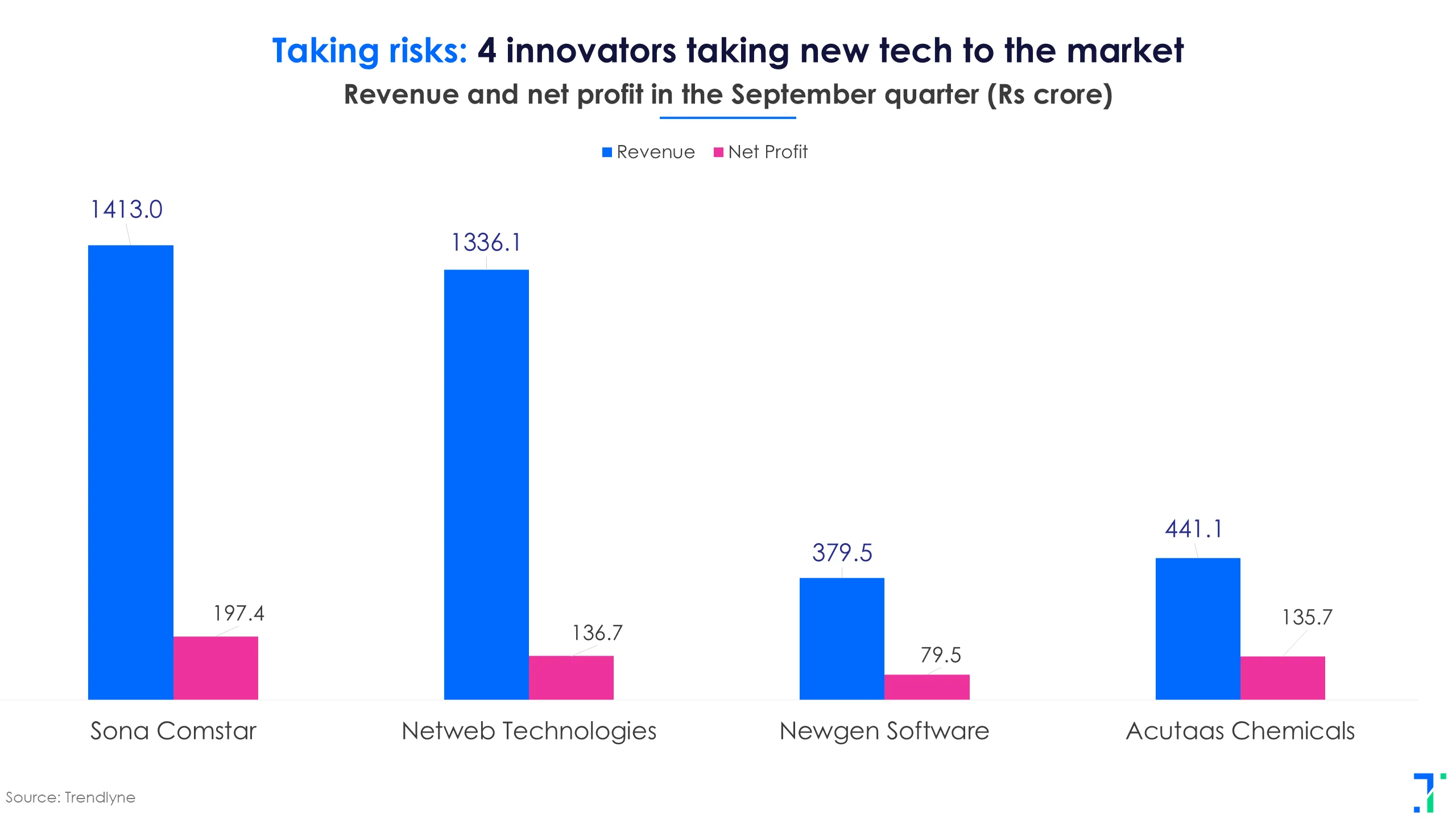
Let's dive in.
1. Sona Comstar: You don’t have to make the whole car
Sona BLW Precision Forgings (Sona Comstar) is far more interesting than the usual “auto ancillary company riding the EV wave” story. The company has expanded from precision forged gears into traction motors, electronics and radar sensors, partly through in-house R&D and partly through acquisitions like Serbia’s Novelic.
Not every invention needs to come from a company's own lab. Knowing what to build, what to buy, and how to fuse systems together is half the battle in industrial tech.
Sona's Managing Director and CEO Vivek Vikram Singh noted during his September quarter commentary, that the company "commercialised three new products, our highest ever in a quarter". These were an EV-specific differential, air springs for railway coaches, and rear radar sensors for two-wheelers. The EV differential has already locked in a Rs 700 crore contract, and the radar sensor has won Rs 100 crore of business.
Battery-electric vehicle customers now generate 51% of Sona's automotive product revenue. Rather than making legacy parts more cheaply, Sona is making itself harder to replace by supplying high-value systems to automakers.

2. Netweb Technologies: An anonymous partner to the big names
Does a company count as innovative if it uses somebody else’s processors? I think it does, depending on what it contributes on its own.
Netweb Technologies partners with Nvidia, AMD and Intel, but it doesn't pretend to build the silicon. Its specialization is in hardware engineering, system architecture, high-performance storage, and the software stack that turns a pile of expensive chips into a working supercomputer. Right now, it is cashing in on the compute boom.
Just owning a professional kitchen does not make you a chef. Netweb provides the alchemy between the chips and the final result. As CMD Sanjay Lodha put it, cost-efficient AI compute requires "strong engineering, system design and solutioning capabilities". ("Solutioning" may deserve a small slap from the language police, but his point stands: Netweb builds the working infrastructure).
The financial proof is already there. AI systems brought in Rs 773.1 crore for Netweb, the majority of its operating revenue. In just the first six months of FY27, Netweb earned Rs 222 crore in net profit, surpassing the Rs 205.8 crore it made the whole of FY26. I would say that is better than slapping a chatbot onto a corporate website.
Netweb however, is concentrated: its top ten customers accounted for 85.2% of first-half operating revenue, and its cash conversion cycle stretched from 84 days in March to 94 days in September. Big-ticket infrastructure projects create spectacular growth, but they can also make quarterly cash flows lumpy.
3. Newgen is where AI has connected with compliance
Consider the $5.5 million, three-year contract Newgen Software signed with a US health insurer, to handle complaints and grievances. It is tough to imagine a less glamorous press release.
Newgen builds enterprise software for document processing and workflow automation. It has also built an AI-enabled loan origination and collections system for Annapurna Finance. An AI demo can give you a clever answer, sure. But AI inside a bank or insurer must also control access, log audit trails, and track business decisions. Newgen's Enterprise AI has been able to work with compliance departments. That is helping it make money.
Newgen’s top line isn't exploding. Overall revenue and net profit growth are in the low single digits. But the kind of growth is changing. Co-founder T.S. Varadarajan noted that subscription revenue officially surpassed licence revenue during the quarter. While investors should be careful not to conflate its 36.4% SaaS growth with its 10 AI deal bookings, the evidence is there. Rather than trying to build its own frontier AI model, Newgen already sits inside regulated enterprises, and is upselling them smarter, industry ready automation.
4. Acutaas: Chemistry gets a second act
Acutaas Chemicals (formerly Ami Organics) is busy filing patents. In September 2026, the company won another process patent, taking its granted tally to 11.
Acutaas’s financial engine is still mainly pharmaceutical intermediates, which powered a stellar 40.3% EBITDA margin in Q2 even as its legacy specialty chemicals lagged. But two big new bets are just crossing the starting line: battery chemicals and semiconductor materials.
CMD Naresh Patel confirmed that Q2 marked the "first quarter of commercial revenue from the battery chemicals business". The company's South Korean facility for semiconductor materials is open, but products are undergoing customer qualification, with a commercial ramp-up slated for FY28.
Acutaas’s core pharma chemistry gives it the balance sheet and credibility to fund these pivots, but the new verticals still have to earn their keep in the coming quarters.
So is India's innovation real?
India has plenty of innovative companies. The real test is whether these companies are making money.
You don't need to own an entire consumer ecosystem to win the 'innovative' tag. Companies like Apple, who have achieved this, are genuinely very rare. You only need to become indispensable in one difficult corner of an industry, whether that is an EV differential, a liquid-cooled AI server rack, a compliance-heavy banking workflow, or a patented chemical process.
This is the reality, rather than the two lazy extremes of our thinking, between "India invents nothing" and "every company with an AI slide is a tech champion." Ignoring a company just because its innovation lives inside someone else’s product is an expensive mistake.
India’s next breakout tech story very likely won't be an app you download or a car you show off to your family when they visit for Diwali. It will be a difficult engineering problem another business spent years failing to solve, and is now paying an Indian supplier to fix.