

The buzz these days feels like it's just about AI, all the time. There is the AI summit happening now in Delhi, with its long queues and 3 lakh+ registrations. Lawyers in the Supreme Court are using AI to write petitions. At least half the emails (and all the festival greetings) I receive read like they were written by a robot. Non-coders are using AI to "vibe code" and make their own apps.

One can safely assume that a sector with this much buzz and free PR, will be overpriced.
Rather than chasing the hype, we focus on an industry that is sitting pretty thanks to Budget sops and rising capex: electronics, specifically printed circuit board (PCB) manufacturing.
Let's take a closer look.

A boom is building in an electronics sub-sector
The weeks after February 1st are a great time to find stocks where the Budget boost hasn't yet been priced in.
The 2026 Budget signaled rising seriousness around Make in India. A major sop the budget offered was to companies in the electronics space. The government nearly doubled the allocation for the Electronics Component Manufacturing Scheme (ECMS) to Rs 40,000 crore. It has also prioritised critical components like multi-layer PCBs, offering companies both turnover-linked and capex-linked fiscal incentives.
Companies with significant presence here, or who have cash to spend, are set to benefit in the coming quarters. We identify three stocks here that are worth watching (and one that may be best avoided, for now).
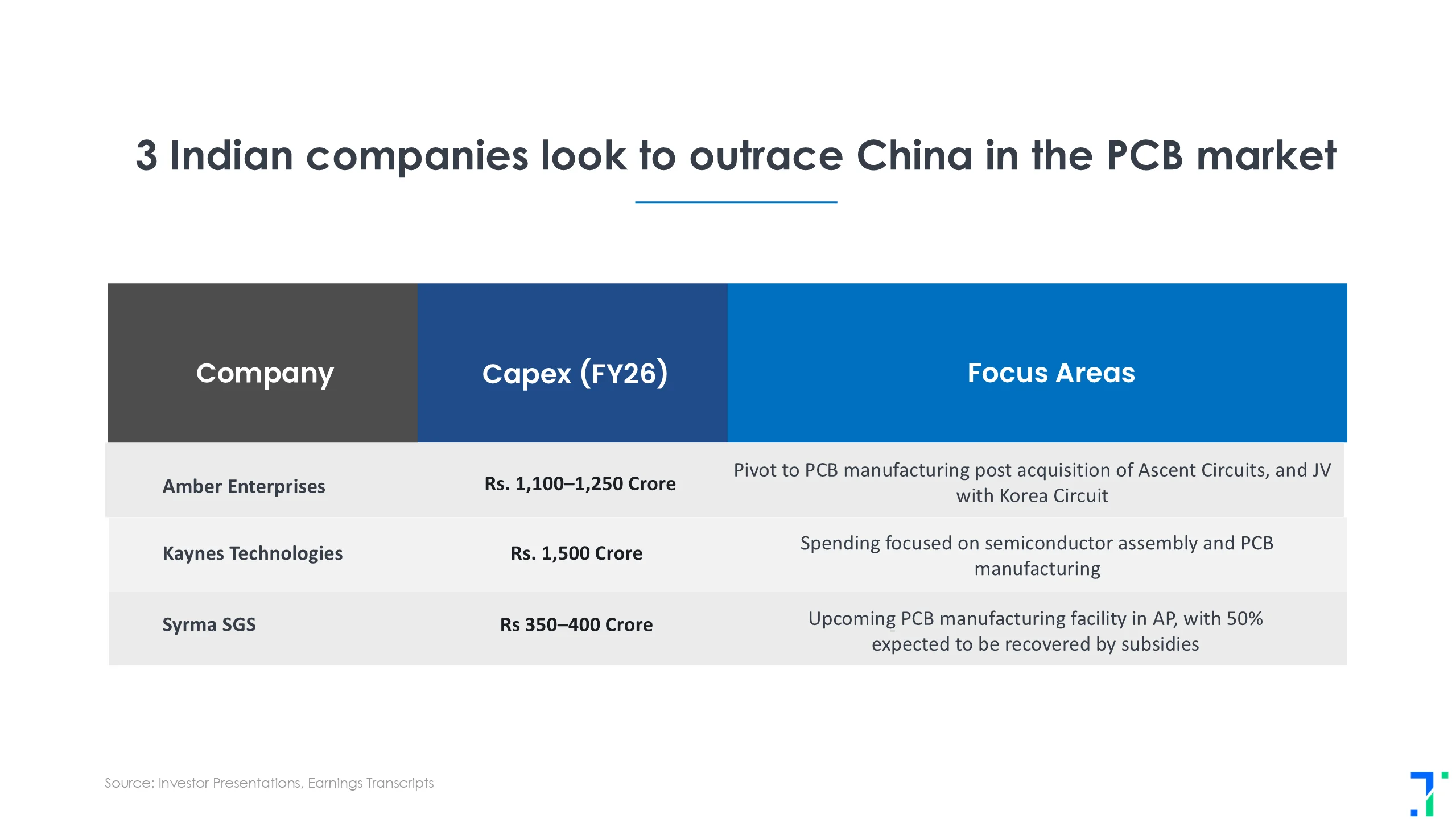
Even as the government has touted India's electronics investments in the past few years, we have been stuck near the bottom of the value chain, where we import printed circuit boards and fit them into cases. But with domestic players now entering PCBs, the Indian market is projected to grow at a CAGR of 15.6% to $24.7 billion by 2033, sharply outpacing the global PCB growth rate of 6.3%.
The government's subsidies, and the lower duties announced in the Budget on raw materials for PCB and electronics manufacturing, is benefiting three companies in particular.
Amber Enterprises: an air-conditioning company enters a space that is heating up
Just as Wipro is no longer a sunflower oil company, Amber Enterprises may not be just an air conditioning business for much longer. The business is pivoting into electronics manufacturing. And it did it the fastest way possible, via acquisitions.
Last year, Amber acquired Ascent Circuits and Shogini Technoarts to enter bare PCB manufacturing, skipping low margin electronics assembly altogether. The acquisitions are already having an impact on the company's topline: revenue from the electronics division jumped 79% YoY in Q3FY26 to Rs 845 crore. The management expects double-digit EBITDA margins for its electronics division in FY27.
Amber has budgeted the majority of its FY26 capex to PCB manufacturing, earmarking Rs 800 crore for manufacturing expansion in Pune and Jewar. The new joint venture with PCB company Korea Circuits provides Amber with technology and market access, derisking its outlook.
Brokerages like Jefferies are bullish as well - it expects Amber’s electronics division to contribute more than 30% of sales by FY28, compared with 22% in FY25.
Kaynes Technology: a PCB and semiconductor play
Electronics player Kaynes Technology has announced a Rs 1,400 crore spending plan which includes making their own PCBs in Chennai, with production set to start in April this year.
Without the government subsidy schemes, the Rs 1,400 crore that Kaynes has earmarked would have resulted in a big hit to the P&L. But with government sops, it expects 65% of its net investment to be received as subsidy over time. The PCB investment is part of a broader capex plan of Rs 8,500 crore over the next 4 years for semiconductor assembly and electronics. This is a significant outlay for this company, with higher risks in the mix compared to Amber's PCB focused capex.
Kaynes' semiconductor manufacturing investment under the India Semiconductor Mission is in partnership with Malaysia’s Globetronics. This is an expensive business where execution is a significant risk, and may not break even until FY28. The first phase of manufacturing has been covered by a QIP fundraise which it completed in June 2025. The PCB vertical is likely to pay off faster for Kaynes compared to semiconductors, and in the meantime, cashflow risks remain.
Syrma SGS: FY26 will be a capex heavy, non revenue year for its PCB effort
The third player targeting the PCB space is Syrma SGS, which entered a joint venture with South Korea based Shinhyup Electronics to establish a Rs 1,800 crore PCB manufacturing facility in Andhra Pradesh.
Among the three players, Syrma has the longest timeline to seeing benefits in the PCB market. Construction of its PCB plant in Andhra Pradesh is expected to be complete only by June-July 2026, and trial production will start by December 2026.
Sales of multi-layer PCBs and single-layer boards (which represent approximately 80% of total Indian demand) will start only by March 2027. Execution risks are there for Syrma, since the company still has significant debt and has raised external funds for its manufacturing effort.
Government subsidies are clearly a major factor in PCB capex, allowing companies to plan over longer horizons. These businesses have budgeted their capex with the expectation of at least 50% in capital subsidies from state or central schemes like SPECS and ECMS.
Indian firms also face "bumps" in raw material price volatility (copper, gold), impacting their costs, and a 1-to-2 quarter lag in passing these costs to customers. While this is a challenge shared by global peers, it is intensified here due to the capex requirements in the mix.
Finally: what happened to Dixon?
In the last few years, the Indian electronics story gave one major player a big boost: Dixon Technologies. Dixon is largely missing from the present buzz.
Dixon has been the biggest beneficiary of the Mobile PLI (Production Linked Incentive) scheme. But this scheme is entering its final stages, and ends March 2026. As the cash incentives for assembling phones dry up, Dixon is facing a 'margin cliff'.
Dixon’s margins are low - its consolidated EBITDA margins have historically hovered around 3.5-4%. This is significantly lower than peers like Kaynes or Syrma SGS (12-14% margins in Q3FY26). The high contribution of the mobile phone segment for Dixon, which is high-volume but low-margin, is a problem. The company managed its low margin high capex dynamic with the help of the subsidies, which are drying up. Even with government benefits, Dixon has been FCF (free cash flow) negative for the majority of FY25 and the first half of FY26
Brokerages like Morgan Stanley have flagged that full benefits of Dixon's backward integration might only kick in by FY28, leaving a potential slack in earnings growth in FY27.
The electronics manufacturing story is intact. But investors here may have to shift their bets. The winners are changing, as players move up the supply chain.
As always,
The Trendlyne team
